1. overview
The ethnographic, geographical and linguistic categorisation of the Cham - also referred to in the specialist literature as Cham-Mwana, Dijim, Bwilim, Cam or Mona, depending on the period and research focus - represents a complex and often controversial challenge in the academic study of the cultures of the Benue Valley. Geographically, the settlement area of this people is located in north-eastern Nigeria in the so-called Adamawa corridor. Specifically, the settlements are concentrated in the inaccessible, rugged foothills of the Muri Mountains on the territorial border between the present-day Nigerian states of Gombe and Adamawa and in the valley of the lower Gongola River, one of the primary tributaries of the Benue. This specific topographical location is not just a geographical footnote, but a fundamental key to understanding the cultural resilience of the Cham: the mountain fortresses historically served as a natural retreat from the cavalry incursions and raids of neighbouring expansive groups, enabling the preservation of a highly distinctive material culture well into the 20th century.
With regard to the demographic development of the Cham, various statistical surveys exist, ranging from early colonial censuses to recent modelling. While the Nigerian census of 1963 put the population at exactly 15,573 people (divided into 6,355 individuals in Kindiyo and 9,218 in Mwona), current projections for the years 2024 to 2026 - correlating with Nigeria's massive national population growth to over 232 to 250 million inhabitants - indicate a population of an estimated 52,000 to 55,000 individuals. This comparatively small demographic base stands in striking contrast to the disproportionate art-historical significance of their ritual objects on the Western art market.
Linguistically, the Cham are categorised in the Waja subgroup of the north-western Adamawa languages, which in turn belong to the Adamawa-Ubangi languages within the gigantic Niger-Congo phylum (Adelberger 2015, Kleinewillinghöfer 2014). The Cham language, usually classified by linguists as Dikaka, is divided into two primary dialects that simultaneously represent the two main territorial and social sections of the people: Dijim, spoken by the Kindiyo section, and Bwilim, spoken by the Mona section. This nomenclatural duality of self-designations (Dijim, Bwilim) and foreign designations (Cham, Mwana) has led to considerable friction in the past when cataloguing museum collections. It is historically documented that in early acquisition registers of European institutions - for example in the British Museum, where the Temple collection was inventoried before 1913 - objects were often classified under blurred or incorrect geographical markers, as colonial administrators were unable to penetrate the subtle linguistic taxonomy of the Muri Mountains.
The social structure of the Cham is classically acephalous and strictly segmentary. There is no centralised, hierarchical state authority, as can be found in the kingdoms of southern or northern Nigeria (e.g. Benin, Oyo or the Hausa emirates). Instead, the political, legal and social order is based on patrilineal kinship systems, clan alliances, age groups and, above all, the authority of councils of elders and ritual secret societies. This decentralised power structure is directly reflected in the production of art: there is no courtly prestige art that serves to legitimise a monarch, but only functional, sacred objects that are used on a local family or clan-specific level to solve problems (healing, agricultural cycles, initiation).
The subsistence economy of the Cham is dominated by agricultural practices that are adapted to the semi-arid and sometimes harsh conditions of the Muri foothills. Agriculture is primarily based on the cultivation of sorghum millet, maize, beans and local tobacco, whereby these activities are supplemented by seasonal hunting and honey gathering. The rhythms of these agricultural cycles completely determine the people's ritual calendar; rainbite rituals, harvest festivals and protective rites for the fields form the temporal backbone of the ritual performances in which masks and vessels are activated. In their interactions with neighbouring peoples (such as the Dadiya in the west, the Longuda in the north-east and the Tula), relations have historically oscillated between economic bartering, inter-ethnic marriages and violent conflicts over land and water resources.
Significant, explicit controversies exist in ethnographic taxonomy and academic art historiography regarding the stylistic and cultural classification of the Cham. These research controversies have direct implications for private collectors, as they determine the attribution and thus the value of objects. Older anthropological studies (such as that of the colonial official C.K. Meek in 1931) and the early collection catalogues based on them often subsumed the material evidence of the Cham indiscriminately under the far better known, dominant neighbouring group of the "Mumuye" or summarised them as a vague part of the "Wurkum" cluster. More modern research, significantly advanced and represented by Marla C. Berns in the paradigmatic publication Central Nigeria Unmasked: Arts of the Benue River Valley (2011), on the other hand, argues emphatically in favour of a complete aesthetic and ritual autonomy of the Cham. Berns deconstructs the concept of a homogeneous "Adamawa-Wurkum-Cham cluster" and proves that the attribution of Cham sculptures as mere "Mumuye sub-tradition" is a construct of the Western art market, which was looking for marketable, established labels in the 1970s. The anthropologist Richard Fardon (2019) supports this criticism and explains that so-called "artefact-ethnicity" often creates a "negative vacuum" in which the complex, fluid identity of acephalous groups such as the Cham is overwritten in favour of commercial categorisations. Due to the constant inter-ethnic exchange of ritual institutions, the sources for the exact historical demarcation remain ambiguous, but the stylistic demarcation of the Cham is now a scientific consensus.
| Demographic and Linguistic Profile of the Cham | Data and Classification |
|---|
| Estimated population (2024-2026) | 52,000 - 55,000 |
| Language family | Niger-Congo > Adamawa-Ubangi > Waja |
| Primary dialects | Dijim (Kindiyo), Bwilim (Mona/Mwona) |
| Social structure | Acephalous, segmentary, patrilineal |
| Subsistence basis | Sorghum, maize, tobacco cultivation, hunting |
| Dominant neighbouring groups | Longuda, Dadiya, Mumuye, Wurkum |
| Religious affiliation | Ethnic religion (50%), Christianity (46%), Islam (4%) |
2. cultural context
The Cham religious system is a complexly organised, highly pragmatic ethno-religious structure. Although recent statistical surveys show a significant proportion of followers of Christianity (approx. 46 %) and a small minority of Muslims (approx. 4 %), the traditional ethnoreligion not only remains intact among the relative majority of the population (approx. 50 %), but also permeates the reality of life of the converted population strata in its ritual practice. This syncretic coexistence is typical of the Benue region. At the centre of the Cham cosmological order is a creator god who initiated the universe but - following a classical deus otiosus concept - has withdrawn from the direct concerns of mortals. In everyday ritual practice, this entity recedes almost completely behind a complex ontology of active ancestral spirits, nature beings and personified disease demons. The Cham believe that disease, infertility and agrarian crises are physical manifestations of metaphysical disturbances triggered by specific spirits (often associated with bushland, water sources or misbehaviour within the clan).
Interaction with these invisible forces is never carried out directly by the layperson, but requires media interfaces in the form of material cultural artefacts and mediation by strictly regulated ritual authorities. Among the Cham, ritual power is not concentrated in a single clerical authority, but is distributed among various complementary actors: Divinators (soothsayers), healing priests, potters and the leading cadres of the initiation societies.
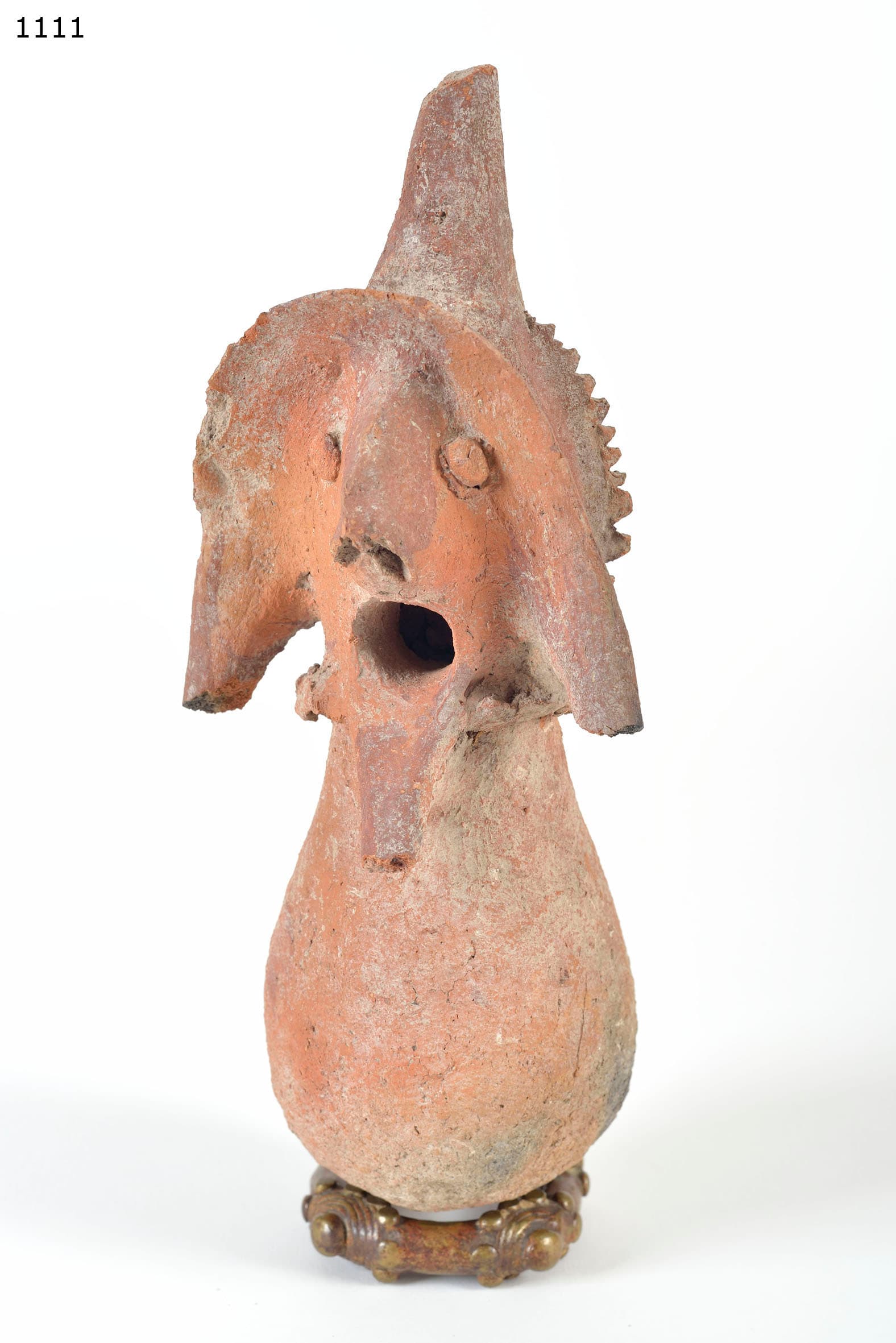
An absolutely unique structural feature that distinguishes the religion of the Cham (and their close neighbours, the Longuda) from the cultures of the lower and middle Benue Valley in a significant and analytically relevant way is the central, irreplaceable role of women in the cult. While in the vast majority of African societies the ritual production of sculptures and the handling of sacred objects is almost invariably reserved for initiated men, the production of highly sacred anthropomorphic terracotta vessels (such as itinate or jina kwimtiyu) is the responsibility of older women among the Cham. These vessels are primarily used for the metaphysical healing of childhood illnesses and to protect pregnant women and their foetuses from malicious attacks. The female potters do not act in any way as profane craftswomen, but as ritual specialists whose products function as physical incorporations and containers for spiritual beings. The act of pottery-making itself becomes a therapeutic process in which the woman imagines the form of the illness and transfers it into the clay.
Parallel and complementary to these healing practices dominated by women, there are masculine secret societies that form the socio-political backbone of the community and control the initiation and transition rituals. The nationally known Vah and Voma cults should be mentioned here in particular. These cults manifest themselves materially in the use of specific ritual insignia: iron rods, bronze bells and the highly abstracted wooden sculptures that are so coveted by collectors. The initiation of young men into these societies marked the physical, mental and social transition from boy to fully-fledged member of adult society. This transition is accompanied by strictly sanctioned mask performances and sculpture unveilings that instil respect, clan knowledge and the cosmological order in the initiates.
Within ethnological and historical research, there is a profound and ongoing author-versus-author controversy regarding the genesis, spread and function of these secret societies. The British colonial anthropologist C.K. Meek, who studied the region in the 1920s and 1930s, and later the influential US researcher Arnold Rubin, postulated that institutions such as the Voma cult (and its equivalents) were primarily adapted from the neighbouring, militarily more dominant Chamba and have an agrarian character at their core. The contemporary anthropologist Richard Fardon (2006, 2011), however, vehemently deconstructs this pan-ethnic homogenisation thesis. Based on decades of field research, Fardon argues that the specific manifestation of the Voma and Vah cult among small, decentralised mountain peoples such as the Cham is the direct result of local ritual innovations that served the purpose of social cohesion against external threats. It was not merely a diffuse cultural transfer ("cultural diffusion") from the Chamba downwards, but an active, strategic appropriation and reconfiguration of instruments of power by the Cham. The source situation regarding the exact diffusion routes in the 19th century is ambiguous, but this debate makes it clear to private collectors that Cham ritualia should not be read as peripheral derivatives or copies of Mumuye or Chamba culture, but as products of an autonomous, highly creative religious system.
Today, objects from this deeply sacred context can be found in the most important collections in the world, for example in the African collections of the Musée du quai Branly - Jacques Chirac in Paris, where curators such as Hélène Joubert precisely contextualise the performative dynamics of these cults and the overlaps between female and male ritual spheres.
| Distribution of Ritual Authority among the Cham | Function and Responsibility | Material Manifestation |
|---|
| Divinators (soothsayers) | Diagnosis of illnesses, investigation of metaphysical disorders | Divination devices, bones, stones |
| Elderly women / potters | Healing (specifically children/pregnant women), banishing spirits of illness | Anthropomorphic terracotta vessels (itinates) |
| Male secret societies (Voma/Vah) | Initiation of youth, social control, agrarian rituals | Wooden sculptures, iron rods, bronze bells |
| Healing priests | Activation of sculptures, performance of blood sacrifices and libations | Patinated altars, sacrificial bowls, sculptures |
3. aesthetic features
The material and visual culture of the Cham manifests itself primarily in two canonical object typologies that are of the highest aesthetic and art-historical significance for Western institutions and private collectors due to their radical abstraction: the columnar, wooden shrine figures and the anthropomorphic terracotta vessels. Both types display a strict canon of proportions characterised by an uncompromising anatomical reduction, a focus on basic cylindrical forms and an expressive surface treatment. In their formal expression, these works anticipated visual concepts that were not recognised in the West until classical modernism.
Typology 1: Anthropomorphic wooden sculptures
The size range of the Cham's wooden statues usually varies between 20 and 60 centimetres. They are characterised by a strongly elongated, cylindrical torso, which often retains the natural growth form of the branch or trunk used. The limbs are removed from anatomical reality: The arms are often pressed close to the body, merge with the torso or are strongly stylised in sharp, zigzagging angles and set off from the body. The legs are usually short, slightly bent and rest on massive feet or pedestals, often marked by termite damage. The iconography inevitably focuses on the face, which is often strongly abstracted, with narrow, slitted or almond-shaped eyes and a striking, slightly open mouth.
Typology 2: Ritual terracotta vessels (itinate / jina kwimtiyu)
The second canonical type, excellently documented in the holdings of the Musée du quai Branly (e.g. inv. no. 73.1998.12.6) or the Fowler Museum at UCLA, are vessels made by women. These highly complex vessels often feature a so-called "blind spout", which is shaped as the open mouth of an anthropomorphic head that rises asymmetrically from the shoulder of the vessel. The bulbous bodies of the vessels are decorated with the same scarification patterns as the wooden figures, demonstrating a remarkable cross-media aesthetic coherence in the Benue Valley.
An absolutely essential, diagnostic feature of Cham aesthetics of both materialities are the concisely carved or applied scarification patterns (decorative scars/cicatrisation). Research by Marla C. Berns and Barbara Rubin Hudson (1986) has shown that these patterns represent direct, literal transfers of the female body scars onto the sculpture and the vessel. As Berns points out, these ornamental scars are used in both media to "civilise" the vessels and statues, thereby activating them as controllable containers for spirits. Characteristic diagnostic features can be found on both types of object: The "Maltese cross" (Cingelyengelye) is often prominently emblazoned on the forehead, while umbilical (navel-centred) patterns in the form of radiating elevations adorn the torso or the vessel's belly. In addition, both types often share the concept of the "blind spout" - a slightly open mouth that is not primarily used for pouring out liquids, but symbolically marks the entry path for spirits and healing powers.
| Typological comparison of Cham art | Wooden sculptures (shrine figures) | Terracotta vessels (itinate / jina kwimtiyu) |
|---|
| Material & production | Local hardwoods, carved by men | Clay, modelled and fired by women |
| Basic morphological form | Cylindrical, elongated torso, abstracted limbs (zigzag arms) | Bellied body, blind-ended spout (head) |
| Diagnostic scarification | Deepened/raised reliefs (e.g. Maltese cross) on the face and navel | Applied clay beads/ribs, identical to the wooden sculpture |
| Iconographic reading (Berns) | Medial construct / container for forces of nature | Container for the banishment/therapy of childhood illnesses |
The research marks a profound iconographic controversy between the leading scholars (Marla C. Berns vs. Arnold Rubin) regarding the fundamental meaning of these sculptures. Rubin (who carried out the basic research in the 1960s) tended strongly to ascribe to the wooden sculptures of the upper Benue primarily the function of generalised "ancestral portraits" representing the lineage. Marla C. Berns strongly disagrees with this interpretation. She argues (supported by later fieldwork) that the highly anthropomorphised features in the Cham do not represent specific ancestors. Instead, the anthropomorphised forms are physical vessels (containers) created specifically to contain wild disease spirits and forces of nature. In this interpretation, scarification does not serve genealogical identification, but functions as a social net that is cast over the chaos: It "civilises" the object and makes the indwelling spirit negotiable for the priest.
A fundamental quality criterion on the art market is the difference between a ritually activated and a purely profane object. Although "master hands" or workshops documented by name (as in the case of the Yoruba carvers, e.g. Olowe of Ise) are unknown in the acephalous Cham society, which is far removed from literature, it is certainly possible to isolate regional hands through formal analyses. However, the ritual legitimisation of a figure, however masterfully carved, is only achieved through the patina. Activated objects exhibit a deep, often encrusted patina, which is created over decades through repetitive offerings of millet beer (pito), red ochre, kaolin, palm oil and animal blood.
Forgery criteria, which are highly relevant for today's market players, include the forensic examination of this patina. Applied, artificial crusts (often baked in modern forgery workshops from glue, coffee grounds and earth) flake off artificially, have a specific chemical odour and show no organic, historically grown deep structure under UV light. Genuine pieces show authentic signs of ageing such as deep cracks in the heartwood (caused by natural hygroscopic fluctuations over decades), leaching caused by natural weathering in the shrines and specific termite damage at the bases where the statues have been stuck in the damp soil of the altars for years.
4. ritual practice
The practice of object use among the Cham is not static, but processual and characterised by a strictly regulated ritual "lifecycle" that extends from the immaterial design of the object through its ritually active lifespan on the altar to its final disposal. This performative dynamic, which is also documented in the comparative analyses of important European institutions such as the Royal Museum for Central Africa in Tervuren (RMCA) for neighbouring Central African phenomena, can be transferred analogously to the cult practice at Benue. A Cham ritual object is not a static work of art in the Western sense, but an agency that only unfolds its power through human interaction.
The cycle usually begins with an existential crisis situation - usually the outbreak of an unexplained illness (especially in children), infertility, a series of crop failures or an impending drought. The affected person then consults a local divinator (fortune teller). Using special instruments or trance, this diagnostician identifies the metaphysical cause of the suffering (often an enraged spirit) and determines the need for the creation of a specific container - be it an itinate clay object or a wooden sculpture.
The physical creation of the object is the first step of the ritual intervention. When shaping an itinate vessel, the potter draws on an established catalogue of forms, but at the same time imagines the visual, plastic form of the specific illness and models it into the clay. This process of materialisation creates the enormous formal variability within the canon that fascinates collectors today about these pieces (Adelberger 2015).
A newly carved wooden object or a freshly fired clay vessel is absolutely profane and ritually worthless immediately after completion - it is empty matter. The transformation into an object of power requires a dedicated activation rite. The sources describe in detail that the healing priest or the head of the family integrates the object into the domestic altar, the shrine of the secret society (Juabe) or a dedicated cult hut. Activation is necessarily carried out through blood sacrifice and libation. Among the Cham, it is specifically documented that certain disease vessels (such as those for the treatment of respiratory diseases in women) are "vitalised" through the ritual slaughter of a red rooster. The animal's blood, often mixed with locally brewed millet beer and crushed medicinal herbs, is poured directly over the head or the "blind spout" of the object. Wooden statues often have small, inconspicuous cavities carved into the body (in the abdomen or skull), into which magical substances ("medicine", bone splinters, earth) are pressed and sealed with resin. This so-called "crypto-fetish" forms the energetic power centre of the figure.
In active use, the object remains in its intended altar place. It continuously receives further offerings during recurring agrarian festivals, at new moons or in repeated acute situations. This repeated overlapping of blood, beer, millet porridge and dust explains the formation of the thick, cracked encrusted patina that accounts for the aesthetic appeal of many museum pieces. However, the ritual performances are not limited to static altars. During initiation rites (e.g. the Voma cults), wooden mask attachments, iron cult sticks and bronze bells are used by initiated men in highly expressive, dynamic dances. These performances serve to ritually purify and assert the spiritual boundaries between the safe human settlement and the untamed, dangerous bush.
| The Ritual Life Cycle of a Cham Object | Phase and Action | Material Impact |
|---|
| 1st Diagnosis & Assignment | Divinator identifies the causative spirit. Assignment to potter/carver | Conceptualisation of form |
| 2nd Materialisation | Imagination of the illness in clay/wood. Scarification as "civilisation" | raw, unpatinated wood / pure terracotta shards |
| 3rd activation | placement in the shrine. Introduction of "crypto-fetishes". Slaughter (red cock) | First blood spatter, filling of cavities with resin/medicine |
| 4. active performance | repetitive sacrifices (millet beer, ochre) during feasts or renewed illness | build-up of the centimetre-thick crust patina (sacrificial crust) |
| 5. deactivation / disposal | purpose fulfilled (healing) or death of the owner. Exposure in the bush/old shrine | termite damage at the base, weather erosion, cracks in the heartwood |
The deactivation of an object marks the end of its ritual life cycle. If the object has completely fulfilled its function (the patient has made a lasting recovery or the spirit has demonstrably left the vessel) or if the original owner for whom the figurine was personalised dies, the artefact suddenly loses its power. The Cham rarely actively destroy these artefacts by burning or smashing them. Instead, they are left in special ritual areas outside the settlement boundaries or simply in abandoned altars, where they are ruthlessly exposed to the weather and insect damage. This process of natural decay is interpreted metaphysically as a gentle return of the remaining matter and energy to nature. For the private collector, this results in an elementary consequence: extremely pure, completely undamaged wooden objects on the art market were historically often unfinished, never ritually activated or explicitly carved as early tourist art, while massive, authentic traces of weathering (such as the feeding galleries of white termites) are incorruptible indicators of an authentic, complete and spiritually charged object biography.
5. historical context
The historical reconstruction of the art and migration history of the Cham is highly fragmented, characterised by the warlike turbulence of the regional demography in the 19th century and the highly complex, sometimes destructive mechanisms of the western art market in the late 20th century. The early migration history of the Cham and their neighbouring groups into the extremely difficult to access, rugged Muri Mountains is primarily dated in historical research to the early to mid-19th century. Although the archaeological sources are incomplete and ambiguous with regard to precise chronologies, there is a broad consensus among historians and ethnologists that these massive population shifts were direct refugee reactions to the brutal jihad wars of the Fulani (Fulbe) cavalry under Usman dan Fodio and his successors (such as Modibo Adama, the founder of the Emirate of Adamawa). The steep, inaccessible mountain landscape offered a strategic advantage over the Fulani horses, prevented the widespread Islamisation of the Cham and thus enabled the undisturbed, self-sufficient survival of their highly materialised, animistic art production well into the post-colonial period.
Colonial encounters in this isolated region only began very hesitantly and marginally in the late 19th century, initially driven by early German voyages of discovery. As early as 1879, the German African explorer Eduard Robert Flegel travelled along the Benue River and mapped the first settlements in the region, noting names such as "Mona" and "Tscham" (today's Cham sections) in his reports. A much more systematic documentation of the material culture was carried out in 1894 by the geographer Siegfried Passarge, whose collected, extremely early artefacts from the Benue Valley are now preserved in the Ethnological Museum in Berlin and form invaluable reference points for age determination. Although the actual British pacification of northern Nigeria at the turn of the century led to the integration of the region into the system of "Indirect Rule" and the levying of taxes, it initially hardly changed art production in the isolated mountain regions. This is in sharp contrast to the coastal regions of Nigeria or the Congo, where colonial influences, missionary work and tourist art (e.g. in workshops) had already massively transformed aesthetics in the 1920s.
The market history of Benue Valley art in the West is characterised by a late discovery, systematic looting and decades of massive misattribution. Until well into the 1960s, the abstract arts of central Nigeria were virtually unknown in Europe and the USA and non-existent in the canon of the "Arts Premiers". The tragic turning point that flushed these artefacts onto the world market was the Nigerian civil war (Biafra War, 1967-1970). The resulting social upheaval, famine and the economic collapse of village structures led to an unprecedented exodus of ritual artefacts. Western traders (so-called runners) brought thousands of sculptures from the Benue Valley to Paris, Brussels and Zurich during this period. As scientific field coordinates and provenances were usually completely missing, the Western art market subsumed the emaciated, abstract sculptures of the Cham, Yendang or Wurkum under the only prestigious and well-known label of the region: "Mumuye" out of sheer ignorance. Between 1964 and 1966, the American art historian Arnold Rubin laid the scientific foundations for the unravelling of this massive corpus through extensive, physically demanding field research.
| Chronology: History and market history of Cham art | Effects on material culture |
|---|
| Early 19th century | Fulani jihad (Usman dan Fodio): Escape to the Muri Mountains, isolation preserves animist ritual art |
| 1879 / 1894 | German expeditions (Flegel, Passarge): First documentation, extremely rare collection objects arrive in Berlin |
| 1967-1970 | Nigerian civil war (Biafra): Mass exodus of ritual objects to Europe. Misattribution as "Mumuye" |
| 1964-1966 | Arnold Rubin field research: beginning of the scientific classification of the Benue Valley |
| 2011 | Exhibition Central Nigeria Unmasked: Final canonisation of Cham art. Massive price increase at auctions |
However, the actual breakthrough, the clearing up of the taxonomy and the final canonisation of Cham art as a completely independent tradition only occurred almost half a century later with the epochal travelling exhibition Central Nigeria Unmasked: Arts of the Benue River Valley (2011). This monumental show, curated by Marla C. Berns, Richard Fardon and Sidney Kasfir, was shown at leading institutions such as the Fowler Museum at UCLA, the Smithsonian National Museum of African Art and the Musée du quai Branly in Paris. This exhibition acted as a gigantic catalyst and led to a drastic, almost disruptive price development on the auction market. Today, authentic, well-attested figures from the Benue Valley regularly realise prices in the five- to six-figure euro range on the secondary market (at Sotheby's, Christie's or Bonhams).
This enormous price increase is inevitably accompanied by a massive increase in the problem of forgery. As the originals often date from the late 19th or early 20th century and the "supply" in Nigeria has long been exhausted, highly specialised counterfeiting workshops (often in Cameroon or on the Nigerian coast) simulate artificial ageing processes to an unprecedented degree of perfection. Today, authenticity criteria are necessarily based on multidisciplinary forensics: in addition to stylistic coherence, the chemical analysis of the patina (spectrometry of baked-in blood, oil and millet deposits) and the wood cell structure is crucial. The assessment of deep heartwood cracks, which differ significantly from superficial stress cracks created artificially in the kiln, as well as the analysis of oxidised cut marks created by traditional hand adzes (adzes) instead of machine tools, form the absolute basis of the expertise.
Institutions such as the Museum Rietberg in Zurich, which pioneered the study of African aesthetics with the historically enormous early collection of the banker Eduard von der Heydt, impressively demonstrate how the forensic and provenance-historical analysis - the creation of a complete "object biography" - of sculptures from Nigeria defines the scientific and monetary collector's value today. For the private collector investing in the complex and fascinating art of the Cham, a traceable, published provenance, ideally dating back to the pre-war period (before 1967) or to renowned expeditions of the 1970s, is by far the surest guarantee against the flood of elaborate forgeries on the contemporary tribal art market.