Overview
The Duala, frequently catalogued under the precise autonym Duala and historically recorded across a broad spectrum of exonyms and orthographic variants including Douala, Diwala, Dwala, Dualla, Dwalla, Dwela, and Deido, constitute a preeminent Bantu-speaking ethnic group indigenous to the coastal regions of Central Africa. Geographically, the Duala are intrinsically and historically tied to the Littoral Province of the Republic of Cameroon, fundamentally concentrated within the Moungo, Nkam, and Wouri administrative divisions. Their ancestral and contemporary settlements form a dense network along the immediate Atlantic coastline and the highly networked estuarine environments extending just inland. The absolute epicenter of Duala territoriality, economic hegemony, and historical power is the Wouri estuary, a vast and ecologically complex aquatic crossroads where the Wouri, Mungo, and Dibamba rivers empty into the Gulf of Guinea. This specific riverine and estuarine topography is not merely a geographic backdrop; it is the defining environmental architecture that engineered the Duala’s socioeconomic dominance and distinctly maritime visual culture. They are bordered by and share deep cultural, linguistic, and mercantile interactions with neighboring coastal and immediate hinterland populations, most notably the Bakweri, Malimba, Batanga, Bakoko, Oroko, and Pongo peoples. Crucially, the Duala remain culturally, linguistically, and aesthetically distinct from the inland Grassfields peoples of Cameroon (such as the Bamileke and Bamum), whose agrarian social structures, highly centralized terrestrial chiefdoms, and volumetric sculptural traditions present a stark contrast to the coastal, water-bound realities of the Sawa (coastal) groups.
Linguistically, the Duala speak a prominent Bantu language classified securely within the vast Niger-Congo language family. More specifically, the language falls under the Southern Bantoid, Bantu Zone A subgrouping (often designated precisely as A24 in linguistic taxonomies), and is part of the Sawabantu (Coastal Bantu) dialect continuum, which closely links it to related tongues such as Malimba. Duala functions as a tonal language utilizing a subject-verb-object syntactical order and encompasses a cluster of mutually intelligible dialects including Duala proper, Bodiman, Oli (Ewodi, Wuri), Pongo, and Mongo (Muungo). Historically, due to the group's absolute economic supremacy on the coast as the primary interlocutors with European traders, the Duala language evolved into an essential lingua franca, serving as a language of wider communication utilized in commerce, missionary education, and early colonial administration throughout the Cameroonian littoral zone.
Linguistic Classification
| Designation | Detail |
|---|
| Language Family | Niger-Congo |
| Sub-branch | Atlantic-Congo, Volta-Congo, Benue-Congo |
| Major Grouping | Southern Bantoid, Bantu Zone A |
| Specific Subgroup | Sawabantu (Coastal Bantu) |
| Linguistic Code | A24 (Duala) |
| Dialect Cluster | Duala proper, Bodiman, Oli (Ewodi), Pongo, Mongo |
Demographically, current anthropological and demographic estimates place the global Duala population at approximately 291,000 individuals, virtually all of whom reside within the borders of Cameroon. Older, twentieth-century demographic surveys frequently cited significantly smaller figures, such as a widely cited 1982 estimate of 87,700 speakers; however, these numbers fail to capture the exponential demographic growth and urban centralization of the region over the last forty years. The traditional capital of the Duala people is the port city of Douala, which takes its name directly from the ethnic group. Today, Douala has metastasized into the largest metropolitan and commercial center in Cameroon, expanding more than fourfold in recent decades to accommodate a massive influx of internal migration. Consequently, while the Duala remain the traditional custodians of the city’s land and its foundational spiritual heritage, their demographic presence in the urban center now reflects the broad, multi-ethnic diversity of the modern Cameroonian state, leading many urban Duala to support themselves by charging rent on ancestral properties, running small businesses, or engaging in specialized trades.
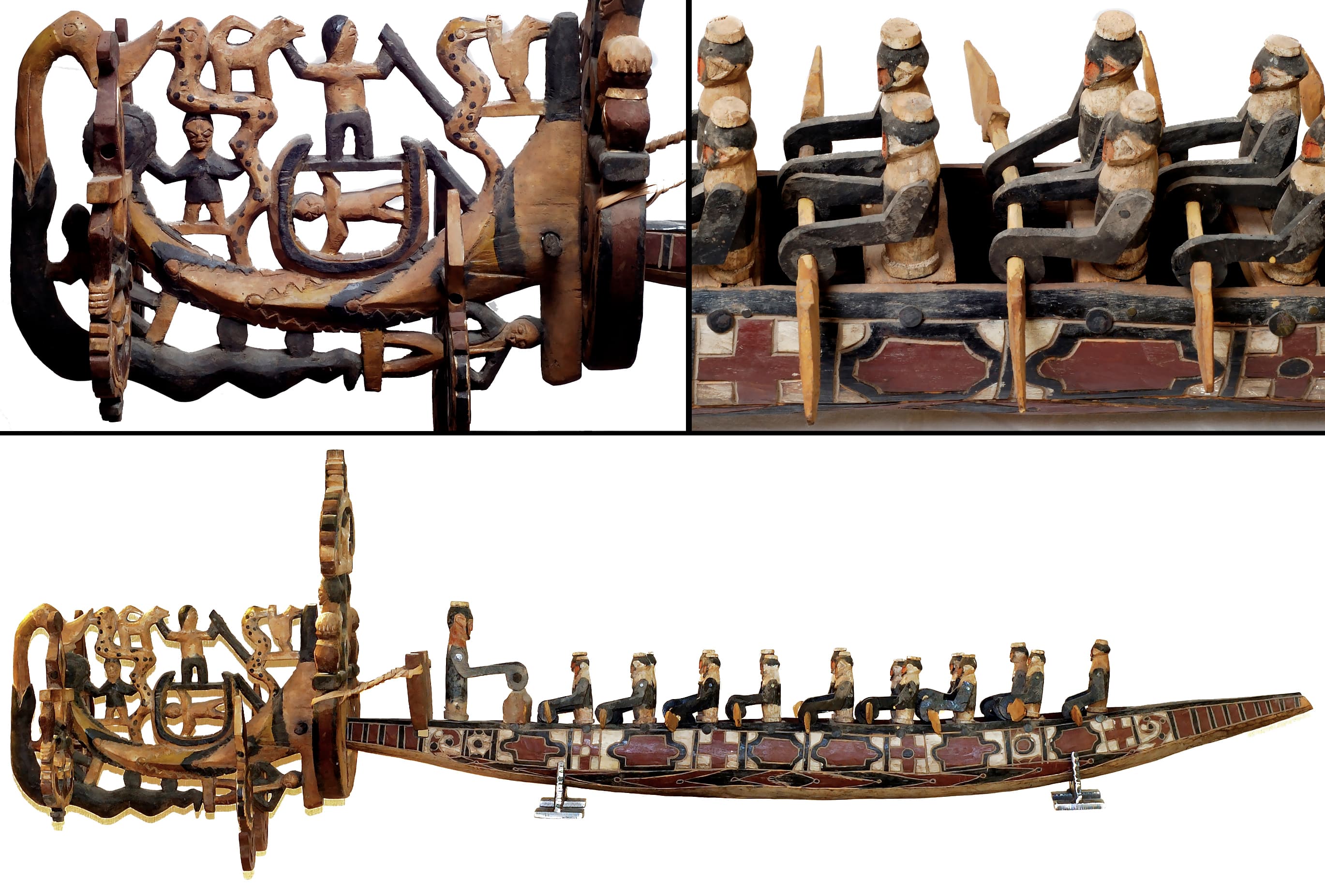
In the broader context of the African art canon, the significance of the Duala cannot be overstated, yet it remains highly specific and frequently underrepresented compared to the prolific output of the continent's interior. Unlike the agrarian societies of the West African forest belt or the Central African Congo basin—whose visual canons are dominated by standing ancestor shrine figures, fertility statuary, and agricultural masquerades—the Duala represent the apex of West Central African maritime arts. Their aesthetic canon is dominated not by terrestrial figures, but by the spectacular tange (monumental, polychrome carved canoe prow ornaments), intricately painted racing paddles, and the highly specialized ritual apparatus of estuarine secret societies. Due to their early, intense, and unbroken contact with European mercantile networks starting in the late sixteenth century, Duala artists engineered an extraordinary "international" coastal style. This style effortlessly syncretized indigenous water-spirit cosmologies with imported European materials, commercial oil pigments, and foreign iconographic motifs centuries prior to formal colonial annexation. As such, Duala art offers scholars, curators, and collectors a critical, highly localized paradigm for understanding early African-European visual exchange, the mechanics of elite indigenous patronage networks, and the assertion of sovereign political agency through the masterful, subversive appropriation of foreign aesthetics.
Cultural Context
The structural foundation of Duala society is inextricably bound to their historical position as the supreme commercial intermediaries, historically documented as the "middlemen" of the Cameroons rivers. From the late seventeenth century through the late nineteenth century, the Duala effectively monopolized the highly lucrative trade routes connecting the resource-rich African interior to the European merchant vessels anchored in the Gulf of Guinea. This geographic and military chokehold over the Wouri estuary facilitated the massive accumulation of material wealth, fundamentally transforming Duala society from an egalitarian fishing community into a highly stratified, fiercely competitive mercantile aristocracy. Social organization was, and to a significant degree remains, defined by a rigid system of kingship, chieftaincy, and deeply entrenched patrilineal lineage dynamics.
The Duala population is structurally divided into several formidable, fiercely competitive, yet interconnected royal clans or dynastic houses—most notably the Bell (Doo la Makongo), Akwa (Ngando a Kwa), and Deido lineages. These clans historically operated as quasi-independent city-states along the riverbanks, bound together by shared linguistic structures, geographical proximity, and an overarching religious system, but perpetually engaged in cutthroat economic and political rivalry to secure favorable trading terms with European supercargoes. Kinship, inheritance, and the transfer of political capital among the Duala are strictly patrilineal. Upon the death of a patriarch or clan chief, his property, trading monopolies, and titles are divided among his male heirs, a system that historically concentrated immense wealth and influence within specific elite households. Historically, the society endorsed widespread polygamy, a practice that not only served as a highly visible metric of a leader's wealth but also functioned strategically to forge essential political and commercial alliances with interior trading partners, rival coastal clans, and subordinate groups. However, profound sociocultural shifts occurred following the intensive presence of European missionaries. By the 1930s, the Duala had become largely Christianized, with Evangelical denominations, particularly the Baptist church, asserting massive influence over the sociopolitical landscape, thereby precipitating a sharp decline in overt polygamous practices and altering traditional household structures. Despite this pervasive Christianization, indigenous cosmologies regarding water spirits and ancestral authority remain highly potent, operating in a synchronized socioreligious reality that dictates communal interaction with the aquatic environment.
| Key Societal Structures | Characteristic Features |
|---|
| Primary Economic Role | Historical monopoly as maritime trade intermediaries (Middlemen) |
| Major Dynastic Clans | Bell, Akwa, Deido (Hickorytown) |
| Lineage & Inheritance | Strictly patrilineal |
| Historical Marriage Patterns | Strategic polygamy (shifting to monogamy post-1930s) |
| Dominant Religious Paradigm | Syncretic blend of Evangelical Baptist Christianity and indigenous Jengu (water spirit) veneration |
| Judicial/Regulatory Bodies | Losango secret societies (e.g., Ekongolo, Koso-isango) |
Within this highly stratified, wealth-driven social order, the visual arts functioned not as mere decoration, but as supreme instruments of prestige, political regulation, and supernatural mediation. Art was not produced for egalitarian consumption; it was the exclusive, fiercely guarded domain of the elite. The acquisition of monumental racing dugouts and their accompanying tange (ornamental prows) was fundamentally a demonstration of immense patronage and political dominance. Powerful kings and clan chiefs commissioned these staggering aquatic sculptures to manifest their economic supremacy, their command over skilled artisan labor, and their military prowess. The ceremonial dugout races were vast public spectacles of wealth redistribution, psychological warfare, and political allegiance, where the symbolic acts of giving and receiving gifts cemented a chief's authority over his dependents and intimidated rival clans.
Beyond the overt display of mercantile prestige, Duala art served crucial regulatory and judicial functions through the operation of powerful secret or initiation societies, collectively referred to as Losango. These closed, elite fraternities operated as the true adjudicators of Duala law, wielding the power of life and death, enforcing trade monopolies, collecting debts, and ruthlessly punishing subversion or theft. The most prominent and feared among these was the Ekongolo society, alongside related fraternities such as the Koso-isango. The visual apparatus of these societies—specifically their highly kinetic masquerades—functioned as the terrifying, tangible manifestation of ancestral and spiritual authority. When an Ekongolo masquerader appeared from the bush, cloaked in raffia and bearing the formidable nyatti (buffalo) mask, the social order was visually reinforced through orchestrated awe and fear. These masks were critical during major transitions of power, notably the elaborate funerary rites of a king, ensuring that the transfer of political and commercial authority was sanctioned by the ancestors and the chaotic spirits of the untamed wilderness.
Finally, Duala art operates as a direct, engineered mechanism for ancestor and spirit mediation. The physical objects are frequently viewed not as inert representational sculptures, but as active, living instruments possessing shared agency. The supernatural forces of the miengu (water spirits) are actively summoned into the wooden carvings during specialized healing and preparatory rites. When a deeply carved tange is affixed to the prow of a racing or war dugout, it is understood by the community that supernatural energies have been captured, harnessed, and localized within the sculpture. This localization provides divine protection to the crew against physical and spiritual attacks, ensures optimal navigation through treacherous estuarine currents, and guarantees the spiritual validation of the clan's terrestrial power. Thus, Duala visual culture is a tripartite engine of social structure: a billboard for immense mercantile wealth, a judicial tool of the Losango enforcement societies, and a sophisticated antenna for capturing the divine power of the estuarine ecosystem.
Aesthetic Markers
The formal vocabulary of Duala sculpture constitutes one of the most distinctive and easily identifiable aesthetic idioms in the entire African art canon, defined by a radical, deliberate departure from the heavy, volumetric, adze-hewn monoliths typical of the continent's agrarian interior. The defining aesthetic marker of Duala art is an overwhelming, highly technical preference for intricate, two-dimensional openwork (ajouré) carving, heavily reliant on complex lateral silhouettes, spectacular polychrome surfaces, and the bold, confident integration of foreign motifs.
The absolute pinnacle of this aesthetic vocabulary is the tange, the monumental canoe prow ornament. The proportions and scale of the tange are vast, often exceeding 150 centimeters to nearly two meters in length, engineered specifically to project visual dominance across wide, sunlit expanses of estuarine water. The physical construction of the tange represents a highly unusual technical methodology in traditional African sculpture. Rather than being carved from a single, contiguous block of wood (monoxylous carving), the Duala artisan typically carves a dense hardwood log lengthwise, to which a separate, highly elaborate transverse section is meticulously grafted. This construction frequently employs advanced, assimilated European joinery techniques observed on merchant ships, including the use of discrete wedged components connected via split pins and sometimes integrated leather buckles. This modularity allowed these massive, fragile artworks to be completely dismantled for safe storage in baskets within the chief's compound when not deployed in ritual or competitive contexts, preventing environmental degradation.
The visual surface of the tange is conceived as an intricate openwork tableau, a delicate, highly porous latticework of positive form and negative space. The iconography executed within this openwork is characterized by a violent, dynamic tension between kinetic energy and static equilibrium, reflecting the constant, dangerous struggle for supremacy in the middleman trade. A highly recurrent, canonical motif is the avian-reptilian struggle: a large, vividly painted snake is frequently depicted emerging from the base (representing the water) to devour the head of a massive, long-beaked, yellow avian form, while secondary, smaller spotted serpents simultaneously attack the bird's abdomen. The avian forms typically feature prominent, elongated tail plumage and exaggerated, threatening beaks.
Interspersed within this chaotic natural order are human figures, often strictly rendered in profile, representing the chief and his elite retinue or chieftaincy guard. Crucially, these figures frequently wear precise renditions of European merchant or military attire—top hats, tailored uniforms, trousers—and carry imported firearms. This is not a capitulation to colonial power; rather, it is a deliberate, sovereign appropriation of the visual markers of wealth and violence, subverting European symbols to elevate the status of the Duala patron. The aesthetic also regularly features bizarre bipedal crocodile-avian hybrids, utilizing rows of aggressive triangular teeth to signify the absolute, dangerous power of the chief on both land and water. The human faces on these prows are frequently painted in stark white, a color traditionally associated with the spirit realm and the ancestors.
Color is paramount and non-negotiable to the Duala aesthetic. In stark contrast to the oiled, darkened patinas or encrusted sacrificial surfaces of neighboring forest groups, Duala sculpture screams with vibrant, synthetic color. Due to their middleman status, Duala artists had early and exclusive access to imported European oil paints, which they eagerly assimilated into their ritual arts. The traditional indigenous calcitic whites and carbon blacks were quickly augmented with bright commercial yellows, brilliant reds, and uniquely, synthetic ultramarine—widely known in the trade as Reckitt's blue—which became an absolute staple in the coloration of both prows and ceremonial lancet paddles.
The masking traditions of the Duala, while exceedingly rare today, conform precisely to this same aesthetic of lateral extension and high-contrast polychromy. The most famous masquerade form, the nyatti (buffalo) mask utilized by the Ekongolo and Koso-isango societies, completely eschews the heavy, cylindrical helmet-mask format favored in the adjacent Grassfields. Instead, the nyatti is carved as a relatively flat, horizontally oriented crest or face mask, meant to sit atop the head. Its facial canon features long, sweeping, curvilinear horns, highly elongated snouts, and geometric, pierced eyes, achieving harmonious overall proportions through a highly controlled, elegant manipulation of flat shapes. The surface treatment of these buffalo masks relies heavily on stark contrasting triangles and chevron patterns executed with thick, applied white lime and dark pyrography (the intentional burning of the wood to create deep blacks), creating a hypnotic, visually vibrating effect when the masquerader moves aggressively during funerary rites.
The prestige seating of the Duala perfectly mirrors the openwork aesthetics of the prows. Duala stools, created in the nineteenth century for prominent elders, utilize deeply concave, curvilinear seats supported by the exact same complex latticework of avian and reptilian forms found on the tange, demonstrating a completely unified aesthetic universe across disparate object types.
This formal idiom aggressively distinguishes Duala art from neighboring traditions. When contrasted with the art of the inland Cameroon Grassfields (such as the Bamileke, Bamum, or Tikar), the difference is absolute. Grassfields art is highly volumetric, massive, terrestrial, and relies heavily on the application of prestige beadwork, cowrie shells, and cast brass. Duala art, conversely, is linear, airy, skeletal, deeply maritime, and fiercely reliant on flat painted surfaces. Aesthetically, the Duala actually share far more formal affinity with the distant Ijo, Ibibio, and Efik peoples of the Nigerian Niger Delta and Cross River regions. The maritime trade networks fostered an "international coastal style," where the flat, geometric, polychrome, water-spirit-oriented aesthetics of the Delta bleed seamlessly into the Duala corpus, united by the shared realities of the mangrove swamps, dugout canoes, and the Atlantic surf.
Ritual Practices
The ritual landscape of the Duala is inextricably linked to the hydrology of the Wouri estuary, the economic imperatives of maritime survival, and the profound theological belief in the omnipresence of water spirits. The absolute apogee of Duala spiritual and communal life is the Ngondo, a massive, highly codified water festival that functions simultaneously as a religious sacrament, a mechanism for inter-clan social cohesion, and a profound assertion of ethnic sovereignty. Held annually between September and the first Sunday of December, the Ngondo represents the living heartbeat of the Sawa (coastal) peoples. The historical genesis of the Ngondo is uniquely well-documented for an African festival; oral traditions anchor its formal inception to the year 1830, when it was convened by King Ngando a Kwa of the Akwa clan on a specific estuarine sandbank. Originally conceived as a military and political alliance to combat Malobè, a tyrannical, harassing giant from the neighboring Pongo group, the festival’s name literally translates to "umbilical cord" in the Duala language. This nomenclature symbolizes the unbreakable bond that unites the Duala to a just communal cause and connects the populace directly to the life-giving, protective waters of the river.
The modern iteration of the Ngondo festival, recognized by UNESCO on the Representative List of the Intangible Cultural Heritage of Humanity in 2024, is bifurcated into highly public popular components and fiercely guarded sacred rites. The popular phases feature extensive caravans touring traditional Sawa districts, traditional wrestling competitions, commercial craft fairs, and highly competitive dugout canoe races. These races are not merely secular athletic regattas; they are deeply spiritual events imbued with historic rivalries. The racing canoes, massive vessels measuring up to thirty meters and propelled by dozens of initiated paddlers, are fitted with the spectacular tange prow ornaments. Prior to the race, specialized rituals are conducted by religious specialists to summon the forces of the water spirits directly into the wooden carvings of the tange. The ornament becomes a temporary battery of supernatural energy, harnessed to protect the crew from malevolent forces, sabotage, and to ensure victory, which in turn validates the political authority and supernatural favor of the canoe's patron.
The sacred, esoteric climax of the Ngondo occurs in early December on the muddy banks of the Wouri River. This intensely guarded rite involves the formal launching of a sacred canoe. As the craft reaches a designated, spiritually charged coordinate in the bay, a specially initiated devotee—the Ngondo messenger—dives directly from the canoe into the murky depths. According to absolute theological consensus within the community, the messenger descends to the underwater kingdom of the miengu (the sacred water spirits). Tradition dictates that the messenger remains submerged for an impossible duration—often hours—communing with the divine entities, before emerging with his garments appearing completely dry. He returns bearing a prophetic message or oracle from the miengu, a sacred decree that dictates the agricultural, social, and moral governance of the Duala community for the subsequent year. The immense power of this ritual to mobilize ethnic solidarity was recognized as a threat by the post-colonial Cameroonian government, which banned the Ngondo entirely in 1981, before political pressure forced its reinstatement in 1991. Children are strictly forbidden from attending the most sacred aspects of the ceremony, underscoring its gravity.
Central to the Ngondo and the broader spiritual life of the Duala is the pervasive cult of the Jengu (plural: miengu or maengu). The miengu are ethereal, radiant water spirits, frequently conceptualized as mermaid-like entities dwelling in rivers, estuaries, and the ocean’s edge, drawing parallels to the broader West African Mami Wata phenomena. They are regarded as the ultimate arbiters of good fortune, potent healers possessing knowledge of sacred medicines, and critical intermediaries between humanity and the ancestral realm. The worship of the Jengu involves highly specific, closed initiations. In many coastal communities, particularly among related groups like the Bakweri, participation in the Jengu cult operates as a rigorous rite of passage for young girls between the ages of eight and ten. Initiates are sequestered, subjected to strict behavioral taboos, and adorned in specific ritual dress fabricated from fern fronds. Upon completion of this liminal period, the girls are integrated into the cult as full members, ensuring the generational transmission of maritime spiritual knowledge.
Parallel to the water-centric Jengu worship are the terrestrial, deeply secretive regulatory societies, broadly termed Losango. These fraternities historically functioned as the police force and judiciary of Duala settlements. The most formidable of these was the Ekongolo society, tasked heavily with the orchestration of funerary rites for elite individuals and the enforcement of social mores. The primary visual manifestation of Ekongolo authority is the nyatti (buffalo) mask. During the volatile transition period following the death of a king or chief, Ekongolo initiates would emerge from the bush wearing these striking, polychrome buffalo masks. The nyatti dancer, embodying the aggressive, untamed power of the wilderness, would perform highly athletic, erratic dances to clear malevolent spirits from the community, enforce mourning protocols, and visually underscore the fearsome power of the society’s elders. The mask itself, heavily decorated with white lime, served as a beacon of ancestral connection, acting as a portal through which the deceased could be safely transitioned into the spirit world.
| Object Typology | Primary Ritual Context | Function within Social Order |
|---|
| Tange (Prow Ornament) | Ngondo festival, dugout races | Prestige display, spiritual protection, harnessing miengu energy |
| Nyatti (Buffalo Mask) | Ekongolo society funerary rites | Enforcement of mourning, clearing malevolent spirits, social control |
| Prestige Stool | Elite seating, chiefly assemblies | Visualizing clan wealth, demonstrating command of syncretic aesthetics |
| Carved Paddles | Regattas, maritime transport | Signaling clan affiliation, aesthetic extension of the tange |
Historical Context
The historical trajectory of the Duala people is a complex, extensively documented narrative of extraordinary economic ascent, intense cultural syncretism, and ultimately, violent confrontation with European colonial ambitions. The origins of the Duala trace back to the broader, ancient migrations of Bantu-speaking populations across the African continent. Oral traditions, supported by linguistic evidence, suggest that the ancestors of the Duala migrated from the continental interior—likely the Niger basin or the Adamawa plateau—pressing steadily southward toward the coast over centuries. By the early seventeenth century, the Duala had firmly established themselves in the Wouri estuary, violently displacing or assimilating the aboriginal inhabitants (such as the Bassa and Bakoko), and securing absolute, unassailable control over the vital river mouths that provided access to the interior.
This precise geographic positioning triggered the defining epoch of Duala history: their reign as the supreme "Middlemen of the Cameroons Rivers". From the 1700s through the late 1800s, as European demand for African resources—initially enslaved persons, and subsequently ivory, palm oil, and rubber—surged dramatically, the Duala leveraged their control of the estuarine choke-points to completely block direct European access to the interior. European merchants were legally and militarily forced to anchor their hulks off the coast and conduct all trade exclusively through Duala kings, primarily the rival dynastic houses of Bell and Akwa. This monopoly generated astronomical material wealth for the Duala elite.
It was during this specific "Classical" period of art production (roughly 1800 to 1884) that the great tange prow ornaments and intricate prestige stools were commissioned and executed. The art from this era reflects supreme Duala confidence and agency; the integration of European top hats, military uniforms, and imported commercial oil paints were not adopted out of subjugation. Rather, they were actively cannibalized by Duala artists and patrons to project their own cosmopolitan mastery and economic dominance over both the Europeans anchored in the bay and the interior tribes dependent on their trade.
This era of sovereign wealth collapsed abruptly and violently in the late nineteenth century. In July 1884, driven by intense internal rivalries and the imminent threat of British annexation, King Ndumbe Lobe Bell and King Akwa signed a controversial treaty establishing a formal German protectorate over the Kamerun coast. However, this capitulation was fiercely contested by other factions. King Lock Priso (Kum'a Mbape) of the Hickorytown (Deido) faction staunchly resisted German rule, maintaining a pro-British stance and absolutely refusing to cede his territorial sovereignty. In December 1884, the German colonial administration, aided by the ethnographer and envoy Max Buchner, launched a brutal punitive military expedition against Hickorytown. Lock Priso’s palace was burned to the ground, and in a devastating blow to Duala cultural heritage, his magnificent ceremonial tange was looted as a prized spoil of war. This stolen prow ornament, a masterpiece of classical Duala carving, was shipped to Europe and remains a highly contested artifact within the collections of the Museum 5 Kontinente (formerly the Völkerkundemuseum) in Munich, serving as a focal point for contemporary restitution debates.
The subsequent German colonial period (1884–1914) initiated a catastrophic rupture in Duala artistic production and social organization. The colonial administration systematically dismantled the Duala trade monopoly, forcing their way past the coast to trade directly with the interior. The tange canoe races, once deeply spiritual events validating Duala power, were forcibly secularized and reformulated by the German authorities. They were reorganized to celebrate European holidays, the Kaiser's birthdays, and sporting regattas, manipulating the public performances to explicitly imply Duala submission to European sovereignty.
Duala resistance to this political and economic disenfranchisement culminated in the tragic, heroic figure of King Rudolf Duala Manga Bell. Highly educated in Germany and fluent in European law, King Manga Bell orchestrated a massive, peaceful, pan-Cameroonian legal resistance against the German administration's plans to expropriate ancestral Duala lands and racially segregate the city of Douala. In response to his brilliant political organizing, the German authorities arrested Manga Bell on fabricated charges of high treason. He was executed by hanging in August 1914, just days before the outbreak of World War I. His martyrdom remains the defining trauma of modern Duala history, a narrative heavily explored in contemporary post-colonial scholarship and recent major exhibitions at institutions like the MARKK (Museum am Rothenbaum) in Hamburg, which featured his legacy alongside historical tange and contemporary graphic novel reinterpretations.
Following the expulsion of the Germans during WWI and the subsequent division of Cameroon between French and British administrative mandates, traditional Duala monumental art entered a severe period of decline and transformation. The classical production of massive tange prows and nyatti masks largely ceased entirely by the 1920s. In their place, a highly localized tourist and export market flourished. Duala artisans, utilizing their mastery of imported European joinery and tools, began producing highly detailed, miniaturized model canoes, paddles, and standalone figures intended explicitly for colonial administrators, merchants, and early collectors like Steckelmann. While utterly lacking the spiritual agency and scale of the field-used tange, these twentieth-century export works nonetheless demonstrate the enduring technical virtuosity of the Duala carving guilds and the total, irreversible hybridization of their aesthetic worldview.