Overview
Autonym and Exonyms The ethnolinguistic group fundamentally identifies itself through the autonym Ga'anda, a term that is locally pronounced and frequently transcribed in regional ethnographic literature as Kaa-nda. In historical administrative records, linguistic surveys, and broader regional documentation, the population is also recorded under a series of exonyms and variant spellings, most notably Mokar, Makwar, Ga'andu, and Ganda. The overarching Ga'anda identity is not entirely monolithic but rather acts as an umbrella classification encompassing four closely affiliated subgroups, each speaking a thinly and fairly differentiated dialect that distinguishes them geographically and socially. These constituent factions are the Ga'anda proper (Kaa-nda), the Gabun (frequently recorded as Kabin), the Boga (alternatively Poka), and the Dingai (locally referred to as Ti'ngi). Despite these internal dialectical variations, the name Ga'anda has been anglicized and universally applied to denote the entirety of their shared territorial expanse, the collective populace, and their common linguistic framework.
Geographic Location The geographic distribution of the Ga'anda locates them predominantly within the rugged, insulated topographical confines of the Upper Benue River Valley. Specifically, their traditional homeland is situated within the administrative boundaries of the Gombi and Song Local Government Areas of Adamawa State, in the north-eastern quadrant of the Federal Republic of Nigeria. This precise geographical pocket is critically positioned near the Gongola River, which serves as the largest northern tributary of the expansive Benue River system. The Ga'anda territory is defined by strict ethnic borders, shared with a complex mosaic of neighboring peoples. To their immediate west lie the lands of the Lala and Shani peoples; to the south, their territory borders the Yungur (also widely documented as the Bəna or Ɓəna); while the eastern and northern frontiers are shared with the Guyaku and Hawul populations, respectively. The defining geological feature of their homeland is the steep-sided massifs of the Ga'anda Hills, a forbidding and easily defensible terrain that historically facilitated profound cultural insulation and protected the population from external imperial incursions.
Language Family Linguistically, the Ga'anda language is firmly classified within the expansive Afro-Asiatic language phylum. Within this massive linguistic architecture, Ga'anda belongs to the Chadic language family, a group of languages spoken widely across northern Nigeria, Chad, and Cameroon. More specifically, it falls under the Biu-Mandara branch—frequently referred to in linguistic taxonomy as Central Chadic—and is further categorized precisely within the Tera (A.1) cluster. This linguistic classification underscores their deep historical divergence from the Niger-Congo speaking populations that dominate the forested regions of southern Nigeria and the adjacent Cameroon Grassfields, linking the Ga'anda instead to the deep historical currents of the Lake Chad basin and the Sahelian corridors.
Approximate Population Current demographic projections and ethnolinguistic surveys position the contemporary Ga'anda population at approximately 96,000 individuals. This figure represents a natural demographic expansion from late-twentieth-century census data and linguistic citations, which recorded roughly 43,000 native speakers in 1992. Despite this population growth, the Ga'anda remain a relatively small, concentrated ethnic enclave within the vast demographic landscape of modern Nigeria, maintaining a high degree of linguistic retention even as their traditional religious practices face existential pressure from external monotheistic expansion.
Political and Social Organisation Prior to their subsumption by colonial and Islamic administrative frameworks, the Ga'anda operated as a highly centralized, independent theocracy. They existed not as a secular kingdom, but as a priestdom or chiefdom, where absolute political, spiritual, and juridical power was concentrated in the office of a paramount chief priest. This spiritual leader's seat of authority was established in Ga'anda town, a settlement that served as the traditional capital and administrative headquarters for all four dialectical subgroups. The primacy of Ga'anda town was derived entirely from its proximity to the sacred Mwakwar Mountain, the mythological and historical terminus of the group's ancestral migration. The society is strictly organized around localized patrilineages, highly structured agrarian cycles, and a gerontocratic regulatory structure heavily mediated by divine mandates rather than standing military forces. The chiefdom's internal cohesion was historically sustained by universal adherence to ritual law, interpreted by lineage elders and enforced by the very spiritual entities housed within their material culture.
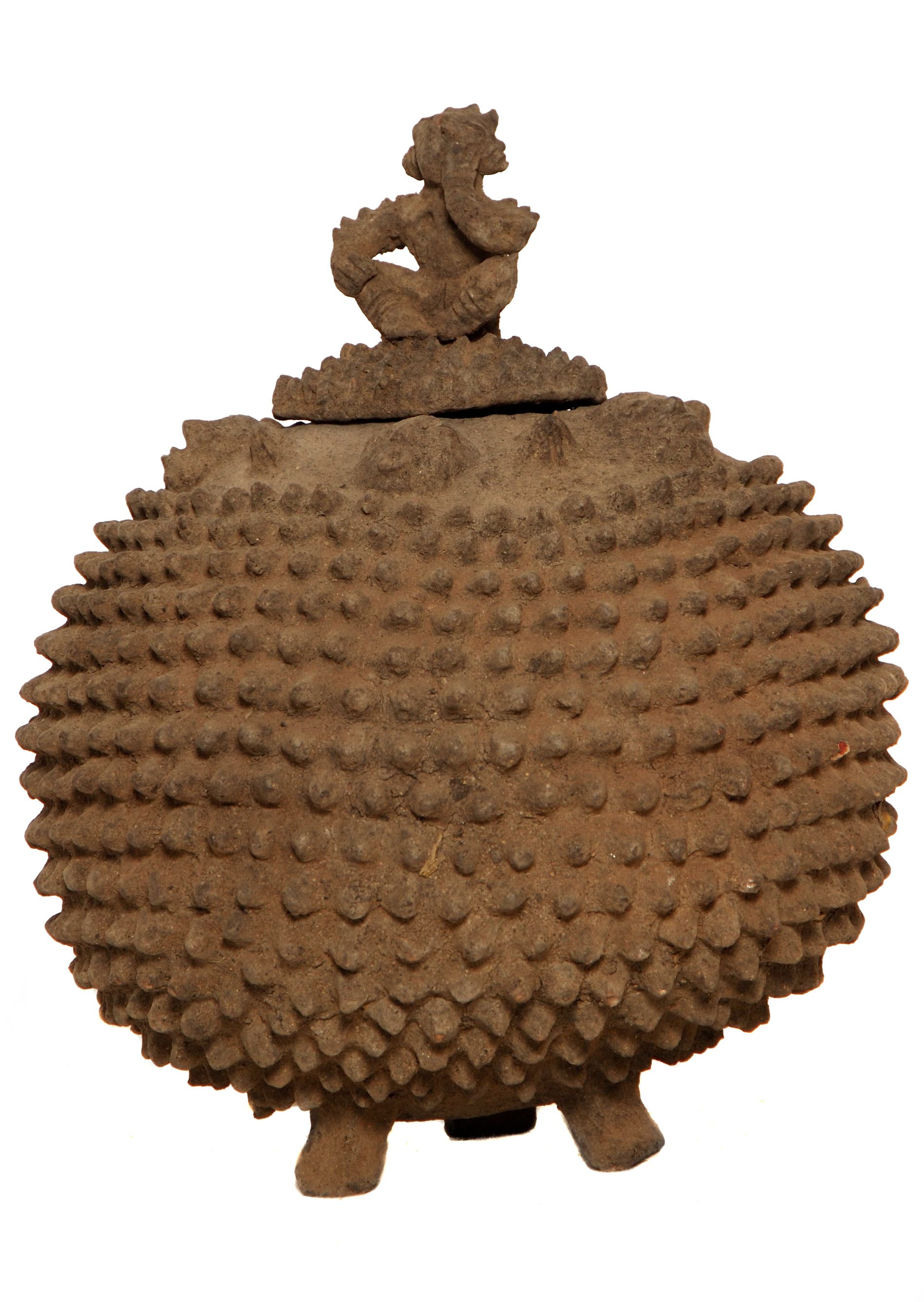
Significance in the African Art Canon The artistic corpus of the Ga'anda represents a monumental, paradigm-defining rupture in the canonical understanding of Sub-Saharan African art. In a continent where classical figurative sculpture is overwhelmingly executed in carved wood, and where religious authority is typically manifested through wooden masks or brass castings, the Ga'anda—alongside their Upper Benue neighbors—entirely abandoned wood in favor of highly sculptural, intricately anthropomorphized terracotta ceramics. These ceramic vessels are not mere utilitarian objects or passive commemorative portraits; they are engineered as the absolute, active ontological containers for the most powerful ancestral and protective spirits in the Ga'anda cosmos. By irrevocably transforming malleable clay through fire into permanent, scarified "bodies," Ga'anda women artists developed a complex visual vocabulary that directly equates the fired ceramic surface with living human skin. The supremacy of ceramic vessels at the center of Upper Benue religious practices marks a clear, indisputable break with the traditions of neighboring sub-regions, establishing the Ga'anda as paramount masters of the expressive and ritual capacities of clay. Their work forces a critical reevaluation of African art history, proving that non-perishable ceramics were utilized to mediate the highest levels of civic, spiritual, and juridical authority.
Cultural Context
Social Structure The fundamental architecture of Ga'anda social life is intrinsically agrarian, entirely dependent upon the rhythmic cycles of wet and dry seasons, planting, and harvesting within the Gongola River valley. The society operates on a rigid patrilineal descent system, characterized by dense webs of localized kinship where extended families occupy enclosed, multi-generational compounds that orbit the central ritual spaces of the community. Within this framework, social cohesion relies heavily on the structured, reciprocal exchange of agricultural labor, surplus crops, and the careful management of women's reproductive potential. Marriages are not individualized contracts but are deeply formalized, arranged alliances between lineages. This courtship system initiates a protracted period of socio-economic exchange: a potential suitor is obligated by customary law to provide sustained, heavy agricultural labor on his prospective bride’s family farm every single season for nearly a decade. This massive transfer of labor is inextricably linked to the physical maturation of the young woman, serving as a material trade-off for the eventual transfer of her fertility and labor to the groom's patrilineage. Consequently, a Ga'anda woman's body, her marital status, and the agricultural wealth of her community are bound together in a single, unbreakable socio-economic matrix.
Kingship, Chieftaincy, and Lineage Organisation Unlike the expansive, militarized, and highly stratified kingdoms of the Cameroon Grassfields or the centralized Fulani emirates to their north, Ga'anda political authority is fundamentally theocratic. Leadership is vested in a paramount chief priest whose authority is derived not from martial conquest, but from his capacity to mediate between the mortal population and the omnipotent cosmological forces that govern rain, agricultural fertility, and public health. While leadership positions are inherited through specific dominant lineages, this authority must be continually validated through the strict custodianship of the region's sacred geography. The Ga'anda landscape is dotted with protected caves and remote rock shelters, which function as the ultimate repositories for their sacred objects. The chiefs and lineage elders maintain their political grip by controlling access to these shrines, interpreting the will of the enshrined ceramic spirits, and ensuring that the community adheres to the strict moral codes required to appease these forces. Lineage organization is thereby reinforced through religious compliance; an offense against a neighbor is viewed simultaneously as an offense against the ancestral spirits housed in the hills.
Regulatory or Initiation Societies A defining characteristic of Ga'anda civilization is the total absence of the exclusionary, masked male initiation societies that dominate the regulatory frameworks of broader West Africa. Instead, the absolute central regulatory mechanism of Ga'anda society is the Hleeta (alternatively spelled Hleeto) scarification cycle. This is an agonizing, highly formalized, eight-to-ten-year process of somatic modification applied exclusively to women, functioning as the primary axis of civic regulation and social identity. Rather than using carved wooden masks to enforce laws, the Ga'anda utilize the female body as the ultimate canvas of civilization. The Hleeta process is entirely managed and executed by skilled female elders who inherit their surgical knowledge through matrilineal lines. These women act as a parallel regulatory authority, controlling a young girl's transition from an uninitiated, "uncivilized" state (associated with the untamed bush) into a fully integrated, marriageable member of society. The completed Hleeta marks serve as a permanent, highly visible public ledger of a woman's civic status, her physical bravery, and her family's adherence to the lengthy bridewealth labor contracts. Furthermore, the body is utilized as an instrument of punitive regulation. Deviations from the strict social order are permanently documented on the flesh; for example, if a woman bears children outside of the sanctioned framework of arranged marriage, she is subjected to specific punitive scarification designs etched onto her calves, serving as a permanent public marker of her transgression.
How Visual Art Functions within the Social Order In Ga'anda society, visual art is never passive, purely aesthetic, or merely commemorative; it operates as an active, aggressive, and essential regulatory agent designed to mediate existence between the human and spirit realms. Because the Ga'anda lacked the monumental wood carving traditions of their neighbors, their most powerful spirit forces were believed to require containment within fired clay pots. The ceramic vessels are the literal, terrestrial dwellings of omnipotent forces, and they enforce the social order through the threat of divine violence. The most critical spirit in the Ga'anda pantheon, Mbirhlen'nda (often transcribed as Mbir'thleng'nda), relies entirely on its ceramic body to enact justice and protect Ga'anda civilization. If a citizen disobeys the codes of morality, the Mbirhlen'nda spirit is believed to inflict horrifying skin diseases upon the transgressor. Therefore, the densely pelleted surface of the Mbirhlen'nda ceramic vessel functions simultaneously as a prestige marker equating to the beautiful, raised cicatrization of civilized Hleeta scarification, and as a terrifying warning of the pathological skin conditions wielded by the spirit as punishment. Beyond civic regulation, visual art is the mandatory mechanism for ancestor mediation. By translating the exact Hleeta scarification patterns of a deceased woman onto the clay skin of funerary urns, the community guarantees that the spirits will recognize, nurture, and correctly route the dead into the ancestral realm. In this social order, the ceramic vessel and the human body are functional equivalents—both require intentional, painful modification to house the social and spiritual life of the community.
Aesthetic Markers
The Formal Vocabulary: Proportions and Facial Canon The sculptural idiom of Ga'anda ceramics relies fundamentally on an anthropomorphic and explicitly feminized geometry, diverging sharply from the utilitarian silhouettes of standard domestic pottery. The foundational proportion is established through the dynamic tension between a vertically elongated, often cylindrical or subtly flaring neck, and an engorged, perfectly spherical midsection. This specific architecture is consciously deployed by the artist as a direct metaphor for the female body; the pronounced roundness of the vessel’s belly directly evokes a woman’s gravid womb, framing the entire pot as the ultimate biological and spiritual receptacle for new life and ancestral containment. To elevate these vessels from functional objects to sacred entities, they are delicately humanized. The vessels frequently feature modeled anatomical additions, including abbreviated, conical breasts, a protruding central navel, and articulated arms. These arms vary in their execution—sometimes rendered as rigid, resting handles, and in other instances articulated with a wavy, undulating dynamism that surrounds the central torso. The facial canon of the Ga'anda is characteristically minimalist, highly stylized, and non-portrait in nature. Heads, when fully rendered at the apex of the neck, are typically simple spherical or ovoid volumes. Facial features are abbreviated, usually rendered through subtle recesses, pinched clay, or slit-like incisions. This intentional suppression of individual portraiture ensures the vessel represents an archetypal, infinite spiritual presence rather than a specific, mortal individual.
Surface Treatment The paramount, defining feature of all Ga'anda aesthetic production is its incredibly intricate surface treatment, which acts as a literal ceramic analogue to human skin. The vessels are completely devoid of applied polychrome paints or thick ritual patinas; instead, extreme physical texture is the primary visual language. The surfaces are densely encrusted with hundreds of applied clay pellets and meticulously incised geometric linear patterns. These relief patterns are engineered to perfectly replicate the raised-dot topography of healed Hleeta scarification. The methodology of creating these clay decorations closely mimics the surgical process and visual appearance of actual scarification on human skin, establishing a direct, physical empathy between the woman making the pot and the pot itself. On the powerful Mbirhlen'nda pots, the pellet application is often remarkably dense and aggressive, creating a highly textured carapace that signifies both the height of civilized beauty (scarification) and the terrifying threat of danger (skin disease). Additional symbolic motifs, such as incised representations of cowrie shells, are frequently mapped around the lower belly of the vessels to explicitly underscore themes of female fertility and reproductive readiness.
Materials, Techniques, Colour, and Scale Every authentic Ga'anda ritual vessel is constructed from locally sourced terracotta clay. They are shaped exclusively by initiated women artists utilizing traditional hand-building and coiling techniques, completely bypassing the use of a potter's wheel. Once the anthropomorphic shaping and the exhaustive, repetitive application of the Hleeta pelleting is complete, the pieces undergo a low-fire, open-pit firing process. This firing irreversibly transforms the malleable clay into a rigid, immutable body capable of safely housing volatile spirits. Colors are entirely restricted to the natural hues resulting from the oxidation or reduction atmospheres of the open fire, typically yielding matte finishes in dark grays, earth browns, and subdued pinkish-terracotta tones. The scale of these objects is highly variable depending on their specific shrine function, but they are generally imposing for hand-built ceramics. Major shrine vessels routinely range from 35 cm to nearly 60 cm in height (approximately 14 to 23 inches), engineered with enough mass and verticality to command the spatial hierarchy of a dimly lit rock-shelter altar.
Distinction from Neighbouring Traditions
To fully grasp the Ga'anda aesthetic, it must be rigorously distinguished from the overlapping ceramic traditions of neighboring Upper Benue groups.
| Feature | Ga'anda (Central / Eastern Gongola) | Cham-Mwana & Longuda (West of Gongola) | Yungur / Bəna (South of Ga'anda) |
|---|
| Primary Function | Ancestor mediation, civic regulation, housing protection spirits (Mbirhlen'nda). | Divination, curing illness, protecting fetuses, housing disease spirits. | Memorializing specific deceased male leaders and chiefs. |
| Formal Architecture | Central vertical neck, spherical gravid belly, wavy arms, symmetrical. | Idiosyncratic "blind-spout" (head emerging diagonally from the lateral wall). | Massive, singular log-like forms or large pots depicting explicit portraits. |
| Surface Treatment | Female Hleeta scarification motifs (pellets) universally applied to all vessels. | Open, screaming mouths to allow direct entry for disease spirits; varied textures. | Explicit male signifiers: modeled beards, filed/chipped teeth, male family scars. |
| Gender Idiom | Exclusively feminized geometry cross-cutting all gender lines in mortuary use. | Gender-variable, highly dependent on the specific illness or divination oracle. | Hyper-masculinized, individuated portraiture of specific dead patriarchs. |
As demonstrated, the Ga'anda completely lack the idiosyncratic "blind-spout" architecture—where an open-mouthed head protrudes at a sharp diagonal angle from the side of the vessel—which is the absolute hallmark of Cham-Mwana and Longuda pregnancy and disease-curing vessels (itinate and kwandalowa). Conversely, the Yungur to the south produce the wiiso—ancestor vessels that act as highly individuated, specific portraits of deceased male leaders. Yungur wiiso are heavily defined by masculine signifiers such as beards, filed teeth, and male family scarifications. The Ga'anda aesthetic idiom entirely avoids this male specificity; they maintain a universal, gender-fluid, or explicitly feminized geometry, permanently cross-cutting gender lines by applying female Hleeta motifs to the urns of both male and female ancestors.
Ritual Practices
The Hleeta Cycle and the Yowo Ceremony The most profound and demanding ritual sequence in Ga'anda culture is the execution of the Hleeta scarification process. Initiated when a girl reaches exactly five or six years of age, this cycle demands immense psychological fortitude and physical endurance, unfolding gradually over a period of eight to ten years. The ritual is meticulously executed in six strict biennial stages. During each stage, specialized female elders utilize small, razor-sharp iron tools to create hundreds of tiny incisions across the girl's flesh, deliberately causing small wounds that heal to produce carefully spaced, raised keloid marks of identical size and shape. These marks are arranged into single, double, or triple outlines forming complex geometric shapes. This grueling sequence is irrevocably tied to the payment of bridewealth and agricultural labor; a marriage cannot be formally consummated until the groom has fulfilled his multi-year labor obligations on the bride's family farm, and the final set of marks is etched upon the bride's thighs. These thigh scars serve as a permanent, visual signal to the entire community that the woman is officially married and bound to her husband's lineage.
The triumphant conclusion of the grueling Hleeta cycle is marked by the Yowo coming-out ceremony, a massive public festival held annually following the agricultural harvest. Emerging from a mandatory period of healing and seclusion, the young women endure a final purification rite involving bathing and the total shaving of the head. They then heavily modify their newly scarified skin, coating their bodies with a rich mixture of karité (shea) oil and mesaktariya—a vivid, intensely red haematite pigment sourced specifically from the edges of stagnant local pools. Adorned in bright bead necklaces, heavy iron belts, and copper anklets, and often wearing masks constructed of beads, the young women are presented to the community in an exhaustive mass dance. It is exclusively during this Yowo harvest presentation that the girls are granted a singular, once-in-a-lifetime privilege: they are allowed to physically cross the threshold into the deeply restricted caves and rock clefts housing the sacred ceramic shrines. Standing directly before the terrifying spirit pots, they commune intimately with the ancestral forces, petitioning the Mbirhlen'nda to grant them the gift of fertility required to sustain the Ga'anda populace. After this supreme spiritual encounter, they formally leave their childhood homes and move into their husband's household.
Funerary Rites and Ancestral Mediation The management of death and the ontological transition of the soul among the Ga'anda require an exhaustive, year-long ritual architecture that is completely dependent on their ceramic arts. When a Ga'anda individual dies, their spirit does not immediately depart for the ethereal next world. Instead, the raw, volatile spirit of the deceased is physically collected and temporarily relocated into specific ceramic vessels to be actively placated by the living. This intricate transition utilizes two distinct, highly regulated pot typologies: the Sambarca and the Hlefenda (pluralized and sometimes referred to as Hlendica). The Sambarca pot is utilized specifically to house and collect the immediate spirit of the newly deceased individual. In contrast, the broader, more monumental Hlefenda jar acts as the permanent receptacle for the overarching, collective ancestral spirit of the lineage clan.
For one full seasonal cycle spanning a year, the Sambarca of the deceased accompanies the Hlefenda inside specialized, secluded household altars known as Ketn Buuca. During this critical, liminal twelve-month period, living relatives interact actively and intimately with the vessel. They present it with food offerings to soothe the spirit and consume traditional corn beer directly from the jar during special commemorative occasions. This act of shared consumption physically binds the living lineage to the temporarily trapped dead. Only at the exact conclusion of the year-long cycle is a final, highly dramatic ceremony executed wherein the Sambarca pottery is intentionally and physically shattered by the community. This destruction of the ceramic body formally frees the now-appeased soul, allowing it to transition permanently and safely into the ancestral realm, while the shards remain as material evidence of a completed mourning cycle.
The Function of Specific Object Types
| Object Type | Primary Function and Ritual Context | Visual Characteristics |
|---|
| Mbirhlen'nda | The paramount guardian spirit of the community. Enforces morality by inflicting skin diseases on transgressors. Protects health and prosperity. | Central placement in shrines. Elevated within broken pottery necks. Extremely dense application of raised clay pellets simulating scars and disease. |
| Ngum-Ngumi | The ancient culture hero spirit. Objectified as the ambulatory pot that led the Ga'anda migration. Invoked for protection and identifying thieves. | Delicately humanized with arms, breasts, a navel, and Hleeta scarification patterns. Functions as an oracle and protector. |
| Sambarca | Temporary funerary receptacle. Captures and houses the immediate soul of a newly deceased individual for exactly one year. | Placed within the Ketn Buuca altar. Used for ritual drinking of corn beer. Intentionally shattered after one year to release the soul. |
| Hlefenda | Permanent ancestral lineage vessel. Houses the collective, ancient spirit of the entire clan. | Long-necked jar decorated heavily with Hleeta designs. Remains permanently within the Ketn Buuca altar alongside the temporary Sambarca. |
Historical Context
Origins and Migration Traditions The historical narrative of the Ga'anda is deeply encoded in their foundational origin myths, which locate their ethnogenesis far to the east of their current territory. Oral traditions point specifically to the Lake Chad basin region of present-day Borno State as their ancestral homeland. Driven by unrecorded historical pressures, the Ga'anda executed a massive southwestern migration, accompanied by their Chadic-speaking kinsmen, the Kanankuri (also known as the Poti). Uniquely within African migration epics, this arduous demographic movement is credited not to the military prowess of a human warlord or king, but entirely to the divine guidance of their sacred ceramic container, the Ngum-Ngumi. The Ga'anda objectify this specific vessel as the literal locomotive force behind their survival. This epic migration eventually terminated at the rocky, highly defensible elevations of the Mwakwar Mountain in the Ga'anda Hills. Believing this to be their divinely ordained sanctuary, the Ga'anda settled the surrounding valleys, establishing Mwakwar Mountain as the absolute spiritual epicenter of their civilization—a status it retains to this day.
Contact with Neighbouring States and European Administration The extreme, rugged topography of the Upper Benue Valley played an outsized, existential role in preserving Ga'anda sovereignty and cultural continuity throughout the turbulent pre-colonial era. During the explosive, violent expansions of the nineteenth-century Fulani jihadist movement, which swept across northern Nigeria, the Ga'anda's relative isolation within the steep rock massifs and deep caves provided an impregnable shelter. The mounted Fulani cavalry, highly effective on the open savannas, could not successfully penetrate the treacherous, rocky terrain of the Ga'anda Hills. This geographic advantage allowed the Ga'anda to operate as a completely independent, unconquered priestdom for decades, successfully maintaining their indigenous religion and Hleeta initiation rites while surrounding plains populations were systematically subjugated, Islamized, or displaced.
However, this fierce independence was ultimately compromised by European colonial intervention at the dawn of the twentieth century. The British colonial administration, seeking to streamline governance across the vast Nigerian protectorate, implemented their pervasive system of indirect rule. Ignoring the Ga'anda's historical autonomy, the British forcibly annexed the independent Ga'anda territory into the overarching, pre-existing Fulani emirate system. The traditional Ga'anda chief priest was politically subordinated, and Ga'anda town was reorganized merely as an administrative district headquarters within a broader Islamic political super-structure. This administrative subjugation marked the beginning of a slow, sustained erosion of indigenous political authority.
Periodisation of the Art and Market Trajectory The periodization of Ga'anda ceramic art is broadly divided into a highly restricted "classical" era—spanning the late pre-colonial period through the mid-to-late twentieth century—and a contemporary era characterized by steep decline and intense market commodification. Because low-fired terracotta ceramics are inherently fragile and highly susceptible to environmental breakage, and because specific funerary vessels like the Sambarca were ritually shattered as a matter of strict religious necessity 17, extant "classical" pieces circulating in Western collections rarely predate the late nineteenth or early twentieth century.
The pivotal scholarly documentation of these objects occurred during a narrow window of intensive fieldwork conducted by American art historian Arnold Rubin between 1965 and 1970. Rubin collected artifacts, shot Super-8 footage of masquerades, and recognized the unparalleled uniqueness of the Upper Benue ceramic complexes. This foundational work was vastly expanded by the exhaustive, definitive scholarship of Dr. Marla C. Berns in the 1980s. Their combined research, culminating in the landmark 2011 Fowler Museum exhibition Central Nigeria Unmasked: Arts of the Benue River Valley, firmly elevated Ga'anda ceramics from ethnographic curiosities into the highest echelons of the global African art canon.
Tragically, by the late twentieth century, the rise of widespread conversion to Christianity and Islam catalyzed the rapid abandonment of traditional religious practices. The excruciating Hleeta scarification practices were outlawed or abandoned by modernizing families, and consequently, the production of the associated traditional shrine vessels ceased entirely. As the living tradition died, authentic, field-used objects became highly prized and aggressively sought after on the international art market. Major shrine vessels began appearing in prominent sales, achieving significant valuations, such as those from the Robert Rubin collection sold at Sotheby's in 2010, and subsequent high-profile offerings at Native auctions in Brussels in 2013. Today, the production of ritual-grade Mbirhlen'nda and Hlefenda vessels has completely vanished, locking the authentic, field-used corpus into a finite, closed, and highly coveted historical window, occasionally supplemented by modern, inauthentic tourist reproductions attempting to mimic the classical pelleting techniques.