Overview
The Ijo (in the endonymic self-designation mostly Izon, historical exonyms include Ijaw or Ejo) represent one of the demographically, historically and art-historically most significant ethnolinguistic entities of the West African coastal belt. Geographically, their primary settlement area is centred on the humid tropical estuary region of the Niger Delta in what is now southern Nigeria, which is criss-crossed by countless river branches. The main population clusters extend across the states of Bayelsa, Delta and Rivers, while significant peripheral and diasporic groups are located in Edo, Ondo and parts of Akwa Ibom (Alagoa 1972: 11). In addition, recent demographic surveys document translocal fishing camps and seasonal Ijo settlements along the coast from Sierra Leone in the west to Gabon in the east. The latest statistical estimates from the Ministry of Ijaw National Affairs (MINA) from 2024 put the population at around 14.39 million individuals. This corresponds to 6.16 per cent of the total Nigerian population (estimated at 233.9 million in 2024), making the Ijaw the fourth largest ethnic group in the nation and the undisputed demographic majority within the Niger Delta political zone (MINA 2024: 7).
This enormous demographic mass stands in remarkable contrast to the pronounced linguistic isolation of the group. The Ijo languages, which comprise around 20 closely related varieties (with Central Izon acting as a lingua franca and dialects such as Kalabari, Nembe, Okrika and Ibani having regional significance), have structural characteristics that are unique in West Africa. In particular, the subject-object-verb (SOV) word order is a characteristic that is unusual in the surrounding Niger-Congo language family and is only shared by distant groups such as the Mande or Dogon. This has led to far-reaching linguistic classification controversies. While Joseph Greenberg classified the Ijoid group in his early works as an extremely early, basal split-off from the Niger-Congo family, this categorisation is disputed in contemporary research. The source situation here is ambiguous, as linguists such as Gerrit Dimmendaal completely reject inclusion in the Niger-Congo phylum and postulate Ijoid as an independent, autochthonous language family that developed over thousands of years in relative isolation in the delta (Williamson 1989: 105).
The social and political morphology of the Ijoid is characterised by a fundamental and historically evolved East-West dichotomy, which has direct correlations with subsistence strategies and interactions with neighbouring peoples. In the western and central areas of the delta, traditionally acephalous, strongly decentralised and egalitarian village structures dominate. Political authority is vested in the village assembly (amagula), which is led by a council of elders under the leadership of the amaokosowei (village elder). Primary authority, however, is often of a ritual nature and is exercised by the pere, the high priest, who acts as a mediator between the community and the local deities (Wariboko 1997: 29). In sharp contrast to this, hierarchically tightly organised city-states developed in the saltwater-drenched eastern delta. This transformation was largely catalysed by early contact with European traders from the 15th century onwards and the later monopolisation of the Atlantic slave and palm oil trade. The fundamental socio-political and economic unit of these eastern states (such as Elem Kalabari, Nembe or Bonny) was the "Canoe House" (Wari), a corporate, highly competitive trade and military structure. At the head of these city-states was an amanyanabo (king or literally 'owner of the land'), whose power was based on the control of trade routes and the provision of heavily armed war canoes (Alagoa 2005: 138).
The Ijo's pre-colonial subsistence strategies were primarily based on the exploitation of maritime and aquatic resources through intensive fishing and salt extraction in the mangrove swamps. As the salty soils of the delta did not permit extensive agriculture, the Ijo were forced to enter into a symbiotic, albeit often conflict-ridden, trading relationship with the agrarian neighbouring peoples of the hinterland (such as the Igbo, Urhobo, Isoko and Itsekiri). They traded dried fish and sea salt for essential agricultural products such as yams and bananas (Horton 1969: 45). This middleman position (middlemen) was later extended to transatlantic trade, which gave the Ijo unprecedented economic hegemony in their region. Corresponding material evidence of this complex trade history is documented today in the archival holdings of the Musée du quai Branly in Paris and the Weltmuseum Wien, which make the early phases of contact tangible.
Demographic and linguistic classification
| Data stock (estimate 2024/2025) | |
|---|
| Primary self-designation | Izon |
| Geographical nucleus | Niger Delta (Bayelsa, Rivers, Delta State) |
| Total population (MINA) | approx. 14.39 million (6.16% of the national population) |
| Linguistic classification | Ijoid cluster (controversy: Niger-Congo vs. isolate) |
| Subsistence base | Maritime/aquatic (fishing, salt production, overseas trade) |
| Socio-political structure (west/central) | Acephalous (Amagula assembly, Pere priesthood) |
| Socio-political structure (East) | Hierarchical (Canoe Houses, Amanyanabo kingship) |
Cultural context
The religious system and the cosmological order of the Ijo form a precise, structurally analogue reflection of their extreme topographical and historical reality. Ijo cosmology eschews the rigid, hierarchical and strongly celestial pantheons found among the neighbouring Yoruba or Edo (Benin). Instead, the Ijo system operates in a fluid, tripartite structural model that divides existence into three distinct but permanently overlapping spheres. The first sphere is the world of people, civilisation and ancestors (Nduen), which is primarily located in the city or village. The second and most distinctive sphere is the domain of the water spirits (Owuamapu), who reside in the countless creeks, rivers and the ocean. The third sphere comprises the dense, impenetrable swamp forest, which is regarded as the seat of wild, unpredictable nature and bush spirits (Anderson 2002: 92). Although an abstract female creator deity (often referred to as Woyingi or Tamuno) exists in the Ijo conception, she largely withdraws after creation, so that active ritual practice centres almost exclusively on the ancestors and the water spirits.
The water spirits (Owuamapu) take on an ambivalent, hyper-potent role. They are conceptualised as capricious, powerful entities that rule over the resources of water and can bring both extreme wealth (historically associated with lucrative overseas trade) and sudden destruction and catastrophic floods. Interaction with them is unavoidable; even mundane economic acts such as the start of the fishing season require complex sacrificial rituals and are symbolically enacted as battles between the village canoes and the spiritual owners of the waters (Anderson 2002: 169). The central ritual authority for mediation with these entities is vested in the Ekine society (also Sekiapu, "the dancing people"), especially among the eastern Kalabari Ijo. This exclusive male society controls the monopoly over the staging of the water spirit masquerades. According to the founding myth of this society, a woman named Ekineba was abducted by water spirits. After her return, she taught the people the dances of the spirits, but was ultimately drawn back into the aquatic world because the people violated the ritual taboos. Since then, she has acted as the patron saint of male mask dancers (Horton 1963: 94). However, the Ekine society does not only operate as a religious medium, but historically functioned as the highest legal and executive authority for the enforcement of social norms, the assimilation of slaves into the canoe houses and the testing of masculinity.
Despite the visual dominance of the male ekine unions, the role of women in the cult of the Ijo is of essential, often underestimated importance. While men dance the masks, women function primarily as divinators, healers and priestesses of the water spirits. As the ethnographic work of Martha Anderson shows, the social role of women as carers and nurturers has structural parallels to the care of the river spirits. Priestesses such as the documented Ngowuka on the island of Bolo manifest direct connections to the numinous through temporary body painting (buruao) and trance states and maintain the ritual balance of the communities (Anderson 2002: 105).
With regard to the cosmological gender order and its historical transformation, there is a significant controversy in contemporary research. The social ethicist Nimi Wariboko identified a profound shift in the numerological symbolism of the Kalabari Ijo, which demonstrates the influence of economics on religion. Traditionally - and in strongly acephalous Western Ijo communities to this day - the number three and odd numbers were generally associated with the masculine sphere, while the number four and even numbers represented the feminine. Wariboko argues that the radical transformation of Eastern Ijo society from egalitarian fishing villages to militarised city-states based on violence and the slave trade (the Canoe Houses) led to a systematic erasure of female numerology (the number four) from religious cosmology. This theological restructuring served to ideologically legitimise the newly established patriarchal and mercantile dominance of the male merchant elite and to abolish the previously balanced gender order (Wariboko 2002: 66). These structural shifts discussed by Wariboko and Anderson can be traced when analysing objects in the Fowler Museum (UCLA), where the aggressive iconography of warrior shrines often literally overlays the more fluid female water association.
| Cosmological Sphere | Associated Entities | Ritual Media & Authorities | Sociological Meaning |
|---|
| Village/Civilisation | Ancestors (Nduen), Founding Fathers | Ancestral Altars (Nduen Fobara), Amanyanabo | Social Continuity, Legitimation of Political Rule in Canoe Houses |
| Aquatic space | Water spirits (Owuamapu) | Ekine men's alliance, female diviners, horizontal masks | Wealth, trade, unpredictability, source of overseas profits |
| swamp forest | bush spirits, wild forces of nature | warrior shrines (Ifiri / Iphri) | aggression, defence, protection from physical enemies |
Aesthetic features
The sculptural canon of the Ijo, especially the Kalabari subgroups, radically eludes the naturalistic or idealising paradigms that characterise the courtly art of neighbouring cultures such as the Yoruba or the Benin bronzes. The aesthetics of the Ijo are deeply abstract, geometric and characterised by an uncompromising cubism that deconstructs physical form in favour of ideal and spiritual legibility (Fagg 1982: 39). The size spectrum ranges from hand-sized amulets to larger-than-life, wall-filling shrine constructions. The canonical object typology can be divided into three primary corpora, each with specific iconographic codes: the horizontally worn water spirit masks (Owu), the elaborate ancestor altars (Nduen Fobara) and the aggressive warrior or forest spirit shrines (Ifiri or Iphri).
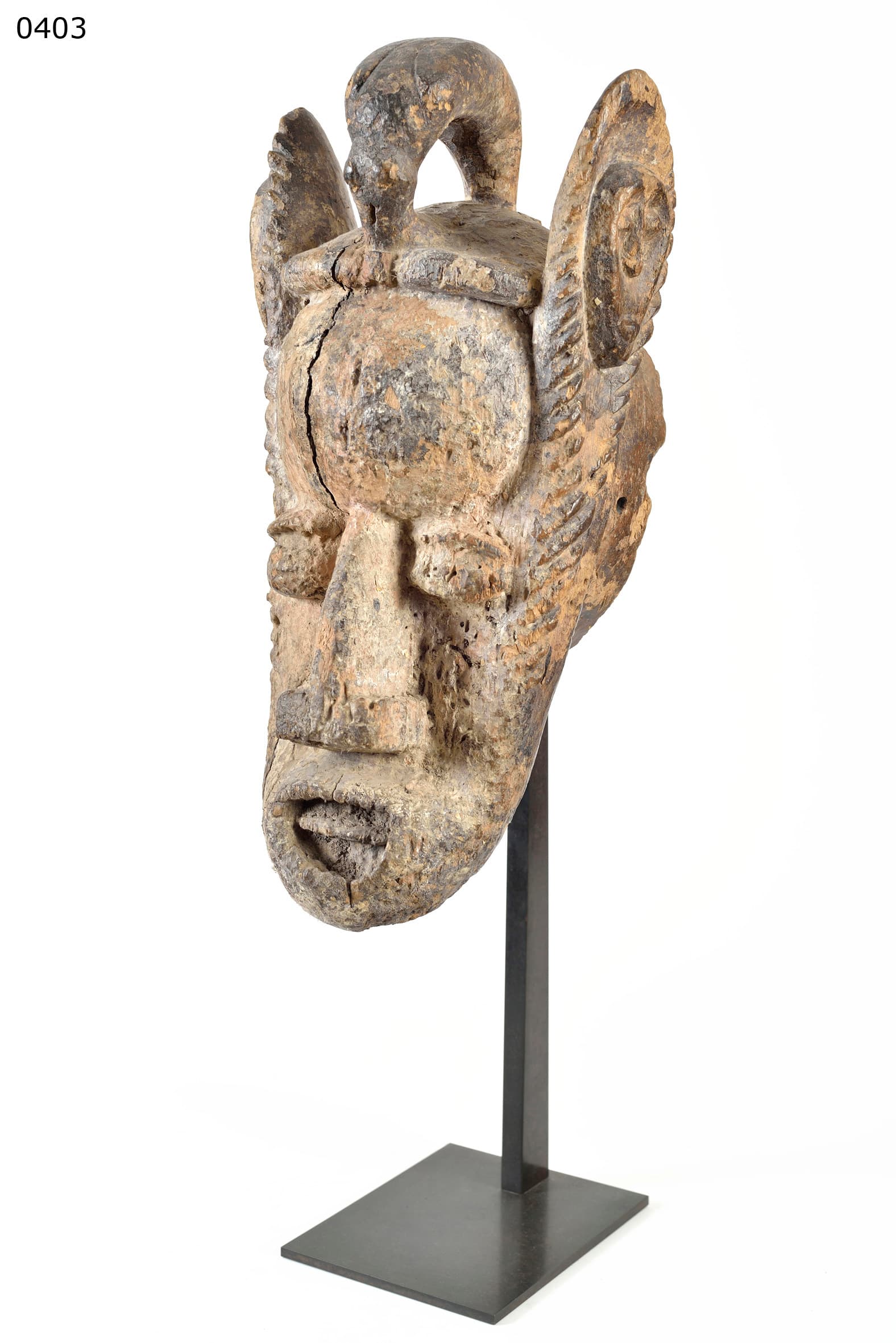
The water spirit masks, which form the performative centrepiece of Ekine society, have a highly singular iconographic orientation in the African context: they are conceived as plank masks that are worn horizontally on the top of the skull so that the main sculptural features are directed towards the sky. This architectural orientation simulates the emergence of a dangerous aquatic creature on the surface of the water. Iconographically, these masks fuse anthropomorphic features (often highly abstracted, tubular eyes and geometric mouth parts) with the anatomical characteristics of dominant river dwellers. Among the most prominent subtypes are the crocodile, the sawfish and the otobo mask, which fuses the massive facial features of a hippopotamus with human features to materialise the raw, untamed power of the spirit (Willett 1971: 177).
Another canonical masterpiece of Ijo aesthetics are the Nduen Fobara (literally: "forehead of the dead"). These rectangular ancestral altars, made primarily from durable iroko wood, rattan and locally and imported pigments, are a massive departure from the classic African tradition of monolith carving (from a single block of wood). The altars are constructed from additive, separate wooden elements and joined together with precise mortise and tenon joints, which refers to the direct assimilation of European ship carpentry techniques in the 19th century (Barley 1989: 12). The canon of proportions is strictly hierarchical: the iconography shows the deceased Canoe House leader (Amanyanabo) frontally and oversized, flanked by smaller accompanying figures. The status of the ancestor is demonstrated by an amalgam of local and imported insignia, including British top hats, imported fabrics, ritual swords and occasional small mask depictions of severed enemy heads that testify to his military might.
With regard to the interpretation of the Ijo sculptures, one of the most prominent art-ethnological research controversies exists between Robin Horton and Martha Anderson. In his classical, structuralist interpretation, Horton (1965) argues that the Ijo sculptures - and explicitly the water spirit masks - have no representative or depictive function in the Western sense. For him, they are purely utilitarian tools, amorphous "anchors" or "nameplates" (points of contact) whose form is irrelevant as long as they serve to bind the otherwise invisible and free-floating spirits to a physical location for the duration of a ritual (Horton 1965: 8). Martha Anderson (2002), on the other hand, sharply rejects this reductive-functional reading. She argues from a re-evaluated ethno-aesthetic perspective that the Ijo artists do indeed consciously depict the physical, dangerous and liminal attributes of the environment (aggression, teeth, scales) in the masks. The sculptures actively evoke specific psychological reactions such as fear and awe in order not only to localise the unpredictable nature of the water spirits, but also to materialise them aesthetically in their full narrative drama (Anderson 2002: 69).
The documentation of master hands known by name is extremely rare in older Ijo art. However, P.A. Talbot documented in the 1910s that the exclusive production of the Nduen Fobara was traditionally delegated to the Pokia carving family on the island of Fouché, indicating highly specialised, isolated workshop structures (Talbot 1932: 237). Today, the choice of material and the development of the patina are the most critical criteria for authenticity testing on the art market, as conservators at the Rietberg Museum in Zurich confirm. The authentic patina of a ritually activated object is created by decades of organic layering of libations (palm wine, blood, kaolin) and forms a heavily encrusted, partially flaking surface (crusty patina). Forgeries often fail to reproduce the deep cracks in the heartwood and the authentic termite damage that is unavoidable due to the storage of the objects in the extremely humid mangrove swamps. A mundane object (often freshly carved for the tourist market) shows a smooth, cosmetic stain that lacks the forensic depth of ritual wear.
Ritual practice
The life cycle and performative activation of the Ijo sculptures testify to a highly dynamic understanding of sacredness. In contrast to the Western museum context, the artwork in the Niger Delta does not function as a permanent, passive idol, but as a temporary medium that is "charged" through ritual acts and returned to a profane state after use. The ritual practice varies significantly between the ancestral altars, which demand semi-permanent worship, and the water spirit masks, which are subject to extreme cycles of activation and disposal.
The mask performances of the Ekine society represent the performative pinnacle of Ijo culture. The horizontally worn water spirit masks (Owu) remain in a latent, almost profane status until they are prepared for the great festival cycle - which can extend over a period of up to 17 years for the Kalabari. The actual sacralisation does not take place through the wood-carved mask itself, but through the fleeting ritual symbiosis of the wooden object, extremely voluminous costume, specific music and the dancer's body. Before the performance, the mask is fixed on the head, while the dancer is completely concealed under layers of raffia and precious imported check fabrics (the so-called Injiri or Madras fabric) in order to complete the transformation from human to numinous (Talbot 1932: 279).
The activation of the spirit in the dancer is primarily initiated by acoustic stimuli, specifically by the drum language. A climactic and highly dangerous moment of the ritual practice is the "pointing ordeal" documented in detail by Robin Horton. The masked dancer, who is often in a deep state of trance, must decode the complex, archaic drum language of the Ekine master drummers flawlessly. The instrument calls out the names of specific shrines, historical figures or places, and the dancer must point his sword or staff precisely at the corresponding locations in the village in real time. Failure in this ordal leads to extreme social dishonour for the dancer and their lineage. It publicly proves that the spirit has left the performer or that the performer has not mastered the core cultural competence of the Ijo (Horton 1963: 95). At the end of the festival, the masks are ritually deactivated. With their ritual charge extinguished, they are stripped of ceremonial respect; they are often carelessly stored in the smoky rafters of houses, where they are exposed to insect damage, or even discarded in the mangrove swamps. This unsentimental life cycle explains the extreme rarity of pre-colonial masks on the international art market (Anderson 2002: 107).
In massive contrast to this is the ritual practice surrounding the Nduen Fobara ancestral altars, which demand a permanent presence at Canoe House in order to maintain lineage status. The initiation of a newly carved shrine follows a rigorous, almost martial protocol. According to the historical records of Percy Amaury Talbot, the completed shrine is transported secretly and under the cover of night from the island of the Carvers' Guild (Fouché) to the village and hidden in a neutral building. On the fourth day, the ritual escalates into a massive, publicly staged military confrontation (mock fight). The heavily armed relatives of the deceased storm the building to symbolically recapture the ancestor from his enemies in a "liberation fight". Only after this dramatic triumph is the altar installed in its permanent shrine room amid songs of victory (Talbot 1932: 237). The continuous activation of the altar takes place through libations; for this purpose, the shrine ensembles are often equipped with small table structures integrated into the weave, on which the descendants make offerings in the form of gin, palm wine and the blood of sacrificial animals in order to secure the intercession of the Amanyanabo for continued commercial success (Talbot 1932).
| Ritual object | Activation medium | Specific rite | Disposal / deactivation |
|---|
| Water spirit mask (Owu) | Drum language, costuming, trance | "Pointing Ordeal" (decoding of drum language) | Profanisation, storage in rafters or throwing into swamps |
| Ancestral Altar (Nduen Fobara) | Armed transport, blood libations | "Mock Fight" (symbolic liberation of the ancestor) | Permanent installation in the shrine, continuous offerings |
| Warrior shrine (Ifiri) | Invocation before war or hunting | Blood sacrifice, display of armed force | Remaining in private or collective clan possession |
Historical context
The historical trajectory of the Ijo communities and their material culture is inextricably linked to the massive socio-economic upheavals and the often brutal integration of the Niger Delta into global capitalism. The migration history of the Ijo forms the chronological starting point, but is the subject of profound scholarly controversy. The historian E.J. Alagoa argues on the basis of glottochronological data and the systematic evaluation of oral traditions that the Ijo colonisation of the delta has an extreme chronological depth. He dates the separation of the Ijo from their mainland neighbours to up to 7,000 years in the past and postulates a monocentric migration movement from the central delta to the eastern and western peripheries (Alagoa 1972: 158). This thesis of an isolated, deep continuity is categorically questioned by Robin Horton. Horton criticises the positivist approach to oral traditions and argues that the genealogical narratives of the Ijo primarily serve to legitimise current political structures. Instead, he develops the model of a "fringe belt" (border or contact zone), which is based on reciprocal, multi-layered migration movements between the delta and the hinterland and implies a more recent, far more hybrid genesis of Ijo identity (Horton 1966: 405).
It is undisputed that the most radical transformation of the region began with the Atlantic slave trade and the later palm oil trade (from the 15th to the late 19th century). This era led to the consolidation of the Canoe Houses and an unprecedented accumulation of wealth in the eastern Delta. This politico-economic nexus generated the specific materiality of the Nduen Fobara altars, in which European trade goods and status symbols (such as imported fabrics, top hats and carpentry techniques) were directly assimilated into the local iconography to visually cement the mercantile hegemony of the elite (Barley 1989: 12).
The cataclysmic break for the material heritage of the Ijo occurred in the early colonial period, culminating in a radical local movement in 1915/1916, led by Garrick Braide (who called himself Elijah II), an extremely charismatic Christian prophet from the Delta, which resulted in systematic iconoclasm. His followers saw the ancestral altars and water spirit masks as the cause of the decline of local autonomy under British rule and burnt thousands of sculptures as "idolatry". This historical moment defines the object biography (biography of deprivation) of almost all early Kalabari objects in Western museums today. The British colonial official, ethnographer and anthropologist Percy Amaury Talbot intervened during these riots and saved (or confiscated) a significant number of Nduen Fobara and Ekine masks from destruction. Talbot's collection, which was formally donated in 1950, today forms the irreplaceable nucleus of the Ijo corpus in the British Museum (London) and continues to shape the global understanding of this art form (Talbot 1932: 237).
The market development for Ijo art in the West was very delayed. While Benin bronzes or Dan masks met the taste of Western modernism early on, the uncompromisingly cubist, often crudely additively crafted art of the Ijo was considered "too raw", too unconventional or simply "un-African" by early collectors, as it broke with common expectations of African woodcarving art. A paradigm shift only took place in the 1960s and 1970s, parallel to the publications of Robin Horton and pioneers such as William Fagg, who embedded the extreme abstraction of the objects in a serious art historical and philosophical discourse. This led to a significant price development. The historical auction database of Sotheby's or Christie's today documents estimated prices of between EUR 15,000 and 60,000 for Kalabari shrines or rare water spirit masks, whereby top pieces with complete provenance (particularly from the ex-Talbot collection or early French collections) generally achieve much higher sums (Sotheby's 2012).
This enormous increase in value has massively exacerbated the forgery problem with Ijo artworks. Today, authenticity criteria are based on complex forensic and optical analyses. Institutional collectors and museums such as the Musée du quai Branly or the Metropolitan Museum of Art pay meticulous attention to the condition of the patina. An authentic encrustation consists of microscopically detectable layers of ritual sacrificial materials (palm oil, blood, kaolin) that have penetrated the wood over decades. Forgers often try to imitate this by applying earth mixtures or chemical stains (Ciram 2021). Another criterion that can hardly be forged is structural ageing: the specific shrinkage of rattan joints, the deep heartwood cracks caused by the constant alternation of extreme humidity and heat and the traces of authentic termite damage bear witness to the harsh climatic reality of the delta. Objects that appear on the art market with overly even, artificially "wiped" ageing or are made from the wrong types of wood (the Ijo primarily used hardwood iroko for shrines) are considered highly suspect. The definitive evaluation of an Ijo artwork therefore requires a simultaneous analysis of its formal-cubist quality, its historical materiality and its ritually verifiable withdrawal biography.