1. overview
The Jarawa, whose precise autonymic self-designation is Afizere (in linguistic and ethnographic nomenclature also documented as Izere, more rarely as Afusare, Afizarek or Fizere), represent a demographically, linguistically and culturally historically significant, but in material-related research often marginalised ethnic group in the central Nigerian region. Their geographical distribution is primarily concentrated on the topographically challenging altitudes of the Jos Plateau and the neighbouring plains of Bauchi State, especially in the administrative districts of Toro Local Government Area as well as Jos East and parts of Mangu (Sule 2018: 5). Current demographic estimates of the exact population size diverge considerably in the academic literature, which is primarily due to fluid ethnic boundaries, high multilingualism and historical administrative recording deficits. While the traditional estimate, which focuses purely on the linguistic core population of the speaker community historically classified as Jarawa, is based on around 50,000 to 100,000 individuals (Haruna 1997: 2), more recent census extrapolations and ethnosociological surveys put the wider socio-cultural Afizere cluster at well over 500,000 members.
At this point, a taxonomic warning must be issued with the utmost vigour: It is imperative that this West African ethnonym be distinguished from the Jarawa of the Indian Andaman Islands, who have the same name. This phonetic coincidence repeatedly led to serious homonymic misattributions and systematic distortions in the popular literature and in early, insufficiently edited academic databases, in which Asian hunter-gatherer narratives were projected onto central Nigerian agrarian societies.
The linguistic classification of the Izere language marks a complex and dynamic field of research that has historically been characterised by considerable controversy. Older linguistic models, which were strongly dominated by geographical proximity to Chadic-speaking groups, tended towards an erroneous classification within the Afro-Asiatic language family. Modern Africanist linguistics, however, clearly locates Izere in the Jarawan-Bantu language branch, a highly specific subgroup of the Benue-Congo language family (Blench 2024: Bantoid Languages). The research controversy is currently focussing on the exact positioning of this group within the Bantu expansion. Roger Blench (2024) and J.A. Ballard (1971: 299) postulate that the Jarawan-Bantu speakers represent an early split-off of the proto-Bantu migration. This population, often described in the literature as "the Bantu who turned northwards" (Gerhardt 1982: 12), migrated back into the northern Benue Basin against the primary, sub-Saharan southern movement. The source situation regarding the exact vectors of separation is ambiguous, but the linguistic affinity to the Zone A Bantu languages (A31-A40) is considered certain today (Mohammadou 2002: 45).
| Linguistic model | proponents | taxonomic classification | justification approach |
|---|
| Afro-Asiatic Chadian | Older colonial linguistics (early assumptions) | Chadian language family | Geographical proximity to Hausa and Bolewa; extensive lexical borrowings through trade contacts |
| Jarawan-Bantu (Benue-Congo) | Ballard (1971), Blench (2015/2024) | Southern Bantoid | Significant cognates with Zone A Bantu; structural nominal affixations that have proto-Bantu roots |
| Narrow Bantu (sub-cluster) | Blench (2024) | Within Narrow Bantu | "Jarawan is probably Narrow Bantu" (Blench 2024) - late typological classification based on affixation and concordance patterns |
The nomenclature of the ethnic group reflects historical foreign rule, interethnic interactions and geographical specifics. The autonymic self-designation "Afizere" can be etymologically translated most precisely as "river dwellers" or "people by the water", which indicates early centres of settlement along the watercourses of the plateau. The exonym "Jarawa", on the other hand, is a loanword from the Hausa, which was established during the pre-colonial hegemony of the Islamic emirates (especially the Bauchi Emirate) as an administrative, often pejoratively connoted collective term for various non-Islamised, autochthonous groups of the plateau (Nyam 1988: 12).
The traditional social structure of the Jarawa presents itself in its pre-colonial origins as an acephalous, patrilineal and segmentary kinship system. The social organisation was based on autonomous village associations (clans) led by councils of elders and ritual specialists, without a centralised, state superstructure. However, under historical pressure from the neighbouring hierarchical Hausa-Fulani emirates and the later British colonial administration, which preferred "indirect rule", these indigenous structures were massively modified. Imported, centralised chiefdoms (district heads) were imposed on the Jarawa in order to integrate them into the colonial tax system (Conant 1963: 17).
In terms of subsistence farming, the Jarawa operate primarily as sedentary, highly specialised agrarian peasants. They have adapted to the harsh, rocky and often eroded conditions of the Jos Plateau through complex, labour-intensive terraced farming systems that guarantee optimal water retention and soil conservation. Primarily drought-resistant millet species, sorghum (Guinea corn), yams and various legumes are cultivated. The relationship with neighbouring peoples is traditionally characterised by a precarious and volatile dichotomy. On the one hand, symbiotic trade relations have existed for centuries with groups such as the Berom and Anaguta. On the other hand, violent, politically and ecologically charged resource conflicts with the semi-nomadic Fulani pastoralists continue to manifest themselves to the present day. These conflicts, which are often erroneously reduced to purely religious differences, are fundamentally based on competition for dwindling grazing land and access to water in a demographically growing region (Stone 1996: 88). We owe the recording and systematisation of the early material culture of this interethnic field of tension not least to the extensive field research and systematic acquisitions of the British ethnologist William Fagg for the British Museum in the late 1940s and early 1950s, which transferred the first reliable, documented object corpora of the Jarawa to Western museum collections (Fagg 1950).
2. cultural context
The autochthonous religious system of the Jarawa is a profound, highly complex synthesis of solar cosmology and an extremely pronounced ancestor cult, which differs structurally, ritually and ontologically from the syncretic or purely animistic practices of the neighbouring Benue peoples. At the undisputed centre of this cosmological order is the undisputed creator god Adakunom. This theological term can be literally translated as "Father of the Sun" or, in a more elaborate exegesis, as "Mighty, all-encompassing Sun" (Nyam 1988: 45). In striking contrast to the distant high gods of many other West African religions, often conceptualised as Deus otiosus (dormant, inactive god), Adakunom actively and permanently intervenes in the physical sphere of the living through a stratified pantheon of mediating natural and spiritual beings. In the ontology of the Afizere, Adakunom is regarded as the absolute, inexhaustible source of vitality, agricultural fertility and physical health. The sun is not understood as the god himself, but as his omnipotent physical attribute and eye that oversees the moral and ritual integrity of the community.
The ancestors, defined in local terminology as the transcended, ritually verified dead, act as the immediate, day-to-day intermediaries between the solar creator entity and the recent kinship group. The ritual authority and monopoly over contact with this transcendence lies primarily with the Atsi, the high priests and dedicated divinators who act as sacred guardians of the earth and ancestral altars (Duyil 2015: 70). These Atsi are recruited from specific patrilineal lineages and undergo years of esoteric training in herbalism, cosmology and sacrificial mechanics. Although rudimentary secret societies exist, these are much less politically centralised than the highly institutionalised, trans-ethnic Poro or Ekpe societies of West Africa and instead focus strongly on the socio-cultural organisation of rites of passage.
The two fundamental pillars of ritual practice and social reproduction are the great initiation and rites of passage: Izhak (the circumcision and formal manhood) and Igasang (the female puberty and fertility rite). The Izhak ritual marks an extensive, three-month liminal phase of isolation of prepubertal boys in a designated sacred forest. Under the aegis of the Aware (the ritual circumciser), they are instructed in esoteric knowledge, the unwritten laws of the ancestors, fighting techniques and the handling of ritual objects. During this phase of ritual exclusion, the ancestral spirits materialise physically in the form of masked performers, the Azhankai or Abage (Duyil 2015: 71; Nyam 1988: 54). These masked beings act as disciplinary instances and physical manifestations of generational continuity. The completion of initiation is sealed by a binding oath on the maitang (the ashes of the sacred circumcision fires), an oath whose breach, according to indigenous belief, inevitably leads to social and physical death.
| Initiation rite | Target group | Duration | Ritual actors | Central function |
|---|
| Izhak | Boys (prepubertal) | 3 months | Aware (circumciser), Atsi, Azhankai masks | Physical circumcision, exclusion in the sacred forest, transmission of esoteric knowledge, oath on Maitang ash, integration into the age group |
| Igasang | Girls (puberty) | Variable | Older women, ritual experts | Preparation for marriage and reproduction, instruction in agrarian cycle and domestic ritual practice |
| Nyam | Young men | Ad hoc | Hunting alliances | Ritual hunting festival, demonstration of physical strength and economic self-sufficiency |
The role of women within this cult system is the subject of a long-running anthropological debate. The sources are ambiguous and often coloured by the androcentric research approaches of early, colonial ethnology. In his early writings, Nyam (1988: 60) states a strict exclusion of women from all sacred spaces and the core secrets of masked performances, which would correspond to the classical paradigm of patrilineal African societies. In direct analytical contradiction to this, Duyil (2015: 73) documents a highly active, albeit structurally complementary, ritual participation of women, especially in the context of the public blessing rites and the extensive Asharuwa ceremonies. Here, female ritual experts prepare the indispensable sacred millet beer, which is essential for the libations on the iron altars, and act as medial interfaces in specific, localised divination processes. This research controversy (Nyam vs. Duyil) reflects the general methodological challenge of precisely separating exoteric (public) from esoteric (strictly secret) ritual lines.
Structurally, the Jarawa religion differs from neighbouring peoples in its massive, centuries-long resistance to the pre-colonial Islamic jihad of the Sokoto Caliphate. While neighbouring groups in the Bauchi region developed syncretic hybrid forms or were completely Islamised, the Jarawa encapsulated themselves in their difficult-to-access mountain massifs. They preserved an archaic cult that utilised extreme visual abstraction in iron and wood as the primary means of communication with the transcendent. The theological density and specific cosmology of this system is often emphasised in comparative exhibitions, for example in the extensive holdings of the Fowler Museum at UCLA, as a singular, hermetic phenomenon within the Benue region, which is otherwise heavily dominated by Jukun and Hausa influences (Berns 2011: 420).
3. aesthetic features
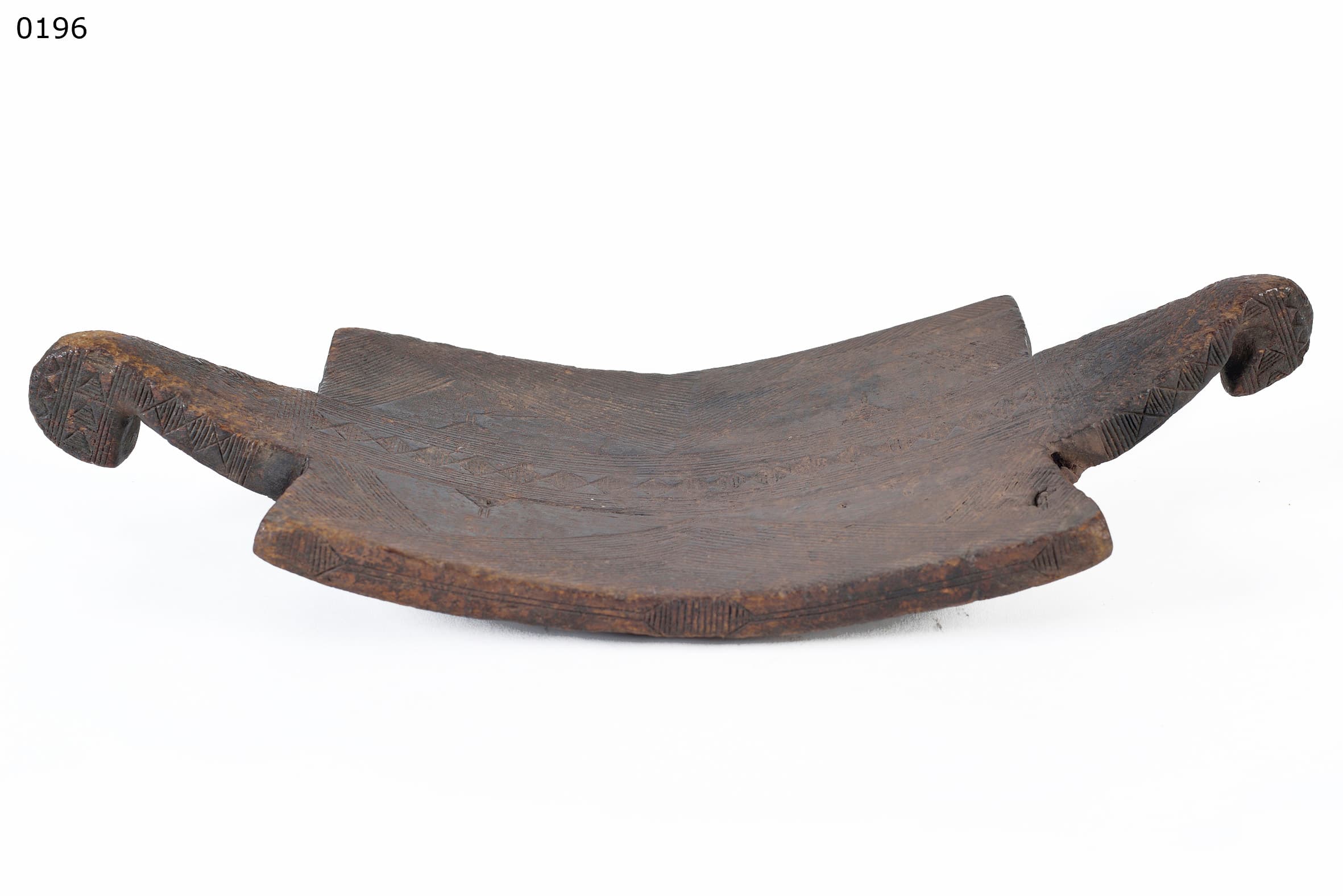
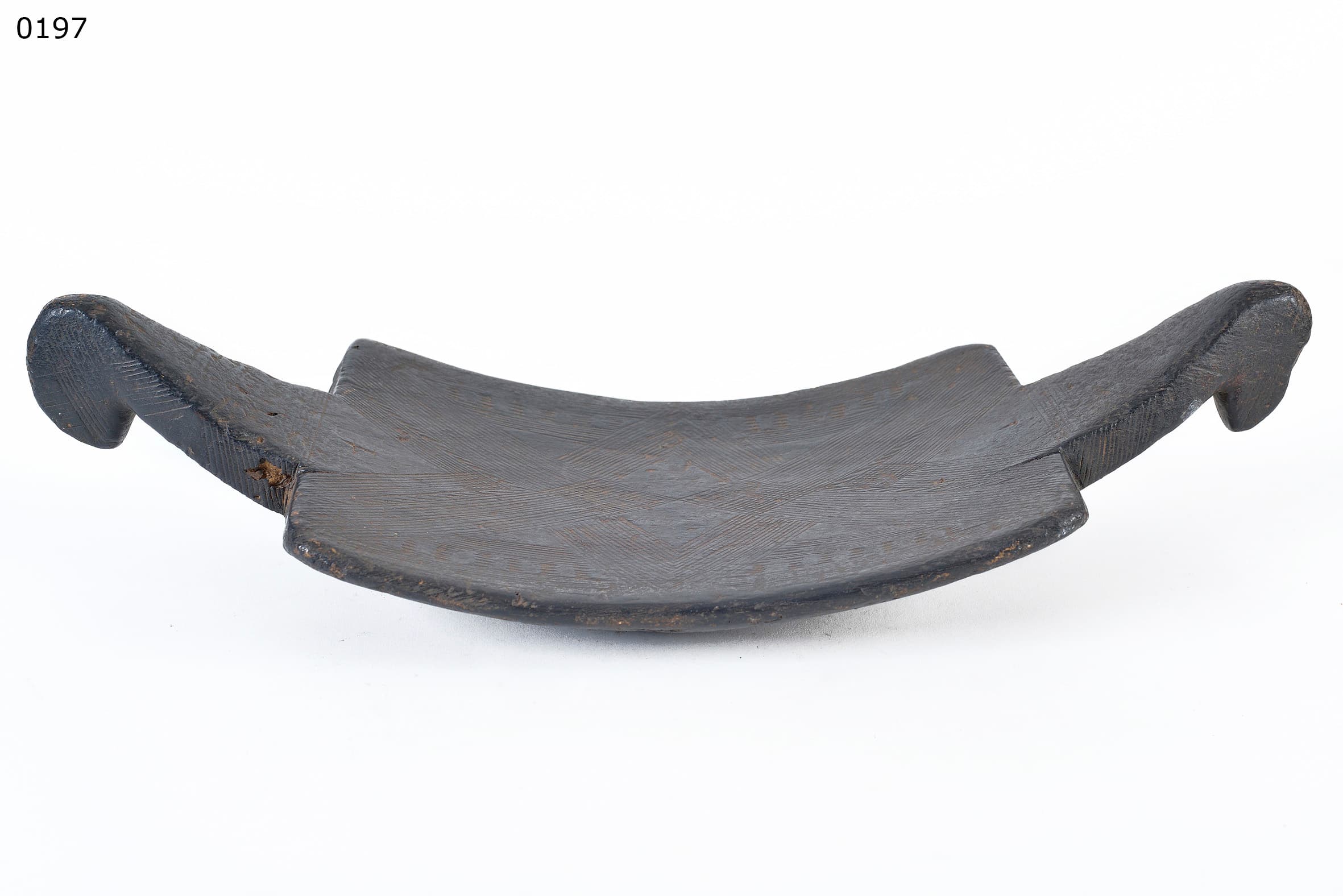
The materialised art world of the Jarawa largely eludes the naturalistic or idealising-figurative paradigms of classical West African wood sculpture (as found among the Yoruba, Baule or Dan) and instead manifests itself in a radical, uncompromising reduction to essential, emblematic forms. The canonical object typology of the ethnic group primarily comprises three categorical groups: massive wooden helmet masks, highly abstracted, linearly emphasised wrought iron sculptures and small-format apotropaics (protective amulets), often bound in clay or wood.
The wooden helmet masks, which were documented by the renowned ethnologist William Fagg (1950) during his field campaigns in the late 1940s for the British Museum as so-called "Congo headdresses", generally have a cylindrical to cumbersome dome-like structure. Iconographically, they do not represent specific human physiognomies, portraits or individualised ancestors. Rather, in their block-like monumentality, they embody the non-human, raw and transcendent power of the Azhankai ancestral spirits. The canon of proportions is characterised by a sharp verticality, massive wall thicknesses and the deliberate absence of delicate details; the eyes and mouths are often only designed as roughly incised, geometric cavities that do not allow for facial expressions but serve as resonating bodies for the voices of the spirits.
The outstanding, internationally recognised, albeit historically highly precarious medium of the Jarawa is forged iron. These sculptures, which can vary considerably in size from 20 centimetres to monumental stelae of over a metre, usually consist of a tapered shaft driven into the ground and an anthropomorphic or zoomorphic top. The choice of material - iron - is not profane, but deeply rooted in the local cosmology. Iron is regarded as a substance of the highest transformative power, controlled by the blacksmith, who occupies an ambivalent, endogamous special position in society, characterised by fear and deep respect. There is a complete lack of documented master craftsmen or identifiable workshops in traditional ethnographic literature. This is due to the indigenous understanding of art: The act of creation is understood as a medial transmission of transcendental instructions, not as an individual artistic achievement that would justify a signature.
The creation of the patina is a gradual, ritualised process of accumulation. The smith's raw object is successively encrusted through repetitive applications of sacrificial blood, palm oil, ash mixtures, chewed kola nuts and millet beer. This organic crust, which often grows several millimetres thick over the course of generations, transforms the "profane" forged product into a metaphysically "activated" object. Without this ritual patina, the sculpture is merely inert metal; with it, it becomes a battery of spiritual energy.
In art historical research exegesis, a significant controversy regarding the size of the corpus and the exact attribution of these wrought iron sculptures manifests itself that has remained unresolved to this day. Strübel (1998) makes an extremely expansive attribution, while Berns rigorously deconstructs this: Klaus-Dieter Strübel, a researcher specialising in metallurgy, attributes an extensive canon of abstract iron sculptures comprising hundreds of objects exclusively to the Jarawa in his publications close to the market. Marla C. Berns (2011: 419) of the Fowler Museum vehemently attacks this narrative market practice in her groundbreaking publication Central Nigeria Unmasked. Berns argues pointedly that empirical fieldwork and archaeological evidence do not support such massive, homogenous iron production for the small Jarawa ethnic group in particular. She postulates that since the 1980s, the Western art market has instrumentalised the ethnonym "Jarawa" as a value-enhancing, convenient catch-all label to commercially locate various indefinable, formally similar iron objects from the entire Bauchi Plateau (including Mumuye, Wurkun, Montol). This sharp debate (Strübel vs. Berns) marks a central research desideratum and requires the utmost caution when cataloguing. The source situation regarding the exact provenance of many iron objects in Western private collections is therefore ambiguous.
For private collectors, forgery criteria are highly relevant in this price-sensitive segment. The visual distinction between an object that has been used ritually for decades and one recently produced for the Western market is manifested in the microstructure of the surface. Authentic pieces, as analysed by material scientists in the depots of the Museum Rietberg in Zurich, exhibit a profound molecular oxidation of the iron beneath the organic sacrificial crust that cannot be simulated. Modern forgeries often simulate this complex patina through the hasty application of acid-induced quick rust, bound with industrial adhesives and artificially added baked earth. Similarly, termite feeding marks are mechanically imitated (often with drills) on wooden elements of the masks. Under a magnifying glass, this can be revealed by the sharp edges and wood fibres of the feeding tunnels - in stark contrast to the smooth, enzymatically decomposed and saliva-lined tunnels of real insects.
4. ritual practice
The performance and handling of sacred objects is subject to strict chronological and spatial regulations among the Jarawa, which are inseparably anchored in the agricultural cycles, meteorological necessities and generational transitions. At the absolute centre of the ritual practice is the use of the altar, which primarily serves to ensure fertility (both agricultural and human) and to ward off calamities such as droughts or epidemics. The design of a classic Jarawa altar is usually decentralised and decidedly close to nature; it is rarely located in enclosed shrines or temple buildings within the village architecture, but is installed precisely in liminal (threshold-like) locations: on prominent rock formations, in dense, untouched parts of sacred groves or on the exposed edges of millet fields. The abstract iron sculptures are rammed deep into the ground as metaphysical "earth antennas". Through this permanent physical contact with the earth, a vital cosmic axis is established between the upper, solar sphere of Adakunom and the chthonic, subterranean forces of the ancestors resting in the earth (Duyil 2015: 75).
The ritual activation of a newly forged iron or a freshly carved mask is a highly complex, multi-stage process. As already mentioned in the iconographic context, a profane, freshly crafted object has no spiritual valence or agency per se. Only the Atsi (high priest) charges the material carrier in a formal rite of consecration. This is initially done through the ritual washing with special, secret herbal decoctions, which "open" the pores of the wood or the surface of the iron. This is followed by the first essential blood washing, usually through the sacrifice of goat's blood or the blood of black chickens, which is meticulously mixed with the maitang ash from the sacred circumcision fires (Nyam 1988: 54). This thick, bloody substance is poured over the object with incantations, transforming it from the passive status of artefact to the active status of agent. In times of peace, the occasions for sacrifice are strictly calendared to the sowing and harvesting cycles, but are ordered ad hoc by the Divinator in the event of acute sociological or ecological crises.
| Phase of the object life cycle | Ritual state | Performing authority | Substances / materials used | Function / mechanism |
|---|
| Fabrication | Profane / Inert | Blacksmith / Carver | Bloomery iron (bloomery iron), local hardwood | Shaping according to transcendent dreams or traditional canon. No spiritual power |
| Activation | Liminal / Charging | Atsi (High Priest) | Herbal decoctions, Maitang ash, goat's blood | "Opening" of the object, binding of an ancestral spectrum to the matter |
| regular use | active / powerful | council of elders, initiates | palm oil, millet beer, chewed kola nuts | nourishment of the spirit, maintenance of cosmic order and fertility. Building the patina |
| Deactivation | Profane / Emptied | Priesthood | None | Controlled abandonment in the bush in case of ritual failure (drought) or social paradigm shift |
The mask performance, which primarily culminates during the Izhak ritual, follows a highly choreographed, dramatic logic. The Azhankai masks always leave the sacred forest in a procession, accompanied by specific polyrhythmic patterns created by drums and acoustic wind instruments made from animal horns. The dancers, who carry the heavy wood on their heads, act in a state of dissociative trance; they are no longer human individuals during the performance, but are seen as physical extensions of the ancestors. Their movements are expansive, erratic and demonstrate extreme physical dominance, visually and acoustically demonstrating to the young initiates the uncontrollable, potentially dangerous power of the transcendent world (Haruna 1997: 4). Regional variations of this practice are particularly evident in the southern foothills of the Jarawa region on the border with the Jukun, where intercultural influences from Benue culture lead to a stronger integration of voluminous fibre costumes that completely conceal the dancer's body.
The life cycle of a ritual object is finite and reflects the Jarawa's highly pragmatic, almost contractual understanding of religion. If a mask or an iron altar loses its power - which manifests itself empirically through a lack of rain, persistent crop failures or rampant diseases despite correct, elaborate offerings - the object is formally deactivated. In his analysis of ritual failure, the ethnologist F. P. Conant (1963: 18) impressively documents the process of deactivation and disposal on the plateau: the objects are usually not actively destroyed, burnt or desecrated, but simply abandoned in the savannah or in the deep bush. Due to the deliberate absence of nourishing offerings and blood libations, the wood rots due to insect damage, or the iron corrodes in the natural weather cycle. The residual energy bound to the material thus flows slowly and in a controlled manner back into nature. Especially during mass, politically forced or opportunistic conversions to Islam in the early 20th century, hundreds of such objects, including sacred hoe blades and divination devices, were left behind in the bush. This practice of systematic abandonment and intentional weathering poses considerable ethical and material challenges for modern conservators, as the sensitive restoration reports on Jarawa fragments at the Musée du quai Branly demonstrate. The conservators there are trying to balance the fragile boundary between the ritual decay intended by the ethnic group and the Western museum's duty of preservation.
5. historical context
The history of the Jarawa is inextricably linked to the complex demographic shifts and migratory movements of the West African Middle Belt. However, the reconstruction of these movements is academically controversial. The historian E. Mohammadou (2002: 45) dates the initial migration of the Jarawan-Bantu speaker groups from the upper Benue Basin in present-day Cameroon to the early 18th century. He identifies serious climatological anomalies, prolonged periods of drought and the resulting economic collapse in the region of origin as the primary triggers. The groups followed the course of the Benue River westwards and gradually shifted their settlement areas to the topographically protected elevations of the Muri Mountains and today's Bauchi Plateau. The linguist J.A. Ballard (1971: 300) dates this process much earlier on the basis of glottochronological models and linguistic divergence analyses, which marks one of the constant dating controversies in regional history. The consensus is that the Jarawa were able to successfully defend their segmental structures and polytheistic cults against the expansionist cavalry armies of the Fulani jihad in the 19th century in these inaccessible retreat areas criss-crossed by rock formations. The topography of the plateau acted as a natural fortress against the Islamic cavalry.
The encounter with the British colonial powers at the turn of the 20th century, however, represented a radical turning point that could not be defended against. The discovery of massive, easily minable tin deposits on the Jos Plateau led to a rigorous industrial and colonial penetration of the region. The British administration forced far-reaching land expropriations and the development of a mining infrastructure. The establishment of Indirect Rule imposed an artificial, hierarchical tax system on the traditionally acephalous Jarawa, which drastically undermined the traditional authorities of the councils of elders and Atsi (Sule 2018: 12). This socio-economic stress had a direct, destructive impact on art production. The blacksmiths, who traditionally functioned as spiritual specialists and artists, were increasingly relegated by the monetary economy to the production of mundane tools for tin mining or the mass production of souvenirs for British colonial officials. The ritual concentration and craftsmanship of the plastic arts experienced a measurable degeneration during this colonial phase.
The reception and market history of Jarawa art in the West is a specific phenomenon of late postmodernism. While classical, often courtly Nigerian art forms (such as the bronzes from Ife and Benin or the naturalistic carving art of the Yoruba) were canonised and collected early in the 20th century, the highly abstracted, reduced iron and wood sculptures of the Bauchi plateau only became the focus of Western collectors in the late 1970s and early 1980s. Fuelled by breakthrough exhibitions in Europe and the USA, which increasingly celebrated archaic, raw and minimalist aesthetics instead of classical perfection of form, the prices for "authentic" iron sculptures from the region rose exponentially in Parisian and Brussels auction houses (Berns 2011: 422). The first prominent dealers recognised the enormous formal affinity of these works to Western modern art (such as the sculptures of Alberto Giacometti or Constantin Brâncuși), which led to an explosion in demand among contemporary art collectors. The "Jarawa" label became the trademark for this specific African abstraction.
This hyperactive market dynamic inevitably gave rise to a massive counterfeiting problem. As the original objects in situ often rotted away in the bush due to ritual practice (Conant 1963: 18), the legitimate supply for the hungry European market was extremely limited. Local workshops in Nigeria began to systematically produce pastiches for export in the 1990s by melting down scrap metal. Since then, the criteria for authenticity have shifted from pure, often subjective analyses of style to hard, objectifiable forensics. Established institutions such as the Metropolitan Museum of Art now use X-ray fluorescence analysis (XRF) to verify the metallurgical composition of iron beyond doubt: Traditionally smelted sponge iron (bloomery iron) exhibits completely different slag inclusions, trace elements and carbon profiles than modern industrial scrap, which is merely recycled and mould-forged for counterfeits, due to the pre-material smelting process. Heartwood cracks in wooden "Congo" masks are also analysed microscopically; natural cracks caused by decades of drying cut through the cellular structure of the wood in a completely different way to artificially induced thermal cracks (such as those caused by baking ovens). Provenance research and material-scientific verification thus remain the indispensable, indispensable premise for the collector of Jarawa objects before every acquisition in order to safeguard himself in a market segment that is heavily contaminated by false attributions and imitations.