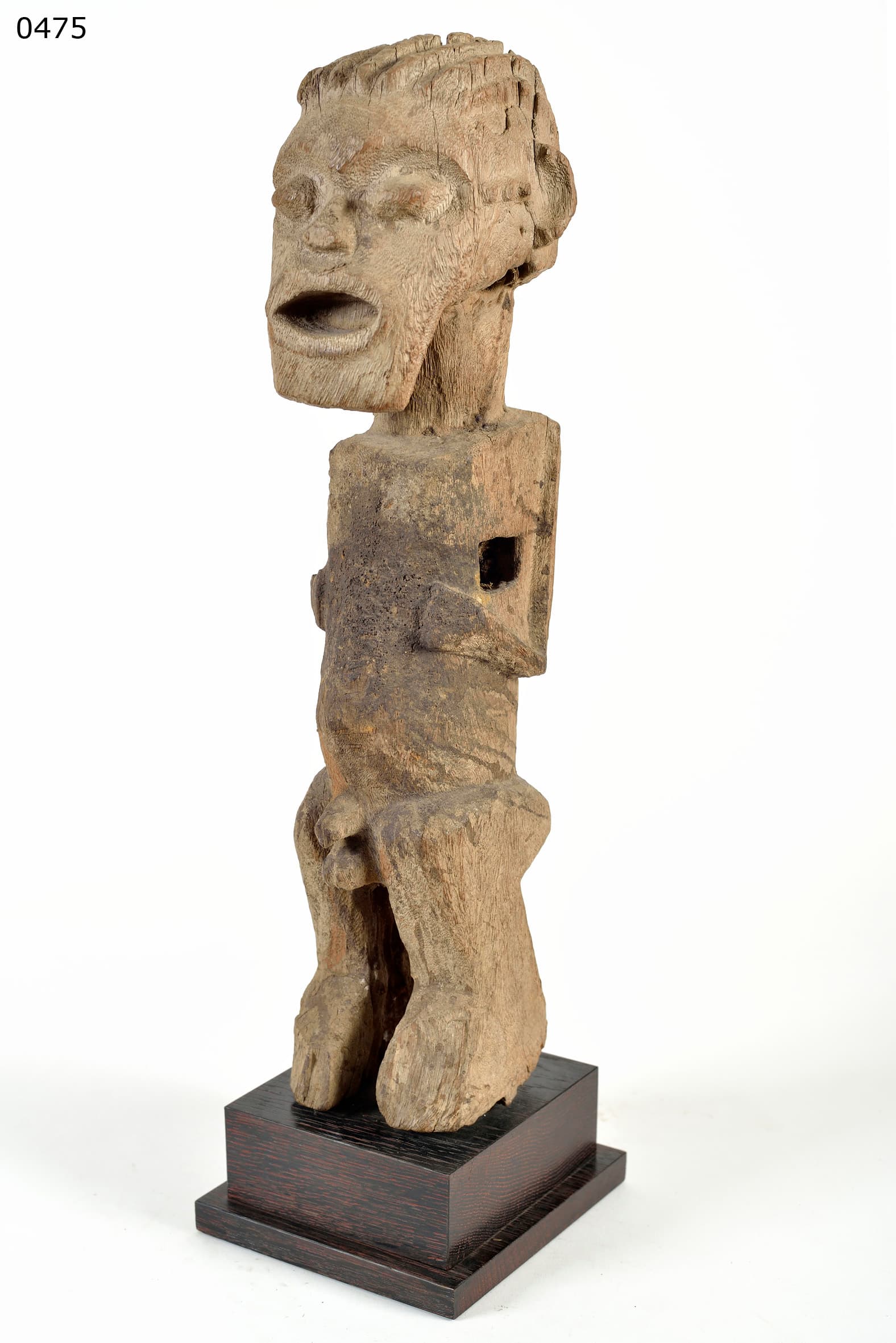
Overview
Geographical distribution and ecology of the settlement area
The Keaka (often referred to as Eastern Ejagham or Keyaka in older literature) form a linguistically and culturally distinct subgroup of the Ejagham people. Their ancestral settlement area extends across the densely forested, tropical border region between south-eastern Nigeria (especially in present-day Cross River State) and south-western Cameroon (primarily in the Manyu Division). The historical heartland of the Keaka is centred on the areas around the village of Ossing, located near the left bank of the Cross River (Harter 1994). This geographical location in a dense rainforest area criss-crossed by waterways characterised not only the subsistence strategies of the group, but also their material culture, which is heavily dependent on the available floristic and faunistic resources (such as tropical wood, antelope skins and specific plant pigments).
The boundaries with neighbouring ethnic groups were historically fluid. The Keaka maintained complex, often symbiotic relationships with their neighbours, which included the Banyang to the east and the Bangwa and Boki to the west. These contact zones were characterised by inter-ethnic marriage alliances, extensive trade networks and the essential exchange of ritual institutions (Nicklin & Salmons 1984). The museum documentation of this regional interdependence and the resulting transcultural formal language is exemplified today in the extensive holdings and online databases of the Dallas Museum of Art, which traces the systematic transfer of stylistic elements in the region (Claessens 2014).
Demographic data and linguistic categorisation
A precise demographic survey of the Keaka is methodologically complex due to the historical and current geopolitical fragmentation of the Cross River Basin. The sources for exact population figures are ambiguous, as modern census data often use broader ethnic categories. Current estimates aggregate the total Ejagham population to around 240,000 individuals, divided almost in half by the post-colonial demarcation (Joshua Project 2024).
| Ethnic classification | Population (Cameroon) | Population (Nigeria) | Total population |
|---|
| Ejagham (total) | approx. 106,000 | approx. 134,000 | approx. 240,000 |
| Keaka (subgroup around Ossing) | approx. 8,000* | - | approx. 8,000* |
*Historical estimate based on censuses in 28 villages in the Ossing region (Harter 1994).
Linguistically, the idiom spoken by the Keaka (often classified as Eastern Ejagham) is assigned to the Ejagham language family, which in turn is located within the Ekoid-Bantoid group of Niger-Congo languages (Glottolog 2024). This linguistic relationship is the primary vector for the smooth interethnic transfer of oral traditions and ritual songs.
Nomenclature, exonyms and the Keaka-Kaka controversy
The nomenclature of the region is historically extremely loaded. The exonymic label "Ekoi", which was popularised in early colonial literature by British officials such as P.A. Talbot or German administrators such as Alfred Mansfeld as a collective term for the peoples of the Cross River Basin, is classified in contemporary research as a colonial misnomer and increasingly deconstructed (Nwednyin 2024; Talbot 1912). The indigenous self-designation of the ethnic group is "Ejagham" or, in an overarching, pan-ethnic context, "Ekpokpa", which can be translated as "a united people". This term emphasises the cross-border cultural homogeneity and resilience against the artificial colonial demarcations between German Cameroon and British Nigeria (Joshua Project 2024; Bonchuk 2023).
One of the most serious taxonomic controversies that still affects the Western art market and museum catalogues today is the systematic confusion of the Keaka (Cross River region) with the Kaka (also known as Yamba, Cameroonian grasslands). In the 1980s and 1990s, the German ethnologist and trader Karl-Ferdinand Schaedler published crudely carved, heavily patinated anthropomorphic figures from the grasslands erroneously as "Keaka" works. As Schaedler later admitted to the US curator Frederick Lamp, he deliberately maintained this serious misattribution. His calculation was based on the fact that the term "Kaka" evoked scatological associations in the French and English-speaking art market, which significantly reduced the commercial value of the objects (Claessens 2014).
This mislabelling was uncritically adopted by renowned authors such as Barry Hecht (2002) and Jill Salmons (1986), as a result of which the error became deeply embedded in the auction catalogues. It was not until 1994 that the researcher Pierre Harter made a definitive and scientifically substantiated separation of the two completely different ethnic groups and their distinct formal languages in the journal Tribal Arts (Harter 1994).
Social structure and economic basis
The pre-colonial social structure of the Keaka is characterised by a strictly acephalous and decentralised organisation. In marked contrast to the highly centralised, hierarchical kingdoms of the Cameroon grasslands (such as the Bamum or Bamileke), political, executive and ritual authority was not vested in a single monarch, but in local councils of elders and highly institutionalised secret societies (Röschenthaler 2004). The kinship system was predominantly patrilineal, but had significant matrilateral obligations that stabilised social networks across village boundaries.
The economic subsistence basis was formed by intensive shifting cultivation within the cleared islands of the rainforest, with a strong agricultural focus on yams and manioc. This practice was supplemented by hunting societies, whose members were often organised into specific warrior and hunter societies. A key economic factor that went far beyond mere subsistence was the strategically important trade in locally produced salt. The region's rich salt mines acted as a historical 'pull factor', evoking initial migratory movements from the area around Lake Ejagham and integrating the Keaka deeply into the pre-colonial, supra-regional trade networks of Central Africa (Joshua Project 2024; Röschenthaler 2006).
Cultural context
Ontological order and the concept of the self
The profound religious system of the Keaka and the surrounding Ejagham groups is based on a tripartite cosmological and ontological order that differs radically from Western linear models of life. As contemporary African sociologists explain, the human construct of the self in the cross-river context passes through three distinct, interdependently interwoven phases of existence (Nsamenang 1992, cited in Pemunta et al. 2014).
The first phase comprises the spiritual self, which exists well before biological conception in the state of potential reincarnation of ancestral spirits. The second phase manifests as the social and experiential self, which is established through ritual incorporation into the village community and spans the entire physical lifespan. The final phase is the ancestral self, which immediately follows biological death, provided the correct funerary rites (including the corresponding mask performances) have been performed. Within this ontology, the dividing line between the profane world of the living and the sacred sphere of the ancestral spirits is extremely permeable. In this cosmology, the Creator God (Obassi) assumes the role of an unapproachable, distant entity; direct intervention in human affairs is rarely attributed to him. Rather, active interaction is the responsibility of the ancestor spirits and countless naturalistic forest and water spirits (mmu), who act as direct intermediaries and require constant ritual appeasement.
Ritual authorities: Closed societies vs. cult agencies
A structural uniqueness that fundamentally distinguishes the ritual world of the Keaka from the Central African ancestral cults of the Congo Basin is the strict conceptual and legal separation between status-based, closed associations (akum) and dynamic, transactional cult agencies.
The akum societies, first and foremost the legendary Leopard League Ngbe (or Ekpe), represent the undisputed legal, political and executive authority of the community. The Ngbe covenant acts as the custodian of absolute esoteric knowledge and draconically regulates the social transition of boys into initiated men. The historical authority of these secret societies was massively cemented by their exclusive possession and mastery of the Nsibidi writing system - an ideographic communication system that encoded complex ritual instructions and judicial judgements and whose influence was even exported to the syncretic Abakuá cults of Cuba (Leib & Romano 1984; Matibag 1996; Etchi 2024).
In direct contrast to the highly exclusive akum is the Obasinjom cult, a highly dynamic and institutionally agile witch-hunting and healing agency. Ute Röschenthaler's research documents in great detail how Obasinjom was not historically bound to a singular locality. Rather, the entire institution was transacted as high-priced "intellectual property" across ethnic and linguistic boundaries between the Keaka, Banyang and Boki (Röschenthaler 2004). In the course of a complex transfer, a buyer village acquired not only the physical mask (the agent), but also the associated specific songs, the complicated choreography of the dances and the top-secret pharmacological recipe.
A significant research controversy exists within the ethnographic discipline with regard to this practice. While older, purely structural-functionalist approaches (such as those still echoed in D.A. Offiong) simplistically interpret the rapid spread of Obasinjom as a purely religious, crisis-induced diffusion movement for the psychological management of witchcraft fears, Röschenthaler (2006) argues against this in a well-founded and empirically proven manner. She postulates that these were primarily pre-capitalist, decentralised networks whose primary goal was the conscious creation of socio-economic prestige, political influence and material wealth for the local authorities involved (the selling priests and diviners) (Röschenthaler 2004, 2006).
Initiation rites, life cycle and the position of women
The position of women in the ritual cosmology of the Keaka is of central importance, even though it has been marginalised or completely ignored in the often androcentric colonial ethnography (Röschenthaler 1998). The spiritual and social power of women manifests itself most impressively in the institution of the Moninkim (also Muoninkim). This is the absolutely central rite of passage for young, betrothed women. During an extended ritual segregation phase, conceptually reminiscent of West African fatting house traditions, the women are physically and spiritually prepared for their essential role as matriarchs and economic pillars of the village. A striking visual testimony to this change of status is the wearing of agurr, extremely heavy, ritually forged ankle rings, which are presented during the final initiation and exit ceremony (Joshua Project 2024; Ozah in Etchi 2024). In parallel, powerful, all-female secret societies existed, whose complex ritual cycles often orchestrated the agri-cultural calendar and fertility cults.
Another defining element of the Keaka spiritual life cycle is Oji Erúìri'om, a singular, non-cyclical ritual of the formal presentation of a newborn. This ritual serves to introduce the infant to the cosmological order of the ancestors and the village community. Conceptually, it is diametrically opposed to the Western construct of the annually recurring birthday, which is traditionally rejected by indigenous cosmology. Instead, Oji Erúìri'om marks the unique, definitive ontological transition from the "spiritual self" to the "social self" (Egbe 2024).
The Fowler Museum at UCLA preserves in its extensive Wellcome Collection artefacts and ritual objects specific to the region that materially attest to the complex and inseparable intersection of healing, witch-hunting and initiation rites in the Cross River region and make them accessible to contemporary viewers (Claessens 2014).
Aesthetic features
The absolute aesthetic canon of the art of the Keaka and the entire Ejagham group is undoubtedly dominated by the wood-carved masks and helmet attachments covered with animal skin. This form of surface finishing is absolutely unique in the whole of sub-Saharan Africa in this specific technical form and forms the unmistakable unique selling point of Cross River art. The museum typology comprises three strictly canonical subtypes:
- Cap Masks: Highly naturalistic or stylised sculpted heads mounted on an elaborately woven basketwork. They do not enclose the dancer's face, but sit prominently on the top of the dancer's skull.
- Helmet masks (Helmet Masks): These often voluminous works enclose the wearer's entire head. They are often Janus-faced and point in multiple directions.
- Animal head attachments: Mostly highly stylised representations of leopards, antelopes or crocodiles, primarily used by specific hunting or warrior bands.
The iconography of the Janus-headed helmet masks is strongly dualistic and symbolically polarised: One half of the face - often coloured dark-skinned by the application of plant pigments such as kedako (an extract from leguminous leaves) or soot - represents the aggressive, physically dominant male power. The light-coloured opposite side, on the other hand, symbolises female sensitivity, spiritual intuition and clairvoyance (Nicklin 1974; Nicklin & Salmons 1984). The size spectrum of these works is considerable and ranges from almost life-size, isolated heads (approx. 25-40 cm high) to monumental, architectural-looking compositions of three on a singular wickerwork (Harter 1994).
The woodcarving art is flanked by another phenomenon of the region: the Akwanshi monoliths of the neighbouring Bakor. These phallic-like stone figures, carved from basalt or volcanic tuff, share numerous iconographic features with the skin masks of the Keaka, in particular the engraved concentric ornamental scars (scarification marks) on the temples and the inclusion of nsibidi symbols. These similarities demonstrate a massive intermedial transfer of style within the Cross River Basin (Allison 1968; Factum Arte 2024).
The "human skin" controversy: Historiography of a colonial myth
One of the most enduring, morbid and heatedly debated iconography controversies in all of African art history concerns the specific material of the skin coverings. In 1912, the British colonial official P.A. Talbot claimed in his widely received monograph In the Shadow of the Bush that the Keaka and neighbouring Ejagham groups had substituted historical, freshly decapitated enemy skulls with wooden masks ritually covered with the tanned skin of skinned prisoners of war (Talbot 1912: 260-261). This macabre narrative perfectly served the European trope of the "cannibal savage" and was subsequently perpetuated uncritically by generations of ethnologists (such as William Bascom).
This romanticising, gruesome assertion persisted for decades in the Western art market, as it lent the objects an aura-like, sinister provenance. The anthropologist Kenneth Campbell finally refuted this toxic myth in his dissertation in 1981. A meticulous forensic examination of 27 historical masks kept in museums proved that not a single sample had human DNA or cell structures; without exception, they were the tanned skin of forest antelopes or, in rare cases, monkeys (Campbell 1981; Nicklin 1974: 8). Recent state-of-the-art forensic analyses at the National Museum of African Art (NMAfA) in Washington D.C., using methods such as DNA sequencing, X-radiography, X-ray diffraction and portable X-ray fluorescence analysis (pXRF), definitively confirmed Campbell's findings. Today, museums strictly oppose the continuation of the human skin narrative in their exhibition texts (National Museum of African Art 2024).
Materiality, handcrafted construction and master hands
The construction process of such a mask testifies to outstanding craftsmanship. The wooden core is usually carved from very light, porous woods (such as Ricinodendron heudelotii) to provide the dancer with physical relief. The decisive, highly specialised aesthetic act is the application of the still moist, untanned antelope skin over the wood. The skin is temporarily fixed with tiny wooden pins, stretched extremely tightly and massaged deep into the recesses of the filigree carving (nostrils, auricles, scar tattoos). In the subsequent drying process, the skin shrinks massively and wraps itself inseparably around the sculpture like a second, organic layer (Nicklin 1974).
The applications are astonishingly detailed: the eyes were traditionally cut out precisely from galvanised sheet iron (often stolen from colonial corrugated iron roofs) and fixed deep into the wooden base with round wooden pegs that served as pupils. The teeth were crafted in hours of precision work from pieces of bone, ivory splinters, metal or the red chalk bark of palm leaf ribs and inserted individually into the hollowed-out mouth cavity. The artists often carved a distinctive gap in the upper incisors, which can be read as a direct reference to the historically widespread practice of cosmetic tooth filing (or tooth chipping) among the Keaka (Nicklin 1983).
In the late 1960s and 1970s, the British anthropologist Keith Nicklin and the art historian Jill Salmons documented specifically known master craftsmen's hands and local carving workshops as part of their specially developed "Ethnographic Retrieval Method". Their declared aim was to revitalise the craft of skin mask construction, which was threatened with extinction by social change, and to safeguard it institutionally for future generations (Nicklin & Salmons 1984). The British Museum in London houses important examples of this type of mould, which preserve the timeless quality of this specific material aesthetic (Scribd 2024).
Ritual practice
The transition from the profane to the sacred
The morphological life cycle of an object among the Keaka requires a strict separation of artwork and cult object. A purely formally finished, unused wooden object - even if it was carved by a recognised master - has absolutely no intrinsic spiritual value in the indigenous context. It is profane matter. The transition to an activated ritual entity charged with agency (power to act) is a highly complex, performative and often secret act. The mask is only activated through the targeted application of sacrificial blood, ritually purified palm wine and the recitation of specific, esoteric incantations in the hidden sanctuaries of the respective covenants (such as the Ngbe house). It transforms from a piece of wood into a temporary vessel for the spirits.
The ritual practice and the enormous emotional impact of these productions become particularly tangible in the example of the Obasinjom cult. The mask does not rest statically on an altar, but demands kinetic unfolding. The structure of a performance requires the perfectly synchronised interaction of various ritual actors. At the centre is the mask dancer, who usually wears a stylised, massive crocodile headpiece combined with a voluminous, fibrous costume that completely dissolves his human contours. During the dance, he falls into a deep trance induced by the mask.
The mask moves through the village in rapid, erratic, almost dangerous dynamics, incarnating the unpredictable, inseparable spirit of the wilderness that has been invoked to track down hidden witches. As the dancer emits glossolalic sounds in a state of trance, the presence of a divinator (translator) is mandatory. The divinator walks alongside the mask and translates the spirit's cryptic judgements into the understandable language of the village community. This spectacle is framed by a choir and polyrhythmic drummers who break down the acoustic barrier between the spiritual and human worlds (Röschenthaler 2004; Pemunta et al. 2014).
Cycle of preservation: offerings and patina accretion
Before each such performance, but also on specific agri-cultural feast days, the dormant altar in the secret society house must be ritually "fed". This is done through deeply rooted rituals: priests perform libations of palm wine, chew and spit the essential kola nuts over the object and sacrifice domestic chickens or small livestock. The blood of the sacrificial animals renews the entropically dwindling ritual charge of the mask (Nicklin & Salmons 1984). The applied blood oxidises over the decades and, together with the omnipresent hut soot, dust and rancid palm oil, forms the deep, dark, encrusted patina (accretion) that provides irrefutable proof of historical ritual use and is valued by Western collectors of African art as the highest aesthetic quality feature.
Deactivation and dealing with decay
A decisive aspect of the life cycle of these objects, which is often irritating for the Western understanding of "art conservation", is their disposal. The sources for this are unmistakable: in diametric contrast to the Western idea of musealisation, which aims to prepare the physical shell for eternity, the Keaka historically had no interest in preserving a dead object. If deactivated masks were irrevocably damaged by the extremely humid tropical climate, the merciless feeding of termites or rotting, or if their ritual power was considered exhausted, they were often carelessly left behind in the dense bush to rot ritually, or they were simply burnt. The physical carrier had become obsolete, as the moulding spirit had finally abandoned it (Nicklin 1983; Matibag 1996).
This indigenous practice of ritual abandonment, coupled with the emerging pressure of monotheistic religions, led to a massive loss of material heritage in the region in the 1970s. This prompted researchers such as Nicklin to initiate a form of preventative museum 'revitalisation' through direct commissions to local carvers (Nicklin & Salmons 1984). This dynamic of use and decay is also reflected in the treatment of the monolithic akwanshi, which were ritually painted and "fed" during ancestral festivals, but were often simply overturned and left to decay in the yam fields in times of post-colonial religious upheaval (especially due to the rise of radical Pentecostal movements that demonised the objects as "juju") (Allison 1968; Factum Arte 2024). Today, the Musée du quai Branly - Jacques Chirac in Paris preserves outstanding examples in its stacks (such as the acquisitions from the Pierre Dartevelle collection, inv. no. 70.2017.66.25), which precisely trace this transformative life cycle from active cultic use to total decontextualisation in the sterile museum space (Musée du quai Branly 2024; Factum Arte 2024).
Historical context
Migration history and the date of first settlement
The pre-colonial historiography of the Keaka largely defies rigid, chronological dating, as it is primarily based on oral traditions and mythical narratives. The oral tradition of the Ejagham groups dates their common origin to the water-rich region around Lake Ejagham in today's Manyu Division in Cameroon. The sources for the exact dating of the initial migratory movements towards the more westerly Cross River basin are extremely ambiguous in historical ethnography and form the centre of various academic controversies. However, there is a consensus that these migrations did not occur in isolation, but were largely driven by internal political factional struggles, demographic pressure from neighbouring grassland kingdoms and, above all, the development of economically extremely lucrative salt mines. One prominent narrative focuses on the leadership of the legendary warrior king Attah Akam Nku, under whose aegis the population groups divided up and formed new settlement clusters (Joshua Project 2024).
The colonial encounter and the work of Alfred Mansfeld
The most radical historical break in the history of the Keaka occurred with the brutal establishment of imperial administrative boundaries during the so-called "Scramble for Africa" (ca. 1884-1914). The arbitrary demarcation between the German colony of Cameroon and the British protectorate of Southern Nigeria cut the formerly homogeneous and fluid cultural territory of the Ejagham into two artificial political spheres, the after-effects of which continue to affect the regional structure into today's post-coloniality (Bonchuk 2023).
An absolutely central actor in this early colonial encounter on the Cameroonian side was the German colonial official and ethnologist Alfred Mansfeld. Mansfeld was the chief administrator of the Odissinge station (in the heartland of the Keaka around Ossing) in 1908 and 1909. He was not only characterised by administrative rigour, but was also an obsessive and systematic collector of ethnological material. Mansfeld organised the confiscation and purchase of thousands of objects, the extensive collections of which today form an invaluable but historically heavily burdened basis of the African holdings of the Museum am Rothenbaum - Kulturen und Künste der Welt (MARKK) in Hamburg. Recent archival studies of his extensive correspondence between the marketplaces of Hamburg, Berlin and Leipzig impressively demonstrate how Mansfeld orchestrated the immediate beginning of the transformation of ritual-sacred objects into purely capitalist, museum commodities, whose value was suddenly quantified in Reichsmarks (Focus JAMS 2024).
Establishment on the Western art market
The definitive breakthrough of cross-river art on the Western art market took place primarily in the euphoric interwar period of the 1920s and 1930s, driven by the Parisian avant-garde and its fascination with so-called "primitivism". In the post-war period, this interest was consolidated at auction level by influential dealers in Paris and Brussels (such as the well-known expert Pierre Dartevelle) (Factum Arte 2024).
An essential milestone in the institutional acceptance of this art was the ambitious build-up of the collection of the Swiss banker and patron Eduard von der Heydt. From the 1920s onwards, von der Heydt acquired a massive number of outstanding pieces of African art via established Parisian dealers - including Keaka skin masks and parts of the excellent collection of the Swiss Han Coray. Today, these high-calibre acquisitions form the qualitative nucleus of the Africa department of the Museum Rietberg in Zurich. The reception object biographies of these pieces - such as the out-of-context staged presentation of the related Batcham mask from the grasslands - illustrate the typically Western process of elevating an ethnographic ritual object to the status of a universal, aesthetic "masterpiece" (Blem 2021; Museum Rietberg 2024). The market prices for authentic, historically verifiable, skin-covered Keaka and Boki masks have risen exponentially in recent decades due to their extreme rarity, the rapid climatic deterioration in Africa and the strict export ban, which has manifested itself in spectacular record surcharges at auction houses such as Christie's (Christie's 2018).
The problem of forgery and modern forensics
The immediate consequence of this immense commercial success was a drastic increase in the forgery rate. Modern African carving centres, particularly in Douala or the Bamum centre in Foumban, now produce masses of replicas for the Western market. The authenticity criteria for private collectors are therefore highly specific and require almost scientific expertise.
Genuine historical Keaka pieces are bound to have deep cracks in the heartwood, which indicate extremely slow, natural drying of the wood in the tropical climate, as well as specific, irregular feeding marks from termites and boring beetles. The patina of authentic pieces is never monolithic or smoothly applied, but necessarily multi-material and layered (consisting of old sacrificial blood, rancid palm oil, kedako pigments and smoke soot from the huts). Counterfeiters often try to simulate this through chemical ageing processes, acid baths or artificial smoking.
As the pioneering forensic studies of the National Museum of African Art in Washington D.C. clearly demonstrate, purely visual inspection is obsolete today. The analysis of hidden fastening techniques (the detection of hand-carved instead of machine-made nails), the micro-chemical age determination of iron eyes using X-ray fluorescence and the DNA analysis of the animal skins used now form the irrefutable gold standard of provenance research and material testing (National Museum of African Art 2024; Factum Arte 2024). Only objects that pass this forensic triad of material consistency, stylistic coherence and unbroken provenance chain (ideally traceable to field recordings by researchers such as Mansfeld or Nicklin) are recognised on today's tribal art market as interpretable originals and museum-worthy relics of Keaka cosmology.