Overview
The ethnographic and historical survey of the region of the Jos Plateau and the central Benue Valley in present-day Nigeria continues to pose complex challenges for researchers, which are directly reflected in the classification and analysis of the ethnic groups living there. The group known in the Western art world and historical literature mainly under the exonym "Mama" settles predominantly in the Wamba Local Government Area of Nasarawa State as well as in the topographically inaccessible, neighbouring mountainous regions of Plateau State. The self-designation (autonym) of this group is Kantana, more rarely the term Kwarra is also used. The genesis of the exonym "Mama" is disputed in research; it is assumed that it is a foreign term that was coined and administratively consolidated during the early Hausa hegemony or in the course of the British colonial administration.
The source situation regarding reliable demographic data is ambiguous and often characterised by historical projections and politically motivated censuses. While earlier ethnographic surveys estimated the population at a marginal 10,000 to 20,000 individuals, more recent demographic projections assume a significantly increased population of around 73,000 members. However, linguistic surveys paint a far more precarious picture: according to current estimates, the Kantana language is actively spoken by only 2,000 to 3,000 people, predominantly in the generation of over 25-year-olds, which indicates a rapid language shift in favour of Hausa as the regional lingua franca.
A significant controversy in the classification concerns the linguistic categorisation of the Kantana. While older and partly popular scientific sources repeatedly classified the language as belonging to the Chadian Plateau languages, dedicated linguistic structural analyses prove that it belongs to the Jarawan subgroup within the Narrow Bantu languages (Zone A) of the Niger-Congo language family. This classification, advocated by Roger Blench and others in his current overview of bantoid languages (2024), corrects older categorisations that saw Jarawan as a mere bantoid sister group outside of Narrow Bantu. The Kantana language shares a high lexical similarity (over 70 per cent in core vocabulary) with other Jarawan varieties such as Mbula-Bwazza and has specific grammatical features such as multi-prefix nominal class systems that isolate it from the Chadic languages of its immediate geographical neighbours. This linguistic isolation supports the thesis of complex and discontinuous migratory movements in the Benue region.
The social structure of the Kantana is traditionally strictly acephalous. In diametric contrast to the theocratically centralised kingdoms of the southern Jukun or the hierarchical empires of the Yoruba, the Kantana have historically had no superordinate, institutionalised central state authority. The political and social organisation is based on a complex kinship system that is primarily anchored in patrilineal clan structures (patri-clans). These networks operate as autonomous political units. Nevertheless, deep ethnographic studies show that matrilineal kinship relationships also play a vital, subsidiary role in the formation of factions, marriage alliances and the regulation of local political affiliations. Decision-making is the responsibility of a consensus-based council of family elders (gerontocracy) and the ritual specialists of the secret societies.
The subsistence economy of the Kantana is based on semi-intensive shifting cultivation, supplemented by hunting and gathering in the inaccessible mountain forests. At the centre of agricultural production is the cultivation of sorghum (guinea corn), which not only forms the calorific basis of the daily diet, but also represents the fundamental economic and ritual means of exchange. The diet is supplemented by yams, taro, sesame and various types of pumpkin.
The relationship between the Kantana and their neighbouring peoples - including the Goemai, Montol, Chamba, Kulere and Jukun - has historically been characterised by an oscillating interplay of cultural exchange, ritual adaptation and strict territorial demarcation. The geographical isolation of the northern river valleys and plateaus offered protection from external aggressors on the one hand, but led to a delayed Western academic reception on the other. The first systematic documentation efforts, the material results of which can be found today in institutions such as the British Museum in London, only began in the early 20th century.
| Demographic and Structural Metrics of the Kantana (Mama) | Specification / Database |
|---|
| Core Geographic Zone | Wamba LGA (Nasarawa State), foothills of the Jos Plateau |
| Population estimate (historical vs. current) | approx. 15,000-20,000 (mid-20th century) vs. ~73,000 (present) |
| Linguistic vitality | Acutely endangered; approx. 2,000-3,000 active speakers (Jarawan, Narrow Bantu Zone A) |
| Socio-political organisation | Acephalous, patrilineal dominated with subsidiary matrilineality |
| Primary subsistence base | Sorghum millet (Guinea corn), yams, taro |
| Central inter-ethnic contact groups | Goemai, Montol, Chamba, Jukun |
Cultural context
The Kantana religious system is deeply rooted in a cosmological order that places the survival of the community, the fertility of the agricultural land and the rigorous defence against disease and social deviance at its absolute centre. At the head of this pantheon is a solar creator deity associated with the sun. However, this entity acts primarily as deus otiosus (an enraptured, passive god), who initiated the universe but has withdrawn from the mundane everyday affairs of mankind. Instead, the Kantana's direct, active spiritual interaction takes place with a dense, omnipresent network of ancestral spirits and local nature or bush creatures.
These subaltern spiritual entities act as mediators between the human sphere and the abstract power of creation. At the centre of this interaction space is a pronounced belief in ancestors. The physical and spiritual presence of the ancestors is manifested through the ritual storage of animal remains, especially buffalo skulls, in mud walls or at specifically designated village shrines. The buffalo (Syncerus caffer nanus) plays a dual role here: on the one hand, it symbolises the indomitable, wild natural power of the bush and on the other, in its ritual taming, it is the ultimate guarantor of material prosperity and good harvests.
As Kantana society is acephalous in structure and has no institutionalised executive or judiciary in the Western sense, the male secret societies assume these essential regulatory functions. The most dominant of these societies is the Mangam cult (in some regional forms and neighbouring dialects also documented as Udawaru society). The ritual authorities - priests, village elders and divinators - direct this cult. From the indigenous perspective, the masked dancers of the Mangam society are not mere theatrical representations. As soon as the mask is put on and ritually activated, the wearer loses his human identity and becomes the physical incarnation of the ancestral or bush spirits. In this function, they regulate the cosmic balance, administer justice in internal disputes, sanction deviant behaviour and monitor compliance with village taboos.
The role of women within this strictly patricentric cult system is structurally complex and has often been reduced to that of a marginalised observer in early Western research, which does not stand up to a differentiated ethnographic analysis. It is correct that women are strictly excluded from active participation in the performative aspects of the mangam covenant and physical contact with the masks. They are subject to strict visual and spatial restrictions as soon as secret rituals are performed. At the same time, however, the women fulfil an indispensable key economic and ritual function that gives them considerable indirect power: they are exclusively responsible for cultivating certain crops and, above all, for brewing millet beer (Guinea corn beer). This beer is not just a profane foodstuff, but the essential, obligatory sacrificial substance required for the ritual activation of the altars and masks. Without the ritual labour and economic production of women, the male-dominated cult literally cannot exist.
Central initiation and transition rituals mark the gradual integration of the male youth into the Mangam covenant. These rites require a physical and psychological separation from the maternal sphere, often accompanied by several weeks of seclusion in bush camps, where the secrets of the masks and the esoteric knowledge of the nature spirits are revealed to the initiates.
Structurally, this religious system differs fundamentally from the cosmologies of neighbouring peoples. A striking contrast can be seen in comparison with the neighbouring Jukun to the south. While the Jukun practise a highly centralised religion around a sacralised king (the Aku Uka), whose physical integrity correlates directly with the fertility of the entire state and who rules through an institutionalised priesthood, the spiritual power of the Kantana is extremely decentralised and anchored in the autonomous clan structures and the collectives of the initiates.
A significant research controversy (author-vs-author) regarding the socio-political function of these confederations in the Benue Valley manifests itself here. Arnold Rubin (1970) postulated in his analyses that the masked secret societies were primarily instruments of elite power consolidation, with which older men (patriarchs) controlled younger men and women through terror and secrecy. Sidney Kasfir (1984) and later anthropologists, on the other hand, vehemently argue that these cults in acephalous societies rather function as egalitarian, equalising mechanisms (levelling mechanisms). According to Kasfir, it is precisely the distribution of ritual power among different age groups and the principle of anonymity under the mask that prevent the emergence of autocratic lone rulers. The cult thus served to prevent hierarchy, not to establish it. Archived field research notes and photographs in the Fowler Museum at UCLA demonstrate the depth of this debate and document the multifaceted embedding of the cult in everyday village life.
| Cosmological and Institutional Roles among the Kantana | Function and Attribution |
|---|
| Creator deity | Solar deus otiosus, creator without intervention in profane everyday life |
| Ancestral and nature spirits | Active mediators, manifested through buffalo/antelope masks |
| Mangam / Udawaru cult | Male secret society, executive power, jurisdiction, taboo surveillance |
| Role of women | Visually excluded, but essential as producers of the ritual millet beer (sacrificial substance) |
| Initiation rites | Transition of male youth, revelation of esoteric knowledge, social categorisation |
Aesthetic features
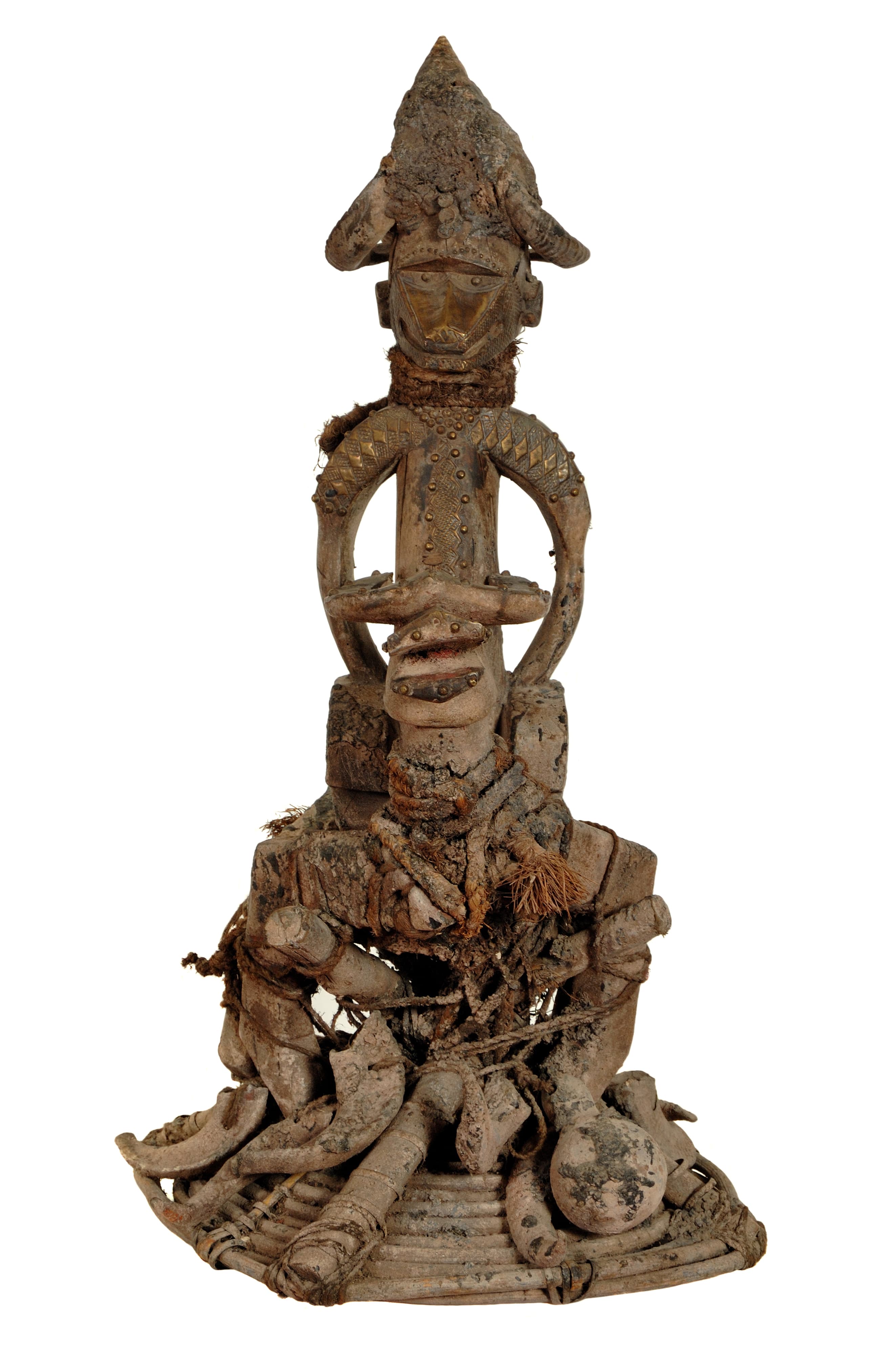
The sculptural art of the Kantana occupies a solitary position within African art history and is primarily known for its radical morphological reduction, formal rigour and unmistakable abstraction. The canonical object typology of the Mama is almost entirely dominated by zoomorphic representations. Anthropomorphic (human-shaped) figures, which characterise the artistic work of neighbouring ethnic groups such as the Mumuye or Montol, are extremely rare among the Kantana, barely documented by museum institutions and can be classified as absolutely exceptional phenomena in aesthetic practice.
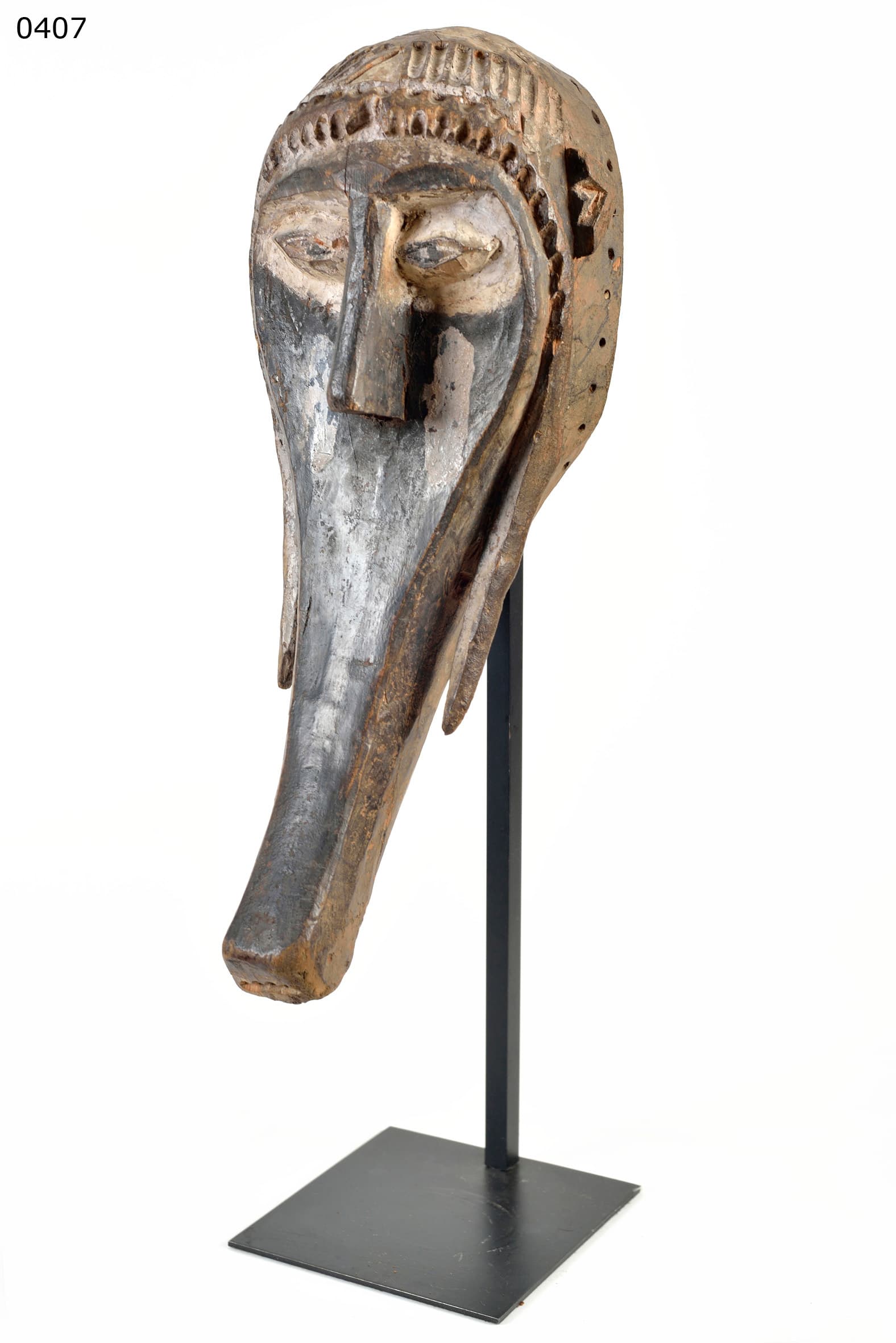
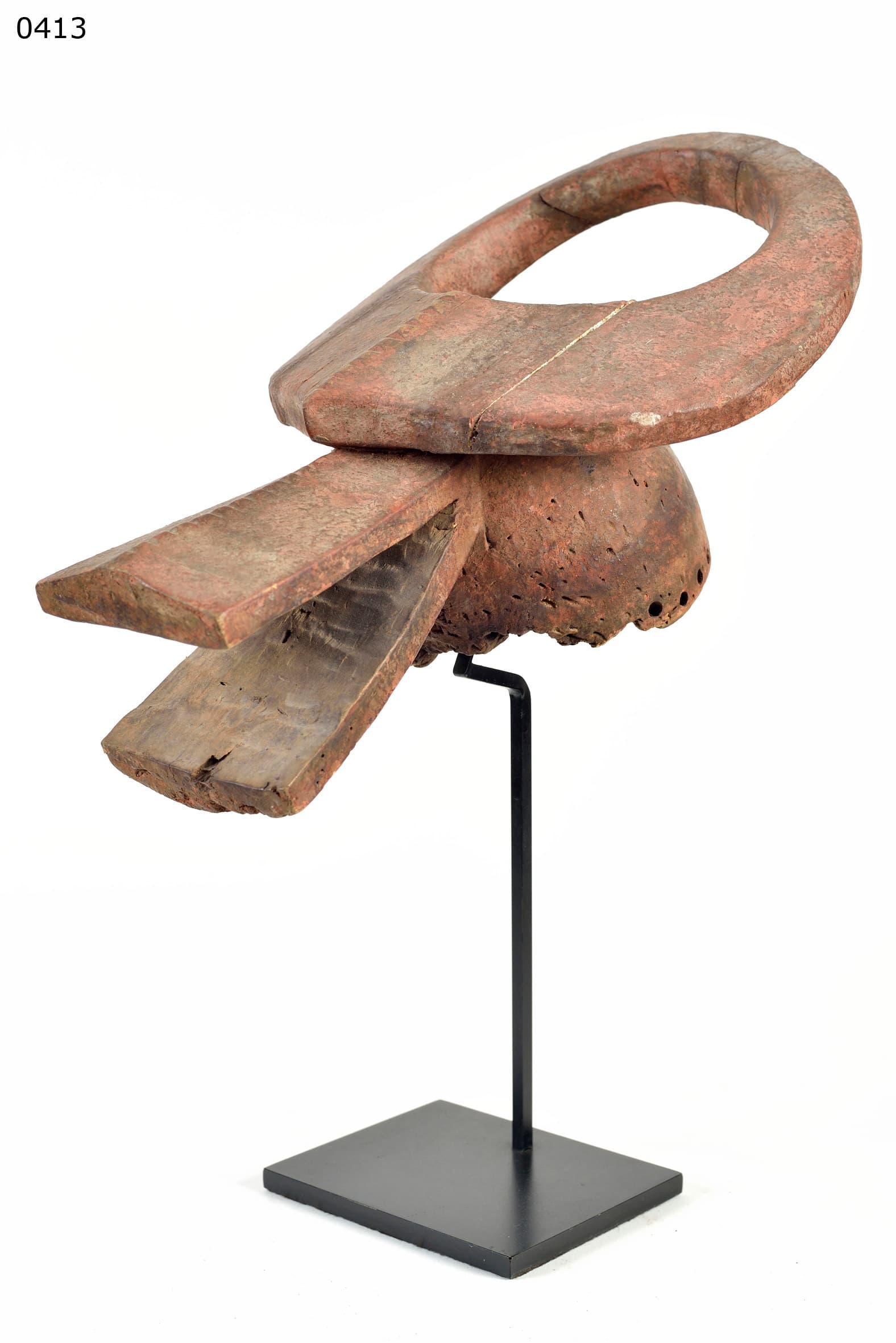
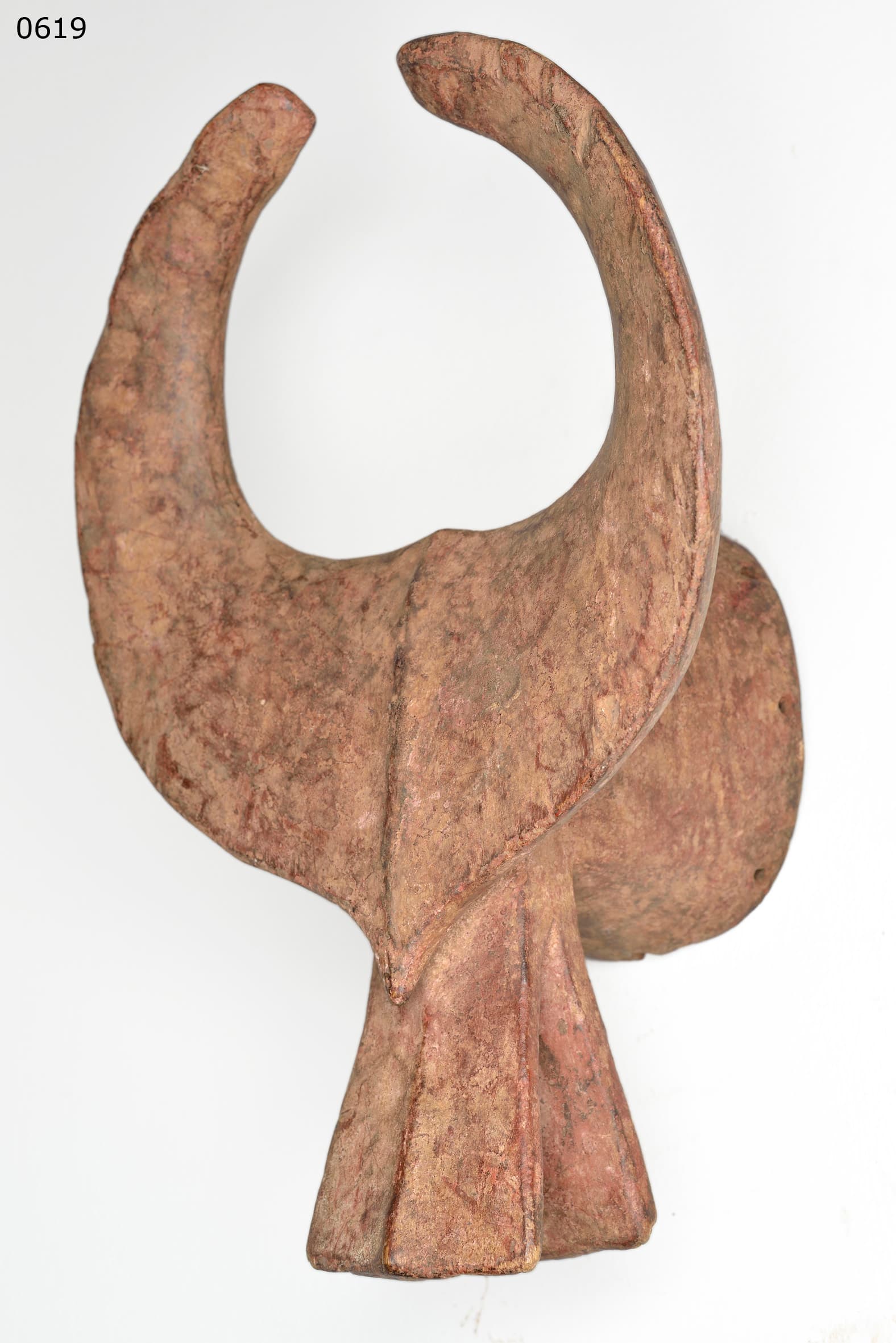
The central and identity-establishing sculptural form is the horizontal helmet or top mask (kambon or zumu), which is performed exclusively as part of the mangam cult. The iconography of these masks focuses strictly on two primary animal subtypes: the forest buffalo (Bushcow / Syncerus caffer nanus) and various antelope species (especially waterbuck and reedbuck). The aesthetic translation of these animal motifs, however, eludes any naturalistic promise of depiction.
The canon of proportions of the mummy masks is highly standardised. The base of the mask is usually a solid, hemispherical to concave wooden dome, which is anatomically hollowed out to fit the upper part of the wearer's head perfectly. The highly stylised, significant features of the animal protrude from this round base: a wide open, often block-like mouth, which is frequently abstracted as a flat, fork-like snout, as well as dominant horns that either extend horizontally or curve backwards in a striking arc. A small knot at the back of the mask's head is often interpreted in research as a stylised topknot, which refers to an intended, hybrid animal-human identity of the mask. The eyes are usually kept minimalist, merely indicated by flat, circular recesses or small cylindrical elevations. The physical size spectrum of these objects varies considerably; it ranges from relatively compact skull tops of around 30 centimetres to monumental, expansive designs that reach lengths of over 80 centimetres and place extreme physical demands on the dancing initiator due to their enormous weight.
When choosing materials, the Kantana sculptors favoured locally available, dense and weather-resistant hardwoods. However, the most significant aesthetic aspect of the activated mask for collectors and ethnographers is undoubtedly its patina. The formation of the patina marks the ontological boundary between a purely profane object and a sacred instrument. For the Kantana, a freshly cut, unpatinated piece of wood possesses no inherent spiritual power or agency (Agency). Only through the ritual application of specific organic substances does the object become a carrier of spiritual presence. The canonical patina of the older kambon masks is characterised by opaque, thick and often chapped incrustations. These consist of red ochre powder (often obtained from the wood of the African padouk, Baphia nitida), which is bound with palm oil, ritually brewed beer and vegetable resins. This intense red colour is deeply rooted in iconography and symbolises blood, life force (vitality) and the dangerous, liminal energies of the bush and the ancestral world. The aesthetics are often complemented by applied materials such as red abrus beans (Abrus precatorius), cowries or bundles of plant fibres pressed into the resinous mass. Outstanding examples in the Musée du quai Branly (Paris) and the Museum Rietberg (Zurich) demonstrate these materially dense surfaces, which can be read as accumulated archives of decades of ritual use.
In the academic consideration of the aesthetic characteristics of the Plateau State, a bitter iconographic controversy regarding the workshop boundaries and the stylistic isolation of the ethnic groups continues to this day. In his groundbreaking work Sculpture of the Mumuye in 1969, Arnold Rubin postulated the thesis of strongly delineated, isolated ethnic styles, the so-called paradigm "One Tribe, One Style". He strictly differentiated the abstract, horizontal and horn-emphasised forms of the Mama from the elongated, vertical-cubist figures of the Mumuye or the rougher, archaic-looking wood of the Montol. Klaus Strübel, whose analyses focus strongly on formal-aesthetic unity, partially supports this perspective by citing the unmistakable, uncompromising morphological independence of the mummy masks - reduced to a snout and pairs of ears - as proof of the self-contained workshop traditions of the Kantana.
More recent research, largely driven by Marla Berns and published as part of the opus magnum Central Nigeria Unmasked (2011), diametrically contradicts these rigid dividing lines. Based on extensive object comparisons, Berns argues that carvers and workshops in the Benue region were highly mobile and often worked for different ethnic groups across different clients. Formal elements were fluidly exchanged. Thus, morphological influences of the Jukun can be detected in older Kantana works, while Kantana style elements appear in the Goemai. This transcultural, hybrid reality of art production makes it extremely difficult to determine the exact origin and attribution to known master craftsmen, which is why personalised artist attributions for the Kantana, in contrast to the Yoruba carvers for example, remain the absolute exception in museum practice.
The formal conciseness and relative technical simplicity of the kambon masks - compared to detailed moulding processes - makes forgery criteria highly relevant on the art market. Modern forgeries imitate the form effortlessly, but usually fail due to the complexity of the patina and the deep structural ageing processes of the wood.
Ritual practice
The ritual practice of the Kantana defies static observation and is primarily revealed through the dynamic, performative use of the kambon masks in the context of the mangam cult. The wooden mask exhibited in the museum represents merely a fragment - the wooden head - of a much larger, choreographed and multi-sensory entity. A detailed description of the mask performance reveals a highly complex staging metaphysically aimed at ritually channelling the uncontrollable wildness of nature and the spirit world and transforming it into the ordering social structure of the village.
The performance is subject to strict physical and ritual requirements. The helmet mask is worn horizontally flat on the head by the initiate, often fixed by chin straps or biting sticks inside the calotte. The illusion of a non-human entity is perfected by the fact that the wearer's face, torso and extremities are completely concealed under a massive, often tent-like costume. This costume consists of dense, multi-layered layers of rigid palm leaves, dried grass and woven raffia fibres, which are attached directly to the perimeter perforations of the wooden calotte. This voluminous garment completely obliterates the human silhouette, giving the dancer a superhuman stature and an animalistic, expansive presence.
The life cycle of such a ritual object is characterised by clearly defined ontological phases. The cycle begins with the felling of the wood and the actual carving process by a specialist. At this stage, the object is profane and has no inherent sacredness. The critical transition to the sacred instance takes place through the act of activation at the village altar or in the hidden bush shrine. Before the mask enters the cult area and becomes visible to the community, it must be spiritually charged. This is done through repetitive libations (drink offerings). The millet beer (Guinea corn beer) brewed by the women specifically for this purpose and palm wine are poured over the wooden surface. Red camwood powder or ochre is rubbed freshly onto the dominant horns and the forehead ridge. In Kantana cosmology, these sacrificial substances are regarded as metaphysical nourishment that awakens the latent power of the represented buffalo or antelope spirit and binds it to the wood.
The primary occasions for the appearance of the masks are cyclically embedded in the agrarian calendar, which dictates the survival of the ethnic group. The masks are required to appear at the beginning of the sowing season to ask the ancestors' blessing for the fertility of the soil, as well as during the extended harvest festivities in the sense of a ceremonial thanksgiving. They also appear as purifying forces in crisis situations such as droughts or epidemics. Another profound occasion is the funeral ceremonies of high-ranking members of Udawaru society; here the wild dance of the masks escorts and flanks the dangerous transition of the soul of the deceased from the world of the living to the eternal realm of the ancestors.
The documented regional variations of the performance indicate that the cult is highly adaptable. In eastern areas, which are geographically and socially closer to the Goemai settlements, the masks often interact in more complex ensembles and take on more specific narrative roles within village myths. The dancer's kinetics always aim to mimetically imitate the impetuous, erratic behaviour of the buffalo - characterised by abrupt advances of the horns towards the audience, aggressive stamping and rapid rotations that cause the heavy grass robe to vibrate. The musical backdrop, consisting of driving percussion instruments, rhythmic clapping and guttural chants from the initiates, dictates the trance-like intensity of the ritual.
The deactivation and eventual disposal of the mask emphasises the pragmatic, action-centred nature of African sacred art, which focuses on the spiritual purpose rather than the preservation of the material shell. When the wood of a kambon mask decays after decades of physical use, is structurally decomposed by termites, or when the divinators determine that the specific spiritual entity has left the object and it is considered "spent", the artefact abruptly loses its sacred status. It is profaned. Disposal is usually unspectacular, with the damaged masks deliberately left behind in hidden crevices, in designated sanctuaries deep in the bush or in abandoned, decaying huts. As early as the 1960s, Arnold Rubin intensively documented among neighbouring ethnic groups in the Benue Valley how such disused sculptures were simply left to decay naturally by the elements. The Royal Museum for Central Africa (Tervuren, RMCA) houses historical comparative material from the Central African region that impressively testifies to these deliberate stages of decay - characterised by massive erosion and signs of erosion. For the ritual community of the Kantana, this decay is unproblematic, as the metaphysical power is seamlessly transferred to a newly commissioned, as yet unpatinated mask through renewed libations.
| Phases of the ritual life cycle (lifecycle) of a Kantana mask | Ritual and material characteristics |
|---|
| 1st profane genesis | felling of the wood, carving by specialists; object is of no sacred value. |
| 2. sacred activation | libations (millet beer, oil), rubbing with red ochre on the altar. |
| 3. performative liminality | horizontal wearing, veiling with raffia costume, ancestor incarnation. |
| Agricultural & Funerary Cycles | Dances for sowing/harvesting and funerals of the Udawaru society. |
| Deactivation & Decay | After loss of spiritual power (termite infestation, cracks) abandonment in the bush. |
Historical context
The historical localisation of the Kantana and the genesis of their art production are inextricably interwoven with the massive, sometimes traumatic demographic upheavals in pre-colonial and colonial central Nigeria. The migration history of the Kantana speakers is still the subject of intense dating controversies among historians. The prevailing scientific consensus assumes that today's peripheral settlement structure in the inaccessible mountain regions and rugged plateaus is the direct result of forced migration. Around two centuries ago, in the early 19th century, the expansive Islamic Fulani jihad wars under Usman dan Fodio sent a shockwave through the region. Numerous smaller ethnic groups, including the ancestors of the Kantana, were displaced from the fertile northern plains to the inhospitable hilly areas of the Middle Benue. During this forced isolation phase, ritual practices were consolidated anew. The production of art, especially the fearsome buffalo masks, served as a massive cultural demarcation and to strengthen internal socio-political cohesion against the permanent external threat from the Fulani cavalry.
The subsequent colonial encounter with the British expeditionary forces at the end of the 19th and beginning of the 20th century established the so-called "Pax Britannica". Although this ended the immediate military threat to their existence posed by the Fulani, it evoked its own profound socio-structural disruptions. The system of indirect rule favoured by the British required the appointment of local chiefs ("Paramount Chiefs" or "Warrant Chiefs") for administrative reasons. This external attempt to artificially impose a vertical hierarchy on a traditionally acephalous, consensus-based society gradually undermined the regulatory authority of the Mangam secret societies. At the same time, Christian missionaries and restrictive administrators condemned the mask dances as subversive or pagan practices. This led to a gradual secularisation and marginalisation of ritual art production. Nevertheless, the Kantana, protected not least by their peripheral geographical location, held on to their sacred traditions far longer and with greater resistance than many of Nigeria's urbanised coastal peoples.
The market history of Mama art in the West and its final breakthrough on the global art market followed a highly problematic and tragic history. Before the 1960s, objects from the Kantana, Montol or Mumuye were hardly present in Western museum collections; they were considered obscure artefacts from the deepest hinterland. This changed dramatically with the outbreak of the Nigerian civil war (Biafra War, 1967-1970). The extreme economic and social devastation in large parts of eastern and central Nigeria led to an unprecedented "exodus" of historical sacred artefacts from the Benue Valley. In desperation, families and communities were forced to trade ritual artefacts for food or medicine.
The first commercial dealers operated in this vacuum, such as the Belgian gallery owner Philippe Guimiot, who transferred large bundles of abstract Nigerian art to Europe via intermediaries in Cameroon (Douala/Foumban). At the same time, academic pioneers such as Roy Sieber and Arnold Rubin forced the scholarly cataloguing of these works through their field research and publications. The epoch-making exhibition of Mumuye and Kantana sculptures at the end of the 1960s at the Majestic Gallery in Paris created an absolute sensation in the Western art scene. The extremely reduced, radically cubist formal language of the masks resonated congenially with the aesthetic understanding of Western classical modernism (primitivism). This reception catapulted the objects into the focus of elite collector circles. The price development was exponential; today, authentic, historically validated Mangam masks from the Kantana regularly achieve sums in the mid to high five-digit dollar range at international auctions at houses such as Sotheby's or Christie's.
The most recent curatorial milestone that finally consolidated the academic appreciation of this region was the travelling exhibition Central Nigeria Unmasked: Arts of the Benue River Valley (2011) conceived by Marla Berns and Richard Fardon. This exhibition, which travelled to venues including the Fowler Museum (UCLA) and the Musée du quai Branly in Paris, reorganised the fragmented debate on style and deconstructed numerous colonial myths about the supposedly isolated workshops of the plateau.
This excessive price development and the unbroken demand from private collectors directly fuelled a complex, global forgery problem. As the rough formal carving of a Kantana buffalo mask is technically far less demanding than, for example, the delicate lost wax casting of Benin bronzes, modern authenticity criteria and the forensics of the art market concentrate almost exclusively on the signs of ageing and use inherent in the material. Commercial forgery workshops, often operating in Cameroon or Mali, use aggressive methods to simulate ageing processes: Replicas are buried in damp earth or manure, artificially exposed to termites, fumigated or treated with sandblasting to simulate erosion.
Forensic material analyses in leading institutions such as the Metropolitan Museum of Art (Met) therefore focus precisely on the deep structure of the patina. In historically authentic masks, the wooden cores show organically grown, deep cracks in the heartwood, which are caused by decades of successive drying out in extreme climates and are almost impossible to reproduce by machine. Under the microscope, the layers of incrustation reveal a complex amalgam of ancient organic binders, old camwood powder, palm oil residues and sacrificial substances. Forgeries, on the other hand, are often unmasked by the use of synthetic adhesives, shoe polish or modern industrial pigments to simulate patina. A further, decisive indication for collectors and provenance researchers is the presence of a specific "bacon lustre" on the inner wearing edges of the mask calotte - a polish that has penetrated deep into the wood and is created exclusively through constant contact with sweat and skin grease during years of kinetically intensive ritual dances and cannot be convincingly replicated artificially.