Overview
Geographical distribution and ecological localisation
The geographical distribution of the Mangbetu is primarily concentrated in the present-day province of Haut-Uele in the north-east of the Democratic Republic of Congo (DRC), with marginal extensions into the Tshopo Province and neighbouring Uganda. This specific habitat forms an ecological transition zone that connects the dense, equatorial Ituri rainforest in the south with the more open tree savannahs and gallery forests in the north. This geographical location between the Uele and Nepoko river systems has historically allowed the ethnic group a highly diversified subsistence strategy, ensuring access to a wide range of flora and fauna - from the okapi of the rainforest to the zebra of the savannah.
Demographic data and classification controversies
The source situation is ambiguous with regard to the exact current population figures, which is primarily due to blurred ethnic and linguistic definitions. While older linguistic surveys from 1985 assumed that there were around 650,000 Kere speakers, more recent demographic models extrapolate a population of 1.8 to over 2.2 million people in the affected cluster. This enormous discrepancy reveals a fundamental classification controversy in research: the term "Mangbetu" is historically highly polyvalent. Originally (self-designation), the autonym exclusively referred to the ruling elite aristocracy of the Mabiti clan, which established an expansive kingdom under King Nabiembali at the beginning of the 19th century. In colonial and post-colonial foreign labelling, however, the term was applied as an ethnic umbrella term to the entire amalgam of subjugated and assimilated peoples. A large part of the population that today appears in Western museum databases (for example in the Musée du quai Branly or the Royal Museum for Central Africa, Tervuren) under the attribution "Mangbetu" historically originated from other lineages.
Linguistic classification
Linguistically, the Mangbetu are assigned to the Central Sudanic language family, which forms a branch of the Macro-Nilosaharan language family. Their language, Kingbetu (or Nemangbetu), is divided into a complex dialect cluster, which includes subgroups such as Meje (Meegye), Makere, Malele, Popoi, Abelu and the linguistically most divergent Lombi. It is noteworthy that due to the strong interaction with southern neighbours, large parts of the vocabulary relating to forest ecology were borrowed from the Bantu languages. In addition to Kingbetu, Lingala, Bangala and to some extent Swahili function today as supra-regional lingua franca.
Social structure and subsistence
In stark contrast to the primarily acephalous societies of the Ituri forest (e.g. the Mbuti game-raiding people), the Mangbetu are characterised by a highly hierarchical, centralised and stratified social structure. The kinship system is strictly patrilineal, with polygynous marriages, flanked by substantial bride price payments in the form of cattle, forming the social standard. Settlements traditionally consisted of extended family groups over several generations. Subsistence is based on intensive hoeing, which is primarily carried out by women, with Asian and African yams, plantains, manioc, oil palms and sesame forming the agricultural basis. This agricultural economy is supplemented by hunting and fishing. A structural peculiarity of the Mangbetu, which sharply distinguishes them from other Sudanese and Nilotic pastoralist peoples, is cattle farming: among the Mangbetu, milking cattle is an exclusive privilege of the men.
Relationship with neighbouring peoples
The historical and recent relationship with neighbouring tribes is characterised by asymmetrical hegemony. From the 18th century onwards, the Mangbetu expanded aggressively into areas previously inhabited by Mbuti Pygmies and fragmented Bantu groups. They subjugated and assimilated groups such as the Madi, Bangba, Mayogo and Barambo. While the relationship with the nomadic Mbuti was often based on economic clientelism, the relationship with the powerful Azande in the north was characterised by military competition and intensive cultural exchange.
| Demographic & Linguistic Overview | Specification |
|---|
| Primary settlement region | Haut-Uele, Democratic Republic of the Congo |
| Population estimate | approx. 1.8 - 2.2 million (incl. assimilated subgroups) |
| Language family | Central Sudanic (Nilosaharan) |
| Main dialects | Meje, Makere, Popoi, Malele, Abelu, Lombi |
| Social structure | Patrilineal, hierarchical-centralised, polygenic |
| Subsistence basis | Hoe farming (yams, plantains), hunting, male cattle rearing |
Cultural context
Religious system and cosmology
The pre-colonial religious system of the Mangbetu is based on a strongly stratified cosmology that combines monotheistic tendencies with a pronounced polytheistic ancestor cult and animistic elements. At the top of the cosmological order is a creator god who is primarily known as Kilima (in some subgroups also Noro). Kilima is understood as the formative, universal elemental force, conceptualised physically as a tall, luminous entity. Although he is regarded as the guardian of moral order, he takes on a rather distant role in everyday ritual performance (Deus otiosus). Natural and spiritual beings are much more active in the material world, among which Ara, a spirit associated with water bodies that can take on threatening animal forms, occupies a central position.
The core of the ritual practice, however, is ancestor veneration (the cult of the "living dead"). The Mangbetu believe that deceased family members remain as active agents in the spiritual realm, continually overseeing the fortunes, fertility and moral integrity of the living. The aristocracy of the Mabiti clan instrumentalised this cult politically: the ancestors of the kings were revered as national patrons whose benevolence had to be secured through elaborate rituals at court.
The concept of witchcraft (Likundu)
A structural element that characterises the cosmology of the Mangbetu and binds them closely to the neighbouring ethnic group of the Azande is the complex system of witchcraft, locally called Likundu. In contrast to the Western concept of witchcraft, likundu is conceptualised as a physically inheritable organic substance (a specific appendix of the small intestine). This essence is inherited in a strictly gender-specific manner - from mothers to daughters and from fathers to sons. It empowers the bearer (often unconsciously) to channel evil spirits and bring misfortune, illness or death to fellow human beings.
Ritual authorities and secret societies
To counter the omnipresent danger of likundu and ancestral retribution, the Mangbetu established specialised ritual authorities. Diviners and priests acted as epistemological authorities to determine the causes of misfortune. Their main task was to verify suspicions of witchcraft through ritual techniques and neutralise them through purification rituals (collective therapies).
Particularly prominent and highly controversial in research are the secret societies of the Mangbetu, above all the Nebeli (or Mambela) society. A significant research controversy manifests itself here (De Jonghe vs. Janzen/Van Bockhaven). Early colonial ethnographers and Belgian administrators such as Edouard De Jonghe (1936) classified Nebeli primarily as a subversive, criminal and rebellious secret organisation that deliberately agitated against the colonial order and the state. Modern historical anthropology, based on authors such as John Janzen (1992) and more recent dissertations, deconstructs this paradigm. It defines Nebeli as a form of "collective therapy" and as an internal political-ritual organ of control. The covenant served to distribute magical-medical substances (dawa) and functioned as a hegemonic instrument of the elite to enforce social consensus and sanction deviant behaviour.
Role of women and initiation rituals
The role of women in the Mangbetu cult was characterised by a strong ritual dichotomy. On the one hand, women were rigorously excluded from certain economic and sacred high rituals. A prominent example of this is iron smelting, which was seen as a highly magical act. The smelting process demanded strict sexual abstinence from the men involved and was accompanied by ritual songs while the priest chewed the sacred Naando root; the physical or ritual presence of women was considered highly contaminating. On the other hand, historical sources document that women could act as mediums in specific ancestral cults, and the aristocratic wives of rulers (such as those of King Mbunza) enjoyed considerable ceremonial influence at court.
Central rites of passage manifested themselves in formalised initiation camps, which had structural similarities with the supra-regional mukanda system. Young men were isolated in forest camps for several months, where they underwent physical circumcision. This liminal phase not only served as an initiation into the adult world, but also functioned as a primary place of knowledge transfer, where esotericism, myths, secret languages and the clan's moral value system were taught.
Aesthetic features
Canonical object typology and the Mangbetu profile
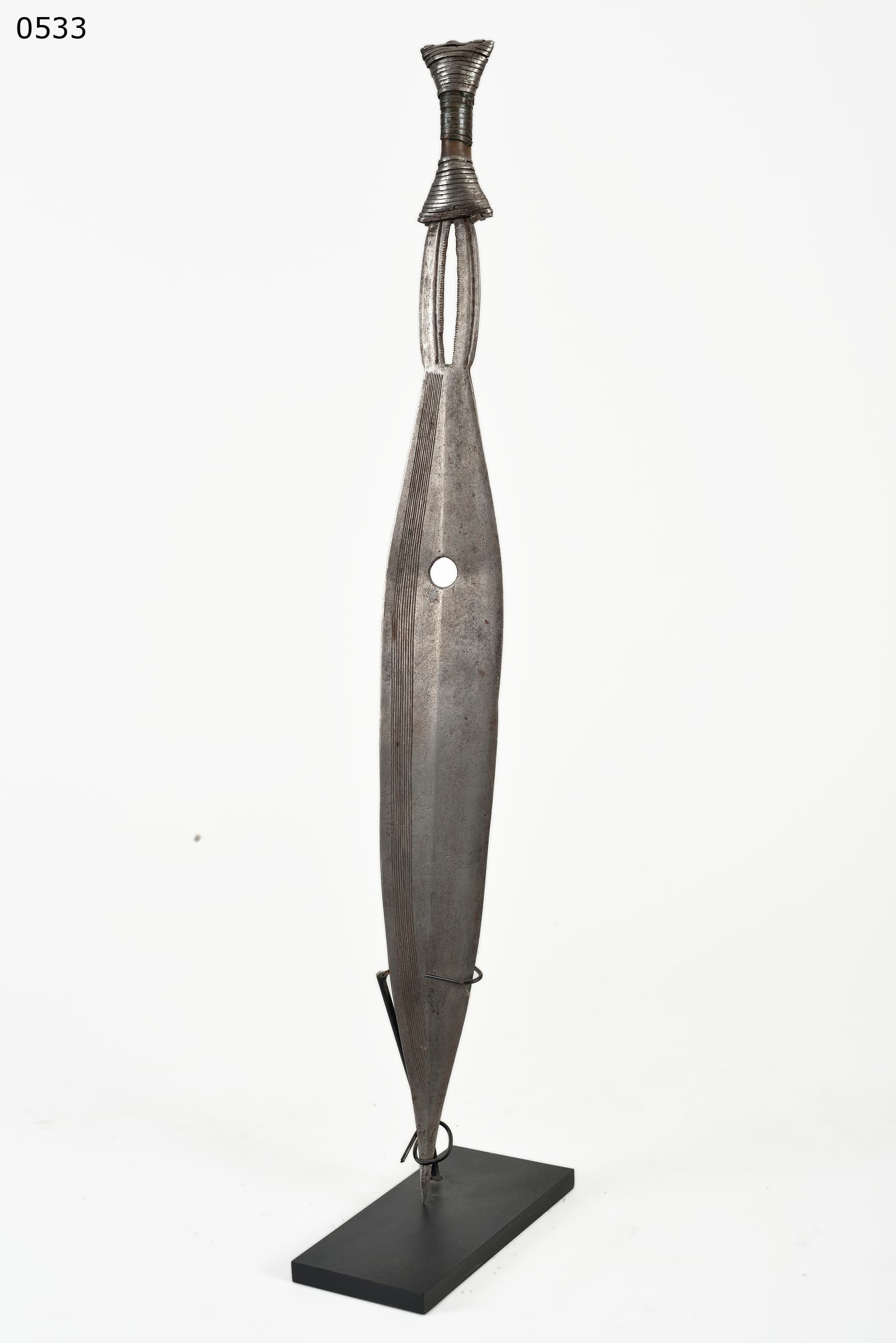
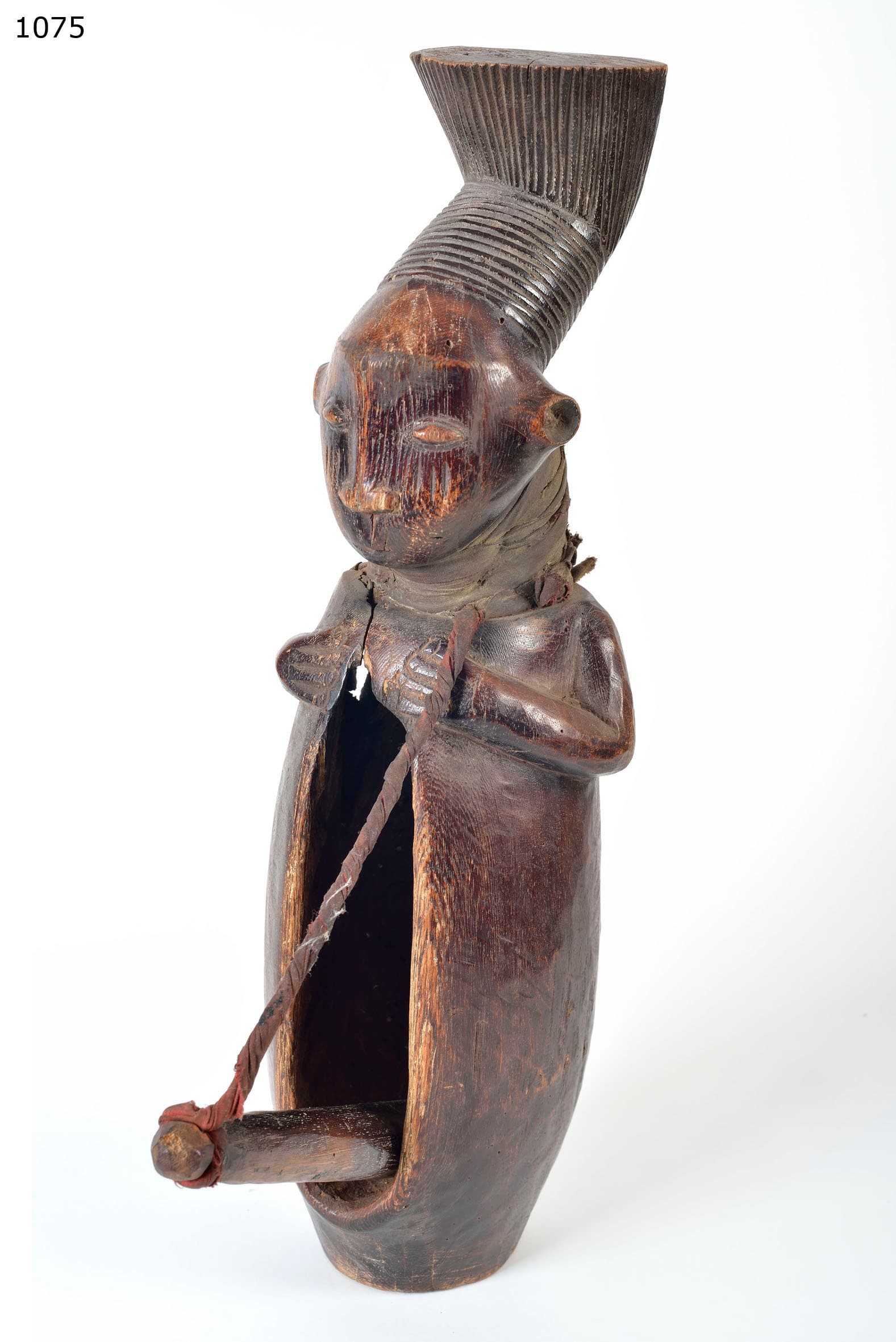
The material culture of the Mangbetu occupies an exceptional special position within Central African art history, which is strongly characterised by the courtly urge for representation. The canonical object typology is primarily dominated by three groups: Musical instruments (especially bow harps), utilitarian ceramics (pots and jugs) and elaborate ivory carvings (hip knives, hairpins, oliphants).
The unifying iconographic characteristic across all subtypes is the iconic "Mangbetu profile". This aesthetic feature is derived from the real somatic practice of lipombo - the artificial deformation of the skull. Infants of the aristocracy had their heads bandaged with tight bast and cloth wrappings, which led to an extreme elongation of the back of the head as they grew. This canon of proportions was complemented by the tumburu, a complex, fan-like hairstyle made of reeds and hair, which visually maximised the elongated profile. In sculpture and ceramics, this canon is reflected in sculptures with strongly receding backs of heads, fine linear scarification patterns around the eyes and mouth (imitating real body painting) and elongated, curved neck lines.
Iconographic research controversy: Tradition vs. Colonial Innovation
The anthropomorphic terracotta vessels of the Mangbetu form the centre of one of the most vehement controversies in African art history. For a long time, these objects were regarded in the West as the epitome of "genuine", pre-colonial African court art, as implied by early anthropologists such as Jan Czekanowski (1924). Enid Schildkrout and Curtis Keim (1990), however, fundamentally revolutionised this discourse. By meticulously analysing early sources, in particular the expedition drawings of Georg Schweinfurth (1870), they were able to prove that anthropomorphic ceramics did not exist before the turn of the century. Schweinfurth only documented highly refined but purely geometrically decorated vessels. Schildkrout and Keim prove that the so-called "royal style" with pronounced head applications was a colonial innovation of the years 1900-1925. Fuelled by the massive interest of Belgian colonial officials and Western travellers in the bizarre Lipombo cult, African artists (often not even Mangbetu, but neighbouring Azande or Zande) began to add anthropomorphic heads to previously unfigurative objects in order to meet the exoticist demand of the West. These pots are therefore not relics of an ancient ritual culture, but early examples of hybrid, colonially stimulated prestige art.
Master hands and workshops
Although African art is often falsely declared to be anonymous, specific master hands can be isolated in the Mangbetu corpus. Probably the most prominent documented workshop is that of the "Master of the T-shaped brow", an artist whose name is unknown today and who was active in the first decade of the 20th century. His oeuvre, of which only five sculptures and three plinths are known today (including one in the Tropenmuseum Amsterdam, collected in 1925 by E. Lefevre), is characterised by an unmistakable signature: The eyebrows and the bridge of the nose form a precise, raised "T". The eyes are executed as deep circle-dot notches, each flanked by two parallel scarification lines. Another characteristic of his workshop is the pentagonal base and the position of the hands, which always enclose the navel.
Material, patina and forgery criteria
The choice of materials used by the Mangbetu artists testifies to a high level of craftsmanship. Dense, tropical hardwoods (such as Ricinodendron rautanenii) were favoured for wood carvings. Ivory, a highly valued status symbol, was first roughly hewn with axes, refined with cross axes (adzes) and then polished to a high lustre in a time-consuming process with sheets containing a high silicate content (similar to modern sandpaper).
The difference between a profane prestige object and a ritually activated object manifests itself radically in the patina. Profane court art was characterised by flawless, shiny surfaces, often simply rubbed with palm oil or red camwood powder (redwood). An activated ritual object of power, on the other hand, was successively covered with layers of coagulated animal blood, saliva, copal resins and magical earths through the cult of sacrifice, resulting in a rough, encrusted and deeply dark sacral patina.
As the Mangbetu style fetches top prices on the art market, forgery criteria are highly relevant. African forgery workshops (for example in Cameroon) often reproduce Mangbetu ceramics on the basis of old photographs. Thermoluminescence dating (TL) is the primary forensic tool for unmasking such imitations. Crystals (quartz/feldspar) in the clay accumulate natural ambient radiation over time. When heated again in the laboratory to over 500 °C, this energy is released as weak blue light. The intensity of the luminescence allows (with a margin of error of approx. ± 20-30 %) the calculation of the time span since the last firing, with which recent forgeries can be reliably distinguished from original colonial-era ceramics (Doreen Stoneham, Oxford Authentication). For wooden objects, wood anatomical determinations are used (often compared with the RMCA Tervuren's xylarium database of over 80,000 samples), as well as the analysis of non-simulable, deep termite damage and natural heartwood cracks.
| Iconographic parameters | Classification in the Mangbetu canon |
|---|
| profile canon | lipombo (skull deformation), elongated back of the head |
| Hairstyle | Tumburu (fan-like reed architecture) |
| Known master hands | "Master of the T-shaped brow" (active ca. 1900-1915) |
| Sacred patina (ritual) | Crusted patina (blood, resin, Dawa essences) |
| Profane patina (court art) | lustre polish, palm oil, red camwood powder |
| Forensic testing | TL dating (ceramics), xylarium comparison (wood) |
Ritual practice
Bark boxes (nembandi) as ritual containers
While the classic Western idea of African ritual practice is often dominated by the performative mask tradition, it must be emphasised that among the Mangbetu - as among most peoples in north-eastern Congo - masks are almost completely absent from the ritual repertoire. Instead, ritual practice focussed on altars, containers and musical instruments. The nembandi played a central role in this. These cylindrical or oval boxes were made from sewn strips of tree bark, the bases and lids of which (often decorated with anthropomorphic heads) were fixed in place with wooden nails. A prominent, purely geometric pre-colonial specimen from the Schuver expedition (1881) can be found today in the Museum Volkenkunde in Leiden.
The use of these boxes was subject to a strong duality. In a secular context, they served as containers for jewellery, textiles or honey when travelling. In the ritual and secret society context of the Nebeli society, however, they became highly sacred reliquaries. They were used to store ancestral bones or served as carriers for dawa - magical healing and harmful substances that were consecrated by diviners. The altar structure in a Mangbetu homestead often consisted of a discreet arrangement of such boxes, combined with ancestor figures, river gravel stones (representing water spirits such as Ara) and leopard's teeth, which symbolised royal authority.
The lifecycle of a ritual object followed a rigid protocol. A newly carved object possessed no intrinsic power; it required ritual activation by a priest. The sources describe the application of offerings in detail: In addition to animal blood, which was poured onto the sculptures to infuse the gods and the ancestor cult with life force ("Life force"), the Naando root was of essential importance. The priest chewed the root and spat the juice onto the object to the rhythm of sacred chants in order to banish the spirits of the ancestors into the wood or ivory and performatively "charge" the object.
An exceptional performance medium of the Mangbetu was the bow harp (Nedongo or Domu). These instruments, whose resonating bodies were covered with animal skin and whose neck often ended in a carved, singing head, were not primarily used for profane entertainment. The musician played the harp sitting down, the resonating body on his lap, the neck pointing away from the body. The musical performance was a deeply ritual-political act: the genealogies of the Mabiti kings, mythological myths and the heroic deeds of the ancestors were sung in hour-long recitations. The harp thus functioned as a mnemonic instrument and acoustic altar, evoking the historical continuity of the kingdom.
If a reliquary or an object of power lost its power due to a lack of ritual success - for example if harvests failed or Likundu witchcraft could not be warded off - it was deactivated. This was done through the ritual removal of the dawa substances. The wooden case, which was now considered "empty" and profane, was either burnt, left to decay naturally in the forest or, in the course of colonial commercialisation, simply sold to European collectors.
Historical context
Migration history and the colonial encounter
The historical genesis of the Mangbetu is characterised by a momentous migration movement. Around the 18th century, Central Sudanese groups migrated southwards from what is now South Sudan into the Uele Basin, where they partly displaced and partly assimilated the indigenous Pygmy population and various Bantu tribes. Under the leadership of Nabiembali, this expansion culminated in the founding of one of the few highly centralised kingdoms in Central Africa at the beginning of the 19th century.
The first documented encounter with a European took place in 1870, when the German botanist and ethnographer Georg Schweinfurth reached the court of the Mangbetu king Mbunza. Schweinfurth's detailed travelogue In the Heart of Africa (1874) was to shape the Western reception of the Mangbetu for a century. He described a court of unimaginable architectural and material splendour, flanked by pronounced polygyny and - what particularly fired the Victorian imagination - systematic cannibalism. These descriptions led European intellectuals to the (now refuted) cultural diffusionist assumption that the Mangbetu were relics of ancient Egyptian civilisation due to their elite physiognomy (skull deformation) and their highly developed artistry.
Influence of colonial history on art production
The subsequent colonisation by the Belgian Congo Free State (from around 1891) led to an unprecedented paradigm shift in material culture. The most important scientific turning point was the Congo Expedition of the American Museum of Natural History (AMNH) under Herbert Lang and James Chapin (1909-1915). Lang collected over 4,000 meticulously documented objects at the court of Chief Okondo. The analysis of these collections (by Schildkrout and Keim, among others) proved that Mangbetu art - especially the anthropomorphic pots and elaborate harps - was not a static "primordial tradition". Rather, African artists recognised the massive interest of Belgian administrators in the exotic lipombo body form and proactively began to invent and mass-produce this "royal style" as souvenir and prestige art for the new Western market. Art production thus shifted from local African patrons to serving a colonial demand economy.
Market history, forgery problems and forensics
With the establishment of the colonial administrative machinery and the banning of many traditional rites (including circumcision and the lipombo cult in the 1950s), the power of the chiefs eroded and the production of high-quality court art came to an almost complete standstill. This led to an extreme shortage on the international art market. The final breakthrough of Mangbetu art in the Western high-end collector scene was sealed in 1990 by the groundbreaking exhibition African Reflections: Art from Northeastern Zaire at the AMNH. Today, authentic Mangbetu objects realise astronomical sums at auctions at Christie's or Sotheby's; for example, an anthropomorphic harp was auctioned for around 360,000 euros in 2016.
This price explosion inevitably brought highly professional forgery workshops onto the scene. To ensure authenticity, museums and collectors today have to use state-of-the-art forensics. Wood anatomical determinations are essential; the RMCA Tervuren has done pioneering work in this area. The curator there, Roger Dechamps, built up a database for which he took minimally invasive samples of thousands of objects (tangential sections for microscopic analysis of the wood cell structure). Today, these methods are increasingly being replaced by non-destructive micro-CT scans. In addition to thermoluminescence (TL) for ceramics, experts look for organic, non-falsifiable signs of ageing in wooden objects: authentic termite damage, deep heartwood cracks (caused by hygroscopic fluctuations over decades) and stratigraphic analysis of the patina layers to expose artificially applied "antique finishes".
| Historical Expeditions | Actors & Relevance for Mangbetu Inventories |
|---|
| 1870 | Georg Schweinfurth (publication: In the Heart of Africa), first western documentation |
| 1907-1908 | Jan Czekanowski (German Central Africa Expedition), ethnographic systematisation |
| 1909-1915 | Herbert Lang & James Chapin (AMNH), collection of > 4,000 objects |
| 1911-1912 | Armand Hutereau (RMCA Tervuren), acquisition of > 10,000 artefacts in the Uele Basin |