Overview
The ethnographic, demographic and art-historical classification of the Mofu requires a highly differentiated localisation within the complex topography of the Mandara mountain massif in the Far-North region (Extrême-Nord) of today's Republic of Cameroon. The geographical distribution of this mountain people is primarily centred on the rugged plateaus and isolated inselbergs of this region, whereby the ethnic group is fundamentally divided into two geographically and dialectally definable main groups: the northern Mofu-Diamaré (which include settlement communities such as Doulek, Meri, Douvangar, Douroum and Wazang) and the southern Mofu-Gudur (which include Mokong and Mofou-Sud). Current and historical demographic estimates indicate an overall marginality of the population, which is determinant for the organisation of its socio-political structures. While historical census data from Hallaire from 1991 documented exactly 28,874 Mofu-Diamaré and 26,235 Mofu-Gudur and Boulet spoke of around 42,100 individuals as early as 1984, modern demographic projections assume a consolidated population of around 50,000 to 55,000 people. This population lives in a settlement density that is remarkably high for African mountain regions, oscillating locally between 30 and 100 inhabitants per square kilometre.
Linguistically, modern linguistics categorises the idioms of the Mofu in the Mafa-South dialect group, which in turn forms a branch of the Central Chadian languages within the gigantic Afro-Asian language family. This linguistic embedding refers to profound historical migratory movements from the East African and Saharan regions. A central discourse within ethnographic nomenclature, which is also of crucial importance for provenance research in collections, concerns the radical discrepancy between self-designation (endonym) and foreign designation (exonym). In historical and colonial literature, the Mofu, parallel to neighbouring mountain farmers such as the Mafa or Kapsiki, were often subsumed under the pejorative collective term "Kirdi". This term, which etymologically comes from Kanuri (derived from the Arabic qird) and simply means "non-Muslim" or "heathen", served the Islamic empires of the plains as legitimisation for slave hunts and the French colonial administration as a reductionist classification tradition. Modern ethnology strictly rejects this term due to its romanticising and simultaneously pejorative "noble savage" tropes and instead uses the specific proper names of the clans or the neutral geopolitical term "Montagnards". The controversial nature of the classification must be explicitly emphasised: The source situation regarding the exact ethnic boundaries to neighbours such as the Giziga-Lulu is ambiguous, as historical assimilation processes and fluid identities make static classifications difficult; around 78 percent of Lulu households originally have Mofu-Gudur elements. Such ethnic fluidities are reflected in object documentation, as evidenced by inventory analyses of recent collections of African ceramics at the Fowler Museum at UCLA, where Mofu artefacts sometimes operate under generic Mandara classifications.
The social structure of the Mofu is characterised by a fascinating, seemingly contradictory dualism. On a micro-sociological level, the society operates in an acephalous-segmental manner and is strictly fragmented into patrilineal kinship groups and self-sufficient homesteads (g ulom), which maintain an extremely strong sense of privacy and autonomy. The authority of a village head rarely exceeds the status of a mere counsellor at this level. Historically, however, this decentralisation contrasts with the theocratic and highly hierarchical superstructure of the chiefdom of Gudur. The so-called Bay Gudal ruled over a geographically tiny core area of just 90 square kilometres, but established it as the most powerful chiefdom in the region. Gudur functioned as a supra-regional "pagan Mecca", whose ritual radiance overwrote the acephalous structures of the neighbouring communities.
The economic subsistence of the Mofu is completely centred on the agrarian calendar and determines the ritual logic of their material culture. In an environment characterised by a short rainy season and an extremely long dry season, they primarily cultivate sorghum, maize, sesame and sweet potatoes as staple foods in terraced farming, while peanuts and tobacco are produced for local trade. Animal husbandry is limited to small livestock such as goats and sheep; cattle are rarer and function primarily as prestige objects and ritual capital. Due to the demographic density and the resulting lack of game, hunting plays a negligible role both economically and ritually, which explains the almost complete absence of objects related to the hunting cult in Mofu art. The relationship with the neighbouring peoples of the plains (Wandala, Borno, Baghirmi, Fulbe) was historically characterised by asymmetrical violence. On the one hand, the Mofu smiths were essential suppliers of high-quality iron, which was exported to the plains and in return ensured access to salt and cattle. On the other hand, it was precisely this specialisation in iron production that made the Montagnards the preferred targets of raids by the Islamic states.
| Socio-demographic indicator | Data basis / Specification |
|---|
| Primary settlement region | Mandara Mountains (Cameroon, Far North Region) |
| Demographic volume | ~50,000 to 55,000 individuals (current) |
| Linguistic classification | Afro-Asiatic > Chadian > Mafa-South |
| Historical centre of power | Gudur (approx. 90 km², theocratic sphere of influence) |
| Economic base | Terraced sorghum and maize cultivation, iron export |
Cultural context
The religious system of the Mofu eludes the paradigms of monotheistic religions of revelation and instead manifests itself as a highly pragmatic, calendar-based instrument of crisis management that is inextricably interwoven with the agrarian struggle for survival in the Mandara massif. The cosmological order is structured in three levels: At the top is a distant, rather abstract creator god, who is rarely addressed directly in everyday cult activities. The operative and ritually tangible sphere, on the other hand, is dominated by two central entities: the patrilineal ancestors (zom baba) and a multitude of localised nature and earth spirits that reside in trees, deep rock pools and mountain tops. These nature spirits occupy a special position in the ontology of the Mofu, as the dividing lines between deified ancestor and abstract nature spirit are fluid; ritual practice locates them at the interfaces of incarnation cycles.
The ritual authorities of Mofu society differ significantly in structural terms from those of their neighbouring peoples. While groups such as the Sukur have a differentiated system of specialised priestly titles (such as the Mbesefwoy), the ritual authority of the Mofu-Gudur culminates almost autocratically in the figure of the priest-chief, the Bay Gudal. The Bay Gudal did not derive his legitimacy from military hegemony, but from his direct genealogical descent from the mythical ancestor Biya, who, according to tradition, brought sacred rain stones and a sacred bull to the region. These stones formed the physical nucleus of his monopoly of power over the rainfall cycles. Unlike many African rulers, who consulted separate specialists for communication with the afterlife, the historical Bay Gudal was a chief, healer and chief divinator who combined magic and cult in one hand.
However, there is a fundamental research controversy in the academic interpretation of this centre of power. The French ethnologist Jeanne-Françoise Vincent (1991) argues emphatically that the almost absolute monopoly of the Mofu princes over the rain rituals and the digging of wells was the primary and unchallenged sign of their political power, whereby the prince was elevated to "lord of the water". In contrast, Judith Sterner and Nicholas David (2009) strongly question this view. They state that while Gudur undoubtedly functioned as a religious epicentre for petitioners from the entire region, the internal structural complexity of the rituals did not exceed that of smaller neighbouring chiefdoms. Sterner and David deconstruct the alleged omnipotence of the Bay Gudal as skilful 'propaganda' and point out that the chiefs' reputations were artificially inflated into 'larger-than-life figures' through the projections of desperate clients plagued by droughts and locusts from the outside.
Divination forms the obligatory epistemological foundation of any ritual intervention. No sacrificial act or altar construction takes place without prior divinatory research into the causes. Diviners decipher the causal connections between failed harvests, illnesses or droughts by identifying the anger of specific ancestors, the revenge of local mountain spirits or acts of destructive witchcraft. This diagnostic practice is not exclusively male-coded, which leads to the complex role of women in the cult. While official ancestor worship is strictly patrilineal in structure and the father of the house serves the family altar, women function significantly as divinators and actively participate in deciphering the cosmic will. Their cultic relevance is particularly evident in the central initiation and transition rituals. The so-called "seasonality" of life - dictated by the harsh alternation of rainy and dry seasons - is reflected in strictly calendrical rites. The initiation of boys, the first marriage of girls and the rites of secondary burial form the social anchor points. The transformation of girls into wives is ritually marked by the wearing of a specific iron apron (livu), which inscribes the material iron deeply into the female transition cycle.
Structurally, the Mofu religion differs from West African systems in the almost complete absence of elaborate secret society structures (such as the Poro society) and mask-based performance cults. The Mofu religion is architecturally bound to the rock, the terrace walls and the private household. The sacredness does not unfold in the public masquerade, but in the hidden materiality of rain stones, ceramic vessels and iron artefacts. Museum collections, such as the British Museum's holdings of divinatory objects and ritual medicine balls, bear witness to the inconspicuousness of these highly potent ritual tools, whose true power is only revealed to the initiated ethnographic gaze.
Aesthetic features
The material culture of the Mofu eludes the usual Western expectations of African art, as the corpus of large-scale wooden sculptures or polymaterial masks is almost completely absent. The canonical object typology is highly reduced, material-economical and focusses primarily on two essential categories: functional and sacred iron sculptures and anthropomorphic or semi-anthropomorphic ceramics used for ritual purposes, in particular ancestral vessels. For the collector of African art, an understanding of this specific aesthetic is of immense importance, as the quality of a Mofu object does not lie in its elaborate decorative design, but in its ritual reduction and the material evidence of its use.
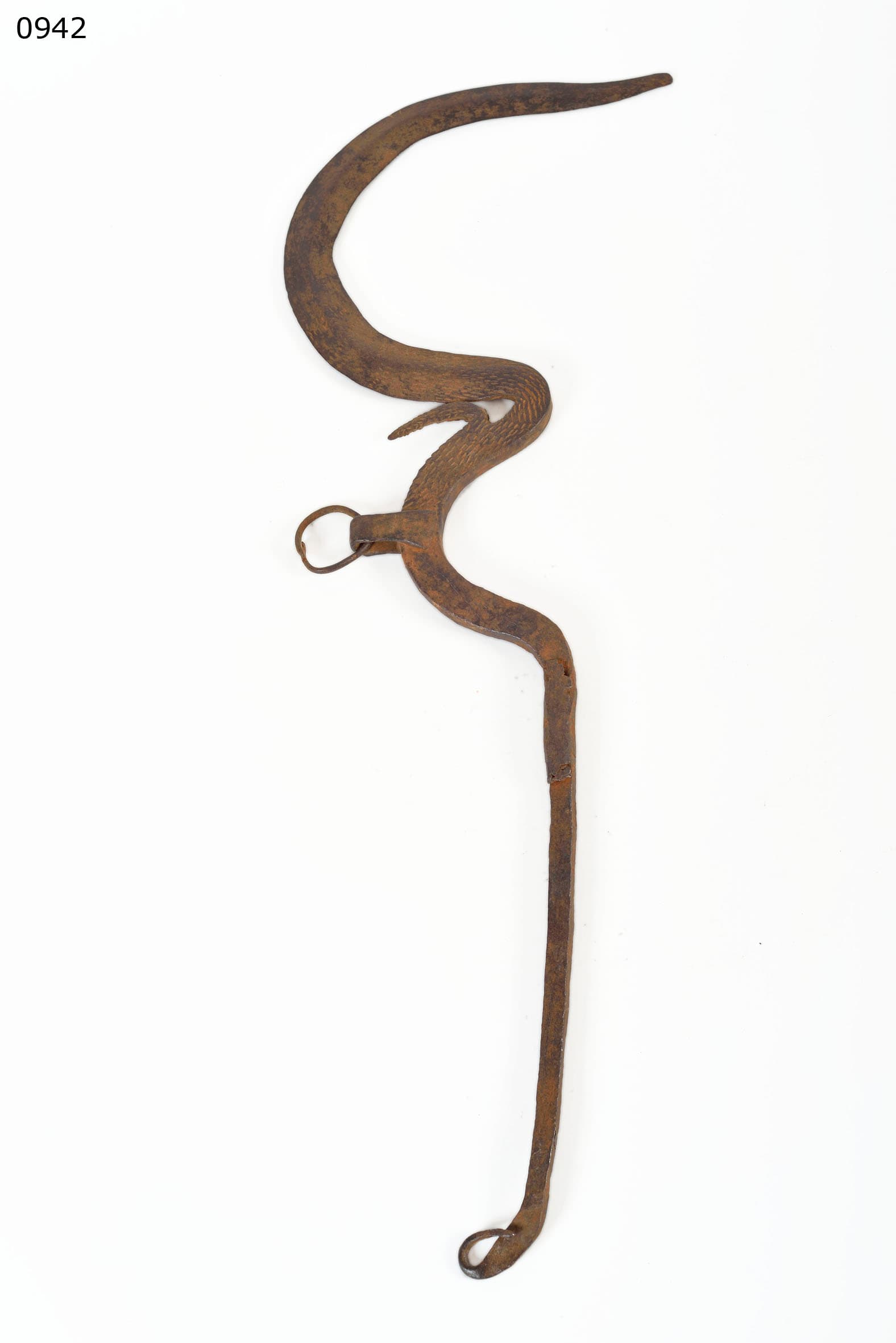
Iron is the absolute sacred material of the Mandara massif and the Mofu identity. The iron objects range in size from 15 to 40 centimetres. The canon of proportions of the forged figures is characterised by extreme stylisation and elongation; anthropomorphic features are reduced to their structural dynamics and minimal hints of extremities, lending the artefacts an archaic-looking presence. When analysing the iconography and choice of materials, one of the most prominent research controversies in African art history stands out: the symbolic coding of iron and forging. In his comparative studies, Walter van Beek (2003, 2012) explicitly argues that iron is radically associated with femininity and transition in the societies of the Mandara massif - unlike in large parts of Africa. The iron bridal robe (livu) is the main iconographic example of this, while brass and copper alloys (which are hardly ever processed locally in the region) stand as luxurious contrasting materials for male status, wealth and seniority. This interpretation stands in head-on contradiction to the authority of the blacksmith castes (Nyonyosi, Numu) of the West African Mande tradition, where iron forging is invariably interpreted as a hyper-masculine, patriarchal-heroic act of subjugating nature. Although the Mofu smiths exhibit structural parallels - they are endogamous and form a separate caste - their symbolic embedding is a completely independent regional development that weaves femininity, death and iron into a singular complex of meaning.
The second pillar of Mofu aesthetics is formed by the ancestral pots (suku). These anthropomorphic ceramics are often characterised iconographically by small, deliberately designed openings and applied facial features. The formal difference between an activated ritual object and a profane water or grain vessel is often morphologically marginal. The inconspicuousness is the programme. A profane pot only becomes a carrier of spiritual power through ritual activation. The absolute proof of authenticity and the primary quality criterion is the patina. Genuine patina on mofu ceramics and iron altars is not caused by environmental influences, but is the cumulative result of ritual feeding: decades of layers of animal blood, millet beer sediment, palm oil and ritual plant extracts bind with the material to form a thick, often encrusted crust (sacrificial patina).
As the Western concept of the individual "artist" takes a back seat to the collective ritual responsibility of the blacksmith and potter caste, it is not possible to verify the names of documented master craftsmen or specific studios for historical mofu objects. Art production is strictly service-oriented. For the recent art market, in which African iron is increasingly traded at high prices, this poses massive challenges in terms of forgery criteria. As the formal canon of Mofu iron sculptures appears simple and easy to reproduce, forgeries focus on the artificial generation of age. Market-relevant forgeries use aggressive acid baths to force rapid oxidation or bury newly forged iron for months in alkaline soils to simulate rust scars. For the rare objects with organic additions (wooden handles of divination instruments), artificial termite damage and forced heartwood cracks are used to feign authenticity. Renowned institutions such as the Musée du quai Branly - which paid tribute to African iron art in its epoch-making exhibition "Frapper le fer" - or the Museum Rietberg in Zurich therefore base their authentication on metallurgical analyses, the density of carbon inclusions in the wrought iron and the chemical composition of the ritual patina layers.
| Criterion | Profane object (mofu) | Activated ritual object (suku / sacred iron) | Forgery indicator (market) |
|---|
| Material surface | Natural wear, no crust formation | Deep, stratified sacrificial patina (blood, millet beer) | Artificial acid rust layer, homogeneous oxidation |
| Contextual placement | Openly accessible in the farmstead | In rock niches, behind ritual dry stone walls | Presented in isolation, without contextual evidence |
| Iconography | Purely functional | Reduced anthropomorphism (elongation, eyes/mouth) | Exaggerated formal language for market ingratiation |
Ritual practice
The ritual practice of the Mofu does not unfold in spectacular, fleeting masked dances on central village squares, but in the intimate, constant and materially dense interaction with the altar. The altar is the pulsating centre of family and social crisis management, and the performative power of the Mofu religion lies in the successive construction, activation and continuous "feeding" of objects over generations.
The lifecycle of a ritual object is deeply inscribed in the biography of its human reference point. This cycle can be traced in detail using the example of ancestral vessels (suku). At his initiation into adulthood, a young Mofu man receives a simple, still profane and inconspicuous clay vessel. This object accompanies him throughout his life without initially functioning as an altar. Only when the individual physically dies does the radical transformation take place. The activation of the object is the exclusive responsibility of the blacksmith caste. This specialisation is rooted in a central founding myth of the mountain farmers: According to it, the endogamy and social isolation of the blacksmiths is the direct result of an indelible ritual contamination (pollution) that the ancestor of the caste brought upon himself when he buried the stinking corpse of a relative and then consumed the flesh of the funeral sacrifice with unwashed hands. Because of this immunity to corpse poison, the blacksmiths act as the sole undertakers. They perform the rituals that transfer the spirit of the deceased into the suku pot.
The skull relic tradition is a regional variation and extreme form of this incarnation practice. The Mofu-Diamaré and neighbouring groups exhume the skull of the deceased elder in secondary burial rites. The skull is seen as the primary carrier of personality and power. It is placed in or under specially made anthropomorphic pots. A significant ritual constant here is the vertical orientation: the skull or corpse is arranged upright, in a sitting position, which is iconographically coded as a position of superiority, authority and equality among the elders. The altar construction itself often takes place in protected zones of the terraced settlements or special architectural structures such as the DGB complexes (Diy-Gi'd-Bay), where the ancestral pots are lined up behind finely stepped, smooth dry-stone facades.
The continuous use of the altar requires permanent offerings, the quantity and quality of which correlate directly with the severity of the crisis to be overcome. Standard offerings for family agricultural security consist of plant and light animal offerings: Millet beer, sesame oil and occasionally chickens. During trans-regional calamities that required the intervention of the Bay Gudal in Gudur, the offerings escalated. Distant supplicants brought horses, iron plates and capons (castrated goats) to receive "magic medicine" - often bullets of highly concentrated millet beer sediment - or access to the sacred locust altar from the priest-chief. In times of extreme crisis, the historical sources even record human sacrifice: The sources indicate that at the height of desperate locust plagues, which resulted in the existential hunger of the mountain farmers, young couples were sacrificed at the locust shrine in Gudur in absolutely exceptional cases in order to break the cataclysmic wrath of the spirits. This sacrificial practice overlays the iron and ceramic objects with the dense, opaque and forensically verifiable patina that is now considered incorruptible proof of ritual authenticity in the scientific laboratories of the Royal Museum for Central Africa (Tervuren / RMCA) or the Fowler Museum UCLA.
The deactivation and disposal of a sacred mofu object follows the strict sociological logic of forgetting. The patrilineal religion actively honours only the two immediately preceding generations (father and grandfather). If the last direct grandchild dies, the bond of personal memory is severed. The spirit of the grandfather is released from the status of active, familial ancestor into the anonymous mass of distant spirits (zom baba). With this ontological change, the specific suku pot loses its ritual charge. It is not preserved in the Western sense, but left to decay. It remains in ruins or splinters in the fields, which explains why intact ancestral Mofu vessels are extremely rare in historical collections.
Historical context
The history of the Mofu societies and their material culture is not a chronicle of static isolation, but the result of permanent climatic and warlike displacement processes in the area of tension of the Chad Basin. The migration history of the Mandara mountain farmers is the subject of complex dating controversies in archaeological research. A dates the consolidation of today's settlement structures to massive, northward waves of migration from the southern regions (the so-called Tur tradition), while B argues on the basis of the Godaliy tradition that early Chadic-speaking groups already appeared in the late Iron Age as builders of the complex DGB architectures and were only pushed into the most inhospitable mountainous regions by successive Wandala speakers.
The encounter with external powers, long before European colonisers appeared, fundamentally shaped the production of art. For centuries, the Mandara massif was the favoured hunting ground for the slave raids of the Islamic Fulbe emirates, especially under the reign of terror of Hamman Yaji from Madagali in the 1920s. These extreme threat scenarios forced the Mofu to retreat deep into inaccessible mountain fortresses and fortified terraced settlements. This existential economy of fear had a direct impact on art production: large-scale, unwieldy wooden sculptures or elaborate mask ensembles, which could flourish in pacified regions of West Africa, were logistically inopportune for a society on permanent flight. As a result, material culture focussed on the essential, portable and concealable - small iron sculptures, locally made divination tools and ceramics.
The European colonial encounter - initially by the German Empire and after the First World War by the French mandate administration - did not bring peace, but instead forced the dismantling of traditional power structures. The colonial powers carried out "pacification campaigns" against the rebellious Montagnards in order to force them into a Western system of taxation and administration. At the same time, the colonial period initiated a process of secularisation that eroded the ritual basis of the Mofu authorities. The formerly untouched monopoly of power of the Mofu princes over water resources and rain was massively weakened by the introduction of Christianity and - even more pragmatically - by the construction of modern, government-financed deep wells in the plains, as survival no longer depended exclusively on the rainstones of the Bay Gudal.
The market history of mofu art in the West shows a clear asymmetry. While West and Central African sculptures (such as those of the Dogon or Fang) were already fed into the canon of classical modernism by the early Parisian art trade around Durand-Ruel or Paul Guillaume, the inconspicuous iron artefacts and rough ceramics of the Mandara massif remained of purely ethnographic interest for a long time. It was only with the paradigm shift in the perception of African metallurgy - catalysed by groundbreaking exhibitions such as Striking Iron / Frapper le fer at the Musée du quai Branly (2019/2020) and publications by renowned anthropologists such as Jean-Yves Martin (1981) - that the breakthrough in the art market occurred. The price trend for authentic, pre-colonial African iron has seen exponential growth at major auction houses in recent decades, fuelled by financially strong single-owner collections that value the archaic minimalism of these objects as an aesthetic statement.
The monetary appreciation inevitably escalated the problem of forgery. The modern private collector is faced with the challenge that the simple formal reproducibility of an iron figure attracts professional forgery workshops. The criteria for authenticity have therefore shifted from purely stylistic expertise (connoisseurship) to forensics. While deep heartwood cracks and microscopically verifiable, old termite damage serve as indicators in the case of rare wooden or calabash objects, the metallurgical composition is decisive in the case of iron. Traditionally smelted iron from the mofu forge has a different density, carbon structure and inclusions of slag than industrial scrap iron, which is often artificially patinated with acid by forgers. The validation of a thick, historically grown sacrificial patina (terminology: sacrificial crust), which contains organic residues of blood and beer, remains - as laboratory analyses of similar objects at the Metropolitan Museum of Art (Met) prove - the ultimate accolade for any dossier that legitimises the translation of a mofu artefact from the rugged terraces of Cameroon into the display case of a global collection.