Overview
The ethnographic, linguistic and art-historical recording of the region of the Middle Benue Valley and the southern Jos Plateau in central Nigeria is historically characterised by considerable terminological and classificatory blurring. At the centre of this museological and anthropological examination is an ethnic group that is traditionally referred to in Western art historiography, in colonial administrative records and in the relevant inventory catalogues under the exonym "Montol" (Sieber 1961: 15). However, the linguistic and anthropological research of the early 21st century increasingly emphasises the need to critically question historical exonyms and prioritises the self-designation (autonym) of the group, which is documented as Tel or Tɛɛl (Blench 2017: 2). The sources on the exact ethnic genesis and historical consolidation of this group are ambiguous, as the colonial administrative structures of the British Native Administration in the early 20th century often combined disparate kinship groups into artificial administrative units for purely pragmatic reasons (Ames 1934: 347). These administrative constructs overlaid the far more complex, fluid identities of the pre-colonial era.
Current demographic estimates and sociological surveys put the Tel population at around 47,000 to 50,000 individuals, making them one of the smaller but culturally highly influential groups in the region (Joshua Project 2023). Geographically and administratively, they primarily settle in Shendam Local Government Area and neighbouring areas of Plateau State in the Federal Republic of Nigeria. The topography of the Jos Plateau, characterised by volcanic elevations, rugged valleys and formerly dense savannah landscapes that are now increasingly open to agriculture, played a determining role in the historical development of the Tel (Hailey 1951: 102). For centuries, this geographical isolation acted as a natural refuge and protective barrier against external aggressors, which ensured the specific socio-cultural independence of the group.
Linguistically, the Tel language is located with great precision within the widely ramified Afro-Asian language family. It belongs to the Chadian branch and is more specifically assigned to the Western Chadian group (classification A.3, Angas cluster) (Frajzyngier 1991: 12). This linguistic classification is a decisive archaeological-linguistic indicator for historical migration movements and kinship relationships.
| Language family | Language branch | Cluster | Related ethnic groups (examples) | Note on material culture |
|---|
| Afro-Asiatic | West Chadian | Angas (A.3) | Tel (Montol), Goemai, Ngas, Mwaghavul | Strong formal coherence in figurative wood sculpture (reductive, cylindrical) |
| Niger-Congo | Benue-Congo | Tarokoid | Tarok (Yergam), Pe | Differing ritual systems, but selective exchange through trade networks |
| Niger-Congo | Benue-Congo | Jukunoid | Jukun | Complex, hierarchical masked beings, historically dominant cultural area of influence |
In contrast to their Niger-Congo-speaking neighbours to the south and east, the Tel share deep linguistic and thus also fundamental cosmological roots with other western Chadic groups such as the Goemai, Ngas and Mwaghavul. Linguistic reconstructions suggest that these groups formed a common ancestral lineage around 5,000 to 7,000 years ago before diversifying into the specific niches of the plateau (Bulkaam & Blench 2016: 4).
The pre-colonial social structure of the Tel can be described as decidedly acephalous (without domination in the sense of a lack of centralised state authority) and segmentary. There was no centralised, hierarchical state order, no sacral kingship and no dominant central court, as is documented among the neighbouring Jukun in Wukari, whose kings (Aku Uka) exercised far-reaching theocratic power (Rubin 1968: 45). Instead, Tel society was and is primarily organised along patrilineal lines. Social, economic and political control was decentralised to the councils of elders of the respective lineages (descent groups) and the leaders of the secret cult societies (Tremearne 1912: 88). This fragmentation, often described as 'gerontocracy', was not only favoured by the rough terrain of the Jos plateau, but was also a highly adaptive survival strategy. It prevented the establishment of large targets and served the Tel as effective protection against the expansion of the Hausa-Fulani emirates and the organised, large-scale slave hunts of the 18th and 19th centuries (Adeleye 1971: 32).
Economically, the subsistence strategy of the Tel has historically been based on a resilient combination of intensive hacking and specialised hunting. The fertile soils of the Jos Plateau, enriched by volcanic ash, enabled the high-yield cultivation of yams, sorghum, millet and the region's endemic cereal Acha ("famine rice"), which is highly resistant to drought (Hailey 1951: 102). This agrarian basis was supplemented by the keeping of goats, sheep and cattle, which, however, were not primarily used for daily nutrition, but as prestige objects and essential sacrificial animals for ritual obligations. This agrarian subsistence is inextricably linked to the ritual cycle of the community, which sanctions sowing, growth and harvesting through specific performative acts and masked interventions.
In relation to their neighbours, the Tel maintained complex, multidirectional networks of exchange characterised by a remarkable permeability of ritual institutions. Early ethnographic inventories and provenance research, as exemplified in the archives and catalogue of the British Museum (e.g. Collection Af1905,1209.53), show that material culture, specific healing rituals and even sculptures often circulated along intertribal trade routes and marriage alliances (British Museum 1905). The Tel participated intensively in a regional reservoir of formal languages and cult alliances, which makes the strict ethnic categorisation of their artworks one of the main problems of ethnographic research to this day. The British Museum, for example, has early acquisitions from the Shendam region whose exact ethnic attribution is fluid between Goemai, Ngas and Tel, as the objects were used in the context of transcultural healing cults. This far-reaching regional integration defies the colonial cliché of isolated, warlike hill tribes and paints a picture of a highly networked society whose identity was defined less by rigid ethnic boundaries than by shared ritual practices.
Cultural context
The Tel's religious and cosmological system is structurally deeply rooted in an animistic ontology that differs fundamentally from Western, monotheistic concepts. In this worldview, there is no strict dichotomy between sacred and profane spheres, nor is there a strict separation between material and spiritual reality. Rather, cosmology assumes a permanent, dynamic interaction between living people, the souls of the deceased, localised natural spirits and animate objects (Ocak 2007: 35). Similar to the linguistically and culturally closely related Goemai, the theological architecture of the Tel includes the concept of an omnipotent but largely distanced creator god, who is often invoked in the Chadian language family as Na'an or in similar derivatives (Fwatshak 2025: 44). This Deus otiosus is respected as the source of creation, but does not actively or punitively intervene in the daily life of the community. Accordingly, no direct figurative altars are erected to him, and there is no formalised priesthood dedicated exclusively to his cult.
Instead, the Tel's ritual and cultic attention is primarily focussed on the sphere of the so-called lower spirit beings, the immanent forces of nature (associated with rivers, prominent rock formations and forest patches) and the entity of the ancestors (Mu'ut), who act as active mediators between the inaccessible creator and human society (Fwatshak 2025: 44). These entities are understood as causal agents that control the well-being, agriculture, fertility of women and the physical health of the lineage. Disease, drought or social adversity are almost never interpreted in this system as random, biological or meteorological phenomena, but as symptoms of a disturbed cosmological balance, as the result of witchcraft or as punishment for neglecting ritual duties towards the ancestors.
The central ritual authority, the moral regulator and the organisational backbone of Tel society is the secret society of men, which is usually referred to in the specialist literature as Komtin (in older sources also Komti) (Sieber 1961: 15). In the absence of a central state executive, this confederation acted as a structuring element that assumed far-reaching social, medical and jurisdictional functions and thus guaranteed the internal cohesion of the segmentary society. In its essential nature, the Komtin covenant is a highly specialised healing and divination complex. For adolescent males, initiation into this covenant marks the decisive ritual transition from the status of a naïve child to a fully-fledged, socially responsible adult. Through the gradual initiation, the novices gain access to esoteric secret knowledge, which includes herbal medicine, complex divination techniques and the dangerous protocols for dealing with ritually charged, activated cult objects (Wittmer & Arnett 1978: 97).
A fundamental and still virulent research controversy exists with regard to the historical genesis and delimitation of this central cult. Representative A (often represented by the early current of diffusion research, based on observations by Arnold Rubin) dates the widespread dissemination and homogenisation of the Komtin cult primarily to the intertribal exchange during the Pax Britannica enforced by the British, which made safe travel possible and allowed local healing cults to merge into regional networks (Sieber 1961: 16). Representative B (represented by later, contextualising approaches, strongly influenced by Marla C. Berns) argues vehemently against this and postulates that these ritual networks and the cult complex are autochthonous and already existed centuries before colonial intervention as deep, localised spheres of circulation (Berns 2011: 19). The phenomenological fact documented by the art historian Roy Sieber in 1958 during his pioneering field research is undisputed: the Komtin covenant of the Tel is functionally almost identical in its structure, methodology and iconographic vocabulary to the Kwompten covenant of the neighbouring Goemai and Ngas (Sieber 1961: 16). This raises the far-reaching religious sociological question of whether religious institutions in the Middle Benue Valley are to be understood as ethnically specific phenomena at all or necessarily as trans-ethnic, problem-orientated networks. In sharp structural contrast to the strictly hierarchically organised, royal ancestor cults of the Jukun, whose Aku cult legitimised the absolute power of the ruler, Komtin operates in a decentralised, egalitarian manner within its ranks and is strongly focused on individual healing and the protection of the local lineage (Rubin 1968: 50).
The role of women within this ritual system is the subject of differentiated, often seemingly paradoxical anthropological considerations. Women are physically excluded from active participation in the rites and decision-making processes of the Komtin covenant. They are strictly forbidden to look at the active cult objects, the masks and the inner shrines under threat of drastic magical and social sanctions (Sieber 1961: 15). At the same time, formal analyses of the figurative carvings indicate that some of the spirits manifested by the sculptures have an explicitly feminine connotation (for example, through implied breasts or specific scarification). This corresponds to a ritual paradigm frequently encountered in West Africa, in which patriarchal, exclusive institutions symbolically co-opt the generative, life-giving power of the feminine and banish it in wood in order to control it and utilise it for the preservation of the male-dominated social order (LaGamma 1998: 18). It is a recognition of female power through restrictive exclusion.
In addition to the omnipresent healing rites, there are agrarian rites of passage that flank and cosmically secure the critical cycle of sowing and harvesting. These are often accompanied by dramatic masked appearances. The Musée du quai Branly (Paris) and the Royal Museum for Central Africa (RMCA / Tervuren) house extensive comparative collections of Central and West African initiation societies, whose formal and functional analogies (for example among the Kusu, Pende or in the Niger Delta regions) provide empirical evidence that the inseparable link between spiritual healing, social control through secrecy and masked performance is a deeply rooted, transregional structural feature (RMCA Catalogue 2015 / Quai Branly 2012). In the Tel, the Komtin complex performs all these composite functions in a highly concentrated form and forms the absolute, undisputed centre of the community's ritual, social and thus also artistic production.
Aesthetic features
The sculptural oeuvre of Tel (Montol) is formally highly coherent and is characterised by an uncompromisingly abstract, reductive canon of proportions, which is considered iconic in African art history. The canonical object typology of the Tel is almost exclusively dominated by the figurative sculptures of the Komtin bundle, while other formats such as stools or sticks are of secondary importance. The size spectrum of these ritual wooden sculptures is relatively intimate due to their function as altar and hand objects of the divinators and generally ranges from 30 to a maximum of 60 centimetres (Zemanek 2011: 45).
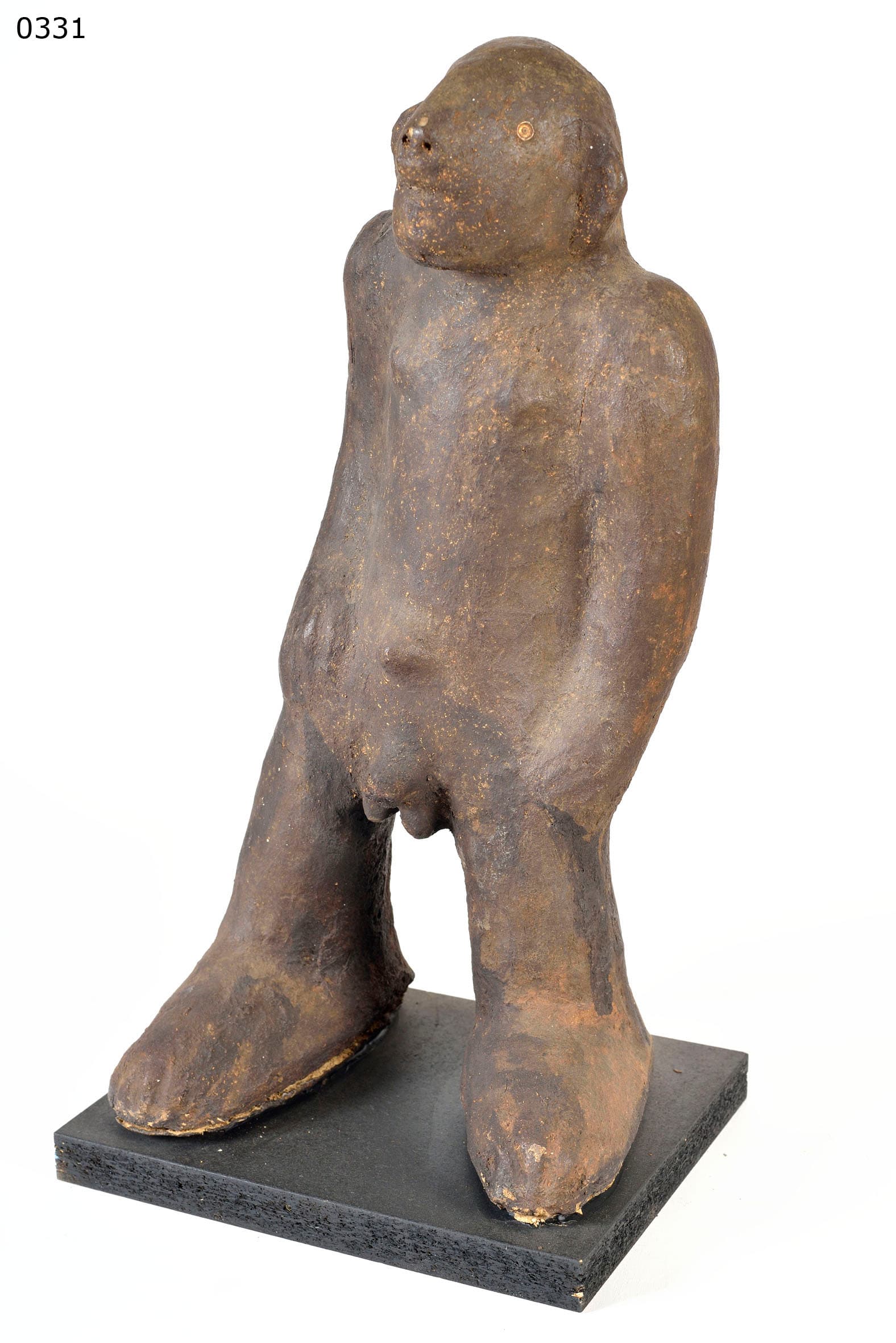
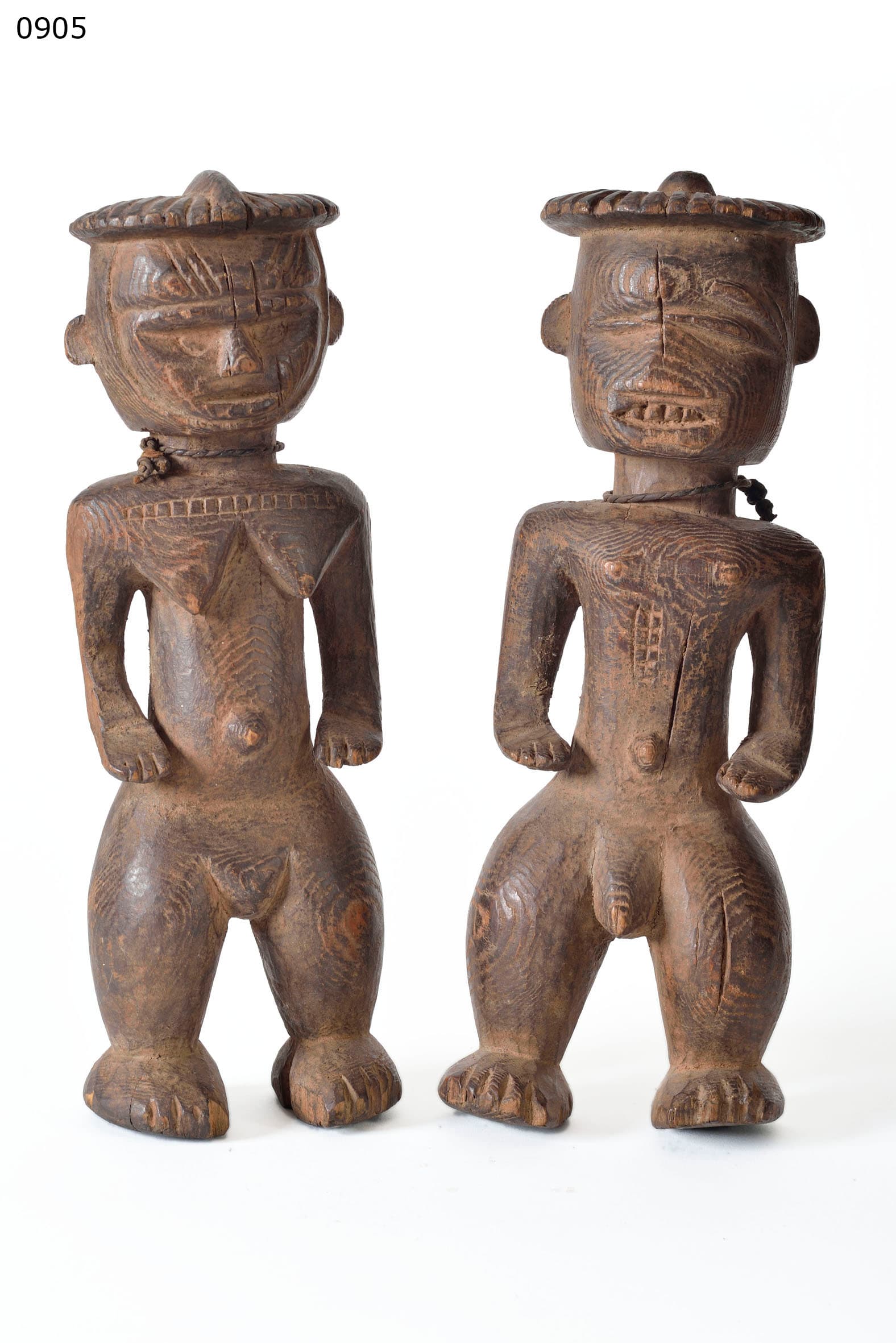
Iconographically characteristic of the Tel figures is a precise geometric organisation of the body, which deconstructs anatomical reality in favour of spiritual essence (Berns 2011: 40). The torso is usually strictly cylindrical, block-like and elongated. In contrast, the legs are drastically shortened, often deeply bent and resting on massive thighs and clumsy feet, giving the figure an earthy, powerful and often crouching presence. The arms are rudimentarily elaborated, characteristically curved forwards or strongly inwards and set off from the body almost in a hard zigzag line; detailed hands are often missing completely or are only indicated by simple notches (Sieber 1961: 16).
Another distinctive, unmistakable feature is the treatment of the head: the head is often spherical to oval, inclined extremely strongly backwards (slanted) and rests organically on a disproportionately thick neck that often merges seamlessly into the torso. The face is radically abstracted and flat; the chin and mouth are completely absent in most classical examples, giving the figure an enigmatic, mute authority. The eye area and a strikingly protruding, often arrow-shaped nose dominate the physiognomy (Zemanek 2015: 18). A bulging, round or pointed belly is also canonical. Iconographically, this prominent navel and abdominal area presumably refers to concepts of fertility, spiritual satiation, the storage of witchcraft power or specific gastrointestinal pathologies that the divinator diagnoses and cures during the consultation.
In art historical research into authorship, the sources for historical African art are often completely obscure, as works usually passed into Western collections without the creator being named. In the case of the Tel, however, the American researcher Roy Sieber documented master hands known by name during his intensive field research in 1958, enabling a rare individualisation of the African artist. The carver Namni, whose workshop style (documented active working phase from approx. 1928 to 1958) decisively shaped and standardised the regional canon and also had a lasting influence on younger carvers in the region, is regarded as absolutely outstanding (Sieber 1961: 15). Namini's works are characterised by a particularly radical geometrisation. Also documented by name is the sculptor Danpeh, who was primarily recorded around 1948 for the excellent carving of Gugwom masks in Lalin (Sieber 1961: 15).
The research controversy surrounding the stylistic delimitation of these figures is intense, of far-reaching significance for the art market and remains unresolved to this day. The debate is crystallised by the divergent scholarly positions of Arnold Rubin (ca. 1968) and Marla C. Berns (2011). In his early publications, Rubin often located the objects in very broad, flowing stylistic clusters and documented the blurring of categorisation in regions where Jukun, Goemai and Tel interacted intensively. He saw the forms as the result of a permanent regional diffusion process (Rubin 1968: 45). Marla C. Berns, on the other hand, fundamentally problematised the Western attempt at strict ethnic fixation in the context of the groundbreaking exhibition Central Nigeria Unmasked (2011, shown at the Fowler Museum at UCLA and the Musée du quai Branly, among others). Berns argues that the striking similarities in form (reductive bodies, cylinder torsos) between Tel (Montol), Goemai and Mama are not necessarily due to a rigid ethnic identity of the carvers. Rather, they result from closely networked ritual institutions and "localised spheres of circulation" in which both the objects themselves and the associated healing rites were traded, adapted and assimilated across borders (Berns 2011: 19). While ethnographers such as Berns and Rubin analysed the ritual and social embedding, actors in the Western art sphere, including the painter and art theorist Klaus Strübel, examined the reductive formal principles of the Montol figures in stark isolation in the context of a universal aesthetic reception in which African abstraction was read as a precursor of modernism. A systematic, quantitative workshop study that differentiates and definitively separates the enormous body of the three groups in terms of style criticism is still lacking in the research literature.
| Object Subtype | Formal Characteristics | Ritual Association | Documented Size |
|---|
| Comtin healing figure | Cylindrical torso, shortened legs, inclined head, often without mouth. Paired or solitary. | Divination, healing the sick, defence against witchcraft within the male covenant | 30 cm - 60 cm |
| Gugwom mask | Horizontally worn helmet mask, zoomorphic features (crocodile snout, bush cow horns), open mouth | Agricultural rites (sowing/harvesting), funerals of important lineage elders | 50 cm - 80 cm (length) |
| Ekwotame type (related) | Seated female figure, often blackened; shows stylistic overlaps with Idoma | Ancestral representation, funerals (placed as a wake at the corpse) | ca. 60 cm |
In addition to the anthropomorphic sculptures, there are also the rare gugwom masks. These zoomorphic helmet masks, usually worn horizontally on the head, imitate highly stylised, martial crocodile or bush cow skulls with wide open, often jagged mouths (Zemanek 2014: 60). They only appear on specific ritual occasions.
The materiality of the artworks is fundamentally characterised by a distinctive patina formation. A metaphysically activated ritual object differs fundamentally from a purely profane carving (such as a toy or a purely prestigious object) through its haptic depth and visual surface. The Komtin figures typically exhibit an "encrusted, dull" or "dark velvety" patina, which often covers the wood to a thickness of millimetres (Zemanek 2006: 36). This crust is not created through intentional painting by the artist, but performatively through repeated ritual libations of blood, millet porridge and vegetable oils over the course of decades.
For the international collectors' market and museum provenance research, these signs of ageing and use are of intrinsic, price-driving importance. Forgery criteria for identifying recent copies primarily include the lack of an organically grown, historically layered sacrificial layer (forgers often use artificial binders and soot). Furthermore, a forgery is unmasked by artificially induced termite feeding, which ignores anatomical cut edges of the wood instead of eating organically from the bottom up, as well as the lack of authentic heartwood cracks. The latter are caused exclusively by decades of natural contraction of the wood in the extremely dry savannah air of the Harmattan wind and are difficult to simulate artificially in the kiln in a physically correct way (Zemanek 2014: 60).
Ritual practice
The ritual practice of the Tel is inextricably linked to the performative activation, ongoing use and cyclical disposal of their sculptures and masks. The abstract wooden sculptures of the Komtin covenant are by no means passive representational figures, decorative elements or mere "ancestral portraits" in the Western sense. Rather, they are operative spiritual vessels or, as ethnographic theory puts it, "invented spirits" (Siroto 1976), which unfold a highly specific, magical power (agency) as soon as they are ritually charged (Cole 2012: 45). Before their activation, they are merely worked blocks of wood without immanent power.
The lifecycle of a Tel ritual object begins with the mundane process of felling and carving, but this must necessarily take place in secret, away from the view of women and non-initiated children. The name of the carver is kept strictly secret in the case of ritually active masks in order to preserve the illusion that the object was not created by human hands but emerged as an entity from the spiritual sphere (Sieber 1961: 15). As soon as the wooden object is plastically completed, it requires an initial, complex activation ceremony in order to be transformed from a profane artefact into a powerful object-subject (Rakita & Porubcan 2023: 53).
This fundamental activation is performed exclusively by the designated Komtin priest or a high-ranking divinator. When diagnosed with an unexplained illness (such as infertility, mental confusion or chronic fever) or to avert an impending collective calamity (for example, an approaching epidemic or a prolonged drought), the affected patient or village community consults the divinator. The divinator uses the newly carved or already tried and tested sculptures in an elaborate ritual structure. During the consultation, the figures are usually placed directly on the rammed earth floor or on small, raised earth altars in order to establish contact with the chthonic sphere of the ancestors.
The offerings made, which energise the object, are strictly regulated and follow a precise hierarchy of power. There are many reports of blood sacrifices (mostly chickens or goats, in extreme crises more rarely also pigs), whose fresh blood is ritually poured over the torso and head of the figure. This blood is almost always mixed with crushed millet porridge (millet) and red padouk wood flour, whose colour evokes the life force and sacred blood (Sieber 1961: 15). These tough, organic crusts dry in the heat and symbolically nourish the spirit inherent in the wood. In the case of a successful healing, which is confirmed by the divinator, the patient is ritually and socially obliged to provide the Komtin covenant with another goat and large quantities of millet for a subsequent feast of sacrifice and joy that celebrates the restoration of cosmic balance (Sieber 1961: 16).
The activated and therefore extremely dangerous sculptures are stored outside of ritual times in special, grass-covered round huts, which are often referred to as dodos in ethnographic literature. These darkened shrines are often decorated at the entrances and walls with the bleached trophy skulls of sacrificial animals or prestigious hunting prey and form the inaccessible spiritual epicentre of the homestead (Zemanek 2015: 10). Here, in the darkness, the figures are kept 'warm' and active by periodic, lighter libations of palm wine or oil. If the figures are taken out of the shrine for a specific ritual, all men involved must observe strict food and sexual taboos. If this is not done, the priest is considered ritually defiled and risks contaminating the purifying, healing power of the object, which can result in the death of the patient or the priest himself (Sieber 1961: 15).
The masked performance at the Tel manifests itself in a completely different, far more public way, primarily in the dramatic appearance of the Gugwom masks. These masks accompany and sanction the critical phases of the agrarian cycles, especially the risky planting season and the crucial millet harvest. In addition, they appear at the funeral ceremonies of important elders of the Komtin confederation, but explicitly do not function at their political enthronement, which underlines their purely spiritual-purifying function (Sieber 1961: 15). The mask wearer usually performs concealed in a complete, voluminous costume made of dried grass fibres, which completely dissolves his human contours, makes him completely anonymous and visually and ontologically dissolves the boundary between the human and spiritual worlds for the duration of the dance (Zemanek 2009: 193).
The deactivation and eventual disposal of the objects marks the natural end of their lifecycle. If a wooden figure loses its ritual power over the decades because prayers fail, if it is severely damaged by accidents, or if the priest caring for it dies without passing on the specific incantations to a successor, the object is robbed of its function. It is removed from the dodo shrine and often simply neglected at the edge of the homestead or in the bush. The hot and humid climate of the rainy season and the aggressive termite infestation quickly destroy the unprotected, soft wood. This rapid process of decay is not mourned by the Tel as a tragic cultural loss, but understood as a necessary, natural return of organic matter and spiritual energy to the earth (Sieber 1961: 17). The figure fulfilled its purpose. It was only through the massive intervention of Western collectors and museums from the middle of the 20th century that this indigenous cycle of disposal and renewal was abruptly interrupted. The Musée du quai Branly (Paris), which presented masterpieces from the Middle Benue as part of the highly acclaimed Nigeria exhibition, impressively illustrated the consequences of this Western intervention in its curation: the figures, often heavily marked by ritual use and termite infestation, were mounted on plinths, frozen in climatic display cases as eternal aesthetic monuments and completely robbed of their temporary, processual and ephemeral character (Quai Branly 2012).
Historical context
The historical reconstruction of Tel culture and its artistic production is a highly complex endeavour which, due to the lack of comprehensive indigenous, pre-colonial written sources, is primarily based on linguistic archaeology, the meticulous evaluation of oral traditions (Oral History) and the early, often Eurocentrically coloured colonial reports. The migration history of the Chad-speaking groups to the inaccessible regions of the Jos Plateau is dated by some scholars and linguistic models to well before 1000 AD, making them one of the longest continuously settled populations in the region (Joshua Project 2023). The Tel established themselves strategically in the valleys protected by steep hills. This geographical choice proved vital during the massive, brutal expansion of the Fulani jihadists under Usman dan Fodio in the early 19th century. The rugged plateau offered effective physical protection from the feared cavalry attacks of the Sokoto armies and the associated systematic slave raids that depopulated the flat land (Adeleye 1971: 32). During this phase of existential threat, the hermetic cult societies consolidated themselves as places of internal solidarity.
The colonial encounter with the British Empire from the early 1900s onwards, characterised by rapid military subjugation and the subsequent establishment of indirect rule, changed the region administratively and socially in profound ways. The "Pax Britannica" enforced by the British administration with military force largely ended the intertribal wars and raids, but at the same time artificially froze dynamic ethnic boundaries. This had an immediate, seemingly paradoxical impact on artistic production and everyday ritual life: for the first time, pacification enabled an unprecedented, safe increase in intertribal trade over long distances. Ethnographers such as Roy Sieber were astonished to discover in the 1950s that some Tel healers no longer carved their ritual figures themselves, but imported them from distant Kanam markets or purchased them from neighbouring groups such as the Piapung (Sieber 1961: 15). This newly created commercial market for cult services and ritual objects led to a rapid hybridisation of carving styles in the 20th century. It is precisely this stylistic blending, accelerated by colonialism, that today makes it extremely difficult for curatorial institutions such as the Rietberg Museum (Zurich) or the Metropolitan Museum of Art (New York) to draw clear, unambiguous ethnic and stylistic boundaries in their African collections.
The market history and reception of Montol art in the West began relatively late, especially in direct comparison to the classical, far more naturalistic art of the Yoruba, Dan or the Kingdom of Benin, which fascinated European collectors as early as 1900. The earliest systematic collector in the inhospitable Benue region was the American art historian Roy Sieber in 1958, whose field study, generously funded by the Ford Foundation, was the first to bring extensive, ethnographically precisely documented and authentic objects from the shrines into American university collections (Sieber 1961: 3). In the following decades, tragically greatly accelerated by the devastating Biafra War (1967-1970) and the associated socio-economic upheavals and looting, a significant number of previously inaccessible works found their way onto the international art market. These were often channelled into private European collections via well-connected dealers and galleries in Paris and Brussels (Zemanek 2009: 17).
| Epoch / Decade | Market Drivers & Historical Events | Effects on Collection & Reception |
|---|
| Before 1950 | Occasional colonial officials (British administration) | Objects often considered too "crude" or "unfinished" to Western eyes; rare exhibits in the British Museum |
| 1950s | Roy Sieber's Ford Foundation Expedition (1958) | First systematic scientific recording and transfer to US university collections |
| 1960s-1970s | Biafra War; socio-economic collapse in Nigeria | Outflow of ritual objects from looted or abandoned shrines to Europe (Paris/Brussels) |
| From 2011 | Exhibition Central Nigeria Unmasked (Fowler/Quai Branly) | Breakthrough of the Benue aesthetic into the high-end market; establishment of the abstract style as masterpieces |
The definitive museum and commercial breakthrough for the abstracting arts of the Benue Valley did not occur until 2011 with the monumental, epoch-making travelling exhibition Central Nigeria Unmasked: Arts of the Benue River Valley. This show, masterfully curated by Marla C. Berns, Richard Fardon and Sidney L. Kasfir, was shown at the Fowler Museum at UCLA, the National Museum of African Art (Smithsonian) and finally at the Musée du quai Branly (Berns et al. 2011: 19). This curation and the accompanying publication established the ultimate scholarly standard for the region and radically changed the market. It catapulted the price trend for Montol figurines in renowned international auction houses (such as Sotheby's and Christie's) from a niche existence directly into the veritable five- to sometimes six-figure range, as collectors now recognised the radical abstraction of the Tel as congenial precursors of classical modernism (Touchaleaume 2013).
However, this rapid, exponential price development has significantly exacerbated the problem of forgery in recent years. Today, the high-priced market for African art demands rigorous, scientifically substantiated authenticity criteria in order to safeguard investments. The following factors are considered to be absolutely relevant forensically and visually for the works of Tel: Firstly, the structure and chemical composition of the patina. An authentic Komtin figure has layers that show microscopic inclusions of old organic material (blood, millet, charcoal, red padouk wood powder) that is deeply embedded in the wood. Secondly, the natural ageing of the wood: authentic heartwood cracks are caused by the extreme, decades-long alternation of oppressive moisture during the rainy season and the extremely dry, crack-forming desert winds of the Harmattan. Thirdly, the specific termite damage that often logically begins on the standing surface of genuine pieces stored in situ in mud huts and penetrates deep into the fibre structure following the natural vascular bundles. Artificial ageing, on the other hand, is usually only applied superficially by forgery workshops using aggressive acids or rotating tools (Zemanek 2014: 60). Experienced private collectors, auction houses and the highly specialised conservators, for example in the modern analysis studios of the Metropolitan Museum of Art, now routinely use UV light analysis, X-ray technology and C14 dating to verify the organic crusts and support wood on Montol sculptures and to legitimise their ritual, pre-commercial biography beyond doubt.