1. overview
The geographical distribution of the Dowayo is primarily concentrated in the northern territories of the Republic of Cameroon, specifically in the foothills and valleys of the Atlantica Mountains and the administrative department of Bénoué in the Poli region. This landscape, which is topographically difficult to access and defined by striking mountain ranges, has historically served as a refuge and significantly favoured the socio-cultural autonomy of the population group. With regard to the current demographic data situation, the utmost scientific caution is required, as the source situation is ambiguous and complicated by fluid ethnic identity attributions in the region. While some more recent demographic surveys and linguistic databases assume a population of around 50,500 individuals (Peoplegroups 2023), more conservative estimates and older ethnographic census models put the core population at only around 30,000 people (Strübel 1984: 42). This significant discrepancy results not least from the problem of state registration in peripheral areas and the methodological difficulty of differentiating between native speakers and multi-ethnic households.
Linguistically, the Dowayo language (often transcribed as Doyayo or Doowaayo) is clearly categorised as belonging to the Adamawa-Ubangi branch of the comprehensive Niger-Congo language family. This categorisation is relevant insofar as it shows the historical distance to the Afro-Asiatic or Nilosaharan-speaking groups of the wider Lake Chad basin (Fardon et al. 2021: 16). A central problem area of ethnographic and art historical research as well as museum inventorying manifests itself in the nomenclature and the associated classification controversies. The self-designation (autonym) of the group is "Dowayo", which in local semantics simply means "people" or "the true people". The term "Namji" (or Namchi, Namshi), on the other hand, is a classic exonym. It is a foreign term that was historically coined by the neighbouring, politically dominant and Islamised Fulbe (Peul). In the perception of the Fulbe, the term "Namji" often carried pejorative connotations and served as a collective term for unbelieving, non-Islamised hill tribes (Kirdi).
On the Western art market and in numerous historical private collections, the term "Namji doll" (namji-doll) has unfortunately established itself as a fixed, albeit taxonomically incorrect and historically loaded term (Krüger 2003: 88). This imprecise nomenclature has led to serious misattributions right up to the present day. It is not uncommon for objects from the neighbouring Verre (Vere), Gimme or Fali to be subsumed under the label "Namji", which makes a precise formal and ritual distinction difficult (Chappel, Fardon & Piepel 2021: 16). The Musée du quai Branly - Jacques Chirac in Paris exemplifies this classification controversy in its extensive holdings. The museum's digital database lists hundreds of thousands of artefacts, but objects from northern Cameroon often have multiple ethnonyms or taxonomic uncertainties (marked by question marks in the classification) in order to do justice to the unclear provenance between Dowayo and Verre.
The social structure of the Dowayo is strictly patrilineal and largely acephalous. There is no superordinate, centralised political authority or royalty, as is the case in the neighbouring Sudanese states or the emirates of the Fulbe. Instead, society is organised into segmentary clan structures that are linked by a complex kinship system and specific ritual obligations. Recent anthropological research on kinship ecologies emphasises that in such acephalous systems, the role of women in food processing (especially in the brewing of millet beer, which is essential for all rituals) is the fundamental link in household formation and intergenerational kinship (Merton 1988: 231; Formosa 2023).
An outstanding sociological constant that forms the backbone of material art production is the extremely sharp segregation between the common farmers and the specialised professional caste of the blacksmiths. The blacksmiths and their female relatives (who usually had a monopoly on pottery) formed a strictly endogamous group. The prohibition of exogamy between smiths and non-smiths is legitimised and maintained by deep cosmological taboos (Sterner & David 1991: 35). The subsistence economy of the majority society is based on extensive hoeing. Primary crops are sorghum (guinea-corn), peanuts, cotton and kapok, supplemented by small livestock such as goats and chickens, which are essential for ritual sacrifices (Barley 1983: 145).
The relationship with neighbouring peoples has historically been characterised by a dichotomy of resistance to assimilation and cultural exchange. While the Dowayo consistently resisted the Islamic Fulbe and defended their indigenous cosmological systems, there was a fluid exchange of ritual practices and aesthetic concepts with neighbouring animist groups such as the Verre or Duru. The controversy of classification (Verre vs. Dowayo) is thus not only a problem of Western collectors, but reflects the real permeability of cultural boundaries in the Atlantica Mountains, where carvers of ethnic minorities made artefacts in the style of the regional majority to meet the ritual needs of their neighbours (Chappel, Fardon & Piepel 2021: 66).
| Demographic and Linguistic Taxonomy | Specification / Data |
|---|
| Primary settlement area | Atlantica Mountains, Département de la Bénoué (Cameroon) |
| Linguistic classification | Adamawa-Ubangi (Niger-Congo language family) |
| Autonym (self-designation) | Dowayo / Doyayo / Doowaayo ("the people") |
| Exonym (foreign designation) | Namji / Namchi / Namshi (historically characterised by Fulbe) |
| Population estimate (recent data) ~50,500 (Peoplegroups 2023) | |
| Population estimate (conservative) | ~30,000 (Strübel 1984) |
| Social organisation | Acephalous, patrilineal, segmentary clans |
| Economic system | Crop cultivation (sorghum, peanuts, cotton), small livestock |
2. cultural context
The religious system of the Dowayo is by no means an amorphous conglomerate of animistic ideas, but a highly structured, institutionally anchored cosmological order. This order is based on the premise that the physical world is continuously permeated by ancestral spirits and localised nature and earth entities, whose ambivalence must be controlled through permanent ritual calibration. While the spiritual universe recognises concepts of a distant creator god, everyday ritual practice is focused on immediate beings. Maintaining the fertility of land and people is the responsibility of specific ritual authorities whose spheres of power are compartmentalised and must not overlap.
The highest agrarian authority is the "Master of the Earth" (Master of the Earth). This priest acts as a sacred mediator between the village community and the chthonic spirits; he controls the fertility of all plants and decides on the agricultural cycle (Jones 2021). The relevance of the exact local context of such authorities is illustrated by the records of Nigel Barley (1983: 166), who impressively describes how the lack of rudimentary contextual information - such as ignorance of the fact that a specific village was the seat of the Earth Master - can fundamentally distort Western ethnographic interpretations. In addition to the earth master, there are rainmakers who are responsible for the meteorological balance, as well as divinators who are consulted on an individual level in the event of crises, illness or infertility.
What distinguishes the Dowayo religion most structurally from Islamised neighbouring peoples, but also from more hierarchical animistic cultures, is the ritual dual role of the endogamous blacksmith caste. In the cosmology of the Dowayo, blacksmiths are not merely artisanal producers of material culture (such as iron weapons, jewellery or wooden figures), but the exclusive ritual administrators of death and transition. They act as undertakers, lead the complex skull festivals and carry out the exhumation and ritual cleansing of ancestral skulls. This deep structural linkage between metallurgical transformation and the management of death creates an aura of danger and impurity, which the social segregation of the blacksmiths enforces (Barley 1983: 108-112). The British Museum (London) documents in its extensive collections artefacts from the Dowayo ancestral cult, whose patination and ritual wear bear witness to precisely this exclusive handling by the blacksmith caste.
There is a sharp controversy within ethnographic research regarding the socio-political implications of this blacksmith role (Boyer vs. Barley). Pierre Boyer (1983: 33) postulates that the blacksmiths possess a hidden, far-reaching spiritual superiority and political power ambition in the otherwise acephalous society due to their exclusive knowledge of metallurgy and their control over mortuary rituals. Nigel Barley (1983: 112) vehemently disagrees with this interpretation. He dates and contextualises the position of the blacksmiths completely differently and argues that they are viewed by mainstream society more as socially isolated, potentially impure service providers. For Barley, their function is of a pragmatic nature; they are performers of dangerous metaphysical "dirty work" without being able to derive political hegemony from it. The source situation regarding the true power-political intentions of the blacksmiths is thus ambiguous and strongly dependent on the theoretical focus of the respective ethnographer.
The central initiation and transition rituals form the performative centre of the religious system. Male initiation is centred around circumcision (Gangni), an elaborate and often brutal ritual of separation and reintegration. The boys are undressed by the circumcisers - again members of the blacksmith caste - at crossroads and led into isolated riverine forests. The ritual actors imitate the roar of hunting leopards to emphasise the metaphysical danger of the transitional space (Barley 1983: 122). Pain and terror are calculated instruments to destroy the childish ego and cement the new status as an adult man.
In contrast to this is female initiation (dei-ki), which is structurally less focussed on physical shock and more on ensuring fertility and integration into the matrilineal and patrilineal networks. The role of the woman in the cult is of intrinsic importance, as she metaphysically secures the continued existence of the clan by caring for the ritual wooden figures. While men act through the control of the skulls of the dead and ancestral altars, women orchestrate the sustainability of society through fertility cults that are deeply rooted in the material utilisation of specific anthropomorphic artworks.
3. aesthetic features
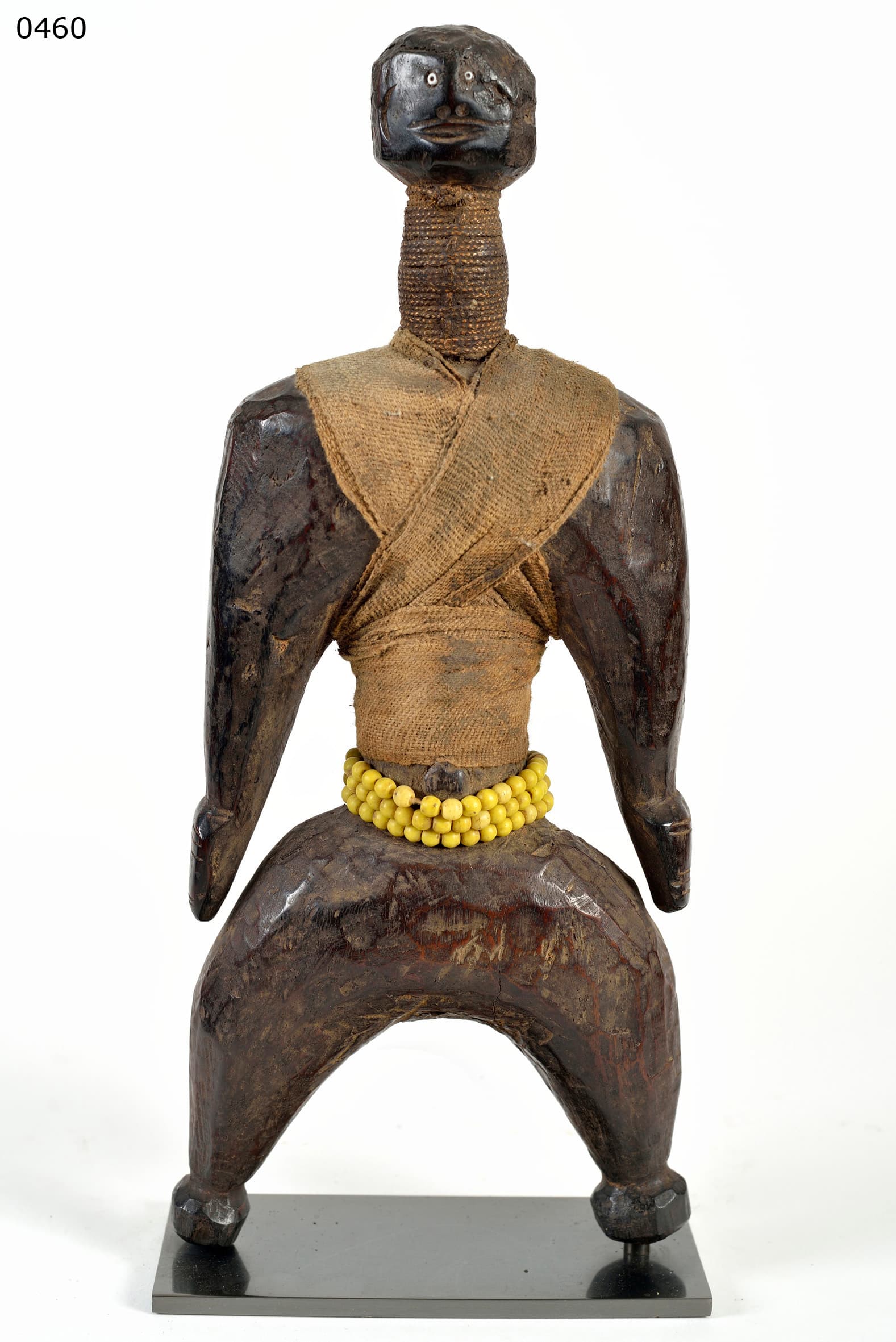
The visual culture and artistic work of the Dowayo are dominated almost unchallenged by a canonical object typology: the anthropomorphic sculptures, which are classified in Western reception as "Dowayo dolls" (namji-dolls). The canon of proportions of these objects is characterised by a radical, almost cubist-like geometric abstraction that negates all naturalism. The canonical structure is based on a strongly elongated, cylindrical or columnar torso that merges seamlessly into a disproportionately long neck. The most defining iconographic feature is the reduction of the shoulder-arm and hip-leg parts to block-like, stylised inverted U-shapes or horseshoe-like constructions, which are often executed without recognisable joint articulation (Chappel, Fardon & Piepel 2021: 66). The head is usually small in relation to the massive body structure, often in a conical or flat disc shape, and has rudimentary, greatly reduced facial features (minimal indentations for eyes and mouth). The size spectrum of these sculptures is considerable and varies from small amulet figurines measuring 14 centimetres in height to monumental altar figurines measuring over 40 centimetres (Leloup 2023).
The choice of material reveals a highly complex, additive process of creation that makes a sharp distinction between the unactivated, profane wooden core and the ritually charged object. The basal support material is solid hardwood (often local African rosewood, historically also other dense species), which is carved from a single block by the smiths. In this naked state, the figure is a profane workpiece. The sacred agency and aesthetic perfection only emerge through the elaborate panelling: The sculpture is densely wrapped with strands of colourful glass beads, kauri snails (Monetaria moneta), coins, strips of leather, animal fibres and occasionally metal appliqués (Cameron 1997: 18; Rogl 2024). These materials are not to be interpreted as mere decoration, but as essential carriers of ritual significance and social status markers.
The development of patina on authentic objects is a cumulative, organic process that takes place over decades. The permanent physical contact of the wearer - the interaction with sweat, sebum and body heat - as well as repeated ritual anointing with red palm oil, camwood powder (Baphia nitida) and lubricated liquids cause the wood to develop a deep dark, encrusted and in places shiny surface. The identification of such an authentic, organically grown patina is the primary criterion for authenticity.
In international art historical research, there is an explicit iconographic controversy regarding the semantics and primary function of these figures (Cameron vs. Krüger). In her work on the "agency" of African dolls, Elisabeth L. Cameron (1997: 18-33) decidedly postulates that these Dowayo objects are by no means profane children's toys. She interprets them as highly effective, spiritually charged surrogates that are prescribed by divinators as a medical-spiritual intervention in cases of female infertility. In contrast, Klaus Krüger (2003: 88) argues on the basis of older ethnographic observations that a significant number of these sculptures served primarily as didactic toys (plaything) for young girls to introduce them to the social and emotional responsibilities of motherhood. Today's ethnological synthesis tends towards a fluid spectrum of meaning: an object can begin as a profane learning tool and later in a woman's life be activated into a sacred fertility amulet.
While the art of the Dowayo is usually traded on the market as anonymous tribal art, precise field research has been able to document a few master craftsmen and individual workshops. One outstanding documented example is the carver Modari of Cholli, who was identified by the ethnographer Tim Chappel in 1966. Modari, then about forty-five years old, was ethnically from the Verre group, but made sculptures exactly in the Dowayo style. He claimed to have copied these figures (e.g. the pieces 66.JII.664 and 66.JII.665 in the Jos Museum) after the model of an old master (Fardon & Piepel 2021: 225). This case impressively demonstrates the permeable aesthetic boundaries and the interethnic trade in ritual objects in the Adamawa region.
As these sculptures fetch top prices on the market, counterfeiting criteria are of eminent relevance. Forgeries and tourist replicas are characterised by machine-like, precisely symmetrical carving marks, artificial ageing using shoe polish or chemical stains and the absence of natural heartwood cracks. A forensically reliable criterion is the analysis of the glass beads: while authentic, museum pieces - such as the figure 1997/1.341 in the University of Michigan Museum of Art (UMMA) or the specimen Acc. 1983.159 in the Metropolitan Museum of Art - feature historical Venetian trade beads (Trade Beads) or old millefiori glasswork, forgeries are almost invariably decorated with modern, industrially manufactured Czech or Asian seed beads.
| Criterion | Authentic ritual object | Profane forgery / souvenir |
|---|
| Surface / patina | Deeply penetrated, organic (palm oil, sweat, camwood), encrusted | Superficial, artificially applied (stain, shoe polish), even |
| Wood structure | Natural heartwood cracks, asymmetrical wear, oxidised | Perfectly preserved, no cracks, symmetrically machined |
| Material application | Historic Venetian trade beads, worn leather, kauri | Modern Czech seed beads, synthetic threads, new kauri |
| Weight & feel | Heavy (hardwood), bead strands sit firmly and organically | Light (inferior wood), beads appear sterile and subsequently fixed |
| Carving dynamics | Subtle asymmetries, traces of tools (chisel) recognisable by hand | Geometrically perfect, edges often smoothed with sandpaper |
4. ritual practice
The ritual use of Dowayo art objects is not a static state, but a highly dynamic, performative practice that unfolds as a continuous lifecycle over decades. At the centre of this practice is the interaction between the human wearer and the anthropomorphic object, which is understood as an entity with its own spiritual agency. The life cycle of the canonical sculpture begins in the isolation of the blacksmith's workshop. The naked corpus, freshly carved from rosewood, is initially an empty material shell. Only the diagnosis of a divinator, who orders its acquisition in the event of a failed pregnancy or in preparation for a marriage, initiates the ritual transformation (Cameron 1997: 20).
The activation of the object is a multi-layered, processual act. The husband-to-be or older female relatives initiate the dressing of the sculpture. By wrapping dense strands of specifically coloured glass beads, Kauri snails and leather amulets around the figure, it is ritually "clothed" and thus integrated into the society of living people. The colour symbolism of the beads often reflects the specific status of the woman and the urgency of her request. After the physical endowment, the actual activation takes place through libations: The figure is anointed with red palm oil and often given a special name. From this point onwards, it no longer functions as a wooden sculpture, but as a metaphysical surrogate for the longed-for child and as a highly potent fertility amulet.
The central mask or sculpture performance consists of the physical and emotional fusion of woman and object. In contrast to objects from other West African cultures, which rest in darkness on stationary ancestral altars, the Dowayo sculpture demands permanent visibility and mobility. The wearer treats the figure exactly like a living infant. She carries the object strapped to her back in a sling (strapped to the back) for all everyday activities in the field and in the household (Strübel 1984: 55). The performance includes the ritual "feeding" of the figure by coating the mouth area with porridge, speaking to the object and carefully cleaning the strands of beads. This performative mimesis of motherhood is intended to persuade the spirits of nature and ancestors to open the woman's physical body for a real conception.
In addition to this primary use, there are highly interesting regional variants that demonstrate the embedding of the figures in the wider ritual calendar of society. Documentation indicates that neighbouring Verre women and occasionally Dowayo members use these wooden figures to dance ecstatically after the completion of the bloody male circumcision rituals (Gangni). Here, the figure functions as a symbol of matrilineal continuity, which counters the pain and mortal danger of male initiation with the life-giving power of the woman. Figures were also held on loan by young boys in the context of female initiation rites (dei-ki), specifically during the zangazaar beer ceremony, in order to didactically teach them the social consequences of marital duties (Chappel, Fardon & Piepel 2021: 66).
The ritual landscape of the Dowayo also includes the use of small earth altars, which are erected to appease territorial earth spirits or to ward off drought. The construction of these altars is rudimentary; they mostly consist of accumulated, unhewn stones and half-buried clay pots. The offerings at these altars are strictly regulated. At the beginning of the planting season or in times of crisis, millet beer is libated here and chickens or goats are ritually slaughtered, their blood being poured over the stones to nourish the spirits. The faithful often also place iron jewellery on these altars to link the transformative and earthbound power of blacksmith magic with the fertility of the soil.
The deactivation or disposal of the ritual object once its purpose has been fulfilled is of the greatest sociological significance. As soon as the wearer successfully conceives and gives birth to a healthy child, the object has fulfilled its primary magical purpose. However, it is by no means carelessly discarded or burnt, as it carries a part of the child's spiritual essence. The deactivation takes place through a gradual withdrawal from the public sphere. The figure is carefully stored in a special wooden box or basket inside the house (Rogl 2024). Within the matrilocal structures, it henceforth functions as a ritual heirloom and is later often passed on to one's own daughter as a wedding gift. Each new generation of owners adds their own strands of beads and amulets to the figurine, making it a cross-generational chronicle of the female bloodline.
Research and inventory analyses, such as those conducted in the Himmelheber Archive of the Museum Rietberg (Zurich), shed light on the most dramatic break in this lifecycle: the sale to Western dealers. When an impoverished family is forced to sell the object, the matrilineal chain is finally severed. This profane act of commercialisation marks the ultimate deactivation of the object, which from this moment on is deprived of its agency and continues to exist in the depots of Western museums or private collections as a purely aesthetic, dead artefact.
5. historical context
The historical localisation of the Dowayo is the result of a migration history marked by violence and repression, the reconstruction of which is still the subject of academic debate today. The dating controversies regarding their arrival and consolidation in the inhospitable Atlantic mountains polarise historical anthropology. While some linguists and archaeologists assume an autochthonous presence since the 15th century due to deep local roots, historians (cf. Sterner & David 1991: 34) argue that the Dowayo were only massively forced into the mountain regions in the late 18th and early 19th centuries. The catalyst for this dramatic population shift was the Islamic Fulani jihad (Holy War) under the cleric Modibo Adama. The brutal expansion of the Sokoto Caliphate forced non-Islamised, segmented groups to abandon their ancestral plains and move to topographically inaccessible mountainous territories. Although this geographical isolation saved the Dowayo from cultural assimilation and enslavement, it cut them off economically from the lucrative trans-Saharan trade networks.
The first formal colonial encounter did not take place until the late 19th century, when the German Empire claimed the region as part of the Cameroon Protectorate, followed by the French Mandate administration after the First World War. Early ethnographers, including prominent figures such as Leo Frobenius, roamed the region, but their records were often distorted by Eurocentric arrogance and a lack of understanding of the decentralised structures of the hill tribes. The influence of colonial history on the Dowayo's material art production, however, was massive and highly transformative. The imperial pacification of the region and the opening of new, secure trade routes led to an uncontrolled influx of European industrial products. This manifested itself most clearly in the substitution of traditional ornamentation. Whereas pre-colonial sculptures were still primarily decorated with red and black seeds of the paternoster pea (Abrus precatorius) or local ceramics, the Dowayo now adapted imported Venetian glass beads (millefiori and chevron) on a large scale, which reached the mountains via the Fulbe trade. Imported metal files and tools from Europe also rationalised the working process of the wooden bodies, which led to a slight smoothing and symmetrisation of the later historical objects (Fardon & Piepel 2021: 225).
Compared to other African art regions (such as Mali or the Congo), the market-historical breakthrough of Dowayo art in the West came remarkably late and was the result of a singular literary publication. Until the early 1980s, the Dowayo remained an ethnographic fringe phenomenon. This changed abruptly with the publication of the book The Innocent Anthropologist: Notes from a Mud Hut (1983) by Nigel Barley. Barley's objective, analytical, often cynical and relentlessly reflexive dismantling of all romanticised field research myths brought the ritual world of the Dowayo to the attention of a broad, academically and culturally interested Western public for the first time. His detailed descriptions of the material culture acted as an unconscious catalyst for the art market.
As a result, Dowayo objects experienced breakthrough exhibitions in major European galleries and institutions in the late 1980s and 1990s. The price trend was exponential. While in the 1970s the first collectors were still acquiring the figures locally for rudimentary exchange values, authentic, historically verified sculptures have now established themselves in the top price segment of the market. The auction of Hélène Leloup's legendary collection (Le Journal d'une Pionnière, Vol. I) at Sotheby's in Paris in June 2023 illustrates this development succinctly: a specific lot (lot 23), consisting of two ritually patinated Namji dolls, was traded with a preliminary estimate of EUR 4,000 to 6,000 (Leloup 2023). Other renowned auction houses such as Bonhams in Brussels have recently even recorded hammer prices in the five-figure range (over EUR 10,880) for exceptional, large-format examples (Bonhams 2025).
This massive commercialisation inevitably evoked a profound counterfeiting problem. Since the late 1990s, local carving workshops in Cameroon have been mass-producing the figures as purely decorative souvenirs for the export market. These pieces often cater to Western stereotypes of "African aesthetics", but have no ritual connection whatsoever. The authenticity criteria for collectors and institutions have therefore shifted to strict forensic parameters. In order to validate the genuine function, experts analyse the chemical composition of the patina (which must contain organic residues of palm oil and sweat), look for traces of organic termite damage, which indicates long-term storage in traditional mud huts, and evaluate natural heartwood cracks caused by the decades-long drying process of the hardwood. Another essential criterion is glass bead provenance. Institutions such as the Royal Museum for Central Africa (RMCA / Tervuren) use microscopic analyses to distinguish old, irregular Venetian trade beads from modern, perfectly round Czech glass beads, which almost inevitably expose forgeries. Only when wood ageing, organic patina and historical bead provenance are congruent can an object be unequivocally attributed to the ritual era before the market explosion.
| Market and Epoch Phases of Dowayo Art | Characteristics / Event | Materiality & Reception |
|---|
| Pre-colonial phase (before 1890) | Regional isolation, production for local ancestor and fertility cult | Abrus seeds, rudimentary processing, deep organic patina |
| Colonial phase (ca. 1890-1960) | Influx through European trade routes, first vague reports by Frobenius | Integration of Venetian glass beads (trade beads), use of files |
| Scientific exploration (1960s-1980s) | Field research (Modari of Cholli documented), Barley's publication 1983 | Objects occasionally find their way into Western museums as ethnographic evidence |
| Market explosion (1990s-2010s) | High demand in the West, first major gallery exhibitions, price boom | Commercialisation begins, first generation of high-quality replicas |
| Present (2020s-2026) | High-price segment at Sotheby's / Bonhams (up to > EUR 10,000), strict forensics | Separation of antique ritual object (RMCA / Rietberg examined) and mass souvenir |