Overview
According to current archaeological and ethno-historical research, the geographical distribution of the population known as Tellem is almost exclusively limited to the Falaise de Bandiagara in what is now central Mali. This striking sandstone massif, which stretches over a length of almost 200 kilometres and has vertical drop-offs of up to 600 metres in height, formed a natural refuge that was difficult to access. The material, textile and physical remains of this culture have been exceptionally well preserved over the centuries in the cliff caves of this massif, which were created by natural erosion due to the extremely dry microclimate. As the Tellem are a purely archaeological and prehistoric to early modern pre-Dogon population, the current population estimate is naturally zero. The historical demography can only be estimated by extrapolating archaeological sites; however, population dynamic analyses indicate a dense and complex settlement structure during the flourishing period between the 11th and 15th centuries.
The linguistic categorisation of the Tellem is the subject of complex deductive research, as the population left no written evidence. The source situation is ambiguous, which is why research is based on linguistic-historical reconstructions of neighbouring and successor populations. The majority of researchers postulate that the Tellem belonged to the Mande or Soninke groups. This hypothesis correlates with historical migratory movements, in particular the Soninke diaspora, which was triggered by the collapse of the Wagadou Empire (the historical Ghana Empire) in the north-western Niger inland delta and drove populations into the Bandiagara massif. Additional linguistic anomalies in the region, such as Bangime - an isolated language with no demonstrable genealogical relationship to other language families, whose speakers (the Bangande) are genetically isolated from the surrounding Dogon - complicate the picture and testify to long-lasting, stratified processes of isolation and integration in this micro-geographical niche.
In terms of nomenclature, a distinction must be made between self-designation (autonym) and external designation (exonym). The autonym of the population is unknown to science. The term "Tellem" (or Temmem) is an exonym and originates from the idiom of the subsequent Dogon population. The term literally means "we have found them" and explicitly refers to the chronological contact and spatial takeover of the cliff caves by the Dogon in the 14th and 15th centuries.
The social structure of the Tellem can primarily be deduced from the analysis of burial practices and the spatial organisation of the cave architecture. The elaborate layout of the niches and the partly collective, partly individualised burial objects (including rare glass beads from the Middle East) indicate a hierarchically structured or at least strongly stratified society that was integrated into supra-regional trade networks. Hélène Leloup also argues that the social structure of pre-Dogon and early Tellem societies may have had matriarchal characteristics, which she deduces from the dominant ritual position of female ancestor figures in the iconography.
The subsistence strategy of the Bandiagara people was based on a system of agropastoralism adapted to the arid and topographically demanding conditions. Archaeobotanical flotation analyses of soil layers from the Ounjougou project show that, in addition to hunting and gathering wild fruits, they mainly cultivated pearl millet (Pennisetum glaucum), sorghum (Sorghum bicolor), African rice (Oryza glaberrima) and fonio (Digitaria exilis).
The relationship to neighbouring peoples and the chronocultural classification of the Tellem represent one of the most prominent archaeological discourse complexes in West Africa. The controversy centres on the question of continuity versus discontinuity. In the 1970s, the archaeologist Rogier M. A. Bedaux established the so-called "Toloy-Tellem-Dogon" sequence through excavations commissioned by the University of Utrecht. This model postulated three strictly separate phases that were separated by massive temporal and cultural hiatuses: The Toloy (3rd to 2nd century BC), followed by a gap of over a thousand years, then the Tellem (11th to 15th century AD) and finally the Dogon. Bedaux argued in favour of a biological and cultural population replacement.
However, more recent research, in particular the field research projects led by Eric Huysecom and Anne Mayor in the context of Ounjougou, mark this older model as outdated. By systematically re-dating architecture and pottery in caves such as Dourou-Boro and Pégué, they were able to prove that the spiral clay structures previously classified as Toloy granaries were in fact primary burial sites, showing a continuous chronocultural evolution over 1800 years (from the 4th century BC to the 14th century AD). The classification debate is so significant that curators in museums such as the Museum Rietberg in Zurich or the Musée du quai Branly often have to choose hybrid designations such as "Tellem/Dogon transitional period" when cataloguing early wooden sculptures in order to do justice to the archaeological complexity.
| Chronological model | Main representatives | Core statement | Archaeological methodology |
|---|
| Discontinuity (phase model) | Rogier M. A. Bedaux (1972) | Three isolated populations (Toloy, Tellem, Dogon) with massive temporal gaps and population replacement. | Craniometrics, early C-14 data, architectural separation. |
| Continuity (evolutionary model) | Eric Huysecom, Anne Mayor (from 1997) | 1800 years of continuous colonisation and cultural evolution without a 1000-year hiatus. | High-precision AMS C-14 dating on clay temples, archaeobotanical analyses. |
Cultural context
Due to the lack of written primary sources, the religious system of the Tellem can only be reconstructed through a combination of archaeological findings, material remains and ethnoarchaeological conclusions from the religion of the subsequent Dogon. At the centre of the cosmological order were complex ancestor cults, the worship of nature spirits and a strongly pronounced care of the dead. The sacred topography was of paramount importance here: the inaccessible cliff caves high up in the rock face functioned not only as necropolises to protect the corpses, but also as liminal zones that connected the physical world of the living with the metaphysical world of the ancestors.
The cosmological order of the region is often understood in research as a continuum between the early cliff dwellers and the Dogon. This system is dominated by the creator god Amma, who created the universe, and the Nommo - androgynous primordial or spiritual beings associated with water and fertility. These Nommo beings play a central role in spiritual purification and the maintenance of cosmic balance. Ritual authorities most likely manifested themselves in the form of healers, diviners and high-ranking priests. Among the recent Dogon, ritual leadership is the responsibility of the Hogon, a sacred leader who often interacts with the ancient relics of the Tellem; analogous priestly functions, especially in initiation and rain rites, are assumed for Tellem society.
The role of women in the cult is the subject of intense debate in academic literature. Hélène Leloup argues on the basis of iconography (especially sculptures from the Djennenke and Tellem environment) that the accumulation of prominent female ancestor figures (maternité representations) is an indicator of a formerly matriarchal social structure or at least of a matrilineal spiritual authority in which female ancestors functioned as primary intermediaries between the community and the cosmos.
Central rites of passage manifested themselves in the burial practices documented in detail. The physical placement of the dead in the caves, sometimes using elaborate rope constructions, marked the transition from earthly existence to the status of a revered ancestor. Anthropology often applies the models of Robert Hertz and Arnold van Gennep, according to which death is divided into physiological separation, a liminal transition phase and the subsequent incorporating ritual-cultural phase. The architectural design of the tombs - spiral clay structures that evolved over centuries from primary to collective burial sites - testifies to the enormous importance of this ritual incorporation.
What distinguishes this religion structurally from that of neighbouring peoples who settled on the plains is the extreme verticality of the cult space. While peoples of the plains used earth altars or ground-level shrines, the Falaise de Bandiagara functioned as a stone axis mundi. The caves formed a vertical connecting line between the chthonic (earthbound) and celestial spheres.
There is a sharp controversy within the research community (Bedaux vs. Leloup) regarding the religious-cultural continuity. Rogier M. A. Bedaux takes the position of absolute discontinuity: the Tellem had disappeared biologically and culturally, and the subsequent Dogon had merely occupied the statues found in the caves at a later date and endowed them with new ritual meanings of their own, which had nothing to do with the original Tellem religion. In extreme contrast, Hélène Leloup argues in favour of a profound stylistic and religious continuity. She postulates that the Dogon adopted the Tellem iconography - in particular the prayer gesture of the raised arms - through cultural osmosis and that the religious concepts of the Tellem formed the foundation of Dogon cosmology.
Interdisciplinary bioarchaeological studies attempt to shed light on this controversy. Isotope analyses of human remains from the caves (curated in collections of the Royal Museum for Central Africa (RMCA) and in Mali, among others) show a complex picture: The analysis of carbon-13 and nitrogen-15 isotopes using the Bayesian mixed model FRUITS proves an absolute dietary continuity from the 11th century until today. At the same time, barium and oxygen-18 values indicate extremely low spatial mobility. This supports the hypothesis that, irrespective of the question of genetic exchange, a massive harmonisation with microregional subsistence and the associated agro-ritual cycles took place.
Aesthetic features
The canonical object typology of Tellem wood sculpture is one of the most iconic, but also most elusive traditions in African art history. The dominant and diagnostic subtype for the Tellem is the anthropomorphic, usually standing (rarely kneeling) figure with strongly raised arms. These sculptures display a radical formal economy: The bodies are highly abstracted, the legs are shortened and the volumes of the torso, legs and arms are often cylindrical. Very often, the figures have a plank-like back section from which the central motif emerges as a relief, creating a fascinating double image effect.
The iconographic significance of this subtype is the subject of hermeneutic debate. The raised arms are usually interpreted as a pleading gesture of prayer to the heavens. In the extremely arid environment of the Bandiagara plateau, this gesture is regarded as a direct ritual request for rain to the creator god Amma. Alternatively, the ethnographer Jean Laude interpreted these figures as representations of the Nommo, the primeval water being of the local cosmology. In this interpretation, the Nommo functions as the "master of water", whose upraised arms establish the connecting line between heaven (male principle) and earth (female principle) as axis mundi. Another central subtype are equestrian figures who represent spiritual, political or legal leaders (similar to the Hogon), whereby the horse itself is often mythologically associated with the ark of the Nommo.
The canon of proportions of the tellem is strictly anti-naturalistic. Characteristic features are the fusion of the head with the torso via a long, cylindrical neck, conical breasts and a prominently protruding navel, which functions as the energetic centre of the ancestral connection. The size spectrum of the wooden sculptures ranges from intimate formats (approx. 15 to 20 cm) to monumental ancestor poles that can reach heights of over one metre.
The choice of material is limited almost without exception to dense, local hardwoods (e.g. from the Moraceae or Newtonia family), which were carved in a fresh state. The formation of the patina is the absolutely unique feature of the activated Tellem sculptures. It is a thick, crusty, opaque sacrificial patina (sacrificial patina) consisting of hundreds of layers of coagulated animal blood, cooked millet porridge and vegetable oils (such as baobab oil). This crust, built up over decades, covers the sharp carving details of the wood and transforms the sculpture into an amorphous mass of concentrated ritual energy. When this patina is removed - which was often mistakenly done by Western collectors in the 20th century to "clean" it - it reveals wood that has been preserved by the extreme dryness of the caves and has a delicate, almost pink-coloured tone.
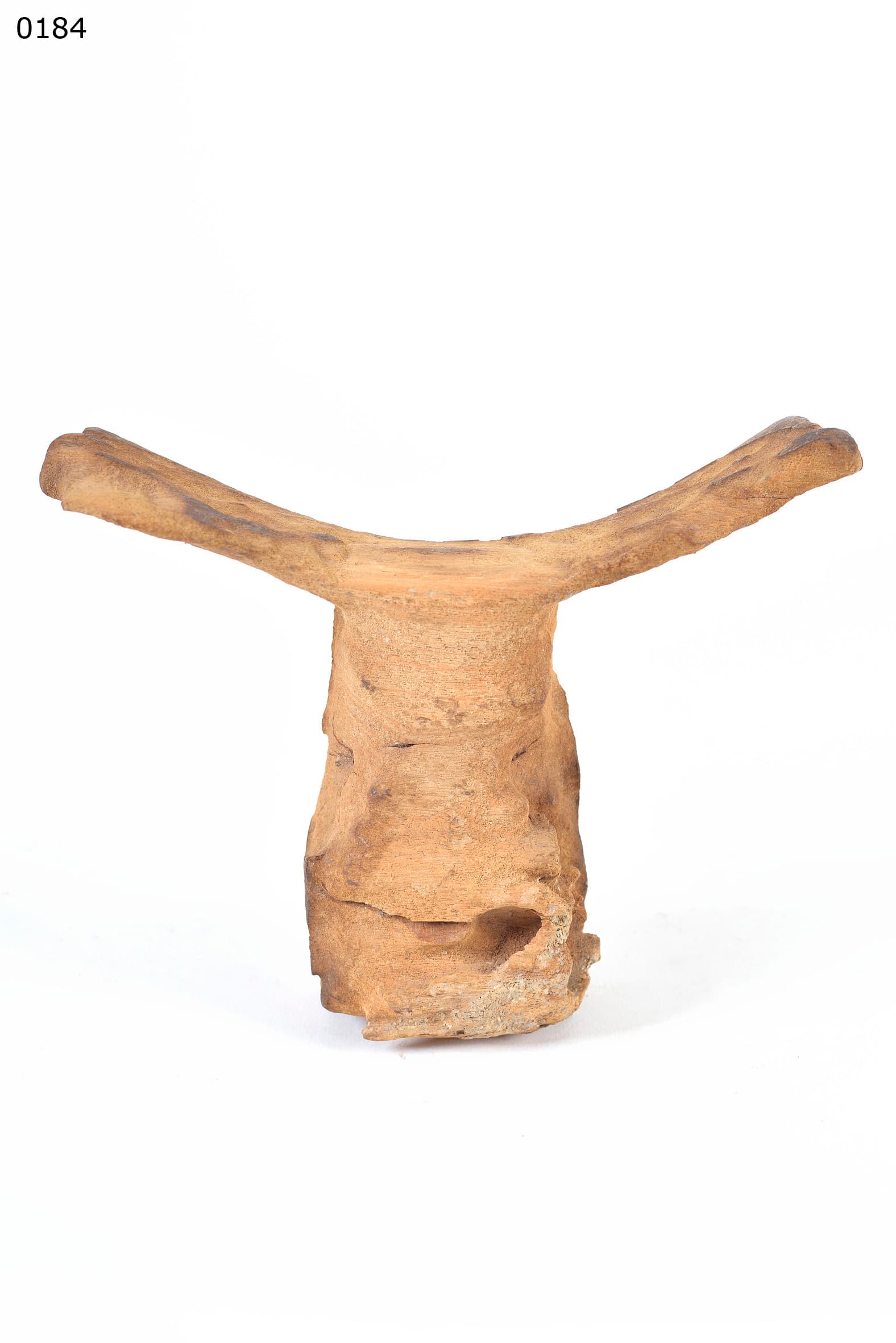
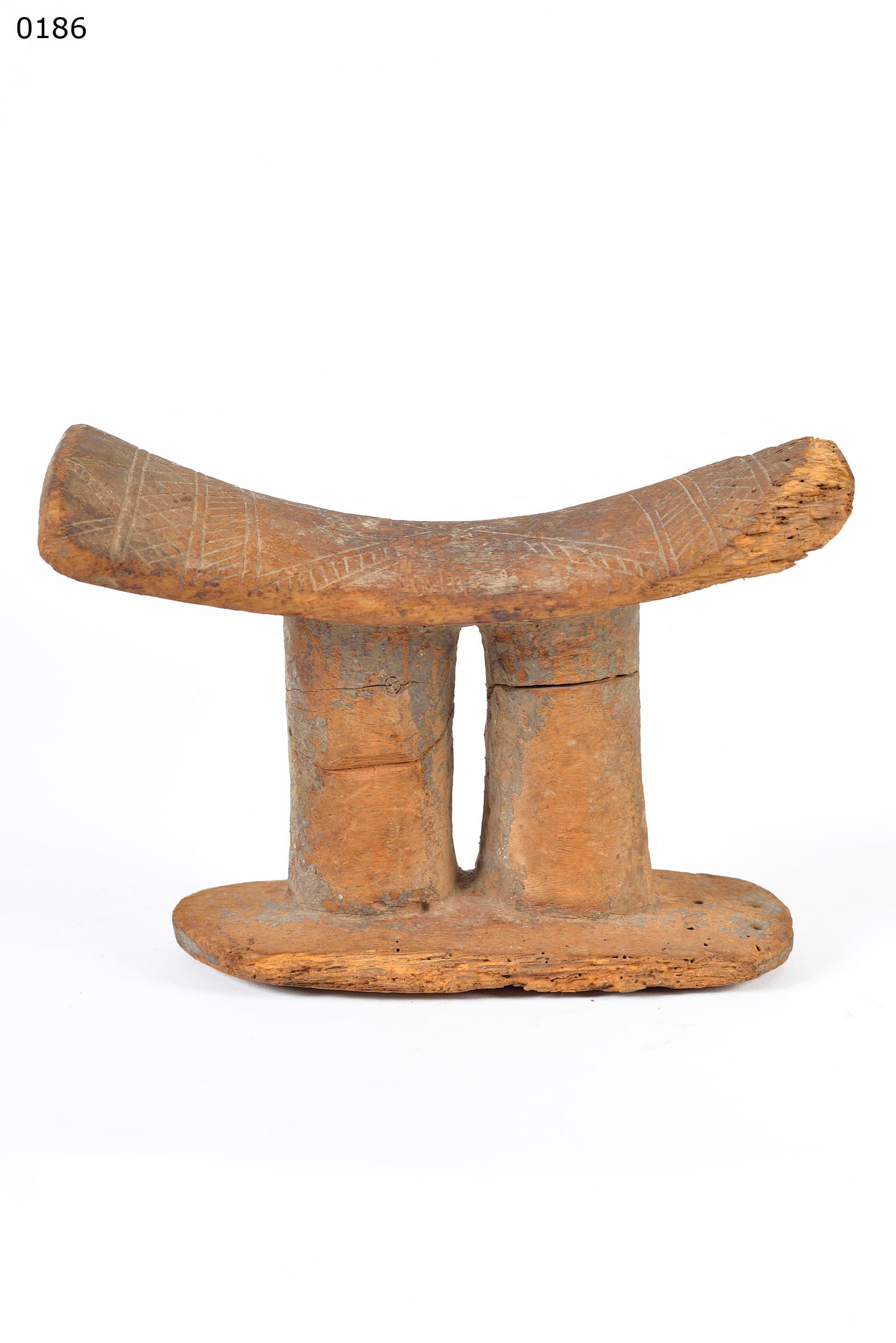
The difference between a ritually activated object and a profane object manifests itself primarily in the surface. Profane objects that were also found in the caves - such as wooden neck rests, leather knife sheaths or the textile fragments intensively studied by Rita Bolland (the oldest in sub-Saharan Africa, woven from cotton and wool with indigo colouring) - do not exhibit this sacrificial crust. In the field of ceramics, Eric Huysecom's team excavated terracotta vessels (often three-footed bowls) decorated with roulette patterns (mat impressions), some of which show sacrificial residues, indicating their use in funerary contexts.
With regard to documented master craftsmen's hands, there are no written records of workshops in anonymised Tellem art. However, the ethnographer Hélène Leloup has isolated specific workshop styles through form-analytical clustering, of which the "Master of Tintam" (named after a region on the eastern edge of the plateau) is the most prominent.
Forgery criteria are extremely relevant to the market in this segment. Many objects that circulate in the trade as "Tellem" (and some of which are listed in the Musée du quai Branly or the Met) are de facto post-15th-century Dogon works. A particular problem is the so-called "old wood effect", in which forgers re-carve ancient wood found in caves in order to feign an advanced age in scientific analyses.
Ritual practice
The ritual practice around the statues of the Tellem largely eludes direct historical observation and must be inferred from the archaeological finds in the cliffs and by drawing analogies to the ritual performance of the Dogon, who took over the caves and their inventory. The use of altars necessarily took place on the periphery of everyday life: The altars were erected directly in the rock niches, protected from the weather, but often in the context of burial areas.
The construction of the altars was highly characterised by interaction with metaphysical entities. Among the successor populations, these sacrificial sites are known as andugo, altars used to invoke rain and worship the nommo water spirits. The wooden intermediaries were not activated by mere carving, but exclusively by consecration. The sculpture functioned as an empty vessel that was animated by the repeated application of sacrificial substances. The offerings consisted primarily of animal blood and viscous, cooked millet porridge, often mixed with vegetable binders. The occasions for these libations were cyclical - such as the preparation for the agricultural planting season - or reactive, in response to epidemic crises or periods of drought, which always posed an existential threat in the Sahel.
The detailed performance of these rites required ritual authorities. The officiant approached the altar and performed physical gestures that mirrored or complemented the iconography of the sculptures. Using special iron hooks (the so-called gobo), the priest imitated the drawing of rain clouds, an act in which the raised arms of the Tellem statue channelled celestial intervenience. The smoke from lit fires in front of the altar was intended to visually simulate the dark rain clouds.
Regional variations in the installation and use can be derived archaeologically. In the northern part of the Bandiagara plateau (e.g. near Tintam), the plank-like figures with a flat back were probably leant directly against the cave wall, while more southerly sites suggest more complex arrangements within or on the clay tombs built using the bulge technique.
The lifecycle of a ritual object is remarkable. The process began with the Tellem carver, who deliberately worked with fresh, living wood, as seasoned, dry heartwood was rare in the Sahel and extremely difficult to work with the iron tools of the time. The newly carved sculpture initially had the status of a profane artefact. It was only when it was transferred to the altar and the first blood washing that it became an active ritual object. Over the decades, the material form of the figure increasingly merged with the ritual substance due to the excessive accumulation of the sacrificial crust (patina), until the original carving lines became almost invisible.
Formal deactivation or disposal in the sense of ritual destruction did not exist for these objects. When the Tellem culture collapsed around the 15th century, the statues remained in the caves. The subsequent Dogon did not dispose of these foreign objects, but ascribed them immense numinous power. They incorporated the statues into their own ritual system, venerated them as relics of mythical ancestors and continued the practice of libations. Today, this ritual secondary use by the Dogon leads to enormous difficulties in the precise separation of Tellem and Dogon artefacts in collections such as that of the Fowler Museum at UCLA.
Historical context
The migration history of the Tellem and the dating of their presence in the Bandiagara massif are characterised by profound scientific controversies. The consensus of older research placed the arrival of the Tellem in the 11th century. It is widely assumed that military and climatic upheavals in the wake of the collapse of the Wagadou Empire (Ghana Empire) forced populations to flee to the rocky massif, which was difficult to access. There they replaced a previous population group or merged with it. The end of the Tellem culture is dated to the 15th to 16th century, an era in which drought disasters, foetuses and slave raids by neighbouring empires (such as the Mossi or Songhai) destabilised the region, whereupon the Dogon immigrated.
As shown in the overview, recent field research dissertations (for example by Huysecom and Mayor) challenge these dating controversies by providing evidence of continuous settlements (without the previously postulated hiatuses).
As the Tellem culture died out centuries before the European colonisation of West Africa, there is no direct colonial encounter with the creators of this art. The influence of colonial history is therefore limited to the archaeological and ethnographic exploration (and appropriation) of the Bandiagara Plateau. The first documented scientific survey was carried out in 1905 by the French officer Louis Desplagnes. A turning point for the reception of African art in Europe, however, was the Dakar-Djibouti mission (1931-1933) led by Marcel Griaule and Michel Leiris. This expedition collected thousands of objects from the region (sometimes under ethically questionable, asymmetrical conditions of power), which formed the backbone of the Musée de l'Homme's collection (now in the Musée du quai Branly).
Market history in the West underwent an explosive development in the second half of the 20th century. Key catalysts were elite collectors and dealers such as Jacques Kerchache and, in particular, Hélène Leloup, who opened a gallery in Paris in the 1950s and established the "Tellem style" on the international art market through strategic acquisitions. Breakthrough exhibitions, for example in 1973 at the Brooklyn Museum ("African Art of the Dogon"), finally anchored the objects in the canon of world art. The price trend reacted to this with extreme increases: While Tellem objects initially only aroused academic interest, masterpieces now fetch top prices at auction. One significant example is the sale of a heavily patinated Tellem statue at Christie's in Paris for 1.25 million euros.
This monetary appreciation has massively exacerbated the problem of forgery in the field of Dogon/Tellem art. Today, the criteria for authenticity are increasingly based on scientific forensics. Radiocarbon dating (C-14) using accelerator mass spectrometry (AMS) is the standard method for determining the age of wooden sculptures. However, this reveals the serious problem of the "old wood effect": As organic materials are preserved in the caves for centuries, forgers steal ancient, uncarved wood from the massif and use it to make modern copies. In this case, the C-14 analysis only dates the historical felling date of the tree (partly 11th century), but misses the recent date of the carving.
As thermoluminescence dating (TL) is physically only applicable to inorganic, fired materials such as terracotta or cast cores (and is successfully used for Tellem ceramics), it cannot be used for wooden sculptures. Authenticity tests of wooden figurines therefore necessarily focus on microscopic and physicochemical analyses of the patina, heartwood cracks and traces of termite damage. The examination of the sacrificial crust (e.g. by secondary ion mass spectrometry, SIMS) aims to verify whether the stratigraphy of the organic layers (millet, proteins, blood) has grown naturally over centuries or was applied artificially by forgers in a short period of time. Only the synthesis of stylistic expertise and metallurgical-chemical forensics enables institutions such as the Metropolitan Museum of Art (Met) to ensure the collectability of the objects.