Overview
The Verre (often transcribed as Vere, Were or Kobo in ethnographic and linguistic literature) constitute a demographic and cultural micro-minority whose historical and current settlement area extends along the Adamawa corridor. Geographically, this population is primarily centred in the Benue Valley of the eastern Middle Belt in Nigeria, namely south of the town of Yola in Adamawa State, with foothills of their settlement structures extending into the Alantika Mountains and across the territorial border into the northern region of the Republic of Cameroon (Fardon 1990: 25). The exact recording of population size is subject to considerable historical fluctuations and methodological recording problems. While early syntheses of British colonial reports, such as those by Olive and Charles Temple from 1919, put the population at a supposedly precise but ethnographically questionable figure of 18,440 individuals, contemporary demographic estimates extrapolate a significant growth. Current data places the population at around 173,000 to 212,000 people (Wiu 2018: 76; Joshua Project 2023). This decided growth implies a high degree of resilience of the local communities to the historical upheavals of the region.
Linguistically, the Verre idiom is assigned to the Duru branch within the extensive Adamawa-Ubangi language family, which in turn belongs to the superordinate Niger-Congo phylum (Eberhard, Simons & Fennig 2019). The Verre linguistic landscape is highly diversified internally and includes dialects such as Mom Jango and Momi (Ziri), which some linguists classify as independent languages due to their divergence (Kleinewillinghöfer 2012). The nomenclature of the ethnic group is characterised by a complex dichotomy of self and other terms. The autonyms are mostly Django or Verre, while neighbouring groups use exonymic constructs; for example, the Komai refer to them as Kobo (Frobenius 1912; Boyd 2012). The controversies of classification in linguistic and ethnological taxonomy should be explicitly highlighted at this point: The source situation is ambiguous regarding micro-ethnic splinter groups such as the Wom, who identify ethnically as Verre but speak a dialect of the neighbouring Chamba Leko (Danbonna 1995). Furthermore, researchers such as Raymond Boyd are debating whether dialects such as Mome or Nya Kopo ("language of the mountain") can be assigned to the Verre spectrum at all or whether they are morphologically Mumuye dialects. These uncertainties demonstrate the high fluidity of ethnic boundaries in the Adamawa corridor.
The social structure of the Verre is traditionally acephalous and strongly organised in segments, with gerontocracy (the rule of the elders) being the constitutive regulatory principle. The kinship systems are based on complex marriage alliances that interweave local lineages without, however, developing centralised state institutions in the pre-colonial sense (Meek 1931; Chappel 1966). The subsistence economy is based on an agri-cultural foundation, primarily the cultivation of sorghum millet, combined with the breeding of a specific, tsetse-resistant breed of dwarf cattle, which is essential for ritual consumption at funerals and initiations (Meek 1931: 434).
The relationship with the neighbouring peoples (such as the Bata, Bachama, Chamba, Fulani and Koma) is historically characterised by a mixture of defensive warfare, especially against the cavalry-supported raids of the Fulani, and intensive economic interdependence. However, the most significant and structurally singular feature of Verre society, which fundamentally distinguishes it from most of its neighbours, is its internal socio-economic division. The society is divided into two strictly separate castes: the agricultural majority of the population, the Gazabi (or non-smiths), and the highly specialised, endogamous caste of smiths and yellow casters, the Tibaai (singular: Tibas or Tiba) (Fardon, Chappel & Piepel 2021). In contrast to the societies of the Mandara Mountains, where blacksmiths lived in isolated and scattered farming villages, the Tibaai of the Verre formed spatially isolated parallel societies in specialised settlements such as Cholli (Soli). This exclusivity resulted in a regional metallurgical monopoly. Consequently, the Verre smiths not only produced tools, but also the central ritual insignia of power and cult objects for large parts of the neighbouring Chamba and Bata (Cullen 1946). Inventories and documentation in the Musée du quai Branly in Paris attest to the supra-regional relevance of these elaborate inter-ethnic trade and ritual networks, through which Verre artefacts circulated as high-value prestige objects throughout the Benue basin.
Cultural context
The religious paradigm and cosmological order of the Verre are based on a multi-layered, hierarchical system of metaphysical interaction. At the top of this pantheon is the creator god Bila Fil (literally: the sky god), who is conceptualised as the ultimate, indirect source of all life, matter and cosmic order (Blench & Edwards 1988). In the religious ontology of the Verre, however, Bila Fil is considered too transcendent and unapproachable to be reached through direct human intercession. Consequently, there is no direct cult for this entity. Instead, communication with the metaphysical sphere is handled exclusively via the complex institutional structure of the Do'os cult (plural: Do'osi) and through the mediation of ancestors and local spirit beings (Meek 1931: 431). Do'os functions as the personification of occult forces of nature and life; it is the direct source of agricultural fertility, physical health and social advancement within the age groups (Wiu 2000: 4).
The ritual authorities within this system are highly specialised and reflect the cosmological duality of the verre. A fundamental ideological and ritual tension exists between the Rainmaker (Do'ga Sas) on the one hand and the Forge Priest (Tibaas or Tibaai) on the other (Edwards 1988). Local myths, which were documented in Yadim in the 1980s, among other places, record a continuous competition for ritual supremacy between these two spheres. The Do'ga Sas controls the sphere of rain, agricultural fertility and metaphysical "coolness". In contrast, there is the blacksmith who, through the element of fire (the "heat"), exercises the transformative power to convert raw natural material (iron ore) into civilising cultural tools (Edwards 1988: 314). What significantly distinguishes the Verre religion structurally from neighbouring peoples is the far-reaching autonomy of the blacksmiths. While in neighbouring groups the blacksmith is usually ritually and socially subordinate to the rainmaker, the Tibaai of the Verre act as almost sovereign priests. They maintain their own esoteric secret and cult societies, namely the Do Tibas, whose nightly rites are accompanied by buzzing woods, deep-sounding iron drums and the use of specific brass objects (Fardon et al. 2021). Alongside these two poles is the divinator (ganna), who performs divination by throwing seven ritual stones (pinni) and initiates complex sacrifices during periods of drought (Frobenius 1912).
The localisation and role of women in the cult form the core of an iconographic and anthropological controversy in research (Edwards vs. Meek). While older sources (such as Meek 1931) often paint a strictly patriarchal picture in which women are completely excluded from the Do'os cult, Adrian Edwards (1988: 323) deconstructs this simplifying binary. He argues that the Verre system deliberately avoids sharp, absolute dichotomies of 'male/female' or 'inside/outside'. The sources make it clear that women have enormous occult potential. For example, they are associated with the power to block the rain through rainbows and are symbolically close to lightning, which in turn links them cosmologically to the sphere of the forge (heat and transformation). In addition, women participate in their own central rites of passage, such as the Dei-ki Peena (a specific scarification ceremony), and play an indispensable role at funerals and initiations by displaying massive yellow-cast jewellery as a manifestation of family wealth (Cullen 1946). The exclusion of women is therefore less absolutely ontological, but rather situation- and cult-specific.
The organisational axis of male socialisation and identity formation is the Gangni ritual (in its full name Daaka Gangni). This central initiation and circumcision cycle culminates in a seven-year rhythm, typically synchronised with the Seerkaana harvest festival (Meek 1931). The male individuals pass through rigid age groups, beginning as wasas (pre-initiation), before entering the status of circumcision through rigorous preparatory rites (gaaka yalan) that include ritual chastisement. After performing circumcision, they advance to was (plural: yangi) in order to later attain the status of saari and ultimately the ranks of dɔndas and dɔnda gbijaas through further cult consecrations (such as Baaka Do'os Banjas) (Chappel 1966). A striking structural difference to the rites of neighbouring peoples lies in the excessive materiality of verre initiation. The Verre instrumentalise an unprecedented density of yellow cast insignia: Initiates wear elaborate brass helmets (bal) and hook stylised circumcision crooks (tamba) into their necks, symbolising the act of physical severance and entry into the cult community (Fardon et al. 2021). The Fowler Museum at UCLA, particularly through the archives of Arnold Rubin and the analyses of Marla Berns, houses fundamental holdings of these initiatory skeuomorphs that open up the understanding of these complex cosmological transitions to researchers and collectors.
Aesthetic features
The material culture and the sculptural canon of verre are primarily divided into two media with completely different artistic intentions and durability cycles: On the one hand, there is an outstanding and quantitatively dominant oeuvre in the field of yellow cast iron (brass and, in rarer cases, bronze), and on the other, a greatly reduced but iconographically concise corpus of anthropomorphic wooden sculptures (ratu). The yellow castings of the Tibaai smiths were invariably produced using the cire-perdue process (lost wax technique). The smiths used local beeswax (dis wasi) to mould highly complex, filigree models, which were cast with molten copper alloys - often recycled from European manillas or Trans-Saharan brass rods - after melting (Frobenius 1912; Neaher 1979).
The object typology of verre castings is almost exclusively skeuomorphic. In this context, a skeuomorph is a true-to-form, metallic replica of a profane, often perishable object in an imperishable, ritually and materially more valuable medium (Fardon, Chappel & Piepel 2021). Among the canonical subtypes are the bal suktundal (circumcision helmets). The iconographic peculiarity of these helmets lies in the meticulous transfer of textile textures into the metal; for example, they imitate detailed braided cow's tail hair, fibres and applied cowries. Another central category is the tamba (crooks for initiation), whose shape symbolically mediates between the agricultural hoe (female) and the sickle (male). The ceremonial daggers (wɛk suktundal) often feature zoomorphisms, such as pommels shaped as gazelle heads (baiyamas), while the ceremonial hoes are decorated with omnipresent spiral motifs (ga), which are said to symbolise the tails of sleeping leopards and functioned as insignia of female wealth. Also canonical are percussive ritual instruments such as the simple hand-held bells (buruk suktunkak) and ritual drinking vessels. These objects were explicitly not used for profane purposes, but functioned as carriers of do'o's life force and as inalienable insignia of the elders' ranks.
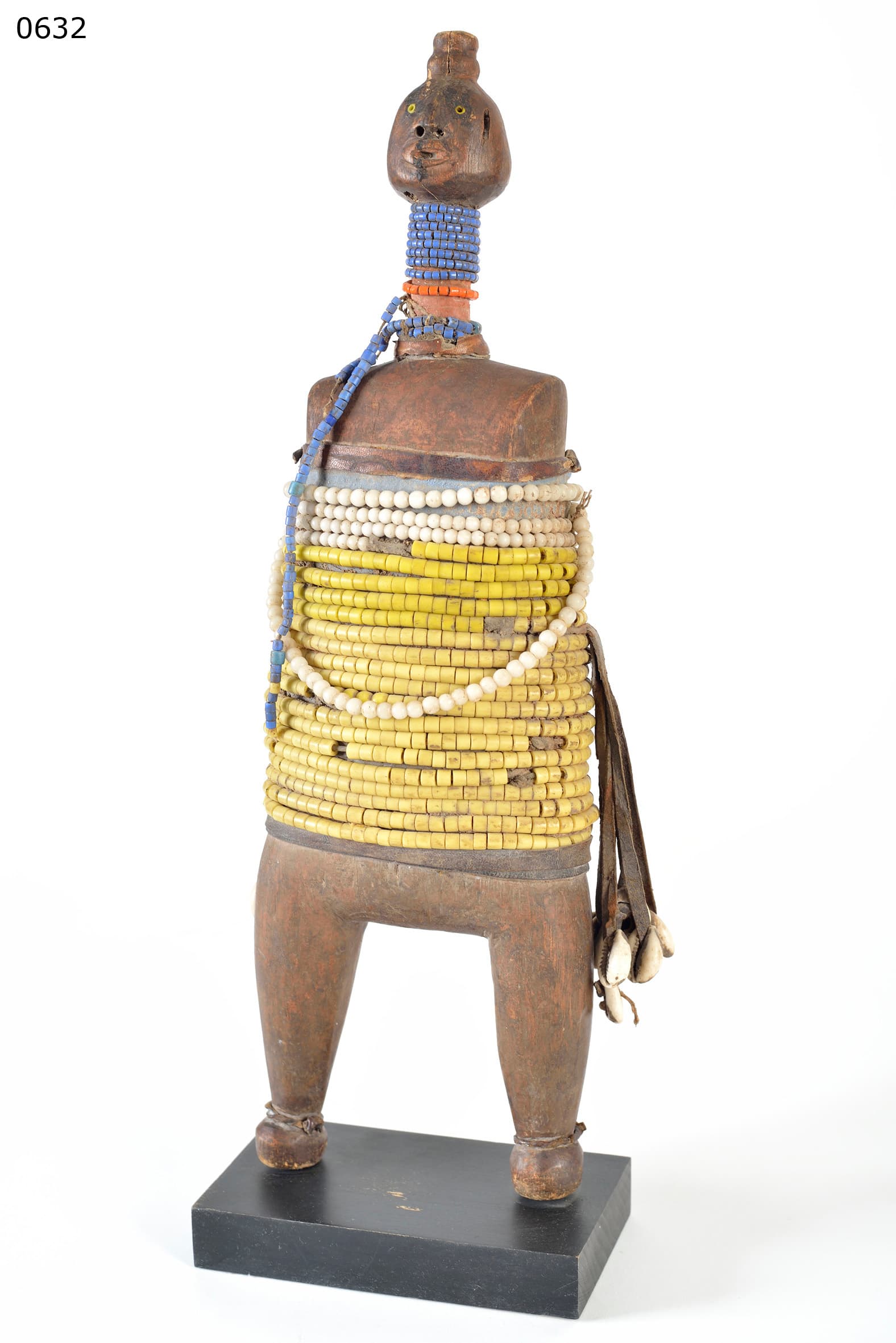
The size spectrum of the anthropomorphic wooden sculptures (ratu) mostly ranges from 20 to 60 centimetres. The proportions of these figures are highly distinctive, abstract and reject any form of naturalism. The abstract anatomy of the Verre figures is characterised by extremely elongated torsos. The skull is characteristically shaped, tapering backwards or upwards (which is sometimes interpreted in research as a representation of helmet-like headgear), while the jaw or mouth protrudes forwards like a trunk, often with terrifying, exposed rows of teeth (Berns 2011: 170). The complete absence of a neck is striking; the head merges directly with the torso. The upper extremities (arms) are greatly shortened and rarely extend beyond the waist, while the legs are rudimentarily carved, often in a compressed zigzag pattern. The choice of material for these statues often fell on hard woods, especially local mahogany (bomp). The patina was created through ritual charging: A profane wooden blank was only transformed into a sacred, activated ritual object through repeated anointing with palm oil, pouring sacrificial blood over it and rubbing it with red camwood powder (Laude 1971). The analytical examination of such complex patinations and the textural surfaces of African artworks has been addressed in the work of Klaus Strübel (2009) and the material analyses of Klaus Piepel, whose collecting and research work has contributed significantly to the understanding of verre aesthetics.
In art historical research, a significant and profound iconographic controversy (Berns vs. Fardon) manifests itself with regard to these wooden sculptures. Marla Berns, co-curator of the seminal exhibition Central Nigeria Unmasked, identified specific volumetric, anatomically reduced sculptures of the Adamawa corridor primarily as manifestations of an overarching "Mumuye style" that diffused into neighbouring groups through historical interactions (Berns et al. 2011). Richard Fardon (2019, 2021) vehemently deconstructs this categorisation. He argues that the classification "Mumuye" is often an artefact of colonial collecting practice and the Western art market, which sought a collective term for unclassified objects from the Benue Valley to simplify matters. Fardon proves that the Verre, Chamba and Mumuye shared a fluid, trans-ethnic catalogue of forms and that Verre carvers demonstrably made ritual figures for their neighbours (such as the Chamba). The "one-tribe-one-style" approach is therefore ontologically incorrect and misleading for this region. One fascinating aspect of verre research is the rare documentation of master craftsmen's hands. Through the meticulous records of Tim Chappel from the 1960s, specific artist personalities are known by name: Modari Cholli has been identified as an outstanding master carver, while Ɔfa Kila from Ragin and Lawam of Yainde are documented as master jelly casters whose works now adorn museum collections (Chappel 1966).
For the contemporary art market and institutions such as the Museum Rietberg in Zurich, forgery criteria are highly relevant. Authentic pre-colonial and early post-colonial verre casts reveal deep, irregular oxidation layers that have penetrated the molecular structure of the metal. Authenticity is also evident in logical signs of wear (e.g. on the insides of the solid brass hip beads, caused by years of friction on the body). In the case of the wooden figures, natural cracks in the heartwood and traces of authentic termite damage are indispensable indicators of an object that has been used in the field. Forgeries, which emerged after the global market breakthrough of Benue Valley art in the 1970s, are often unmasked by chemically induced, superficial and washable acid patinas as well as by mechanical milling that merely artificially imitates insect damage (Chappel, Fardon & Piepel 2021).
Ritual practice
The ritual activation, utilisation and eventual deactivation of objects in the Verre cultural space follows a strictly regulated, esoteric choreography that takes place primarily within the exclusive sphere of the Tibaai (smith caste) and the ranks of the highest age groups of the Do'os cult. The physical and metaphysical nucleus of ritual practice is the altar space, which in local nomenclature is referred to as lug Do'os or do-bu'uk (cult shrine) (Wiu 2000: 4). These shrines are not designed as monumental temple structures, but are usually located on the periphery of the village, surrounded by dolmen-like stone settings. This architecture serves to provide strict visual and physical shielding of the occult processes from the view of the uninitiated, women and lower age groups (Meek 1931). The interior of the altar resembles a depot of sacred agents: Here rest the irreplaceable ritual instruments such as iron and brass double bells (dengkongkas), medicine bundles (bunut), ritual buzzing woods and the wooden sculptures (ratu) encrusted in palm oil and sacrificial blood, which channel the ancestral presence.
The ritual performance and the activation of the artefacts are inextricably linked to the agri-cultural cycles, namely the Seerkaana harvest festival, as well as the initiation crises (Daaka Gangni). A newly created object, whether made of wood or brass, is initially profane. The ontological change of status to an active, power-filled ritual object requires complex sacrificial ceremonies. Activation requires the spilling of animal blood (typically from goats or, at funerals, indigenous dwarf cattle) and extensive libations of locally brewed sorghum beer. This cult beer is not consumed from ordinary vessels, but is served in specially moulded brass vessels (jinu or jinugo) decorated with ritual knobs or leopard spirals (ga) (Chappel 1966). During the ritual acts, the priests (gbijaas) put the beer in their mouths and spit or splash it ritually towards the east. This libation is accompanied by an immense auditory performance: The striking of the clapperless iron bells and the deep, booming sound of the gul (ritual cow horns), summoning the spirits of the ancestors and, indirectly, bila fil.
The masculine insignia of the dɔnda gbijaas (the highest-ranking class of elders) dramatically demonstrate the juridical and executive power of the activated objects. Each of these elders wields a specific brass rod (gbala arandu). According to historical field notes from 1966, this staff was not a mere representational tool, but an activated weapon to protect the sanctuary. If an uninitiated person entered the lug Do'os, the elder had the sacred right to strike the intruder down with the gbala. The death was not communicated to the community as a secular murder, but legitimised by the ritual formula "Do'os has killed him" (Chappel 1966). This practice emphasises the agency attributed to objects in the ontology of the verre.
The lifecycle of a ritual object diverges fundamentally depending on its materiality. Brass objects (skeuomorphs, bells, rods) elude organic decay; they remain in the sanctuary as the imperishable, inalienable property of the Tibaai caste and accumulate a profound ritual power and haptic patina through intergenerational use. They are not deactivated unless they are removed from their context through theft or trade. The ontology of the wooden sculptures is diametrically opposed to this. These objects are subject to natural degradation. When a wooden figure loses its structural integrity due to the effects of the weather or, in particular, excessive termite damage, its ritual charge is extinguished at the same time. It is not restored, but regarded as an empty shell and usually left to decay naturally in the bush.
A highly specialised, regional form of deactivation and successive reactivation of "material" can be seen in the burial rites of the Verre elders. The dead are buried in a seated position in shaft graves with niches at the sides, sewn into cowhides. The shaft is deliberately not filled with earth. This enables those responsible for the cult to open the grave again after the soft tissue has completely decomposed in order to remove the ancestor's skull (Meek 1931: 434). This skull is ritually cleansed, often painted with red ochre in the mountain region and then transferred to the Do'os shrine as a physical manifestation of the ancestor, where it is reactivated during rainmaking rituals (Orka Maam). The explosive nature of this macabre practice was documented early on by the purchase of painted ancestor skulls by the British Museum, which demonstrates the close intertwining of body, ritual and object among the Verre.
Historical context
The historiography of the Verre, the establishment of their metallurgical dominance and the genesis of their art production are inextricably intertwined with the violent migratory movements of the 19th century. Anthropological and archaeological research postulates a nuanced scenario: the ancestors of the Verre and other highland populations originally settled more extensively in the plains of the Benue Valley. However, the geopolitical tectonics of the region collapsed with the proclamation of the Fulani jihad under Modibbo Adama from around 1809 (Njeuma 1969; Abubakar 1977). The cavalry-supported expansion of the Fulani, whose seat of power (the Adamawa Emirate) gradually shifted via Gurin and Ribadu to Yola (founded in 1841), forced the uncentralised communities to flee on a massive scale. The Verre retreated to the rugged, inaccessible retreats of the Alantika Mountains (Temple 1919). This demographic pressure in the highlands forced by the jihad led to a densification of the population and intensified technological exchange. Archaeologists such as Scott MacEachern (2012) argue that this forced concentration catalysed the transfer and refinement of metallurgical techniques, with some researchers even suggesting that the highland casting industries represent distinct technological echoes of the ancient Sao culture of Lake Chad (Wade 1986: 5). A serious effect of the Fulani hegemony on art production was the loss of the traditional copper mines. While Verre smiths in the oral tradition reported a "golden age" of their own ore mining (analysed ores from the Verre hills had a copper content of up to 20%), they were forced to change their material procurement under pressure from the emirate. From then on, yellow cast iron was based almost exclusively on the recycling of imported artefacts and pre-colonial currencies such as manillas and brass rods (Fardon et al. 2021).
The colonial encounter transformed the structure once again. With the conquest of Yola by British troops in 1901 and the subsequent Franco-German-British border demarcation (1907-1913), the territory was carved up (Temple 1919). Ironically, the British colonial authorities formally placed the autonomous Berg-Verre under the administration of the Fulani-Emirs, their historical enemies. This early colonial phase saw the first massive contact with the European museum and art market. Between 1911 and 1912, the German Inner Africa expedition led by ethnographer Leo Frobenius travelled through the region and acquired around 300 Verre artefacts for the Ethnological Museum in Berlin and for museums in Leipzig, Dresden and Bremen. This episode is highly criticised in reception history research. Frobenius never set foot in the Alantika Mountains himself; for reasons of safety and convenience, he operated from the Cameroonian town of Tchamba and used Fulani as intermediaries. This modus operandi generated what Richard Fardon (2021) calls a "striking mismatch": A flood of decontextualised objects inundated European repositories without documenting the ritual functions, the names of the creators or the esoteric meanings of the works.
The systematic and scientifically sound recording of verre art only took place in the post-colonial decade. The ethnographer Tim Chappel operated in the field between 1965 and 1967 on behalf of the Nigerian Federal Department of Antiquities and acquired over 500 objects for the museums in Jos and Lagos. In contrast to Frobenius, Chappel meticulously documented the identities of over 30 Verre traders and artists (such as Samuel Cholli and Yakubu), recorded the ritual typology and thus saved the epistemological foundation of Verre culture from oblivion. At the same time, Danish missionaries from the Sudan United Mission (SUM) were collecting artefacts, which expanded the European corpus.
However, the global market breakthrough for the art of the Benue Valley in the West was linked to a historical tragedy. The outbreak of the Biafra War (Nigerian Civil War, 1967-1970) led to a total collapse of local structures and initiated an uncontrolled, massive exodus of artworks via Cameroon to Europe, mostly to Paris and Brussels (Fardon 2019). As a result, prices on the secondary market exploded and objects by Mumuye, Chamba and Verre became high-priced icons in galleries and at auction houses such as Sotheby's. This process culminated in 2011 with the epochal exhibition Central Nigeria Unmasked: Arts of the Benue River Valley (curated by Marla Berns, Richard Fardon and Sidney Kasfir), which started at the Fowler Museum (UCLA) and later travelled to the Musée du quai Branly. The exhibition provided the definitive scholarly canonisation of the Verre aesthetic.
This extreme increase in market prices inevitably led to a wide-ranging problem of forgery, which poses considerable curatorial challenges for private collectors. Today, the Royal Museum for Central Africa (RMCA) in Tervuren and other leading institutions are increasingly basing their authenticity criteria on interdisciplinary forensics. Genuine bronzes can be distinguished from modern industrial castings by metallurgical alloy analyses (pre-colonial low-tin brass vs. modern zinc-copper standards). In the case of wooden sculptures, UV light analyses are used to differentiate between authentic incrustations of palm oil and blood built up over decades and artificial acid or shoe polish patinas applied more recently. Ultimately, understanding the correct ageing pattern of the wood - the difference between the biologically correct, tunnel-like termite feeding that follows intact heartwood cracks and the mechanical imitation by modern milling tools - remains the crucial litmus test for the integrity of a verre sculpture.