1. overview
The geographic and demographic location of the Waja (often declared as Wadjawa in Hausa foreign designation) extends over a historically highly complex and topographically challenging terrain in north-eastern Nigeria. The core settlement area of this people is centred on the mountainous foothills and valleys of the western lower Gongola Basin, north of the Benue River, at the geopolitical interface of the present-day states of Gombe, Taraba and Adamawa. Within this region, they primarily dominate the Balanga Local Government Area. Current demographic projections for the year 2024 put the Waja population at around 160,000 to 164,000 individuals (Kunga 2022: 139). If this figure is embedded in the macro-demographic context of Nigeria - a nation with over 218 million inhabitants and a rapid urbanisation rate of 54.3 % - the extreme marginalisation and rural character of this ethnic group becomes clear. For topographical and historical reasons, the population is divided into two distinct sub-groups: the "Hill Waja" (mountain Waja), who fled to the inaccessible, rural regions of the country as a defensive measure against the cavalry of the Fulani jihadists in the 19th century. In the 19th century, as a defensive measure against the cavalry of the Fulani jihadists, they retreated to the difficult-to-access, rocky refuges of the Muri Mountains and the Tangale-Waja plateau, and the "Plain Waja", who remained in the agriculturally more productive but strategically vulnerable valleys (Woodhouse 1923: 110; Adelberger 1992: 42).
Linguistically, the Waja represents an entity of extraordinary morphological density and still poses enormous classificatory challenges for researchers today. It is assigned to the Tula-Waja language group within the Adamawa branch of the Adamawa-Ubangi family (part of the Niger-Congo phylum) (Greenberg 1963: 20). The enormous morphological complexity of Waja is remarkable: it is one of the few languages in the region to have an elaborate nominal class system with an unusually high number of concordances (grammatical agreements) as well as unique phenomena of simultaneous prefixation and suffixation (Kleinewillinghöfer 2014: 38). In contrast, closely related languages such as Dadiya, Maa or Yebu have almost completely lost their nominal classes. This linguistic-architectural structure has led the linguist Ulrich Kleinewillinghöfer to the groundbreaking hypothesis that the Tula-Waja group represents a direct evolutionary bridge to Proto-Central Gur, which implies the existence of a hypothetical Central Adamawa-Gur continuum (Kleinewillinghöfer 1996: 94).
Linguistic diversification in the region was further accelerated by a fascinating sociolinguistic mechanism: the strict naming taboo. Traditionally, the names of the deceased were never pronounced again in their former place of residence and in the presence of relatives (Adelberger 1992: 36). As proper names among the Waja and their neighbours were mostly borrowed from everyday vocabulary, this taboo forced a continuous, almost disruptive lexical re-creation. This led to the formation of a regional "language alliance" in which basic vocabulary - for example for essential concepts such as "bird", "dog", "blood" or the numbers "two" and "three" - was massively exchanged between the northern Tula-Waja languages, Chadian idioms (such as Bole-Tangale and Tera) and Kanuri (Kleinewillinghöfer 2002: 45).
The social structure of the Waja is traditionally acephalous and organised in segments. It lacks centralised, overarching royal rule and is instead strongly rooted in co-resident, village lineages in which the council of elders and ritual authorities exercise political and social control. The subsistence base is a diversified, rain-fed agricultural sector that includes the cultivation of peanuts, cotton, sorghum, millet, cowpeas and yams. This is complemented by the rearing of small livestock, sheep and goats as well as a regionally highly regarded weaving and dyeing industry for indigo cotton fabrics (Blench 1997: 69). The development of limestone deposits for the local cement industry has created an additional, albeit ecologically controversial, source of income in recent decades.
Relations with neighbouring peoples such as the Lunguda, Tangale, Cham, Tula and the nomadic Fulani have historically been characterised by fluid alliances, inter-ethnic marriage networks, but also by periodic resource conflicts. Recently, these tensions have escalated dramatically: between 2020 and 2023, bloody land conflicts erupted between the Waja and the neighbouring Lunguda in the Balanga Local Government Area, destroying historical alliances, claiming numerous lives and disrupting traditional hunting and farming cycles by destroying crops and property (Pindiga et al. 2023: 157; Abubakar 2020).
In ethnographic and art historical research classification, there is a fundamental controversy regarding the autonomy of the Waja. While early British colonial officials such as A.B. Mathews categorised the Waja as an isolated, static tribal entity in the context of the "Pagan Administration" (1934), contemporary researchers such as Marla C. Berns argue vehemently against such rigid, colonially influenced ethnic labelling (Berns 2011: 436). Berns postulates that Waja art production should rather be understood as an integral, albeit specific, sub-tradition of the entire Gongola-Benue Valley, in which ritual objects, smithing techniques and performative practices continuously migrated across ethnic boundaries. This controversy - colonial isolationism versus fluid regional tradition - marks a significant research gap that needs to be addressed in order to adequately contextualise the material legacies of the region. At the Fowler Museum at UCLA, whose archive for this region is world-leading, this struggle for classification is reflected in the increasing avoidance of rigid "tribal names" in favour of regional spheres of circulation (Fardon 2011: 231).
| Demographic and Linguistic Profile of the Waja | Specification |
|---|
| Estimated population (2024) | 160,000 - 164,000 |
| Language family | Niger-Congo > Adamawa-Ubangi > Tula-Waja |
| Main morphological feature | Highly complex nominal class system, simultaneous affixation |
| Social structure | Akephalic, village lineages, gerontocracy |
| Economic form | Rain-fed agriculture (sorghum, cotton), weaving |
2. cultural context
The religious and cosmological system of the Waja is a fascinating amalgam of autochthonous earth and nature cults, deeply rooted ancestor worship and significant influences from the neighbouring sacred dominions. The foundation of the cosmological order is the belief in an omnipotent but usually transcendent creator god, who is usually referred to in the regional nomenclature of the Adamawa peoples as Yanba, Yan or adapted in syncretic contexts (Idowu 1973: 104). According to traditional African theology, this creator is understood as the initiator of the universe, who withdrew from direct worldly concerns after creation. He delegates the maintenance of the cosmic balance, the fertility of the fields and the protection of the human community to a hierarchically structured pantheon of ancestral spirits (the spiritual ancestors of the lineage) and local nature beings who reside in rivers, mountains and sacred groves (Olupona 2015).
A formative structural influence on this cosmology historically emanated from the formerly powerful Jukun empire, whose religious and political influence encompassed large parts of the Benue Valley. This manifests itself among the Waja in the belief system of tsafi Kuru, a ritual order that dictates the moral, social and agricultural life of the community (Rubin 1969: 97). In this system, ritual authority is primarily vested in the chief priest of the Waja, whose exclusive task is to act as a mediator between the human sphere, the often unpredictable spirit powers and the Kuru order. He is assisted by specialised divinators and members of closed secret societies of men (such as the Komtin society of neighbouring groups), who are consulted when diagnosing spiritual disorders - be it unexplained illnesses, droughts or witchcraft (Evil Eye).
What fundamentally distinguishes the religion of the Waja and the neighbouring Gongola peoples structurally from the religions of the major western and southern Nigerian peoples (such as the Yoruba or Igbo) is the exceptional ritual role of women and the ontological preference for clay and earth as the primary media of spiritual materialisation. While wood carving (an exclusively male domain) dominates the sacred field in many African cultures, fired clay forms the absolute centre of ritual communication among the Waja (Berns 1989: 48). This results in a powerful gender dynamic specific to the region: the production of the highly ritually charged, figurative healing vessels is almost exclusively in the hands of female potters. This female mastery of ceramics is far more than a profane craft; it is a genuinely priestly, sacred act. The women functioned as ritual architects who, by modelling the moist clay, created the physical form into which spirits of illness and ancestral forces could be bound (Berns 2011: 476). The sources are ambiguous as to the exact nature of the women's secret initiation rituals into these pottery cults; however, comparative fieldwork in the western Gongola Valley suggests that the transmission of this esoteric knowledge and the necessary spiritual immunity is strictly matrilineal.
In the scholarly exploration of this cultural context, there is a significant, sometimes acrimonious author-versus-author controversy regarding the origins, vectors and originality of these cosmological practices. Arnold Rubin (1969), one of the pioneers of Benue research, argued vehemently in favour of the hegemony of Jukun culture in his early writings and dissertation. Rubin advocated the paradigm that the Jukun represented the absolute ritual epicentre of the region and that complex practices - such as the use of monumental vertical masks, specific earth shrines or architectural shrine structures - diffused unidirectionally from the elite Jukun to peripheral groups considered 'less developed', such as the Waja, Mumuye and Wurkun (Rubin 1969; Fardon 2011).
This diffusionist thesis is fundamentally contradicted by modern researchers such as Marla C. Berns and Sidney L. Kasfir (2011). Berns postulates a multidirectional, dynamic network ("fluid artistic identities") in which the Waja were not merely passive recipients of foreign cults, but developed and exported their own autochthonous ontological concepts - particularly in ritual ceramics and performative healing (Berns 2011: 437). In this paradigm of the 'Gongola River Tradition', the river valley functioned as a corridor of permanent ritual exchange in which Waja ideas amalgamated with those of the Jukun, rather than being colonised by them. A precise understanding of this theoretical debate is essential for the private collector in order to avoid falsely forcing objects into rigid tribal categories, as they were uncritically reproduced for decades in the archives of the British Museum in London or in early auction catalogues.
| Research controversy: Cultural Transfer in the Benue Valley | Arnold Rubin (1969) - Hegemony Model | Marla C. Berns (2011) - Network Model |
|---|
| Centre of Ritual Innovation | Jukun Empire (Centralised Sacral Rule) | Decentralised, Multidirectional Interaction (Gongola Corridor) |
| Role of peripheral peoples (Waja, Mumuye) | Passive recipients, imitators of Jukun-typical mask cults | Active innovators, creators of autochthonous ceramic ontologies |
| Vectors of cultural transfer | Unidirectional (top-down, from elite to periphery) | Multidirectional, driven by migration and flight (jihad) |
| Consequences for classification | Rigid tribal attributions based on form characteristics | Focus on "localised spheres of circulation" and fluid identities |
3. aesthetic features
The material culture of the Waja and the neighbouring Gongola peoples is characterised by a radical formal reduction, a strong expressionist plasticity and a profound iconographic polyvalence. The canonical object typology, which is of primary interest to the international art market and museum collections, can be divided into two fundamental categories: therapeutic-apotropaic ceramic vessels and abstracted iron-wood composite sculptures.
The first category comprises the small, figurative clay vessels, which range in size from just 5 to 15 centimetres (2 to 6 inches) (Berns 1986: 50). These highly specialised objects functioned as personal amulets and as incubators for healing processes. Iconographically, the canon of proportions of these vessels is not oriented towards naturalistic realism, but towards the visualisation of pathological and protective powers. The physical morphology of the vessel mimics the specific illness it is intended to alleviate or banish (sympathetic magic). A vessel used by the priestesses to alleviate severe back pain (analogous to the regional kulok-kulok type) has a distinctive, spiky or thorny structure that visually evokes a painful, deformed spine. Other vessels, which are modelled to protect newborns (jina kwimtiyu), take on the abstract form of a mother carrying a child protectively on her back. The clay is not just a material, but an ontological container of life force.
The second typology, more prominent on the Western collectors' market, comprises the Wundul guardian figures and related pillar sculptures (Adepegba 1992: 276). These are highly stylised, cylindrical wooden corpuses, often mounted on forged iron rods (spikes) so that they can be driven into the ground. These figures, usually between 35 and 45 centimetres high, are characterised by their geometric rigour: they have a long, columnar torso flanked by ribbon-like arms that tightly encircle the body. A strongly protruding navel (symbolising the lineage connection) and a block-like or ribbed crested hairstyle are also striking. Documented master hands or workshops known by name do not exist for the 19th and early 20th centuries, as the creation of these objects was understood as a collaborative act between the blacksmith (for the iron base) and the carver, whereby spiritual activation was more important than individual authorship.
The difference between an inactive, profane carving and an activated ritual object is visually striking and is defined by the addition of 'power' materials. A raw wooden woundul unfolds no power. Only through the ritual assembly of archaic materials - such as forged axe blades, animal horns, bundled medicine sticks, metal rings or, in the 20th century, industrial fragments such as bicycle chains - does the sculpture become an apotropaic centre of power (Berns & Hudson 1986). The aesthetic conclusion is formed by the ritual patina: layers of coagulated chicken blood, encrusted millet porridge and rancid palm oil, which often cover the object as a thick, organic crust and blur its formal sharpness in favour of an ominous, textured aura.
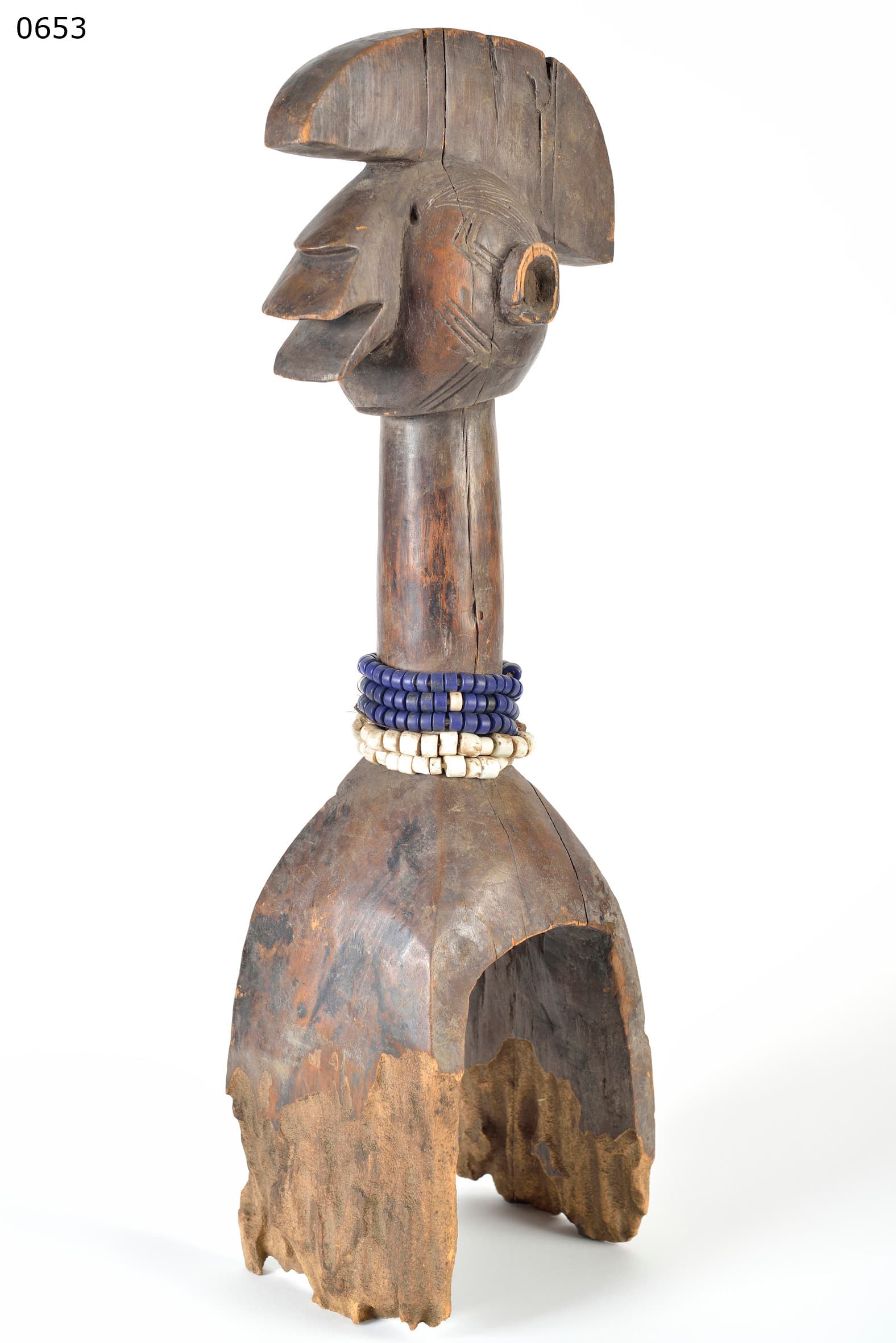
At this point, a central problem of forgery and attribution that has overshadowed the discourse surrounding the art of this region for decades must be addressed: the iconographic controversy surrounding the so-called "Waja shoulder mask" (or vertical mask). For three decades, monumental, wooden masks (80 to 160 cm high) with a strongly elongated column neck, a tiny stylised head, oversized ears and a U-shaped base yoke were celebrated in renowned catalogues and museums as masterpieces of "Waja art" (Leuzinger 1971; Gillon 1979). In groundbreaking publications, the art historian Marla C. Berns and the ethnologist Jörg Adelberger revealed that this attribution was based on a colossal error in early ethnography. These vertical masks - which were not balanced on the dancer's shoulders in the ritual, but on the top of his head - actually originate from the ritual canon of the neighbouring Wurkun, Bikwin or Mumuye (Berns 2011: 437). While older authors traditionally date the origin of this type of mask to the Jukun culture, Berns confirms a polycentric genesis in the Muri Mountains. The fact that these vertical masks were incorrectly classified as "Waja" in the holdings of the Musée du quai Branly in Paris or in international auction houses until well into the 21st century illustrates the precarious nature of attribution of origin on the art market.
For the private collector, this history gives rise to razor-sharp forgery criteria: If a 150 cm high vertical mask is offered today as a "Waja shoulder mask", this testifies at the very least to the dealer's serious ignorance of art history. When assessing authentic apotropaic Waja wood-iron objects, the key to authenticity lies in analysing the patina. A historically grown, ritual sacrificial layer builds up asymmetrically over decades. It has penetrated deep into the pores of the wood and, under magnification, reveals remnants of decomposed organic material. Modern forgeries produced specifically for the art market often imitate these crusts by quickly boiling and brushing on bitumen, resins, coffee grounds or industrial shoe polish, resulting in an unnaturally homogeneous, often shiny and flaking surface with no olfactory depth.
| Canonical object typology of the Waja / Gongola region | Material / Dimensions | Iconography & formal language | Primary ritual function |
|---|
| Therapeutic amulet vessels | Fired clay (5-15 cm) | Form imitates symptoms (e.g. spikes for back pain), mother-child motifs | Incubation of disease spirits, healing, infant protection |
| Apotropaic Wundul figures | wood on iron tip (35-45 cm) | cylindrical torso, ribbon-like arms, crested hairstyle, navel | guardian function in fields and house shrines |
| Vertical masks (misattribution) | Wood (80-160 cm) | Elongated neck, U-shaped yoke (actually Mumuye/Wurkun) | Agricultural festivals, ancestral representation |
4. ritual practice
The performative and ritual practice of the Waja is deeply interwoven with ontological concepts of material transmutation, spiritual incubation and a strictly defined life cycle of sacred objects. At the centre of religious practice is the premise that invisible cosmic powers - ancestors, nature spirits or witchcraft energies - can be controlled, appeased or warded off through the targeted manipulation of matter.
This manifests itself particularly impressively in the ritual use of therapeutic ceramic vessels, which form the core of healing practices. The construction and activation of such a clay altar follow a precise choreography. If a member of the community falls ill, a potter is consulted who also acts as a healer. In Waja ontology, the wet, still unfired ("raw") clay is regarded as a liminal, highly permeable and receptive medium. In a complex ritual act, often accompanied by specific incantations, the pathogenic spirit causing the patient's illness is physically extracted from the sufferer's body and transferred into the mouldable clay mass (Berns 2011: 476).
Only through the subsequent act of firing - the thermal transformation by fire - is the ritual completed and the vessel permanently activated. The fire transforms the soft clay into a closed, impenetrable container. The spirit agent is permanently sealed and controlled in the now hard vessel, sealing the patient's healing. This irreversible chemical-spiritual process transforms the object from a profane piece of handicraft into a highly dangerous, ritually charged vessel of power, which is henceforth kept in special "houses for pots" (shrines) to ward off future calamities.
In the case of the wooden and iron guardian figures (woundul), the ritual practice takes place through a different mechanism of activation, which is primarily based on repetitive libations and blood sacrifices. These sculptures are placed on altars or, thanks to their forged iron bases, driven directly into the ground at the edges of agricultural fields. In order to maintain the protective powers of these figures, the ritual authorities must "feed" them at regular intervals - at least twice a year during the critical phases of sowing and harvesting (Adelberger 1997: 11; Berns & Hudson 1986).
The offerings are strictly codified and include chicken or goat blood, crushed baobab seeds (a favoured offering of the neighbouring Kode, which is also used by the Waja in syncretic festivals), millet porridge and, above all, red palm oil. The palm oil functions here as r'o - a propitiatory, cooling substance that is supposed to calm the heated anger of the ancestors, while the blood, as a heated, vital energy component, strengthens the apotropaic barrier against witchcraft, drought and evil spirits (Evil Eye). This accumulation of organic material over the years forms the highly prized, encrusted sacrificial patina, which for Western collectors is a primary indication of authentic use. In regional variants in the wider Benue Valley (such as the Tangale), large ceramic or wooden structures are transformed into veritable "power" altars through the aggregation of animal horns, pieces of iron and modern artefacts to shield the entire village.
However, the life cycle of these sacred objects is decidedly finite. The religious ontology of the Waja and their neighbours does not conceive of a "museum eternity" for works of art. As soon as an object has fulfilled its teleological task - for example, when the disease has been banished, the enemy has been fended off or a certain agricultural epoch has come to an end - or when the accumulated spiritual charge is categorised as used up, corrupted or even dangerously uncontrollable, it is deactivated. The sources describe impressively that such entities are ritually disposed of. They are removed from the sacred context and thrown into special waste pits (disposal pits), sunk in swamps or transferred to flowing waters (Adelberger 1997: 17; Girard-Muscagorry 2020). This systematic disposal practice explains the physical condition of many ancient artefacts held in renowned Western collections such as the Rietberg Museum in Zurich or the RMCA in Tervuren: Heavily eroded, water-polished surfaces, mineral incrustations caused by soil storage or aggressive termite damage are not signs of civilisational negligence in this context, but rather the final, forensic evidence of the object's successfully completed ritual life cycle.
5. historical context
The historical reconstruction of the ethnic genesis and cultural identity of the Waja requires a critical balance between autochthonous myths, hard linguistic evidence and the highly distorting colonial historiography. The orally transmitted, official migration history of the Waja was written down and preserved in the so-called "Labarin Waja" (The History of the Waja) by Kwoiranga, the second Sarkin Waja (term of office 1927-1936), in Hausa (Kleinewillinghöfer 2014: 37). This unpublished but influential manuscript postulates an epic, almost mythical descent of the Waja from distant Yemen. According to the narrative, the group travelled across the Red Sea, Egypt and Sudan to the historical Kanem-Borno Empire (Kukawa) before finally settling in Shani (south of Biu). According to myth, a dramatic succession conflict took place in Shani, which led to the division of the ethnic group: The Derwo faction moved to Degri, while the Wiyya fled to the mountains to escape, establishing the geographical and social dichotomy between the Plains and Mountain Wiyya that still exists today (Carlyle 1914; Woodhouse 1923).
However, more modern, linguistically and archaeologically based dating controversies (Kleinewillinghöfer 2014, 2018) massively deconstruct this Yemeni origin myth. The profound lexical and morphological anchoring of Waja within the Adamawa language family rather proves an autochthonous, millennia-long development within the Benue Plateau and the Lake Chad Basin (associated with the Daima and So cultures), far removed from any Middle Eastern origin. The Yemen myth must therefore be seen as a political construct of the early 20th century, which served to give historical prestige and legitimacy to the Waja elite in the Islamic-dominated north of Nigeria (especially vis-à-vis the powerful Fulani emirates).
The brutal colonial encounter in the early 20th century irreversibly changed the production of art and the social fabric of the region. British officers such as T.F. Carlyle (1913), E.A. Brackenbury (1917) and C.A. Woodhouse (1923) documented, mapped and pacified the "pagan tribes" (Pagan tribes) of the Gongola Basin, often using military force (Adelberger 2009). From the 1930s onwards, the British administrative doctrine of "Pagan Administration" (under A.B. Mathews) attempted to force the highly fluid, acephalous communities into rigid, artificial administrative units - such as the Tangale-Waja District. This led to a fixation of previously permeable ethnic boundaries. This colonial pressure increasingly forced local artists to produce objects not just for fluid, inter-ethnic ritual exchange, but as standardised representations of 'their' designated tribe in order to conform to Western classification expectations.
The market history of Waja and Benue Valley art in the West began with a considerable delay. While bronzes from Benin and Yoruba carvings were already circulating in European capitals in the late 19th century, the inaccessible Muri Mountains remained a blank spot on the map of African art for a long time. It was not until the devastating social upheavals of the Biafra War (Nigerian Civil War 1967-1970) that a flood of previously hidden ritual objects reached the international market in Paris, London and Brussels via local middlemen (so-called 'runners') and Islamic dealers (Girard-Muscagorry 2020: 4).
In the late 1970s, legendary auctions, such as the sale of the mythical James Hooper Collection (1976-1979) at Christie's under the direction of Hermione Waterfield and William Fagg, established the massive financial value of Central Nigerian art for the first time. Objects that were wrongly classified as Waja rose rapidly in price. Recently, exceptional sculptures from the Benue Valley have achieved estimated prices of between 4,000 and 40,000 US dollars at auction - for example from the Allan Stone Collection or the Estate of Liz Claiborne at Heritage Auctions (Sotheby's 2016). However, the absolute scientific and curatorial breakthrough for this region did not come until 2011 with the epochal exhibition Central Nigeria Unmasked: Arts of the Benue River Valley at the Fowler Museum in Los Angeles, which subsequently travelled to the renowned Musée du quai Branly in Paris (curated by Marla C. Berns, Richard Fardon and Sidney Kasfir). This breakthrough exhibition radically corrected historical misattributions and definitively elevated the abstract clay and iron works of Upper Benue into the global canon of African high art.
This complex market history inevitably brought with it a massive problem of forgery. In order to satisfy the insatiable hunger of Western collectors for "authentically primitive" objects from the Benue region, specialised forgery workshops in neighbouring Cameroon (Foumban) and in eastern Nigeria were already active in the 1980s, deliberately trimming vertical masks and iron figures in the style of the Waja and Mumuye to look old (Girard-Muscagorry 2020). Since then, the authenticity criteria of institutional provenance research have become much stricter. Forensic analyses such as C14 dating of the wood and CT scans to identify hidden modern tool marks (such as chainsaws) are increasingly becoming part of the standard repertoire for high-priced objects that end up in museums such as the Metropolitan Museum of Art (Met) or Sotheby's (Boullier et al. 2003).
For the private collector, meticulous, microscopic analysis of the patina remains the most important criterion of authenticity. It is important to distinguish between deeply penetrated sacrificial layers that have grown organically over decades (blood, oil) and artificial, quickly applied stains (such as bitumen or industrial shoe polish, typical of foumban forgeries). Similarly, natural, uneven oxidation in forged iron reductions, asymmetrical termite damage that was not artificially milled into the edges, and deep, dirt-filled cracks in the heartwood are reliable indicators of the long, ruthless ritual use of a Waja object before it found its way into the Western hemisphere.