1. overview
The ethnographic and art-historical recording of the Jukun represents one of the most complex challenges in the study of the Nigerian Middle Belt. The Jukun, historically often subsumed in the literature under the pre-colonial autonym Apà or foreign designations such as Kororofa, do not form a monolithic, homogeneous ethnos in the classical sense. Rather, it is a highly stratified, linguistically and historically interwoven cluster whose settlement area extends primarily along the banks of the Middle Benue and Niger rivers in the present-day Nigerian states of Taraba, Benue, Nasarawa and Plateau, with offshoots as far as the Furu-Awa subdivision in Cameroon. The current demographic estimate assumes a total population of over 209,600 individuals attributed to the Jukun cluster. However, this macro figure masks the considerable internal fragmentation. The historically and ritually most dominant subgroup, the Wapan, who control the theocratic centre of Wukari, comprises only around 25,000 to 35,000 speakers.
Linguistically, Jukunoid is categorised as belonging to the Benue-Congo language family (Adamawa cluster). Recent linguistic field studies show that the dialect landscape is characterised by extreme diversification. A standardised, overarching Jukun language (standard Jukun) lacks linguistic reality; instead, there is a continuum of highly divergent varieties such as Wapan, Jibu, Takum-Donga and Wase Tofa, whose morphological and phonological differences make mutual intelligibility difficult in some cases (Idris 2022). This linguistic inconsistency correlates directly with the controversies surrounding ethnic classification. The source situation is ambiguous when it comes to the exact distinction between the Jukun and closely associated but independent groups such as the Wurkun, Bikwin, Yendang or Chamba. Institutions such as the Fowler Museum (UCLA) emphasise in their recent analyses that cultural and artistic variation in the Benue Valley is determined less by rigid ethnic boundaries than by regional diffusion networks.
The Wukari federation is at the centre of the Jukun social structure. Unlike the largely acephalous neighbouring peoples (such as the Tiv or Mumuye), who are organised along fluid kinship lines, the Jukun socio-political system is characterised by a strict, theocratic hierarchy. At the head of this system sits the Aku Uka - a sacred king (divine king), who conceptually functions as the direct representative of the gods on earth and whose physical body embodies the vitality of the entire empire. Although the ritual authority of the Aku Uka is immense, the kingship does not operate absolutistically. The power of the ruler is institutionally contained by a complex system of courtly title-holders and councils. The Achuwo acts as head of the council of nobles and de facto prime minister, seconded by dignitaries such as the Abo Zike and the Kinda Achuwo, who represent the interests of the various lineages vis-à-vis the throne.
The subsistence strategy of the Jukun was historically based on a triad of specialised fishing along the major river systems, intensive agricultural production (especially yams, cassava and sweet potatoes) and a hegemonic role in transregional long-distance trade. In particular, control over lucrative salt resources in the Benue Valley and the trade in cavalry horses from northern Kano in exchange for slaves established the Jukun as an economic power in the run-up to the British colonial period.
The relationship with neighbouring ethnic groups was characterised by a highly complex, often ambivalent dynamic of military raids, tribute obligations and profound cultural exchange. Smaller communities often voluntarily subordinated themselves to the ritual-political hegemony of the Jukun, driven by respect for their superior oracular and metaphysical authority. The attribution of historical art objects to the "Jukun" in Western museum collections (such as the British Museum or the Rietberg Zurich) must therefore always be read with the caveat that "Jukun" often functions as a taxonomic construct for an extensive, polycentric Kwararafa network whose fluid, intercultural reality defies simple categorisation.
| Linguistic subgroup | Geographical focus (LGA / region) | Estimated population | Ritual significance |
|---|
| Wapan (Njuku) | Wukari, Takum, Bali (Taraba State) | ~35,000 | Seat of sacred kingship (Aku Uka), centre of courtly mask and altar production |
| Jibu | Gashaka (Taraba State) | ~25,000 | Continuity of agri-cultural mask dances, strong interaction with Chamba styles |
| Takum-Donga | Takum, Sardauna (Taraba State) | ~40,000 | Transmission zone to the southern and eastern neighbours, focus on ancestral iconography |
| Wase Tofa | Shendam, Langtang South (Plateau State) | Undocumented | Northern periphery, historical interaction with the foothills of the Sokoto Caliphate |
2. cultural context
The religious paradigm of the Jukun is based on an elaborate, dualistic cosmological order characterised by a strict dichotomy of solar creative forces and telluric instances. At the head of the pantheon is the creator god Chidô (also known regionally as Fiiô), whose metaphysical sphere is the sky and solar energy. He is complemented by the earth goddess Ama, who acts as a formative, chthonic force and regulates the matter of life. This fundamental cosmological duality manifests itself institutionally in sacred kingship: the Aku Uka is explicitly understood in pre-colonial ontology as a direct descendant of the solar gods ("son of the sun-god"). His ritual rhythm is inextricably linked to solar rituals and the erection of sacred sandhill altars, which draw the solar axis down to earth. The Jukun belief system also integrates a dense presence of ancestors and nature spirits, whose untamed energies must be domesticated and channelled through complex rituals in physical vessels - statues and masks - in order to avert crop failures or epidemic crises.
Ritual authority among the Jukun is polycentric and highly specialised, although the king is the nominal spiritual leader. Divinators, cult leaders and specialised secret societies administer the metaphysical knowledge. Of particular structural importance are the esoteric societies that control the mask performances (such as those of the Akuma and the Akumaga). These ritual apparitions are strictly codified and are not primarily used for entertainment, but to maintain cosmic balance, agricultural fertility and the transition of boys to the status of initiated men. Access to this secret knowledge is draconically regulated; uninitiated persons, especially women and children, are denied access to certain masked entities under threat of massive metaphysical and social sanctions.
The role of women in the Jukun cult, however, is a central focus of current research controversies and marks a striking difference between normative visibility and actual ritual power. While public, performative authority (such as the wearing of helmet masks) is exclusively male, the fundamental basis of spiritual vitalisation often lies in female hands. Historically documented rituals from Wukari prove that cult priestesses play an essential role in libation; for example, it is the priestess of the ancestor cult who hands the king the sacred ritual beer in order to initiate daily communication with the predecessors on the throne in the first place.
In the academic reception of this gender dualism, there are two opposing paradigms (Meek vs. modern gender research). The British ethnologist C.K. Meek (1931) interpreted the Jukun system largely through a patriarchal-evolutionist lens as an absolutist, solar kingship in which women merely assumed peripheral, serving functions in the cult. Modern structural-analytical and feminist authorities - often with comparative recourse to research on the neighbouring Yoruba (cf. Abiodun 1994) - deconstruct this view. They argue in the broader West African context that kings, although they form the political executive, are ontologically dependent on the spiritual vitalising power (vitalising power or àjẹ́) of mothers and priestesses. Without the sanctioning, esoteric power of the female authorities, no enthronement would be ritually valid and the spiritual survival of the state would not be assured.
Structurally, this centralised, dualistic system differs fundamentally from that of neighbouring groups. While acephalous ethnic groups such as the Tiv organise ritual authority in a decentralised manner via lineage elders and fluid, needs-based alliances, the Jukun centralise their spiritual essence in the physical body of the Aku Uka as a living altar. The Musée du quai Branly, which is working on important holdings from this region, logically contextualises Jukun cult objects not in isolation as ancestral representations, but always as political instruments of a theocratic raison d'état that visualise institutional power over life, death and agricultural cycles.
| Cosmological Entity / Office | Function in the Jukun System | Symbolic Assignment |
|---|
| Chidô (Fiiô) | Supreme creator god, omniscient authority | Heaven, sun, absolute metaphysical superiority |
| Ama | Earth goddess, shaping force of the material world | Earth, chthonic energies, decomposition and rebirth |
| Aku Uka | Sacred King, living altar, mediator | Son of the Sun, incorporation of state vitality |
| Akuma / Akumaga | Masked representatives of untamed nature/ancestors | Forest, initiation, social sanctioning |
| Cult priestess | Guardian of libation, facilitator of contact | Female vitality force, ontological basis of power |
3. aesthetic features
The formal canon of Jukun sculpture is one of the most imposing and at the same time most hermetic stylistic provinces in sub-Saharan Africa. The canonical object typology is dominated by massive vertical shoulder and helmet masks (vertical masks / yoke masks), high-ranking status objects in the form of ancestor sculptures (pindiga type) and courtly insignia such as caryatid stools and bronze staffs. The aesthetic language is characterised by extreme formal reduction and aggressive geometrisation, which differs fundamentally from the naturalistic traditions of southern Nigeria (such as Ife or Benin).
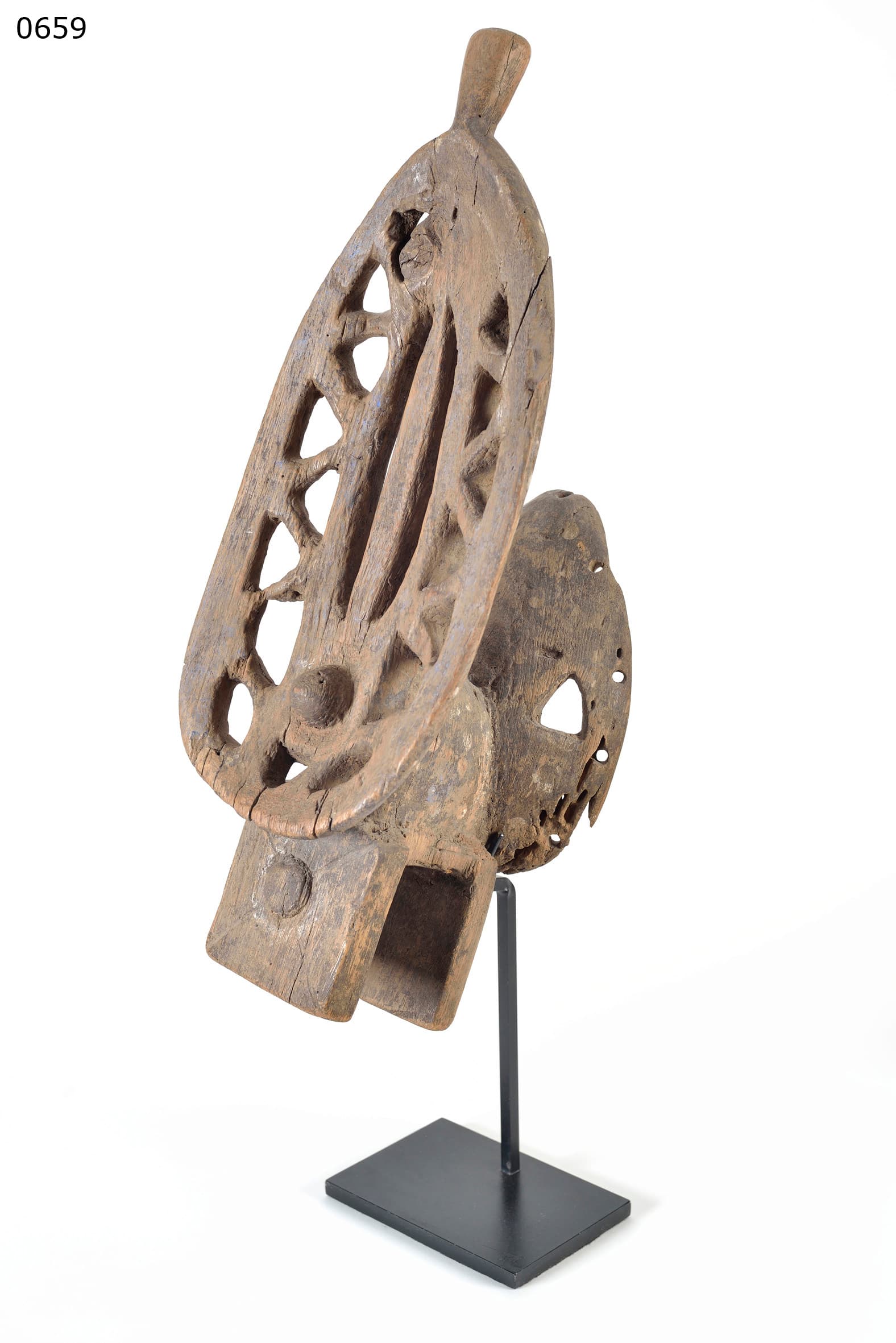
Undoubtedly the most striking segment of art production are the vertical masks associated with the Jukun, Wurkun and Bikwin. These masks are traditionally carved monoxyl - from a single solid block of wood - and reach monumental dimensions of 80 to over 160 centimetres in height. The construction is based on a U-shaped yoke (yoke) that rests on the dancer's shoulders and merges into a long, columnar neck that supports the actual head. A detailed examination of the canonical Type One Wurkun/Bikwin/Jukun mask type reveals a radical multiperspectivity in the formal language: from the frontal view, volumetric, almost hemispherical domed heads dominate. In the profile view, however, this emphasised roundness unexpectedly collapses into an extreme two-dimensionality with sharp, jagged, highly abstracted contours that make the nose and mouth appear like a saw blade (Berns 2011). This stylistic decision forces the viewer to a dynamic reception from multiple angles during the ritual performance. Male masks of this typology can be clearly identified iconographically by their high, transverse crests, which the female counterparts lack. Another canonical element for courtly masks - as the outstanding example in the collection of the Metropolitan Museum of Art (Inv. 2015.445) demonstrates - are flat, disc-shaped ear appliqués (earflares), which function as explicit status markers of the regional elite.
In addition to the masks, caryatid stools (caryatid stools) form another pillar of the royal aesthetic. These stools, often carried by equestrian figures or female ancestors in a state of liminality, serve as physical and spiritual seats of power. The iconography of the supporting figures does not imply subservience, but refers to the supporting role of the ancestors and female vitality for kingship. A jukun chair documented in the museum shows an equestrian warrior figure (possibly a jagun-jagun type), which recalls the importance of cavalry for the expansion of power in the Kwararafa empire.
The choice of material and the formation of the patina are direct derivatives of the ritual function. The objects are primarily made of dense hardwoods and accumulate an extremely thick, encrusted sacrificial patina of palm oil, organic binders, animal blood and pigments over decades. The ontological status of an object fluctuates sharply: an activated ritual object is a life-threatening accumulator of spiritual power (vital force), while in its profane state - outside the ritual season, for example - it is carefully wrapped in special cloths or animal skins to neutralise its gaze and radiance and protect the uninitiated members of the community. Known master hands in the Western sense are hardly documented by name for the 19th century. Creation was the responsibility of specialised carvers, who often worked in ritual isolation in order to realise the principle of minimal design with maximum spiritual density.
The art-historical categorisation of this aesthetic is the subject of a vehement research controversy. The iconography of the Jukun masks was long regarded as a hermetic, isolated phenomenon of the Benue Valley, as categorised by Arnold Rubin (1969) and later Marla Berns (2011), who defined the yoke configuration as a genuinely regional invention. The renowned art historian Sidney Kasfir radically contradicted this purist view: rather, she contextualised the jukun aesthetic as the result of historical migrations. As a result of conflicts with the Fulani, "refugee enclaves" emerged along the Benue, which led to stylistic interaction and a diffusion of formal elements of the Cross River style to the north. The uncertainty in historical taxonomy also manifests itself in museum misjudgements; for example, Elsy Leuzinger wrongly attributed Jukun masks to the Waja in her reference work Jukun-Masken in 1971.
For private collectors, market-relevant forgery criteria for Jukun art focus on the complex microstructural degradation of the material. Since the peoples of the Benue Valley did not produce "airport art" on this monumental scale for the Western market, the simulation of authentic age is extremely complex. Authentic objects from the 19th century exhibit deep cracks in the heartwood, termite damage integrated into the fibre structure (which was often stopped by ritual washing) and a non-homogeneous sacrificial patina that has penetrated deep into the pores. The Rietberg Museum's holdings and the Allan Stone Collection (auctioned by Sotheby's) contain excellent reference pieces that document the contrast between ritual accumulation and the underlying sculptural sharpness.
4. ritual practice
The performative dimension of Jukun art is not a decorative accessory, but the vital, rhythmic heart of the theocratic state. It is inextricably linked to the agri-cultural rhythm of the harvest cycles and the royal life cycle of the Aku Uka. The lifecycle of a ritual object undergoes a drastic ontological metamorphosis. Freshly carved wood has no inherent power for the Jukun; it is a profane artefact. Only through complex consecration rituals, which include ritual ablutions, the ritual rubbing with palm oil and the application of specific pigments, is the object "opened" and transformed into an active altar or mask. This ritual activation transforms the object into a physical vessel for spiritual entities, nature spirits or ancestors.
Detailed observation of the mask performance reveals a strictly regimented, almost militaristic set of rules. Masks such as the Ajiku type documented in the Metropolitan Museum of Art or the Akuma masks appear exclusively as "nocturnal apparitions". The wearer of the mask has the extremely physically demanding task of dynamically manipulating the top-heavy attachments, some of which are over 160 cm tall. They look through lateral openings or the mouth gap of the mask, while a costume made of dense plant fibres completely conceals and annihilates their human identity and anatomy. Access to these ritual performances is strictly exclusive; visual contact is taboo for women, children and non-initiated men. Violations have historically been penalised with serious illness or the intervention of ancestral spirits.
If an object is not in the ritual phase (deactivation), it is not profaned, but treated as a highly potentially dangerous, uncontrolled entity. Caryatid stools, which represent courtly ancestors, are carefully wrapped in animal skins or ritual cloth and kept in dedicated shrines. They are only uncovered for enthronement ceremonies where, placed on leopard skins, they serve as the seat of power for the Aku Uka and physically isolate him from the earth to avoid a "short circuit" of metaphysical forces. Arnold Rubin's groundbreaking fieldwork in 1966 documented the extremely rare condition of an activated ancestral object of the Pindiga type operating in the context of communal harvest festivals in the central Benue region, where it acted as an intermediary between the priest and the spirit world.
Undoubtedly the most complex, ritually dense and mysterious event in Jukun practice is the Pánkyá ceremony - the ultimate rite of passage triggered by the physical death of the incumbent Aku Uka (Agbu 2023). The eschatological conception of the Jukun demands that the ruler is not merely buried, but ritually transferred to divine ancestor status through a sequence of highly symbolic acts. The modalities of this ceremony are breathtaking: the body of the deceased monarch is wrapped in traditional, sacred adiri robes and fixed on a horse. This horse is led through the streets of the capital Wukari to a sacred forest by a selected, trusted young man from the community. This rite is accompanied by absolute social silence and a total interruption of worldly life: all shops and markets close, the entire economy is suspended and the people wave goodbye to their king in traditional dress.
The historical interpretation of this procession is the subject of profound controversy. Ancient accounts and oral traditions suggest that in pre-colonial times this procession was necessarily accompanied by the ritual suicide of the horseman, as his spirit was considered essential to be available to the king in the afterlife as a loyal servant and navigator. However, modern Jukun authorities and publications following the Pánkyá ceremony of Aku Uka Dr Shekarau Angyu Masa-Ibi in January 2022 categorically reject these narratives about the horseman's fate as false, colonial rumours ("totally false") (Bekyu Akweh 2022). Following the funeral procession, the male descendants and the Achuwo priests perform secret libations barefoot at the traditional shrines of Puje and Nando to appease the earth and cleanse the spiritual vacuum of the throne for the successor.
The final disposal and decommissioning of ritual objects is not carried out by the Jukun through simple destruction. Masks or wooden sculptures that have lost their physical integrity and thus their capacity as ritual vessels through years of use, termite infestation or structural decay are often left to the elements in dedicated sacred forests. This process allows spiritual energy to gently flow back to the earth goddess Ama without contaminating human space. Ethnographic collections, notably the British Museum and the Fowler Museum, preserve artefacts that physically trace these life cycles from immaculate cult object to weathered, ritually 'emptied' relic.
| Life phase of the object | Ritual status | Action / safekeeping |
|---|
| Creation (songi) | Profane, material potency | Carving in ritual isolation, raw wood |
| activation | liminal, transition | offerings (palm oil, blood), incantations |
| Ritual use | Metaphysically active, highly dangerous | Nocturnal performance (masks) or libation (altars) |
| Seasonal deactivation | Potentially volatile | Wrapping in cloth/skins, storage in shrine |
| Decommissioning | Ritually emptied, physical decay | Return to nature in sacred forests |
5. historical context
Jukun historiography is inextricably interwoven with the myth and historical reality of the Kwararafa Empire (also known as Kororofa in the literature). This geopolitical entity, which flourished in the vast Niger-Benue Basin between the late 14th and 18th centuries, remains one of the most complex historiographical and archaeological challenges in West Africa today. From the chronicles of the northern Hausa states, especially Kano and Katsina, as well as from the records of the Borno Empire, it is known that Kwararafa was able to lead powerful cavalry attacks deep into the north. At the same time, Kwararafa maintained lucrative and widespread trade relations: The Jukun bred or imported cavalry horses from Kano and traded them for slaves and coveted salts from the Benue Valley.
In the ethnological and archaeological literature, however, there is a sharp controversy regarding the territorial extent and political nature of this "lost empire". In 1931, the British colonial anthropologist C.K. Meek manifested the image of a massive, centralised theocratic empire modelled on the Middle East in his seminal monograph A Sudanese Kingdom, with a god-like, pharaonic monarch at its head who controlled a vast territory militarily.
Modern African archaeologists and historians, above all Akinwumi Ogundiran (2002), significantly deconstruct this colonial narrative. The sources of archaeological research in the Middle Belt do not reveal any monumental imperial ruins, as one would expect from Meek's descriptions. Ogundiran and his colleagues therefore argue convincingly that Kwararafa was less a classical, territorial military empire, but rather a network-like "hegemony" based primarily on the control of trade capital (especially the lucrative salt production, the kwàróórò) and a superior, oracular infrastructure. The historical "power" of the Jukun therefore did not lie in a dense, standing army, but in their role as spiritual service providers and oracle monopolists. They controlled divination systems related to the Ifá or Áfa complex, whereby neighbouring peoples - out of fear of metaphysical reprisals or to solicit harvest blessings - voluntarily paid tribute to them.
The colonial encounter at the end of the 19th and beginning of the 20th century marked a brutal, irrevocable break in the cultural continuity of the Jukun. Administrative reorganisation by the British colonial power, punitive expeditions and the aggressively growing influence of reformist Islam (Sokoto Caliphate) and Christianity led to a rapid abandonment of traditional rituals. Historical museum documentation shows that significant parts of canonical Jukun art production - in particular the production of monumental masks and ancestral shrines - collapsed almost completely in the first half of the 20th century. This makes the exact dating and identification of pre-colonial works historically extremely uncertain; the sources for objects that were definitely created before 1850 are extremely fragmentary.
The reception of Jukun art on the Western art market was initially very hesitant, but from the middle of the 20th century it experienced exponential price leaps. The defining moments for the market for African art in the West were the major auctions of the 1960s, above all the auction of the Helena Rubinstein Collection in New York in 1966, which finally catapulted archaic African sculpture into the realm of high-end collecting. For the art of the Benue Valley, it was visionary dealers such as Philippe Guimiot, Jacques Kerchache and Hélène Kamer who brought the first absolute reference pieces from Nigeria to Paris and exhibited them under adventurous conditions in the late 1960s and early 1970s (e.g. Kamer's "Nigeria" exhibition in 1971).
A historic breakthrough in academic exploration and the resulting pecuniary valuation took place in 2011 with the groundbreaking travelling exhibition Central Nigeria Unmasked: Arts of the Benue River Valley. This exhibition, curated by Marla Berns, Richard Fardon and Sidney Kasfir, travelled from UCLA's Fowler Museum to the Smithsonian to the Musée du quai Branly in Paris, finally bringing the abstract, angular aesthetic of the Benue Valley out of the shadows of the hitherto dominant, classical-naturalistic West African styles. This scholarly reassessment culminated in spectacular auction results, such as the sale of the outstanding Pindiga ancestor figure from the renowned collection of Sidney and Bernice Clyman at Sotheby's in New York in 2020.
For the serious private collector, this complex history gives rise to highly specific authenticity and quality criteria. As the active production of large-scale cult sculpture came to an early halt, objects attributed to the 19th or early 20th century must show clear forensic traces of long-term ritual use. These include not only thick, stratified sacrificial layers of palm oil and organic material, but also unmistakable indicators of ageing such as natural heartwood cracks and deep, historical termite damage that attacks the integrity of the wood. The forensics of Jukun objects in Tervuren (RMCA) or in the Rietberg Museum often show that such termite damage did not mean the end of the object, but was stopped by ritual intervention and the traces of damage were integrated into the aesthetics of the object as proof of the survival of the indwelling spirit force.