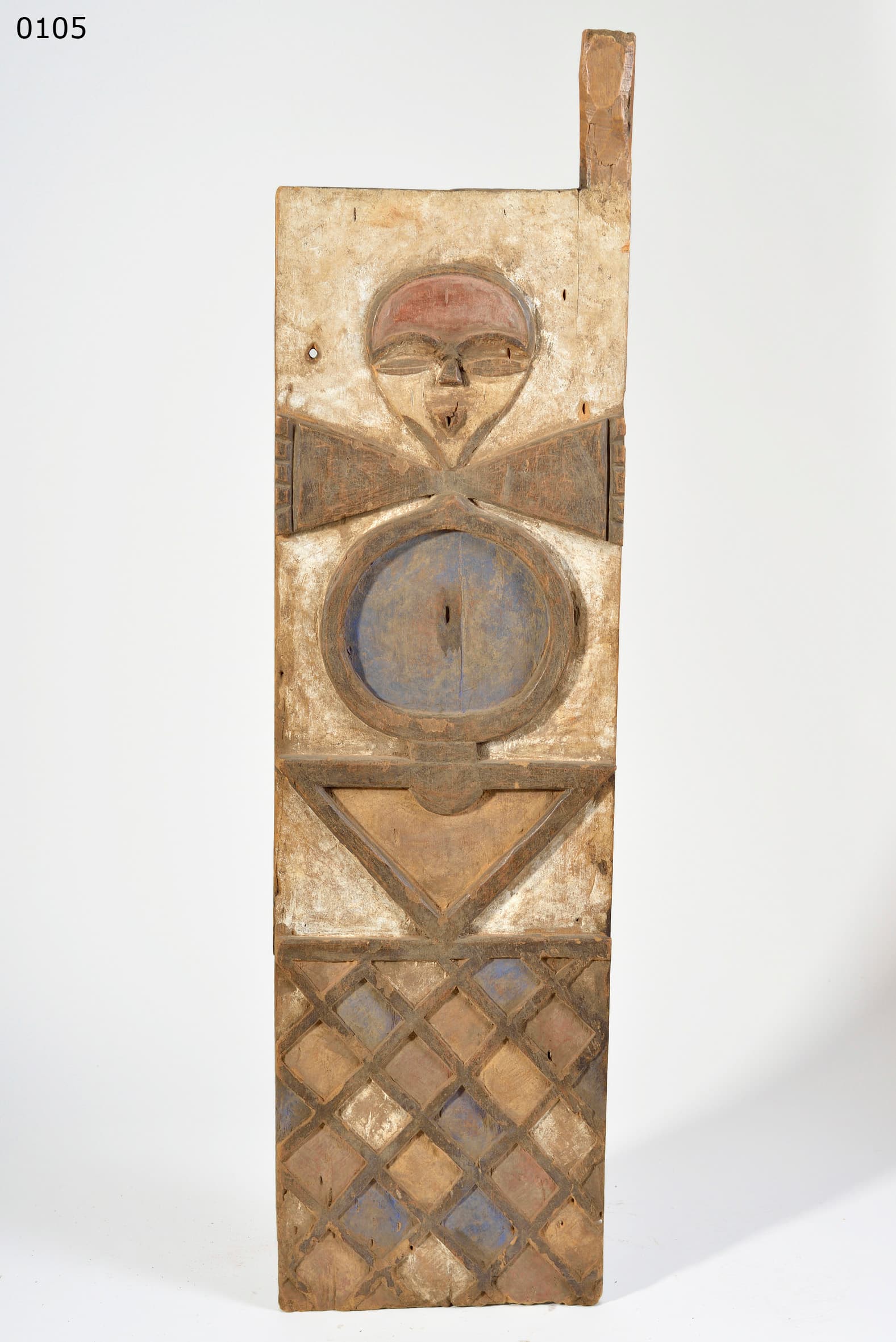
Eine flache, rechteckige hölzerne Schreinplatte (1. Hälfte 20. Jh., 101 cm) von den Tsogho aus Gabun - im Flachrelief geschnitzt mit einem stilisierten herzförmigen Gesicht über konzentrischen Kreisen, Dreiecken und bemalten polychromen Motiven.
1. Innere Säule der Ebanza
Diese kleinere Tafel gehört zu demselben architektonischen Programm wie ihr größeres Geschwisterchen.
- Innerhalb des Tempels: Die Tafel ist im Inneren der Bwiti-Ebanza angebracht und nicht an ihrem Eingang.
- Teilung des heiligen Raums: Sie unterteilt die Struktur und markiert die Grenzen, die nur Eingeweihte der Bwiti-Gesellschaft passieren dürfen.
2. Der Vorfahre als Zeuge
Das herzförmige Gesicht hat eine spezifische Initiationsrolle.
- Stiller Beobachter: Der in die Tafel geschnitzte Ahne ist ein stiller Beobachter der im Tempel durchgeführten Riten.
- Iboga-Vision: Unter Iboga halluziniert der Eingeweihte nicht allein - der geschnitzte Ahne "führt" ihn durch die Geisterwelt und bestätigt die folgenden Visionen.
3. Kosmisches Diagramm
Die Geometrie, die das Gesicht umgibt, ist ein Miniaturdiagramm des Universums.
- Konzentrische Kosmologie: Kreise innerhalb von Kreisen bilden die verschachtelten Ebenen der lebendigen Welt, der Ahnen und des Schöpfers ab.
- Polychrome Aktivierung: Die rot/weiß/schwarze Farbpalette ist nicht ornamental - die Farben stehen im Einklang mit der dreiteiligen Kosmologie der Bwiti: Blut, Geist und Leere.
Zusammenfassung
Diese kleinere Tsogho-Tafel ist die ruhigere Hälfte eines Schreinpaares. Ihre Rolle ist eher kontemplativ als deklarativ und führt die Eingeweihten tiefer in den Bwiti-Raum mit einem Ahnengesicht, das von einem dichten kosmologischen Diagramm eingerahmt wird.
KI-unterstützt erstellt aus Sammlungsgutachten, Objektfotografie und eigener Recherche, redaktionell geprüft. Fehler sind möglich — Hinweise darauf sind uns willkommen. Zum Verfahren →