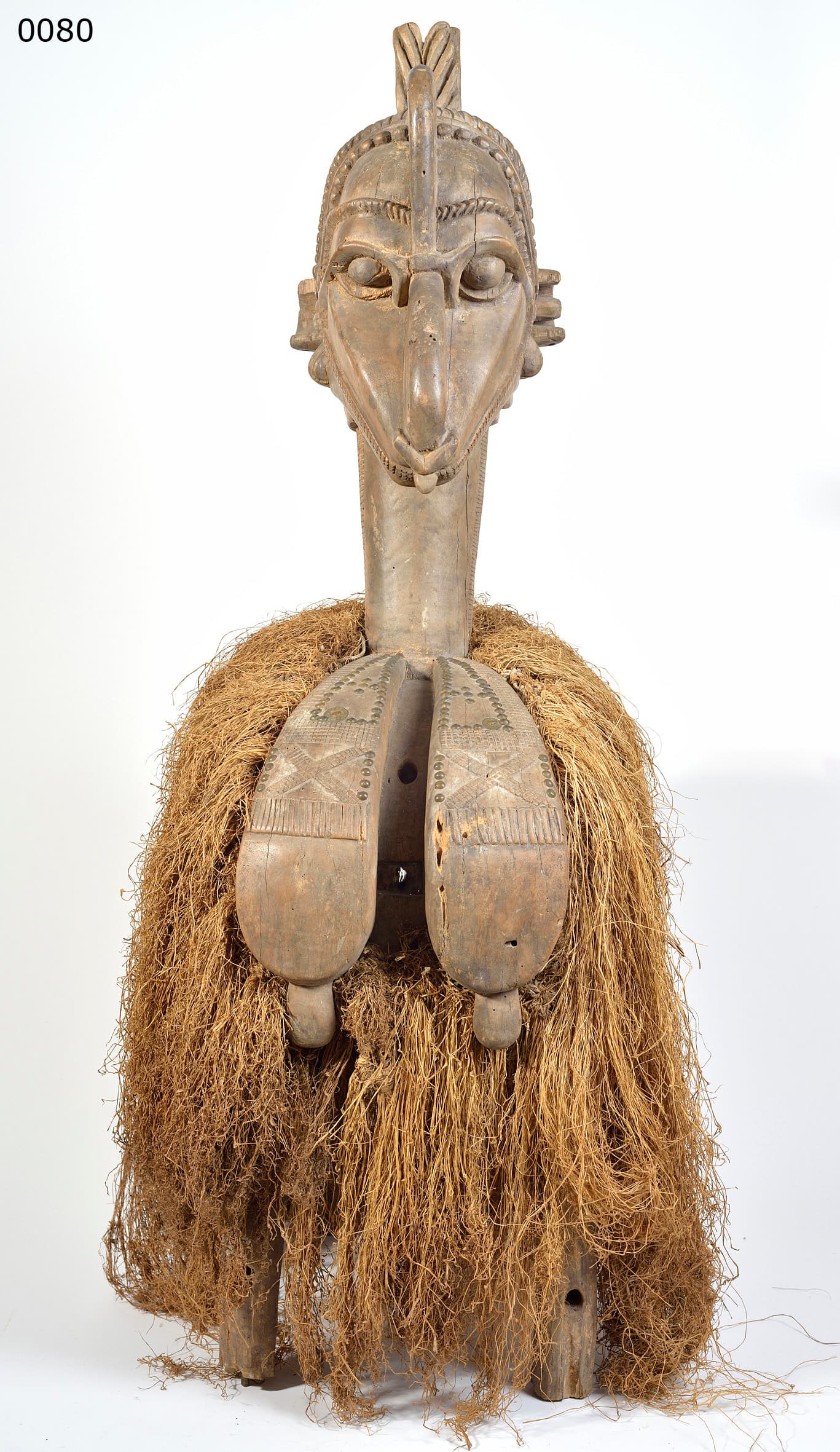
Ein komplexer Baga-Doppelaltar A-Tshol (1. Hälfte 20. Jh., 86 cm) aus Guinea - eine dicke rechteckige Basis, die zwei ausgeprägte langschnäblige A-Tshol (Vogel-Mensch-Hybride) trägt, die sich auf zylindrischen Hälsen erheben, wahrscheinlich männlich und weiblich. Das schwere Holz ist stark oxidiert und zeigt eine trockene, krustige, erdfarbene Patina mit starker Erosion an den markanten, geschwungenen Schnäbeln.
1. Zweiköpfige Zusammensetzung und kinetische Geometrie
Der A-Tshol (oder Elek) gilt als eine der prägnantesten Formen der zoomorphen Abstraktion der Baga – eine Verbindung aus menschlichem Schädel und dem geschwungenen Schnabel eines Nashornvogels.
- Skulpturale Rarität: Es ist eine seltene skulpturale Form, zwei A-Tshol-Figuren auf einem einzigen, einheitlichen Altarsockel zu finden – die bicephale Komposition schafft eine ausgewogene architektonische Symmetrie.
- Zwei freitragende Schnäbel: Die massiven freitragenden Schnäbel ragen nach außen, während die gewölbten menschenähnlichen Schädel das Stück verankern – was für ein ausgeprägtes handwerkliches Geschick beim Ausbalancieren massiver gegensätzlicher geometrischer Volumina auf einer einzigen Basis spricht.
2. Die Simo-Gesellschaft und Duale Kosmische Verteidigung
Der A-Tshol gilt als ein zentrales rituelles Schutzobjekt der Simo-Geheimgesellschaft, das traditionell von den Ältesten eingesetzt wurde, um schädigende Einflüsse abzuwehren.
- Männlich-weibliche kosmische Einheit: Dieser duale Altar wird oft als Darstellung einer komplementären Ordnung interpretiert – vermutlich manifestieren sich hier männliche und weibliche Prinzipien im Zusammenspiel.
- Omnidirektionale Verteidigung: Die Platzierung zweier Geistdarstellungen auf einem Altar sollte traditionell eine umfassende Schutzbarriere für die Lineage bilden – Berichten zufolge wurde der schwere Altar in Krisenzeiten getanzt oder präsentiert, um die Gemeinschaft rituell zu schützen.
3. Elementare Degradierung und Opferkruste
Die Oberfläche zeigt deutliche Spuren, die auf eine aktive Nutzung im Kontext eines halboffenen Schreins hindeuten.
- Erdig strukturierte Kruste: Das Holz ist unpoliert und weist eine trockene, stark strukturierte, erdige Kruste auf, die auf wiederholte rituelle Opfergaben und Umwelteinflüsse zurückzuführen sein dürfte.
- Schnabelspitzenerosion: Starke Kantenabnutzung, Abstumpfung und altersbedingte Abplatzungen an den Spitzen der massiven Schnäbel und der Basis legen nahe, dass dieses Objekt aktiv gehandhabt, bewegt und im rituellen Kontext genutzt wurde.
Zusammenfassung
Dieser doppelte A-Tshol-Altar stellt ein bemerkenswertes Zeugnis der Baga-Schnitzkunst dar und zeigt eine seltene bicephale Komposition. Seine ausgeprägte, geschwungene Geometrie und seine tief verkrustete, trockene Patina stützen eine Zuschreibung als rituelles Objekt der Simo-Gesellschaft.
KI-unterstützt erstellt aus Sammlungsgutachten, Objektfotografie und eigener Recherche, redaktionell geprüft. Fehler sind möglich — Hinweise darauf sind uns willkommen. Zum Verfahren →

Cresthead Schlangenmaske

Zoomorphe Schreinfigur (wird bei rituellen Zeremonien verwendet)
Schlangenkopfwappen