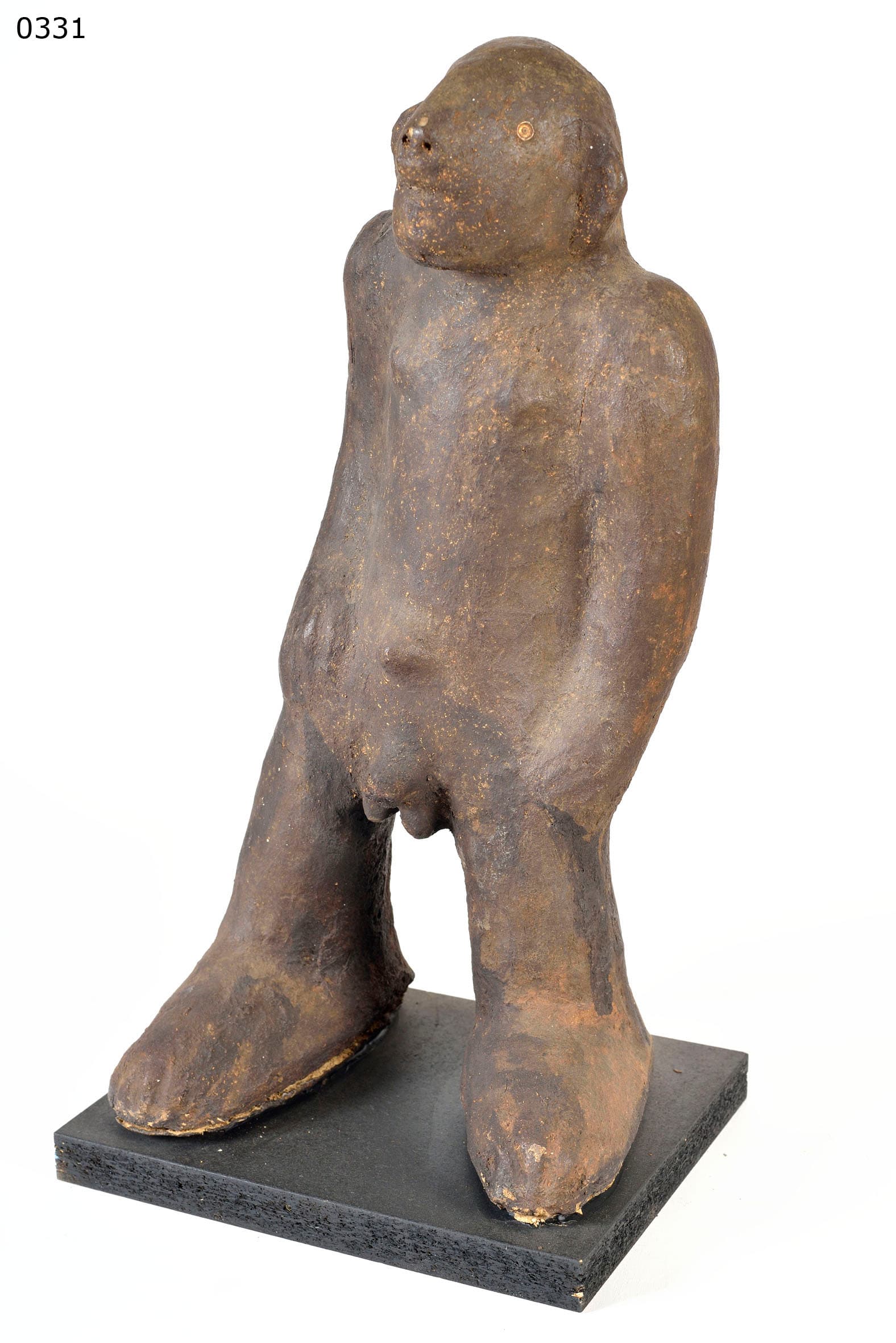
Dieses hölzerne Figurenpaar zeigt eine extreme, bauchige Abstraktion mit geschwollenen Hüften und Schultern, die im Kontrast zu drastisch verengten Torsi und flachen, regalartigen Köpfen stehen. Eine dicke, krustige und trockene braune Patina überzieht beide Figuren und spricht für ein hohes Alter.
1. Ästhetischer Stil und regionale Eigenheiten
Die Montol (und die benachbarten Wurkun und Goemai) aus dem mittleren Benue-Tal in Nigeria sind für ihren hochexpressionistischen, nicht-naturalistischen Schnitzstil bekannt. Dieses Paar setzt auf radikale volumetrische Kontraste - die explosive Schwellung der Oberschenkel und Schultern steht im Gegensatz zu unmöglich dünnen Taille. Diese aggressive Geometrie erzeugt eine dynamische visuelle Spannung, ein Markenzeichen der Montol-Ästhetik, die eher spirituelle Kraft als physische Realität vermitteln soll. Die Ästhetik des Benue-Tals arbeitet eher mit extremer proportionaler Verzerrung als mit der detaillierten Artikulation von Merkmalen.
2. Rituelle Funktion und Komtin-Heilung
Diese Figuren waren von zentraler Bedeutung für die männliche Geheimgesellschaft der Komtin (oder Njem), die sich mit Heilung, Wahrsagerei und sozialer Kontrolle befasste. Diese Statuen waren keine statischen Ahnenporträts, sondern aktive, kinetische Akteure. Bei Heilungszeremonien hielten die Eingeweihten der Komtin diese Figuren in der Hand, während sie sangen, und nutzten sie, um geistige Kräfte zu kanalisieren, um Krankheiten zu diagnostizieren und zu heilen oder um bösartige Hexerei zu bekämpfen. Ihre Tragbarkeit spiegelt sich in ihren robusten, handlichen Formen wider. Die Figuren fungierten im Rahmen des Komtin-Lehrplans gleichzeitig als Diagnoseinstrumente und therapeutische Mittel.
3. Physische Patina und Altersnachweis
Die schwere, undurchsichtige und körnige Oberfläche dieser Figuren ist der Inbegriff einer "Machtpatina". Sie wird auf rituelle Opfergaben aus Hirsebier, Blut und gekauten Wurzeln zurückgeführt, die von Komtin-Priestern auf die Figuren aufgebracht wurden. Diese biochemische Kruste spricht für eine Entstehung der Figuren im frühen 20. Jahrhundert und dient zudem als buchstäbliche Verkörperung der angesammelten spirituellen Wirksamkeit der Figuren und macht sie zu pharmakologischen Objekten und gleichzeitig zu Kunstwerken.
Zusammenfassung
Durch ihre radikale volumetrische Abstraktion und ihre dicke Opferkruste fängt dieses Montol-Paar die kinetische und medizinische Kraft der Statuen aus dem Benue-Tal ein. Sie sind eindringliche Zeugnisse der spirituellen Architektur der Komtin-Gesellschaft.
KI-unterstützt erstellt aus Sammlungsgutachten, Objektfotografie und eigener Recherche, redaktionell geprüft. Fehler sind möglich — Hinweise darauf sind uns willkommen. Zum Verfahren →