Overview
The geographical location and demographic recording of the Ambete (also known in ethnographic and art historical literature as Mbete, Mbede, Mbeti or Ambété) poses considerable methodological challenges for research. The core settlement area of this ethnic group extends across the central Congo Basin, primarily along the current political border between the Republic of Congo (particularly in the western districts around Mossendjo and Zanaga) and eastern Gabon, specifically in the province of Haut-Ogooué. Current demographic estimates put the population at around 50,000 individuals, although such quantitative surveys must always be viewed with a considerable margin of error due to fluid ethnic boundaries, recent urbanisation processes in Central Africa and historical migration movements. Linguistically, the Ambete are undoubtedly assigned to the large Bantu language family, which embeds them in a far-reaching cultural and semantic exchange area within Equatorial Africa.
The classification and nomenclature of this group is not uncontroversial in research and reveals the problems of colonial ethnography. The self-designation (autonym) of the local lineages varies greatly from region to region, while the exonym "Ambete" often functioned as a linguistic collective term of the early French colonial administrators in order to construct an administratively comprehensible unit (Miletto 1951: 22). A fundamental research controversy that continues to this day is the ethno-historical positioning of the Ambete in relation to their northern neighbours, the Kota. In their own oral traditions, the Ambete often claim direct Kota descent, which is why early ethnographers and art historians classified them as a pure subgroup of the Kota complex (Siroto 1976: 45). The renowned art historian Louis Perrois coined the term "Ambete-Obamba" style in his seminal works to capture the fluid morphological and ritual transitions within the Ogooué basin. Other authors, such as Marie-Claude Dupré, on the other hand, emphasise the strict independence of the Ambete and deconstruct the "Kota" concept as an artificial construct of Western research that does not do justice to the socio-political realities of the region (Dupré 1980: 345). The source situation is ambiguous in this respect, as linguistic proximity does not necessarily correlate with congruent material culture.
The social structure of the Ambete is primarily organised acephalously; consequently, there is no centralised political authority, no institutionalised kingship and no bureaucratic state apparatus. Instead, society operates on the basis of segmentary, patrilineal kinship systems. In this system, descent is passed down exclusively through the male line, and the rule of residence is patrilocal, meaning that wives move into the households of their husbands' families. Political power is decentralised and negotiated at the level of local village chiefdoms, where authority is not absolute but legitimised by age, ritual competence and the ability to reach consensus. The anthropologist E.E. Evans-Pritchard has aptly described this type of segmentary organisation as a system of balancing oppositions, which can also be applied to the Ambete (Evans-Pritchard 1940). In the absence of an executive central power, secret societies and ritual associations assume the function of social control, jurisdiction and peacekeeping between rival lineages.
The subsistence system of the Ambete is traditionally based on semi-permanent slash-and-burn agriculture in the tropical rainforest, which is supplemented by extensive ritual hunting and fishing. Farming is primarily the responsibility of women, who cultivate root crops such as manioc and yams, while hunting is considered an exclusively male domain that is deeply embedded in the religious system. The territorial and cultural neighbourhood to the Kota in the north, the Teke (Tsaayi) in the east and the Kwele generates an extremely complex, multidirectional interaction zone. Corresponding contact phenomena are clearly reflected in the inventory catalogue of the Musée du quai Branly or the Fondation Barbier-Mueller, where Ambete objects often exhibit hybrid traits of neighbouring ethnic formal languages (Perrois 1979: 21).
| Socio-political characteristics | Specification of Ambete society | Comparative context (Central Africa) |
|---|
| Political organisation | Acephalous (rule-free), segmentary | Contrast with centralised kingdoms (e.g. Luba, Cuba) |
| Descent rule | Patrilineal (agnatic) | Contrast with matrilineal systems in the southern savannah belt |
| Residence rule | Patrilocal | Typical of patrilineal Bantu groups |
| Social control | Secret societies, council of elders, initiation societies | Similar to the Bwete societies of the Kota and Mahongwe |
| Subsistence strategy | slash-and-burn agriculture, ritual hunting | adaptation to the tropical forest-savannah ecotone |
Interaction with neighbouring peoples was historically characterised by an interplay of marriage alliances, ritual exchange and sporadic territorial conflicts. The influence of the Teke in particular, who settled on the eastern plateaus of the Haut-Ogooué, is documented in the adoption of certain insignia and necklaces by Ambete dignitaries. In this structure, the Ambete often acted as cultural mediators between the pure forest communities and the savannah peoples, which makes their art a fascinating amalgam of regional influences.
Cultural context
The religious system of the Ambete is deeply rooted in an all-encompassing cosmological order that understands the visible and invisible universe as an inseparable unity. At the head of this pantheon is a dual principle of creation. The creator god Nzambi Mpungu (in regional Bantu cosmology often associated with the sky, the sun and the male life force) and his female counterpart Nzambici (associated with the earth, the moon and fertility) form the origin of existence. According to traditional creation myths, they created the spark Kalûnga in the primordial nothingness (Mbûngi), from which the material universe emerged. However, as is common in many Central African religions, Nzambi Mpungu withdrew from the immediate living world of humans after the initial creation as Deus otiosus (an inactive, distant god). He is neither depicted in sculptures nor directly invoked through regular cult events.
Instead, the active, everyday spiritual interaction of the ambete is centred almost entirely on ancestor worship, which is structurally closely related to the extensive Bwete initiatory complex of the region (Perrois 2012: 88). The ancestors function as irreplaceable mediators between the absolute power of the creator god and the profane needs of the living. According to Ambete eschatology, a deceased person ideally transforms into a benevolent spirit that watches over the lineage; however, if the rite of passage fails, existence as a harmful, wandering spirit is imminent (Perrois 2002: 85).
At the centre of religious authority are male secret societies that monopolise esoteric knowledge. In an acephalous society without a formal state executive, these associations are the primary bearers of power and social order. They control access to the ancestral relics, which represent the essential physical link to the transcendent power. Ritual authority lies with specialised priests and divinators who are empowered to call upon the ancestors to guarantee hunting success, fertility and the protection of the village community from witchcraft.
The role of women in the Ambete cult is strongly underrepresented in the historical literature, which is mostly written by male colonial officials, but requires differentiated consideration. While women were usually strictly excluded from the direct handling of primary ancestral relics in the Bwete context, recent cultural anthropological research indicates that they functioned as essential "custodians of culture". Women held important roles in ritual preparation, in agricultural fertility rites and as mediums in specific possession cults that operated outside of patriarchally controlled relic cults (Woodhead 2007: 15). Nevertheless, sacred sculpture production and its initiatory activity remains a male-dominated sphere.
What structurally distinguishes this religious practice from the cults of its north-western neighbours manifests itself fundamentally in the concept of the reliquary. Among the Fang (as part of the Byeri cult), the sculpture (Eyema byeri) functions merely as a guardian figure, which is placed on a cylindrical bark box containing the actual bones. The separation between the protective sculpture and the sacred contents is physically evident. In the Ambete, however, the sculpture itself is the container (LaGamma 2007: 45). The relics are integrated into the specially hollowed-out torso of the fully sculpted figure.
This structural difference forms the core of one of the most prominent iconography controversies in the study of African art. Researchers are intensively debating the evolutionary genesis of the reliquary complex in the Ogowe Basin. Louis Perrois (1979) postulates a morphological continuum: he argues that the fully sculptural, three-dimensional (3D) Ambete figure represents an evolutionary bridge or a conserved archaism from which the highly abstracted, two-dimensional (2D) and metal-clad Mbulu-Ngulu figures of the Kota later developed. In contrast, Leon Siroto (1976) dates and interprets these traditions as parallel developments. Siroto and other critics argue that the 3D conception of the Ambete and the 2D conception of the Kota do not necessarily stem from a linear stylistic evolution, but are the result of divergent ritual requirements and separate socio-political developments within the region's acephalous power struggles. Hybrid objects documented in the holdings of the Musée du quai Branly and the Rietberg Museum illustrate these fluid cultic boundaries and partially support the thesis of a continuous exchange (Le Fur & Perrois 2017: 15).
Aesthetic features
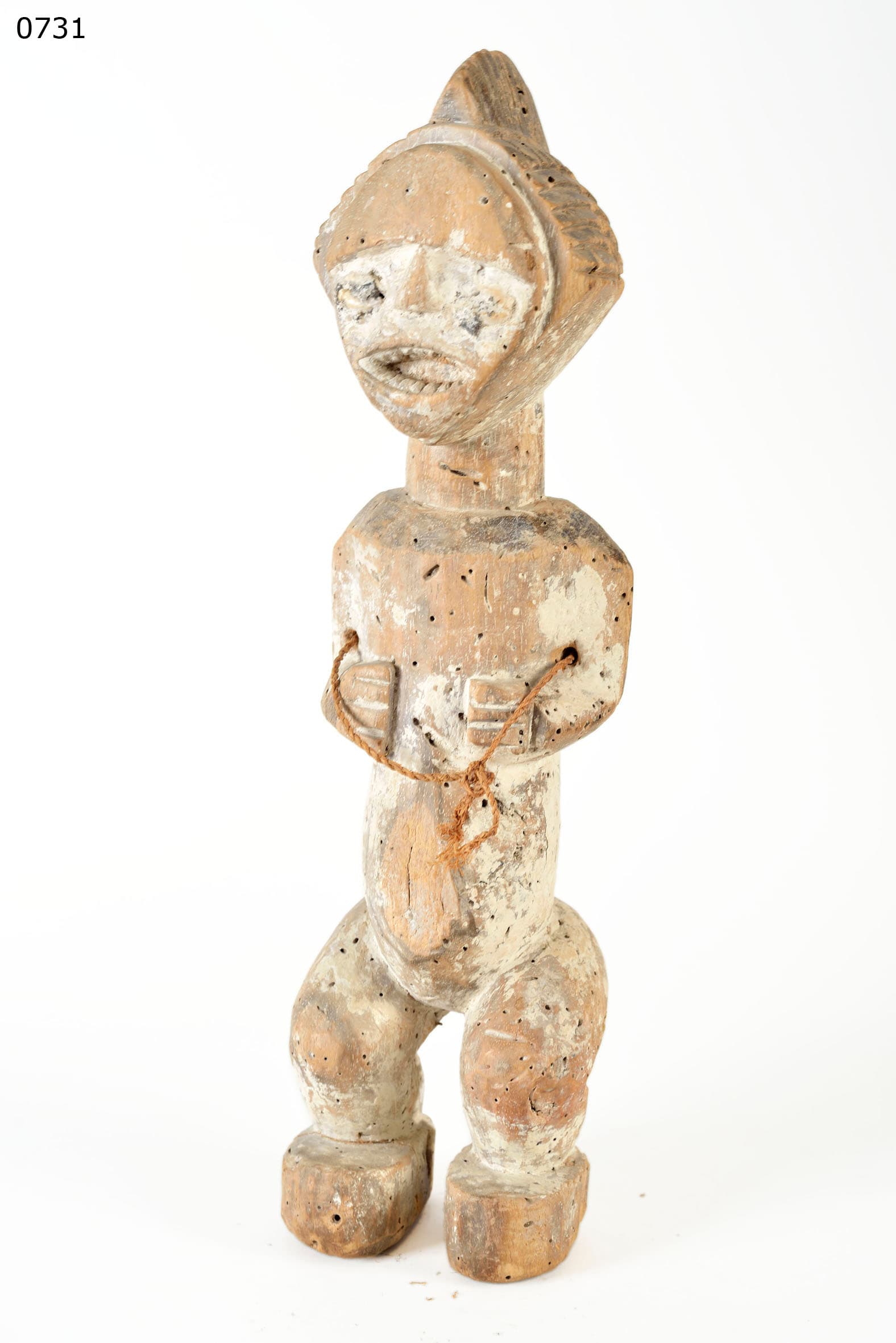
The canonical object typology of the Ambete manifests itself primarily in three distinct sculptural formats: solitary heads, torso busts and fully sculpted figures (Fagg 1958: 156). The absolute opus magnum of this aesthetic tradition is undeniably the anthropomorphic full figures, which simultaneously function as sacred reliquaries. In contrast to the more profane heads and busts that were placed on poles in front of the houses of local dignitaries in the villages as apotropaic symbols of protection and emblems, the activated ritual object is characterised by a specific architectural modification: an often elongated rectangular cavity carved into the back of the torso (LaGamma 2007: 50). This dorsal cavity, which was closed by a small wooden door usually fixed with bast fibres, contained the essential bones. The dimensions of these figures range from a compact 40 centimetres to monumental versions of almost one metre.
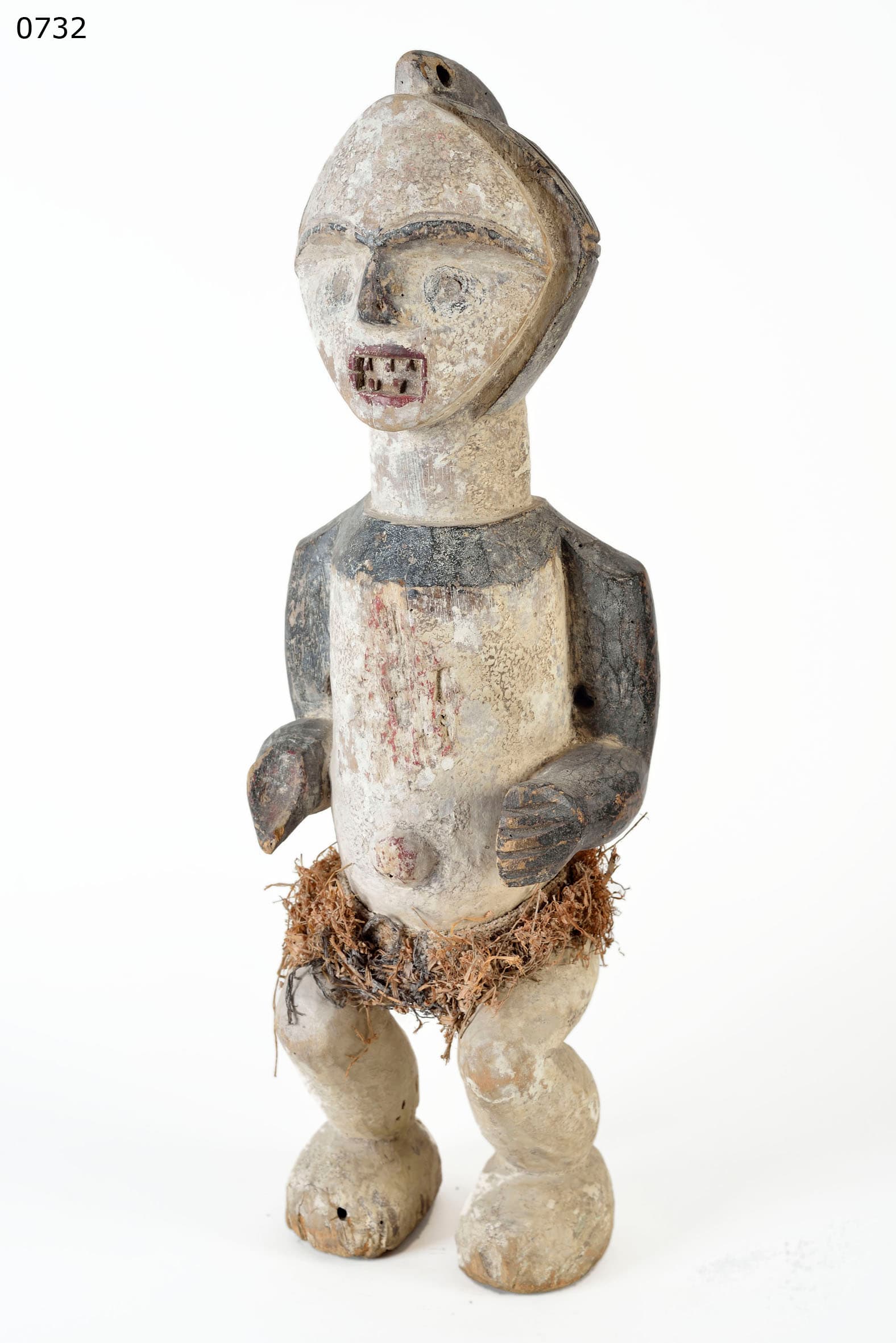
The Ambete sculpture's canon of proportions operates with a highly cubist and reductionist vocabulary of forms, which stands in stark contrast to the relative naturalism of the neighbouring Punu Lumbu groups. The face is dominated by a massive, protruding forehead section that lies like an architectural canopy over a strongly hollowed-out, receding facial plane. The block-like, often open mouth - sometimes with inserted metal teeth - and the characteristically tiered hairstyle (which ends in horizontal bows or a striking hat shape) emphasise the tectonic severity of the composition. A key feature is that the original cylindrical shape of the tree trunk, which serves as the material, always remains visually tangible. The arms are often worked out of the trunk in rudimentary relief, pressed close to the body, with the hands usually resting asymmetrically on the stomach. This rhomboid, almost diamond-like arm position, paired with shoulders that fall forwards and legs that rest with pronounced calves in angled, dynamic tension, creates the characteristic gesture of a watchful presence - the figure is an "active guardian" (LaGamma 2007: 52).
The sources for documented "master hands" in the classical ethnographic literature are sparse, as African woodcarvers mostly worked in collective paradigms and attributions by name in the Western sense were uncommon. Nevertheless, modern stylistic and forensic analyses can isolate distinct workshops or individual creators. A prominent example is the so-called "Mbete Kota artist", whose handwriting was clearly identified in a 19th century relic masterpiece in the holdings of the Metropolitan Museum of Art (Inv. 2002.456.17, formerly Pierre Matisse Collection).
| Pigmentation | Material basis | Cosmological symbolism in the Ambete |
|---|
| White | Kaolin (clay) | Ancestral world, vision, initiation, spiritual clarity, defence against witchcraft |
| Red | Camwood (Tukula powder), palm oil | Vitality, renewed potency, agency, blood, liminal transitions |
| Black | Charcoal, burnt resins | Death, mourning, concealment, physical finitude |
The choice of materials and the creation of the patina follow a strict, ritually regulated polychromy symbolism. White kaolin pigments, which were often applied to the interstitial areas of the arms and face, represent the ancestral world and visionary clarity. Red camwood powder invests the figure with "renewed potency" and vitality, while black burnings or resins are associated with death and mourning. Additional applications such as cowrie shells for the eyes intensify the sculpture's staring, hypnotic gaze.
Understanding the patina is of critical relevance for private collectors, as it is the primary criterion for identifying forgeries. A profane object carved solely for sale is radically different from a ritually activated object. The authentic patina (the so-called "seeping patina", which acts like living skin), which has grown over decades of ritual libations (palm oil, blood) and handling, penetrates the wood deeply. Forgers from modern workshops, on the other hand, artificially apply dirt, tar or battery acid, which can be revealed microscopically and chemically as a superficial crust (Scarola 2018). In addition, real objects often exhibit autochthonous heartwood cracks (desiccation cracks), which are caused by the natural drying process over decades, as well as specific feeding paths of endemic termites that follow the natural fibre courses of the wood - parameters that are almost impossible to reproduce artificially. In addition to the relic figures, the Emboli helmet mask is also a canonical object of the Ambete. These Janus-headed masks, which are stylistically reminiscent of the Mahongwe and Punu, often feature striking sagittal ridges and are among the most impressive woodwork in the region.
Ritual practice
The ritual practice of the Ambete was primarily focussed on maintaining socio-cosmic balance. In an environment characterised by the vagaries of the tropical rainforest, periodic food shortages and the latent threat of witchcraft, ancestor worship provided a systemic instrument of control. At the epicentre of this performance were the relic figures, whose cycle of existence - from the felling of the tree to its ritual activation and final disposal - followed a precisely defined sacred choreography.
The life cycle of an ambete reliquary begins with the wood carving. At this initial stage, the sculpture is a purely profane artefact, an empty wooden vessel with no inherent power. The carver (usually a specialised craftsman within the community) shapes the cubist contours and hollows out the characteristic dorsal cavity. The ontological transformation from wooden block to sacred centre of power - the activation - only takes place in a ritually protected space through the formal introduction of ancestral relics. These relics mostly consisted of the purified long bones (Ossa longa) and skull remains of outstanding personalities of the lineage: successful hunters, warriors, visionary diviners or lineage founders (Perrois 1979: 110). The placement of the bones directly in the torso of the figure (in contrast to the external placement of the Kota or Fang) gave the sculpture the immediate status of a living, acting subject (Agency); the figure "became" an ancestor.
The construction of the altar and the placement of the activated figures were subject to strict taboos. The reliquaries were kept hidden from the view of non-initiates, women and children, mostly in the darkened interior of the Ebandza, the cult and meeting house of the male society, which architecturally symbolised the cosmos (Gollnhofer et al. 1975). The ritual use involved regular, highly formalised consultations. In times of crisis - droughts, rampant diseases, hunting failures or for decision-making in social conflicts - the priests appeared before the figures. The interaction required specific offerings to "fuel" the power of the ancestors. These libations included the pouring of palm wine, the offering of sacrificial animal blood (usually chickens) and the repeated anointing of the sculpture surface with red tukula powder and palm oil. White kaolin was also applied for initiation occasions or visionary rites. This constant care over generations led to the deeply saturated, multi-layered "sacrificial patina" (seeping patina) so characteristic of authentic pieces, which collectors today value as evidence of ritual use.
Another, dramaturgically completely different element of the ritual practice was the mask performance. While the reliquary had a static effect in secret, the Emboli mask made a public and dynamic appearance. The Emboli masks are massive helmet masks, often Janus-faced, worn by high-ranking initiates whose bodies were completely concealed under dense costumes of raffia. Their use centred on two main occasions: the complex initiation rites for young men, in which they were introduced to the knowledge of the secret societies, and aggressive anti-witchcraft campaigns (Anti-Witchcraft rituals) (Perrois 2002: 85). The Janus-faced (two-faced) design symbolised the all-seeing, omniscient surveillance power of the ancestral world, which could simultaneously detect physical and metaphysical dangers. Regional variants of the masks often show references to the Kwele or Punu, which demonstrates the fluid ritual exchange in the region.
The life cycle of a sacred object inevitably ended with its deactivation or disposal. This occurred when a specific lineage became extinct, a village was completely relocated after a calamity or the wooden figure collapsed structurally beyond repair due to indigenous termite infestation. In such cases, the valuable bones were removed in a secret ceremony and either transferred to a newly carved sculpture or permanently buried in a secret location. The old wooden vessel abruptly lost its sacred status the moment the bones were removed. It was profaned, was now considered an empty shell and was mostly left to rot naturally in the rainforest or simply used as firewood. This ontological transition from an activated, feared cult object to profane waste - and later, in a Western context, to a highly valued work of art - is now the subject of museums such as the Museum Rietberg (Zurich) and the RMCA Tervuren.
Historical context
The historical classification and genesis of Ambete art production is inextricably linked to the complex migratory movements in Central Africa and the shattering dynamics of the colonial encounter in the late 19th and early 20th centuries. The prehistoric migration history of the region is the subject of ongoing dating controversies in research. There is a broad consensus that the Ambete and related Bantu groups migrated in successive waves from the northern savannah borderlands into the dense forest regions of the Ogooué Basin (Soret 1955, cited in Dupré 1980). However, the exact chronology of this land occupation remains ambiguous due to the lack of comprehensive archaeological evidence in the tropical environment.
The most decisive historical caesura was the arrival of European powers. The Upper Ogooué region was primarily opened up by French expeditions, most notably by Pierre Savorgnan de Brazza from 1883 onwards. The establishment of the French colonial administration (Afrique Équatoriale Française) and the massive influx of Western missionaries had catastrophic effects on the traditional social structure. The anti-colonial tensions and forced labour on plantations destroyed the fragile acephalous networks. Christian missionaries in particular saw the Bwete ancestral cults as an incompatible, "pagan" threat. In many places, this led to the forced abandonment of relic cults, the systematic destruction of altars or the confiscation of objects. Paradoxically, it was precisely this colonial confiscation that ensured the physical preservation of many sculptures that would otherwise have rotted away in the rainforest.
Aristide Courtois, a French colonial administrator who was stationed in the Congo and Gabon between 1910 and 1938, was a central, ambivalent protagonist of this era. Apart from his administrative duties, Courtois developed an extraordinary eye for the formal language of indigenous sculpture. He collected an immense number of top works, including exclusively the most important Ambete relic figures known today as well as Kuyu and Kwele masks (Lehuard 1987: 12). Courtois sent these works in large instalments to Paris, where they were primarily acquired by the influential art dealer Charles Ratton.
The transformation of the Ambete works from ethnographic curiosities to masterpieces of world art began with Ratton. The year 1935 marked a historic turning point in the reception of the works in the West: while the Museum of Modern Art (MoMA) in New York presented the epochal exhibition "African Negro Art" curated by James Johnson Sweeney, the ambitious gallery owner Pierre Matisse (the younger son of the painter Henri Matisse) organised the exhibition "African Sculptures from the Ratton Collection" in New York at almost the same time. Here, an Ambete reliquary (now owned by the Metropolitan Museum of Art) was not presented in overloaded ethnological display cases, but as a solitary, perfectly formed modernist sculpture. Critics praised this staging, which significantly inspired Cubist and Fauvist artists and revealed the congenial structural relationship between African abstraction and the European avant-garde (LaGamma 2007: 18).
| Epoch | Event / Actors | Impact on Ambete Art |
|---|
| Pre-1880 | Local power structures, ancestor cult intact | Production of ritually highly charged, functional cult objects. |
| 1880-1930 | De Brazza (1883), missionisation, Aristide Courtois (1910-38) | Confiscation, destruction, outflow into European collections. |
| 1930-1950 | Charles Ratton, Pierre Matisse (exhibition 1935, MoMA) | Transformation into a modernist art object in the West. |
| Post-2000 | Auction houses (Sotheby's, Christie's), Metropolitan Museum | Highest prices in the "Trophy Lot" segment, massive wave of forgeries. |
The market history in the West, especially in the prosperous post-war period, then recorded a rapid price development. Works from the Ogowe Basin (Kota, Fang, Ambete) became highly sought-after "trophy lots" at leading auction houses such as Christie's and Sotheby's. In the 2020s, the upper market segment ("$1m+ market") realised record prices for outstanding provenances, with historical proof of provenance (e.g. Ratton, Miré or Matisse collection) often equating to the monetary value of the sculptural quality (Petterson/ArtTactic 2022). Today, complete provenance is the absolute backbone of market value.
This economic hypertrophy inevitably leads to a massive and increasingly highly professional forgery problem. Counterfeiting studios in Kinshasa or Libreville use sophisticated techniques to simulate signs of age. Authenticity testing in the 21st century therefore no longer relies exclusively on classical stylistic analyses (connoisseurship) by art historians, but requires stringent forensic methods. Modern laboratory methods, which have been established in co-operation with institutions such as the British Museum or the Rathgen Research Laboratory, use X-ray fluorescence analysis (XRF) and pyrolysis gas chromatography (Py-GC-MS) to distinguish post-industrial or modern pigment binders (such as acrylic resins) from traditional, organic substances. Nevertheless, expertise in wood ageing remains essential. The connoisseur pays attention to microscopic details: authentic termite damage always follows the density of the wood fibres in an organic way, while mechanical forgeries often show unnatural cross-sections. Deep, oxidised heartwood cracks caused by decades of shrinkage also offer forensic security against hastily oven-dried copies. The interplay of material-scientific forensics, complete provenance research and in-depth knowledge of traditional ritual typology therefore remains the indispensable toolkit of every serious collector.