Overview
The Babungo people, formally identified in indigenous linguistic and cultural contexts by the autonym Vengo (phonetically rendered as vengo for the settlement and gháŋ vəŋóo for the language), constitute a preeminent, highly centralized polity within the complex ethnographic mosaic of the Cameroon Grassfields. In historical literature, colonial administrative records, and early ethnographic surveys, the group is frequently cataloged under a variety of exonyms and orthographic variations, including Bamungo, Pengo, Ngo, Nguu, Ngwa, and Nge. The nomenclature "Bamungu" was first applied to the group by the German explorer Eugen Zintgraff during his late nineteenth-century expeditions into the hinterlands; this designation was subsequently maintained by both German and British colonial authorities until 1951, when the standardized spelling "Babungo" was officially adopted for administrative and scholarly use.
Geographically, the Babungo chiefdom is situated in the Upper Nun Valley on the Ndop Plain, an ecologically rich, highly arable, and strategically vital depression within the mountainous highlands of the North West Region of Cameroon. The traditional and contemporary territory is specifically localized at Latitude 60° 44' 43" North and Longitude 100° 26' 59" East, forming an integral part of the Babessi Sub-Division within the broader Ngo-Ketunjia Division. This positioning places the Babungo settlement directly along the regional "Ring Road," approximately fifty kilometers east of the provincial capital, Bamenda. The chiefdom operates as a critical geographical and cultural nexus, bordered by a dense network of highly active artistic and industrial neighboring peoples. To the immediate vicinity lie the fellow Ndop Plain chiefdoms of Bamessing (Kenswei Nsei), Bambalang, Babessi (Wushi), and Bamunka, while slightly further afield are the major Grassfields carving centers of the Oku, the Kom, and the Nso.
Linguistically, the Vengo language belongs to the vast Niger-Congo macro-family, descending sequentially through the Atlantic-Congo and Benue-Congo branches into the Southern Bantoid grouping. More precisely, it is classified within the Grassfields language family, specifically forming part of the Ring linguistic subgroup (South Ring division). The extreme linguistic density and diversity of the Grassfields region point to a long, sustained history of localized development and diversification in situ, a phenomenon that functioned as a natural barrier to broader assimilation while fostering deep, highly localized cultural identities and distinct artistic micro-styles. Demographic estimates for the Babungo population vary across sources, reflecting the complexities of rural census-taking and diasporic movement, but generally fall within the range of 14,000 to 45,000 native speakers residing primarily in the core rural community and its immediate regional extensions.
The political and social organization of the Babungo adheres strictly to the classical, highly centralized Tikar-derived model prevalent throughout the Bamenda plateau. The state is governed by a sacred monarch, the Fon, who exercises paramount executive, judicial, and spiritual authority. However, the Fon's power is not absolute; it is structurally balanced and rigorously mediated by powerful, closed regulatory and initiation societies—most notably the Tifwan (analogous to the Kwifon, Ngumba, or Ngwerong in neighboring Grassfields polities)—and a structured hierarchy of titled nobility, lineage heads (Bah), and a highly influential Queen Mother. This socio-political architecture facilitates a dynamic, tension-filled interplay of power, where visual art operates as the primary constitutional document, manifesting authority, defining rank, and executing social control.
The significance of Babungo within the broader African art canon is monumental; it stands as one of the most prolific, unique, and materially wealthy centers of sculptural and metallurgical production on the continent. Unlike European models of aristocratic patronage where monarchs merely commission works, the Babungo tradition is defined by the phenomenon of the "sculptor-kings". Successive Fons, including masters such as Nyichikau, Nyifuan, and Saingi II, were not merely consumers of art but the principal master carvers of the realm, translating cosmological mandates directly into wood and iron. Fueled by unprecedented economic wealth generated by a massive nineteenth-century iron-smelting industry that earned Babungo the academic moniker "the Ruhr of Central Africa," the palace accumulated an unparalleled royal treasury. Today, the Babungo palace retains a staggering, actively curated repository of over 30,000 ritual and prestige objects, constituting the most impressive continuous collection in the Grassfields. This unbroken physical lineage offers a profoundly rare, in situ record of formal evolution, iconographic coding, and the indissoluble link between economic hegemony, sacred kingship, and material culture in pre-colonial Africa.
Cultural Context
To fully comprehend the visual output of the Babungo, it is necessary to undertake a rigorous analysis of the complex socio-political, cosmological, and economic structures that necessitated and sustained its immense production. The Babungo social order is intensely hierarchical, operating on a cosmological mandate that historically stratified the population into rigid categories: royals (the Fon, his wives, and immediate princes/princesses), title-holding commoners, retainers, and historically, slaves. At the absolute apex of this structure resides the Fon. In Grassfields ontology, the Fon is not merely a political executive or a secular ruler; his physical body is regarded as a sacred vessel, serving as the terrestrial anchor for ancestral continuity and the ultimate guarantor of the earth's fertility and the community's survival. The legitimacy of the Babungo political institution, and indeed the sacred nature of the Fon himself, is derived from ancestral Tikar origins—a legendary center of civilization (often cited as Kimi, Ndobo, or Rifum) that sanctioned the adoption of sacred kingship, princes' fraternities, and complex regulatory societies across the Bamenda plateau. The Fon's authority is absolute in theory, physically manifested through exclusive sumptuary rights to specific materials (ivory, brass, beads) and specific iconographies (the leopard, the elephant, the double gong).
However, the operational reality of Babungo kingship is heavily mediated, scrutinized, and counterbalanced by the Tifwan, the paramount regulatory and initiation society. The Tifwan functions as the constitutional counterbalance to the monarchy, preventing autocratic excess. Operating entirely in secret within a highly restricted, sacred precinct of the palace, the Tifwan association constitutes the ultimate arena for diplomatic and political debate. Information flows inward to this closed body from various sectors of the society, and decisions are exported to the general populace as the consensual, unquestionable mandate of the state. Through this mechanism, art functions as the primary visual apparatus of civic regulation. The terrifying "night masks" and heavily encrusted helmet masks utilized by the Tifwan and allied secret societies are not mere representations of spirits; they are the physical manifestation of the society’s executive power, capable of executing judgments, policing the community, enforcing capital punishment, and repelling hostile metaphysical forces or witchcraft. When an emissary of the Tifwan appears in mask, the wearer is entirely stripped of human identity, replaced by the lethal, mythic authority of the state apparatus.
What distinguishes Babungo's cultural context most sharply from neighboring Grassfields polities—and what ultimately underwrites its staggering sculptural output—is the foundational role of iron metallurgy and its direct integration into the system of royal artistic production. During the nineteenth century, Babungo, alongside the neighboring chiefdom of Bamessing, dominated a vast regional economy based on the smelting and forging of high-carbon bloomery iron. As documented extensively by historians and archaeologists such as Jean-Pierre Warnier and Ian Fowler, Babungo was the primary node in a massive industrial complex that processed an estimated 100 metric tons of iron annually, leaving behind over 200,000 cubic meters of slag across more than 270 localized smelting sites. This industry was so immense that scholars have dubbed the Ndop Plain the "Ruhr of Central Africa".
The kingdom's blacksmiths emerged as an immensely powerful economic and social force. However, the Fon effectively centralized, taxed, and monopolized the wealth derived from this metallurgical dominance, utilizing the massive surplus capital to fund an unprecedented expansion of the royal treasury and the broader civic infrastructure. Iron provided the highly efficient, locally forged tools—specialized adzes, straight knives, and multi-purpose gouges—required for monumental woodcarving. Furthermore, the profound economic surplus generated by the iron trade afforded the Fon the time and material resources to dedicate himself fully to artistic pursuits, rather than subsisting purely on agricultural administration.
Consequently, the Babungo monarchy evolved a unique tradition of the "sculptor-king." While the phenomenon of royal carving exists selectively in other Grassfields centers like Kom and Bafut, it was hyper-developed in Babungo. The Fon was expected to be a master carver. Figures such as Fon Nyichikau, Fon Nyifuan, and Fon Saingi II personally authored many of the masterpieces within the royal collection, actively utilizing a carefully coded sculptural language to record dynastic history, mythic scenes, and complex political philosophies. The act of carving was itself heavily ritualized; sculptors—whether the Fon himself or retained palace craftsmen—were required to observe strict sexual abstinence and perform specific traditional rites during the carving of major cult objects. By controlling both the means of production (iron tools) and the ultimate material outputs (royal thrones, masks, and architecture), the Fon physically materialized his authority.
Within this highly charged socio-political order, visual art functions on three distinct, yet intersecting axes. First, it dictates prestige and hierarchy. Objects such as elaborately carved stools, terracotta and brass pipes, heavily beaded calabashes, and ivory tusks are strictly sumptuary. Their ownership, the specific iconography carved into them, and their physical proximity to the Fon visually map the intricate hierarchy of the Babungo court. A stool carved with a leopard motif or a pipe depicting an elephant head signals an immediate, state-sanctioned proximity to the apex of power. Second, art facilitates regulation and enforcement. The mask is the literal face of the law. Masks deployed by the Tifwan act as the ultimate deterrent against civic disobedience and witchcraft. Finally, art enables ancestor mediation. Commemorative statues of past Fons, Queen Mothers, and formidable lineage heads serve as active shrines. During state emergencies, complex funerary rites, and the annual Nekai festival, these objects are ritually activated as conduits to the ancestral realm, ensuring the continued fertility, stability, and historical continuity of the Babungo universe.
Aesthetic Markers
The formal vocabulary of Babungo sculpture represents one of the most identifiable, aggressive, and forceful iterations of the overarching "Bamenda-Grassfields style". While sharing foundational elements of volumetric plasticity, deep relief carving, and dynamic tension with the neighboring carving centers of Kom, Oku, and Nso, the Babungo aesthetic is distinguished by a specific hyper-articulation of facial features, a predilection for massive, monumental forms, and a highly codified, densely packed iconographic lexicon.
The anatomical proportions of the Babungo anthropomorphic canon aggressively subvert naturalism in favor of conceptual scale and hierarchical emphasis. The human head is consistently rendered at a ratio of one-third to one-fourth of the total body height, establishing the cranium as the undisputed seat of wisdom, life force, and ancestral connection. Bodies are frequently depicted in a compressed, squat, or seated posture, with bent, spring-like arms and legs that impart a sense of contained dynamic movement and imminent action, firmly grounding the figure to the earth or the structural base of a stool.
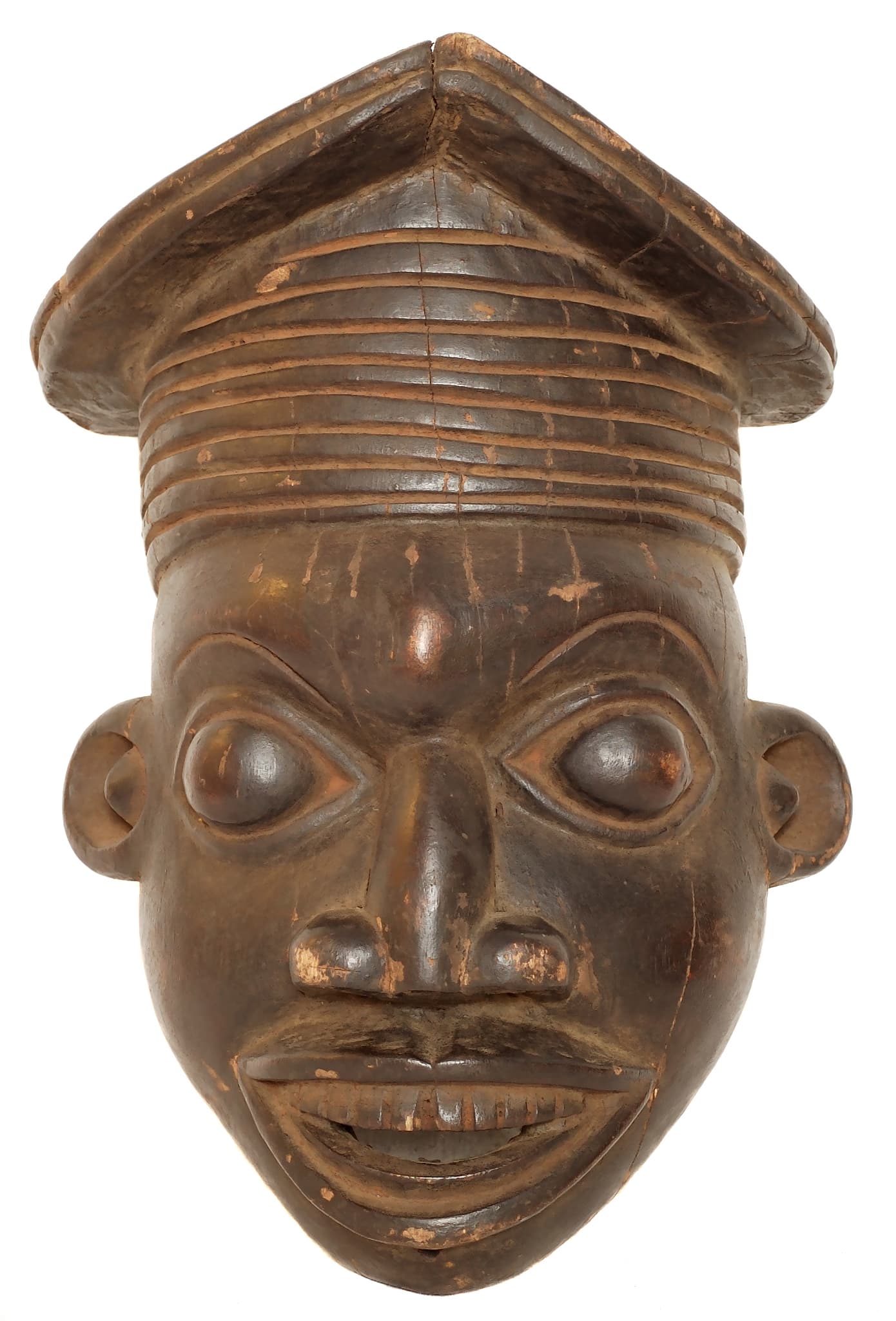
The Babungo facial canon is rigidly defined and instantly recognizable. Masks and commemorative figures exhibit a pronounced, high-domed, bulbous forehead that sharply intersects with deeply concave, cavernous ocular orbits. The eyes are characteristically large, protruding, and searching, often rendered as aggressive spheres or wide almond shapes, projecting an aura of intense surveillance, guardianship, and focused insight. Below the eyes, the most critical diagnostic marker of Babungo—and indeed the wider Ndop Plain—sculpture emerges: the pronounced, inflated, "puffy" cheeks that tightly flank a broad, powerful, thickly articulated nose. This swelling of the cheeks imparts a sense of stored breath, speech, or internal pressure. The mouth is almost invariably depicted open, forming an elongated horizontal oval or a fierce grimace, deliberately exposing a meticulous, unbroken row of aggressively carved block-like teeth. This open dentition is a multi-valent symbol: in human figures, it represents the act of authoritative speech, the singing of praises during royal celebrations, or the dissemination of knowledge; in zoomorphic masks, it signifies furious power, the bared fangs of a predator, and lethal potential.
The physical scale of Babungo production frequently borders on the monumental, a direct result of the wealth generated by the iron trade. Babungo carvers produced massive architectural components—elaborately carved door frames, towering structural pillars, and complex house posts that framed the entryways to secret society lodges. Furthermore, the kingdom is renowned for its monumental royal drums. Massive slit drums and membranophones, some measuring over a meter in height, were carved from single, colossal logs of Cordia platythyrsa or heavy Iroko wood. These instruments were often flanked by fully three-dimensional carvings of buffalo heads or intricately undercut networks of earth-spiders. The immense physical weight and commanding volume of these objects directly reflect the gravity, permanence, and unyielding nature of the Fon's authority.
Surface treatment in Babungo sculpture provides crucial diagnostic data regarding ritual use, object taxonomy, and chronology. The surface patination is never accidental; it is a deliberate, chemically complex application of meaning.
| Object Taxonomy | Primary Function | Characteristic Surface Treatment & Patination | Metaphysical Association |
|---|
| Royal / Prestige Arts (Thrones, Commemorative Statues, Staves) | Status marking, public display, ancestor veneration. | Heavy, friable encrustation of red camwood powder (Baphia nitida) mixed with palm oil. | Bloodlines, royalty, life force, fertility, public celebration. |
| Regulatory / "Night" Masks (Tifwan society, executioner grades) | Enforcement, witchcraft mitigation, capital punishment. | Glossy, opaque black patina built from thick carbon soot, sacrificial blood, and aged oil. | Obscurity, the night, lethal force, deep river bottoms, secrecy. |
| Prestige Utilitarian (Calabashes, Stools, Pipes) | Courtly use, diplomatic gifting. | Dense sheathing in imported, multi-colored glass trade beads; highly polished bare wood. | Wealth, global trade connectivity, royal sumptuary privilege. |
Materials and techniques in Babungo represent a sophisticated, highly integrated mixed-media approach. While the primary matrix is wood—carved green utilizing locally smelted iron adzes and left to cure slowly to prevent radical checking—Babungo artists were master assemblers. Furthermore, Babungo is renowned for its exceptional terracotta pipes. Modeled from local clay, these massive, elaborate pipe bowls, sometimes depicting complex elephant or human heads, were frequently mounted on long wooden stems encased in cast brass or indigenous iron, demonstrating an integrated mastery of earth, wood, and metal.
This visual idiom distinguishes Babungo clearly from its neighbors. While the Bangwa to the west are characterized by hyper-kinetic asymmetry, dramatically twisted torsos, and moving, emotionally volatile forms, Babungo sculpture heavily favors strict frontal symmetry, rigid composure, and compressed, internalized energy. Compared to the tall, highly elongated, and relatively austere throne figures of the Kom 23, Babungo statuary is broader, heavier, and more aggressively robust, relying on deep, high-contrast carving and the explicit articulation of the puffy cheeks and bared teeth to project an unyielding, confrontational authority that leaves little room for aesthetic ambiguity.
Ritual Practices
The activation of Babungo visual art occurs within a highly structured, heavily policed matrix of ritual practices, masquerades, and state ceremonies. In Grassfields ontology, a carved object is rarely considered "finished" upon leaving the sculptor's hands; its operational functionality and spiritual efficacy are entirely dependent upon its specific performative context, wherein the static wood, terracotta, or metal is transformed into a dynamic, active agent of the spirit realm or the political state.
The most critical, unifying ceremonial event in the Babungo calendar is the annual Nekai (or Nikai) festival. This vast public spectacle is fundamentally an engine of political stability, social cohesion, and the reaffirmation of the complex social contract existing between the populace, the titleholders, the Tifwan society, and the Fon. The Nekai festival serves as the primary public interface for the royal treasury, a rare, highly choreographed moment when a selection of the 30,000-piece collection is conceptually and physically deployed from the darkness of the palace storerooms into the light of the public plaza.
The choreography of the Nekai is meticulously scripted to articulate civic hierarchy. At the climax of the rite, the Fon, completely enveloped in a masterwork mask and a concealing, often heavily feathered or beaded costume, dances in the central arena. He is met by the Bah (lineage heads) and key nobles, specifically the Fuanje, who approach in a slow, rhythmic cadence. Their movements are dictated by the acoustic directives of massive royal drums and the sharp, penetrating sound of double iron gongs. This interaction—a physical homage paid to the masked Fon, often involving the presentation of a spear or a ceremonial vessel—visually reinstates the exact geometry of Babungo political allegiance. The masquerade here is not a disguise, but a transubstantiation; the Fon momentarily becomes the mythic founder or the totemic animal represented by the mask.
Masquerades in Babungo are sharply divided by function, gender access, time of deployment, and the specific society that commands them. Diurnal (daytime) masquerades, which appear at agricultural festivals, the installation of sub-chiefs, and the grand death celebrations of prominent citizens, utilize an array of wooden helmet masks. These masks are typically massive, elongated horizontal structures worn atop the head, resting on a collar of raffia fiber, and often depicting the buffalo, the elephant, the leopard, or complex anthropomorphic figures. The buffalo, a recurring and dominant motif with its massive sweeping horns, flared nostrils (often packed with red pigment), and bared teeth, functions as the ultimate metaphor for the raw, devastating, and unstoppable power of the Fon. The leopard, conversely, represents his swift, predatory, and nocturnal omniscience. During these public dances, the wearer is believed to be fully possessed by the specific spiritual force represented by the mask, moving with a harrowing, unpredictable intensity that commands profound respect and fear from the audience. Women, and specifically pregnant women, are historically subjected to strict interdictions regarding the viewing of certain potent masks, lest the spiritual radiation harm the unborn child.
Conversely, the nocturnal realm belongs entirely to the "night masks" of the Tifwan and allied secret regulatory societies. The deployment of these masks is restricted to the deepest hours of the night and is strictly interdicted to women, children, and uninitiated men. Night masks operate on a vector of mythic power, clairvoyance, and sanctioned witchcraft. Often carved with grotesque, intentional distortions—cavernous eye sockets, owl-like ocular features to pierce the darkness, asymmetrical planes, or multiple faces to symbolize all-seeing, panoptic omniscience—these masks are utilized to execute the covert judgements of the Tifwan, hunt malevolent witches, and historically, enforce capital punishment. The terror they evoke is acoustic as well as visual, heralded by the blast of a sacred trumpet or the chilling, rhythmic striking of a single iron gong, signaling the uninitiated to bolt their doors and avert their eyes.
Specific object types are inextricably linked to distinct rites. The monumental slit drums, often flanked by carved buffalo heads, and the membranophone "spider drums" are not standard musical instruments for entertainment; they are the acoustic voices of the ancestors, sounded exclusively to summon the community for war, to announce the death of a Fon, or to dictate the heavy, measured rhythm of the Nekai. Commemorative statues of past Fons and Queen Mothers are not static idols; during funerary rites, they are removed from the palace sanctuaries, publicly displayed, and heavily anointed with fresh camwood and palm oil, effectively reviving the presence of the royal lineage to oversee the seamless transition of power. Even the mundane act of smoking is deeply ritualized; the massive, intricately carved terracotta and iron pipes are smoked by the Fon and titleholders during secret Tifwan councils, the rising smoke symbolizing communication with the ancestral realm, the sealing of pacts, and the deliberate, weighted process of political deliberation.
Historical Context
The chronological trajectory of Babungo art is a profound record of mythic origins, staggering industrial expansion, intense colonial rupture, and modern museological preservation. The foundation mythology of the Babungo traces their genesis to the Forghai waterfall, a sacred aquatic site located to the east of the present settlement. From this origin point, the Vengo people integrated into the broader, complex migratory currents of the Tikar (or Ndobo) peoples, who, driven by regional conflict, expanding trade networks, and ecological pressures, dispersed from the North (traditionally cited as the Bornu region or Kimi/Rifum) across the Bamenda plateau from the late eighteenth century onward. This Tikar heritage provided the ideological and structural blueprint for the Babungo state: centralized sacred kingship, hierarchical title societies, and the institutionalization of palace-controlled artistic production.
The true historical catalyst for Babungo’s artistic supremacy, however, was the exponential explosion of its iron-smelting industry in the nineteenth century. Archaeological and ethnographic data reveal that Babungo and its immediate neighbors developed an industrial complex of astonishing scale, fundamentally transforming the local and regional economy. With over 270 active smelting sites, the Babungo produced high-carbon steel utilizing tall, natural draft furnaces, yielding approximately 100 metric tons of iron per year. This massive surplus of iron hoes, weapons, and tools became the primary currency of the Ndop Plain, traded far beyond the chiefdom's borders. The socio-economic result was a rapid, intense concentration of wealth and power within the Babungo palace.
The nineteenth century, therefore, represents the "Classical Period" of Babungo art. The wealth generated by the "Ruhr of Central Africa" allowed a succession of highly talented sculptor-kings—most notably Nyichikau, Nyifuan, and Saingi II—to commission, carve, and stockpile an unprecedented volume of royal art, resulting in a palace treasury that eventually swelled to over 30,000 objects. Art from this classical period is characterized by deep, organic patinas built over generations of ritual use, heavy, pure formal mass, and the exclusive use of indigenous bloomery iron for structural repairs and decorative additions.
This classical autonomy was irrevocably fractured by the arrival of European colonial powers. The German explorer Eugen Zintgraff made contact with the area (which he termed "Bamungu") in 1889, initiating a period of tense diplomatic, economic, and military maneuvering. By the late 1890s and early 1900s, figures like Gustav Conrau and various military expeditions integrated Babungo into the German colonial orbit, fundamentally shifting the balance of power. During this era, royal arts were increasingly weaponized as diplomatic currency. Significant masterworks were presented as strategic gifts to German administrators and military officers to secure political favor, avoid punitive expeditions, and acquire European trade goods. This politically motivated dispersal resulted in the foundational collections of European institutions like the Ethnologisches Museum in Berlin, meticulously documented by early scholars like Felix von Luschan and later analyzed by Hans-Joachim Koloss.
The transition into the twentieth century, marked by the shift from German to British administration following World War I, forced a profound periodisation shift. The colonial imposition of new economic systems, the decline and eventual collapse of the local iron-smelting monopoly due to the influx of cheap European scrap iron, and the introduction of new technologies altered the patronage matrix. This initiated a "Transitional and Market Period" (circa 1920–1960). While secret society masks retained their ritual efficacy and rigid formal strictures, royal workshops began adapting prestige forms for new commercial realities. A prime example is the Babungo "spider drum" or spider stool; motifs historically restricted to the palace—such as the earth-spider, symbolizing wisdom and ancestral connection—were increasingly adapted, standardized, and produced by royal carvers for commercial distribution and exchange with colonial travelers, missionaries, and early collectors. Sculptors like Phonchu Aséh codified specific styles that perpetuated the kingdom's artistic reputation while engaging actively with this new, lucrative tourist and collector market.
In the contemporary era, Babungo has entered a highly self-reflexive "Museological Period." Recognizing the vulnerability of the colossal, thousands-strong royal treasury to physical degradation, changing religious paradigms, and illicit international trafficking, the Babungo leadership partnered with international organizations and scholars (notably the art historian Jean-Paul Notué and architect Bianca Triaca) to establish the Babungo Royal Museum. Opened officially in 2006 at the gateway to the palace, this institution stabilizes and publicly displays the paramount masterworks of the sculptor-kings. This initiative transformed the active ritual center into a curated anchor of global African art heritage, navigating the complex intersection of living ritual practice and international heritage conservation.