Overview
The Bété, one of the most significant ethnolinguistic communities in the central and south-western forest area of the present-day Republic of Côte d'Ivoire (Ivory Coast), represent an essential pillar for the understanding of West African art history and ritual practice. Geographically, their traditional settlement area extends primarily over the regions of Daloa, Soubré, Gagnoa and Issia. In this dense, tropical rainforest zone, they border the hierarchically organised, Akan-speaking Baoulé in the east and the Guro, who belong to the Mande language group, in the north. The exact demographic recording of the Bété is proving to be scientifically complex and is the subject of ongoing ethnographic debates. With the total population of Côte d'Ivoire estimated to be around 32.7 million people in 2025 (with an annual growth rate of around 2.43%), serious anthropological research assumes that there are around one million individuals who can be ethnically classified as Bété today.
The linguistic and ethnographic classification of the Bété is subject to significant scientific controversy. The sources are ambiguous: while some macro-statistical analyses and demographic overviews incorrectly categorise the Bété as a subgroup of the Akan and attribute them a share of 18.1% of the population, established linguistic research clearly assigns them to the Krou language family (Kru). The term "Krou" or "Kru" goes back to a historical European corruption of the indigenous term "Krao", which European seafarers used to collectively refer to the coastal inhabitants from the 15th century onwards. Within the Ivorian population as a whole, the Krou-speaking peoples (which include the Dida, Guéré, Wobè and Kroumen in addition to the Bété) make up an estimated 11% to 11.7%.
In terms of pre-colonial social structure, the Bété are traditionally characterised by a decidedly acephalous (non-dominating) social order. In strict contrast to the hierarchically highly centralised Akan kingdoms in the east (such as the Baoulé or the neighbouring Ashanti in Ghana), the political ontology of the Bété knew no supralocal authority. Political and legal power was based on the autonomy of the individual village, which was usually congruent with a patrilineal descent group (lineage). Leadership was the responsibility of a council of elders (gerontocracy), whose authority was based on descent and ritual competence, whereby a nominal village chief was always bound to the consensus of this council. The kinship system was strictly patrilineal and characterised by an aristocratic succession. This means that the possessions, lands and ritual rights of a deceased person do not pass linearly to his sons, but initially laterally to his brothers and cousins of the same generation. Only after the death of all male relatives of this generation level is the inheritance transferred to the next generation.
| Socio-cultural dimension | Bété (Krou language family) | Baoulé (Akan language family) |
|---|
| language family | Krou (Kru) | Kwa (Akan) |
| Social order | Acephalous, decentralised | Hierarchical, centralised |
| Descent system | Patrilineal, adelphic succession | Matrilineal |
| Political authority | Local councils of elders, village autonomy | Kingdoms, chiefdoms |
| subsistence basis | chopping (yams), hunting in forest areas | agriculture, historically gold trade |
The foreign and self-designation of ethnicity is a central and highly controversial subject of research. In his seminal monograph La société bété: Histoires d'une ethnie (1985), the renowned ethnologist Jean-Pierre Dozon postulates that the present-day identity of the Bété is largely an administrative construct of the French colonial administration. Dozon argues that the exonym "Bété" was originally assigned as a pejorative label (derived from the French bête, meaning stupid or stubborn) by colonial officials to categorise an amorphous group of independent forest villages that resisted colonial penetration. He dates the formation of the "Bété ethnie" as a coherent group capable of political action only to the late colonial phase, when these various descent groups formed in order to distinguish themselves from the hegemony of the Baoulé favoured by the French. Other anthropologists disagree with this radically constructivist view and point to deep pre-colonial cultural continuities within the Krou language area. This acephalous structure necessitated an art production that did not serve courtly representation, as was the case with the Baoulé, but rather the decentralisation of spiritual power. For curators and collections, such as at the British Museum, this understanding of fragmented, village-based patronage is of crucial importance for interpreting the extreme stylistic micro-localisations of Bété carving. The primary subsistence strategy of the Bété was historically based on a combination of intensive chopping and specialised hunting in the rainforest, with land always owned collectively by the lineage but farmed by individual family branches.
Cultural context
The religious and cosmological system of the Bété is deeply rooted in a nature-loving, animistic ontology, which has structural similarities with neighbouring Krou groups, but is differentiated by specific ritual modalities and social integration mechanisms. At the absolute head of the pantheon is the all-powerful creator god Lago. In striking contrast to the active, intervening deities of other West African cosmologies, Lago is a classic Deus otiosus: He created the world, but then withdrew into an unapproachable transcendence. He is not directly worshipped by the Bété, nor are prayers addressed to him, and there is no figurative or abstract representation of this entity in material culture.
Instead, the operative religious practice focusses on the complex network of lower nature spirits and in particular on the ancestors (the ancestors of the patrilineal line). These spirits and ancestors act as indispensable intermediaries between the profane sphere of the living and the transcendent divine order. The Bété locate these metaphysical forces in specific topographical elements of their environment: sacred trees, rivers and striking rock formations are regarded as the residences of these spirits, whose benevolence is essential for harvest success, hunting luck and defence against epidemics. The theology of the Bété is, as the theologian Laurenti Magesa puts it for African traditions in general, not a compartmentalised religion that is only practised on certain days, but a continuously "lived religion" in which the secular and the sacred merge inseparably.
Ritual authorities among the Bété primarily include priests, diviners and the functionaries of local secret societies. These specialists are responsible for maintaining the cosmic balance. Divinators often use figurative carvings to diagnose illness or social dissonance. Initiation rites and complex funerary rituals are at the centre of ritual life. Physical death is not seen as the final end, but as an ontological transition. As research in religious studies emphasises, death requires a series of precise spiritual rites to ensure that the deceased passes successfully into the realm of the ancestors and does not terrorise the community as a restless spirit. A Bété funeral therefore has a dual function: it transforms the deceased into a protective ancestor and ensures "tomorrow" - the continuation of life within the lineage.
The role of women in the ritual and social structure of the Bété is subject to a profound historical change in meaning and is the subject of current ethno-sociological research. Traditionally, direct access to the mask-based secret societies and their esoteric knowledge was strictly reserved for men; women were not allowed to see the unmasked dancers and formally had a marginalised position in the ancestor cult. However, recent ethnographic analyses from the Ivory Coast document a de-standardisation of these traditional gender roles. The phenomenon of the "letagonins" (literally: female boy) impressively illustrates how women are increasingly taking control of the extremely cost-intensive funerary rituals through economic emancipation - for example in the urban food trade. This takeover of the funerary economy, an area that was historically the exclusive domain of agnatic (male) kinship, represents a significant subversion of patrilineal dogma. Although some of these specific case studies relate to the Guro, who neighbour the Bété, the mechanisms are structurally identical in the transcultural transition zone around Daloa and radiate deeply into Bété society.
Research controversies also determine the sociological interpretation of the cult. A central theoretical debate revolves around the relationship between lineage (descent group) and age groups in the ritual organisation. In her work on the societies of Côte d'Ivoire, the anthropologist Denise Paulme (1971) emphasised the enormous importance and complexity of the horizontal age class systems that run across the kinship lines and coordinate specific ritual tasks. In contrast, more recent research, including Dozon (1985), focuses much more on the vertical lineage dynamics of funerals and the legitimisation of power. Leading institutions such as the Musée du quai Branly in Paris reflect this cosmological complexity in their collection presentation by contextualising bété objects not in isolation as aestheticised works of art, but as material manifestations of this field of tension between patrilineal ancestral hierarchy and egalitarian village age classes.
Aesthetic features
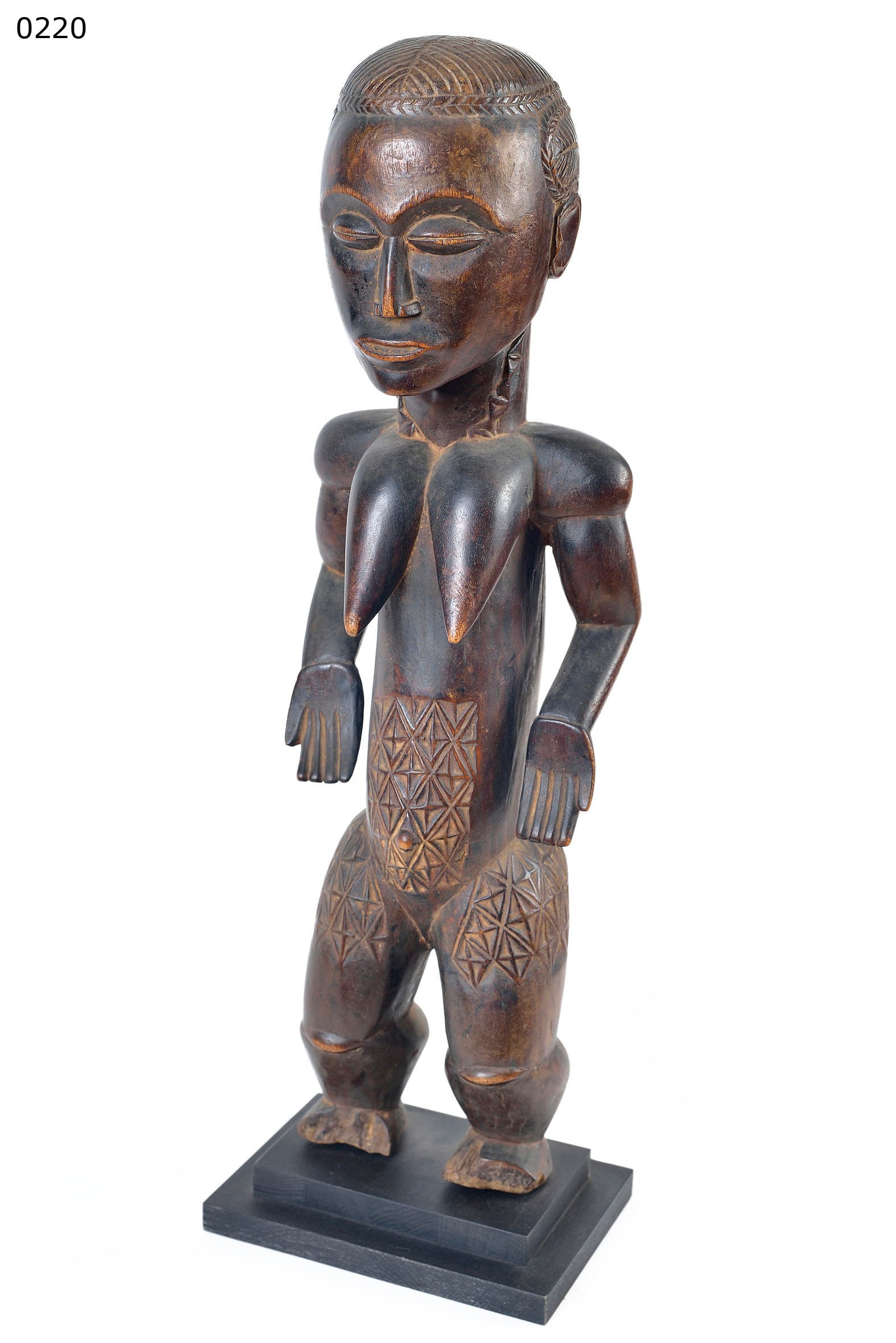
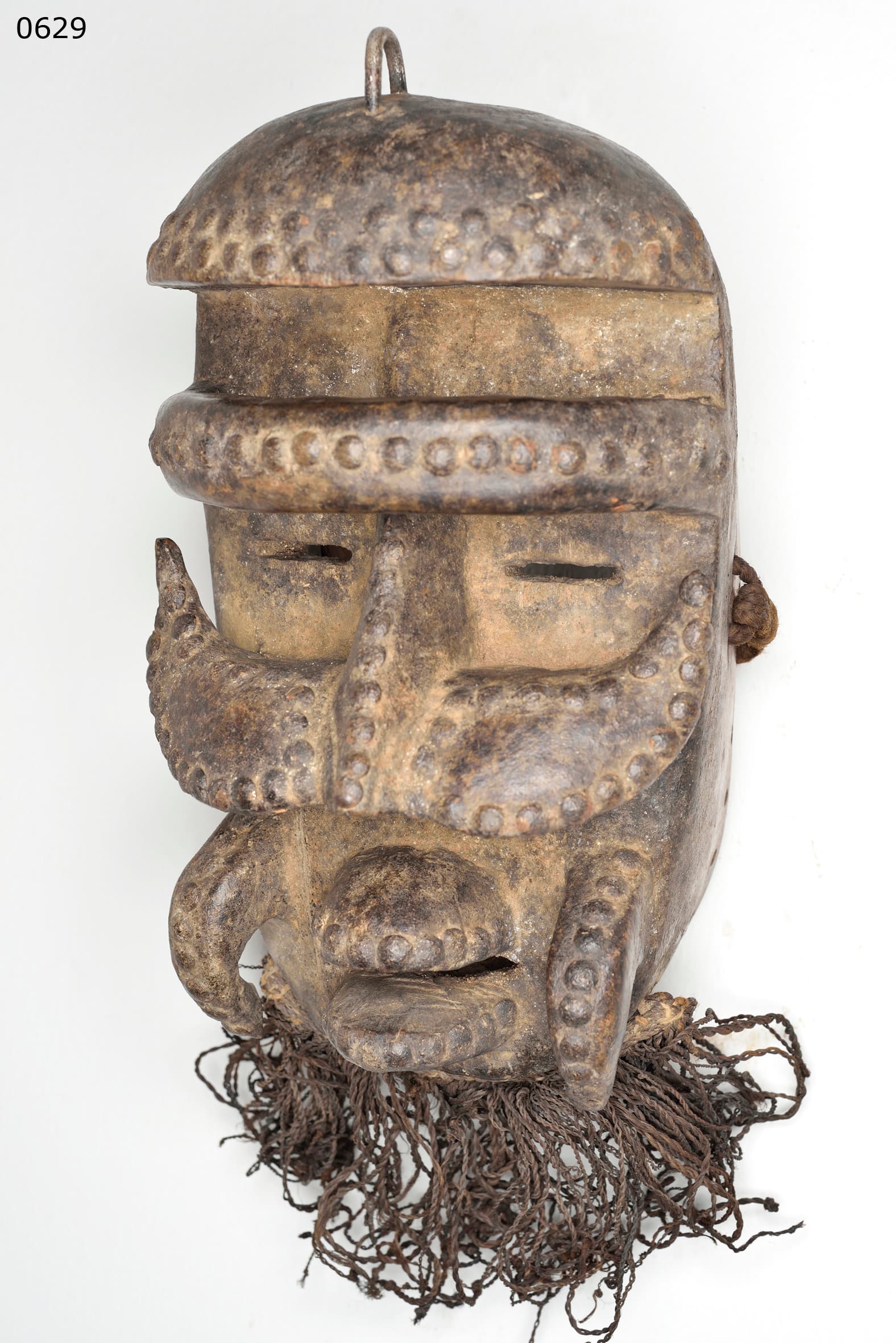
The Bété sculptural canon is absolutely dominated by the so-called gre mask (also known as gla in some dialects and literature), which forms the undisputed centrepiece of every museum and sophisticated private collection of African art. These objects are characterised by a martial, strongly expressionist and terrifying formal language that immediately captivates the viewer. The canonical morphology of an activated gre mask contains almost cubist, cuboid basic structures. The most characteristic feature is the oversized, strongly protruding and voluminously curved forehead area, which is often divided vertically by a dominant, sharp centre bar. Below the forehead is a mostly flat, broad triangular nose. The deeply cut, open mouth is carved with bulging, full lips and in many cases contains aggressive applications such as real animal teeth, nails or metal teeth, complemented by protruding red fabric tongues. The edge of the mask is often tightly perforated to attach protruding beards made of plant fibres, raffia or monkey fur, which completely conceal the dancer's human face.
In art historical classification, there is a profound and bitterly fought controversy regarding the ethnic attribution of these masks, which is of enormous importance for the art market. A often dates and attributes these highly dramatic objects in auction catalogues strictly sub-ethnically as either purely "Bété", "Guéré", "Wobè" or "Wè", whereby nuances in the placement of forehead horns are used as ethnic distinguishing features. B, on the other hand, represented by the renowned art historian Eberhard Fischer, rejects this microscopic separation as ahistorical and artificial. In 1985, Fischer established the more integrative paradigm of the "Krou mask complex" in his groundbreaking work on the art of the Ivorian forest peoples. He argues conclusively that the four Krou language communities cultivate an almost identical mask tradition across rivers and villages. The ethnographer Bohumil Holas (1968) supports this thesis with field research data showing that only the westernmost Bété groups around Daloa actively used these specific masks, primarily because they were in direct contact with the neighbouring Niabwa and Guéré and assimilated their ritual aesthetics.
Despite the anonymity of most ritual carvers, modern research has identified outstanding master craftsmen within the Bété/Guro transition zone. By far the most famous individual artist is the so-called Maître de Gonaté (Master of Gonaté), who is thought to have been active in the late 19th or early 20th century. His oeuvre, of which only an extremely limited corpus of around six verified masks is known worldwide, is characterised by exceptional sculptural qualities, formal rigour, architectural lines and the utmost precision of craftsmanship. Eberhard Fischer and Lorenz Homberger were instrumental in establishing the attribution to this masterful sculptor as part of the exhibition "The Art of Guro". Another groundbreaking example of master attributions is the influence of the German anthropologist Hans Himmelheber, who systematically identified individual carvers in the Ivory Coast in his standard work Negerkunst und Negerkünstler (1960), documented their social status and deconstructed the Western myth of collective "tribal art".
Materiality and the ontogenesis of patina are the primary forensic indicators of an object's authenticity and ritual status. The classification requires a strict distinction between profane carving and a metaphysically activated ritual object. While unused carvings often have a smooth wooden surface that is merely oiled or coloured with local pigments, activated ritual objects are characterised by deep, heavily encrusted patinas (patinas). These are created by the repetitive application of ritual offerings over decades - including coagulated animal blood, palm wine, decomposed millet beer and kaolin. As Bété art now fetches six-figure sums on the Western market, the problem of counterfeiting is highly virulent. Authenticity criteria include the natural, microscopically verifiable formation of the patina deep within the cell structure of the wood. Counterfeiters often simulate artificial termite damage through mechanical or chemical acid treatment. A genuine ritual object, on the other hand, shows specific cracks in the heartwood, which indicate a natural, slow rate of ageing and loss of moisture. Laboratory analytical forensics, as offered by the Authentic Art laboratory of the MAS in Milan, as well as computer tomography (CT) and C14 dating, are now part of the indispensable standard toolkit of modern provenance research in the run-up to acquisitions for institutions such as the Museum Rietberg Zurich or the Metropolitan Museum of Art (The Met).
Ritual practice
The ritual activation and the kinetic performance of the Bété objects represent a highly complex, dynamic process that goes far beyond the static artwork as presented in Western showcases. At the absolute centre of Bété ritual practice is the ritual performance of the gre mask, which is not to be understood as a masquerade in the sense of a theatre, but functions as a real, physical container for transcendent entities, ancestral and forest spirits. The life cycle of such a ritual object begins with the profane production by the master carver. Immediately after completion and handover to the secret society or the village priest, the wooden sculpture is ontologically still completely inert - a profane piece of wood.
The sacred "activation" takes place through strictly secret rites in demarcated forest areas, away from the view of women and the uninitiated. During these rites, the sculpture is anointed with a ritual substance, which initialises the transfer of the spirit into the form. It is only through this ritual consecration that the mask is transformed from a pure image into an independent, spiritual actor. The mask performances of the Bété serve a variety of sometimes conflicting social and spiritual purposes: they function as incorruptible legal authorities in the settlement of complex land and family disputes, serve as an apotropaic protective force in times of war and accompany the rigorous initiation of male youth.
The ethnologist Armistead P. Rood, who documented a Bété mask ceremony in a village (Zahia) in 1969 as a participant observer, provided groundbreaking insights into the performative experience ("A View From Within"). Rood describes in detail the physical and psychological transformation of the dancer. When donning the massive gre mask, the wearer completely relinquishes his individual identity; he falls into a trance and becomes an unconditional instrument of the spiritual entity. The choreography is wild, unpredictable and radiates an intentional aggression that manifests the presence of the untamable rainforest in the civilised space of the village. However, the dancer never acts in isolation, but is accompanied by a polyphonic entourage of drummers, singers and ritual assistants. The latter act as translators and moderators who decode the non-verbal communication and the guttural sounds of the terrifying mask for the village audience.
Offerings form the indispensable fuel of this ritual economy. Before every public appearance and on specific calendar festivals, sacrifices must be made to the spirits residing in the masks. These ritual offerings range from simple libations (libations of palm wine or distilled gin) to bloody animal sacrifices (chickens, goats), the blood of which is poured directly onto the forehead area of the mask, resulting in the formation of the characteristic encrustation. There are significant regional variations: As Bohumil Holas points out, the masks of the western Bété groups (in geographical proximity to the Guéré) are far more martial in design and deeply integrated into executive jurisdiction, while more eastern groups incorporate visual elements more strongly into social control mechanisms or even entertainment contexts.
The process of ritual "deactivation" and material disposal is another essential aspect that counteracts the Western paradigm of preservation. If a mask loses its ritual effectiveness - whether through irreparable physical decay (such as severe termite infestation), through the death of its designated wearer or because the attached spirit has left the object - it is generally not preserved by the Bété as a "work of art". The object is profaned in a final rite and stripped of its spiritual charge. The wooden structure is then usually deposited in specific areas of the sacred forest and left to decay naturally due to the weather, or ritually burnt. The historical fact that Western ethnologists and traders often "rescued" such objects immediately before their ritual disposal or even actively removed them from use raises highly complex provenance-historical and ethical questions. These translocation dynamics are currently being intensively debated by curatorial departments at institutions such as the Fowler Museum at UCLA and the Musée du quai Branly.
Historical context
The historical genesis of the Bété as an ethnic entity is inextricably linked to the large, centuries-long migratory movements of West Africa. The colonisation history of Côte d'Ivoire from the 10th century onwards, with a massive intensification between the 15th and 19th centuries, recorded a steady immigration of various Crou-speaking groups from the north-western forest and savannah regions (today's Liberia and Guinea). These groups mostly entered the dense forest area by land, driven by the pressure of expanding African empires (such as the Mande) and internal conflicts. However, this field of research is characterised by serious dating controversies: while some historians date the final territorial consolidation of the Bété in their current settlement areas to the late 18th century, indigenous narratives and in-depth linguistic analyses argue for a much earlier, almost autochthonous presence in the forest region.
Physical contact with the French colonial power from the 1890s onwards radically and permanently changed the social structure of the Bété. In contrast to the British strategy of "Indirect Rule" in neighbouring colonies, the French pursued a rigid policy of assimilation and centralisation. The implementation of brutal forced labour systems (corvée) for the establishment of plantations (coffee, cocoa) and road construction led to bloody, sometimes decades-long uprisings by the acephalous Bété, which were put down with extreme severity by the French military. As Jean-Pierre Dozon analyses in depth, it was paradoxically only this enormous external pressure and the administrative colonial demarcation that forced the numerous fragmented, independent villages into a collective consciousness and a political "Bété" identity. Even in the post-colonial era, ethnicity remained an explosive political factor, culminating in the presidency of Laurent Gbagbo (himself a Bété), whose polarising rhetoric of "Ivoirité" plunged the nation into deep conflict.
This historical upheaval had a dramatic impact on artistic production. Traditional rituals were often forced underground by colonial restrictions, hundreds of masks were destroyed by zealous missionaries as "pagan idols", and from the 1930s onwards, the first secular commissioned art stimulated by European demand emerged. The market history of historical Bété art in the West is remarkable and closely linked to classical modernism. The first significant collectors came directly from the Parisian avant-garde. A historical milestone was reached in 1923, when Marius de Zayas exhibited Bété masks at the Whitney Studio Gallery in New York - one of the first breakthrough exhibitions worldwide to present African carvings not as ethnographic curiosities (ethnographica), but explicitly as perfectly formed works of art on a par with works by Pablo Picasso. Prominent dealers such as Paul Guillaume and Charles Ratton formed the western canon of ivory coast art with their galleries in the 1930s and made the cubist forms of the Krou masks sought after by collectors.
The price trend for outstanding, authentic pieces has reached astronomical historical highs in the 21st century. This is exemplified by a Gouro/Bété mask, attributed to the Maître de Gonaté from the famous Laurent d'Albis collection (and formerly Charles Ratton), which was sold at a Christie's auction in Paris for a record price of 480,000 euros - many times its already high estimate of 40,000 to 60,000 euros.
| Artist/attribution | Object | Auction house | Estimated price (EUR) | Realised price (EUR) | Provenance |
|---|
| Maître de Gonaté | Bété/Guro Mask | Christie's (Paris) | 40,000 - 60,000 | 480,000 | Laurent d'Albis, Charles Ratton |
| Unknown Master | Yaure Mask | Sotheby's (NY) | - | - | Mathias Komor |
| Bété/Krou Complex | gre mask | Zemanek-Münster | 25,000 - 50,000 | - | Armistead P. Rood |
This enormous market and museum breakthrough is due not least to the systematic art-historical reappraisal by pioneers such as Susan Mullin Vogel. Vogel, co-founder of the Museum for African Art in New York and long-time curator at The Met, fundamentally revolutionised the Western view with influential exhibitions in the 1980s and 90s (such as the show "African Art/Western Eyes"). She successfully established African woodcarvers - who had previously often been degraded in ethnology as purely executive instruments of a rigid tribal style - as distinct, individual master artists with their own stylistic genius.
However, this astronomical increase in value brings with it a threatening dark side and drastically exacerbates the problem of forgery. As African works of art are now subject to the same financial laws as contemporary art, a highly specialised counterfeiting industry has established itself in West Africa. In the modern market, the unquestionable establishment of authenticity therefore requires far more than just visual expertise (connoisseurship). It requires a rigid, laboratory-based examination of patina layering, the search for manipulated termite damage versus natural heartwood cracks and the exact physical determination of wood age (C14 dating). In addition, the consistency of traces of use, in particular wear on the lateral binding holes of the masks, is a critical factor. These forensic criteria are now applied as standard in the acquisition process by leading museums worldwide, such as the Royal Museum for Central Africa (RMCA) in Tervuren or the British Museum, in order to protect the invaluable cultural heritage of the Bété from falsification.