The Senufo are a West African people from the tri-border region of northern Côte d'Ivoire, southern Mali and south-western Burkina Faso, known for classical Poro art production, exclusive woodcarving, and blacksmithing.
Overview
The Senufo (self-designation preferentially Sienambele, etymologically often translated as "those who work in the fields" or "those who speak") constitute a pluri-ethnic and multilingual population group whose primary settlement area extends across the strategically and historically significant tri-border region of northern Côte d'Ivoire, southern Mali and south-western Burkina Faso. Current demographic surveys and demographic projections put the total population of Senufo speakers at a range of 2.7 to over 3 million individuals. Within this macro-ethnic cluster, the Mamara-Senufo (also known as Minianka) subgroup in southern Mali alone represents a significant entity of an estimated 1.73 million people.
Linguistically, the Senufo languages - a complex dialect continuum of over 15 to 30 distinct varieties, including Senari, Mamara, Suppire and Karaboro - are generally categorised as belonging to the Gur branch (Volta languages) within the superordinate Niger-Congo language family. However, there is a profound structural peculiarity: in contrast to most Gur languages, the Senufo languages have a subject-object-verb (SOV) word order, which indicates a massive historical and linguistic influence of the neighbouring Mande languages. These morphosyntactic loan structures also manifest themselves in the lexical area, where numerous terms have been adapted from Bamana and Jula, which emphasises the permeable cultural borders of the region.
| Linguistic classification | Population share (estimate) | Main geographical distribution | Specifics |
|---|
| Mamara (Minianka) | ~ 1,730,000 | Southern Mali | Strong historical interaction with Bamana structures. |
| Senari | ~ 800,000 - 1,000,000 | Northern Côte d'Ivoire (Korhogo region) | Centre of classical Poro art production. |
| Suppire | ~ 400,000 | South-eastern Mali (Sikasso region) | Historical centre of the Kénédougou empire. |
| Karaboro / Nafaanra | ~ 100,000 | Burkina Faso / Western Ghana | Peripheral dialects with strong Kwa loanwords. |
The socio-political and ethnographic classification of the Senufo is highly controversial in recent research. The sources are ambiguous with regard to the question of the extent to which they are a homogeneous ethnic entity in the pre-colonial sense. The term "Senufo" itself is primarily an exonym that was introduced into the colonial archive as an administrative collective term by the French colonial official and linguist Maurice Delafosse around 1906 on the occasion of the colonial exhibition in Marseille. In pre-colonial reality, local communities identified themselves far more strongly through their affiliation to specific settlement communities, kinship groups or their occupation-specific position. In the exhibition "Senufo: Art and Identity in West Africa" at the Cleveland Museum of Art (2015), curator Susan Elizabeth Gagliardi explained that the paradigm of a uniform "Senufo style" cemented by Robert Goldwater in the 1960s fails to recognise the historical reality of the fluid, transcultural networks in West Africa.
The traditional social structure of the Senufo is strictly acephalous; before the 19th century there were no centralised state authorities, but autonomous village communities regulated by complex networks of secret societies and gerontocracies. The kinship system is based on strictly matrilineal lines of descent, although public political representation is patriarchally dominated. The socio-economic subsistence economy is based on intensive agricultural hoeing (cultivation of millet, yams, maize and cotton), which is practised by the majority of the population, the Sienambele or Senambele (farmers).
In contrast, there is a strictly separate, endogamous caste structure of artisans, the so-called Fijembele. Within this system, the kulebele act as exclusive woodcarvers and the fono as blacksmiths. Although the Kulebele live within the Senambele villages, they occupy a marginalised and at the same time feared social position. They carry out carving activities and ritual services in exchange for agricultural goods. Their social isolation is cemented by their exclusive access to a specific, feared spiritual power, the Kafigeledjo. This complex socio-economic balance characterises the relationship with the neighbouring peoples (Mande in the west, Kwa in the south), which has historically been characterised by a constant oscillation between armed conflicts, alliances and the exchange of ritual specialists.
Cultural context
The religious system of the Senufo is structured by a profound cosmological duality that differs significantly from the strictly patriarchal and centralised theistic models of many neighbouring peoples. At the top of the cosmological hierarchy is the creator god Koolotiolo (or Kolotyolo), an unapproachable entity who created the world but has withdrawn from the profane affairs of humans. The active, immanent counterpart is Katieleo or Maleo ("the Old Mother"). She represents the protective, female facet of the supreme deity and acts as the spiritual mother of the village community as well as the central patroness of all initiation rites. The Madebele (or Tugubele), unpredictable nature and bush spirits, and the ancestors, who are involved in village life through complex ritual interventions, act between these macro-deities and the people.
Ritual authority within the village community is strictly divided along gender lines and is exercised through two complementary institutions: the Sandogo divination society of women and the Poro initiation society (also called Lô) of men. The role of women in the cult is characterised by exceptional institutionalised power. The Sandogo is predominantly recruited from the female elders of the matrilineages and is responsible for maintaining social harmony, divination and "ensuring the purity of the matrilineage". As the spirits do not interact directly with humans, the Sandogo diviners act as necessary mediumistic interfaces, deciphering the will of the Madebele through the use of carved oracle figures and ordering atonement sacrifices or the making of apotropaic objects.
The male Poro, on the other hand, is an obligatory, esoteric secret society that dominates the social and political structure of the community. Initiation into the Poro is a decades-long process that is divided into cyclical, usually seven-year age groups. The central rites of passage take place in absolute isolation in the Sinzanga (the sacred grove), a dense, cathedral-like forest on the edge of the settlement. Here the novices learn complex survival techniques, esoteric chants, secret languages and the genealogy of the village. Structurally, the Senufo religion differs significantly from the Bamana: although the Poro is an exclusively male organisation, its entire theological focus is on the worship of the female elemental force (Maleo). Initiation is understood as a symbolic process in which the adolescents are metaphorically devoured by the deity and reborn as fully-fledged adults. In certain regions, such as the Kufuru zone, there are also exclusive female parallel organisations such as the Tyekpa society, which perform their own masked and figurative rites at funerals.
However, the scientific literature shows deep research controversies regarding the origins and the geographical and ethnic autochthony of the Poro society. The American ethnologist Anita J. Glaze argues in her groundbreaking dissertation and publication (Art and Death in a Senufo Village, 1981) that the Poro represents the genuine, autochthonous essence of Senufo culture and that the ritual sphere is primarily fed endogenously from its own cosmology. Glaze focuses strongly on the isolationist, village-centred aspects of ritual practice. Till Förster (1988, 1993), on the other hand, whose research strongly influenced the inventory of the Museum Rietberg (Zurich), relativises this closed model and considers the institutions in the context of regional dynamics. Susan E. Gagliardi (2014) deconstructs the idea of the autochthonous Poro even more radically. Gagliardi dates the emergence of many Senufo confederations to the phase of intensive contact with the Mande peoples and argues that the term "Poro" (often erroneously written as a proper name with a capital "P") is rather a generic typology for power associations that were strongly influenced, if not adapted, by supra-regional Mande institutions such as the Komo or Kono. The "Glaze versus Förster/Gagliardi" debate makes it clear that the assumption of a hermetically isolated Senufo religion is not empirically tenable; rather, it is a dynamic system that continually integrates elements of transcultural networks.
Aesthetic features
The Senufo sculptural canon is one of the most intensively documented work complexes in African art history and is characterised by a highly formalised object typology whose iconography is strictly functionally determined. The canonical mask types primarily include the Kpelie face mask (also Kpeliye'e). These anthropomorphic, mostly small-format masks represent female nature spirits or the mythical primordial woman. Iconographically, they are characterised by an idealised, symmetrical oval face shape, narrow eye slits, a delicate mouth and characteristic geometric flank elements, which are often interpreted as stylised legs, wings or hornbills (sejen). In Senufo cosmology, the hornbill is regarded as a primordial symbol of intellectual penetration and fertility.
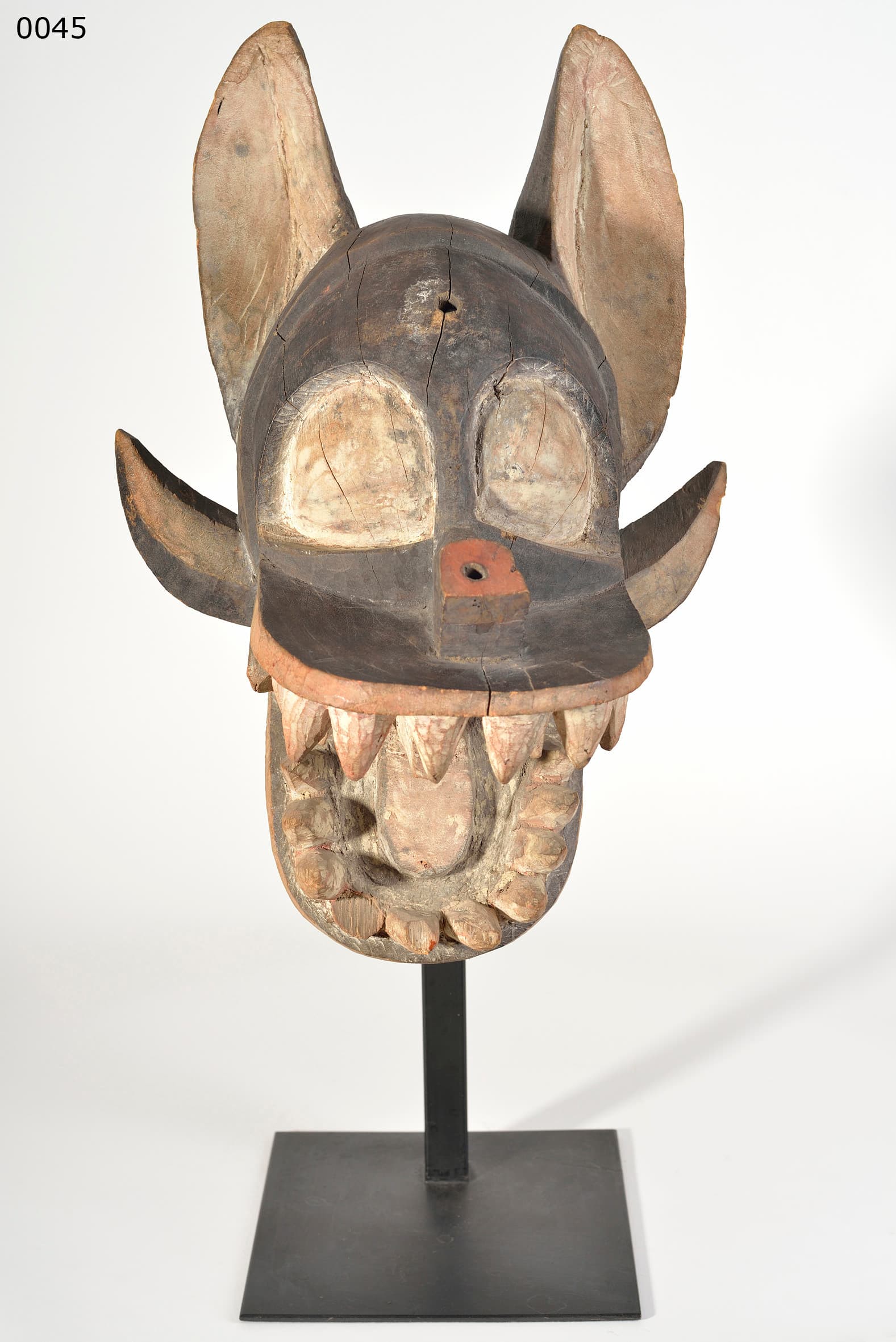
The zoomorphic waniugo or kponyungo helmet masks form an extreme formal and conceptual contrast to the kpelia. These hybrid artefacts - often boldly referred to as "firespitters" in Western collectors' jargon - completely defy human proportions. They combine aggressive physical attributes of different species: the ripped jaws and teeth of a crocodile or hyena, the tusks of a warthog and the horns of an antelope. This iconographic amalgamation is not an expression of surreal fantasy, but the visual materialisation of concentrated, potentially destructive bush energy channelled by the Poro to fight witches.
In addition to the masks, large-scale sculptures dominate the aesthetic repertoire. The deble (rhythm stampers) are elongated, mostly female figures standing on massive, cylindrical pedestals. Their canon of proportions is extremely verticalised, with long, cylindrical torsos and reduced limbs. Equally striking are the Pombiele ("Children of Poro"), majestic large figurative sculptures, as well as the Kalaga staffs, which serve as trophies for the champion farmers of the Senambele and are often crowned by equestrian figures.
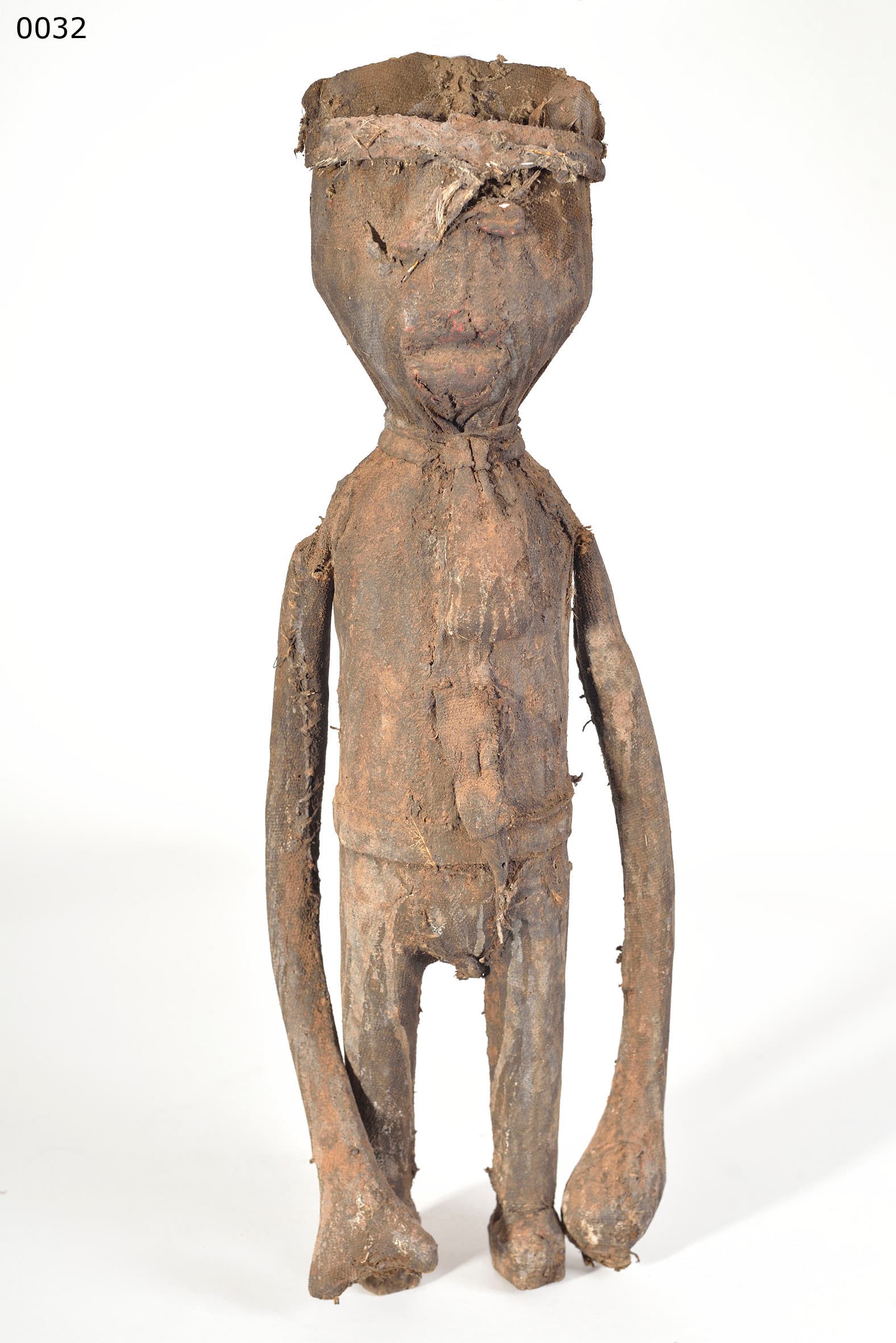
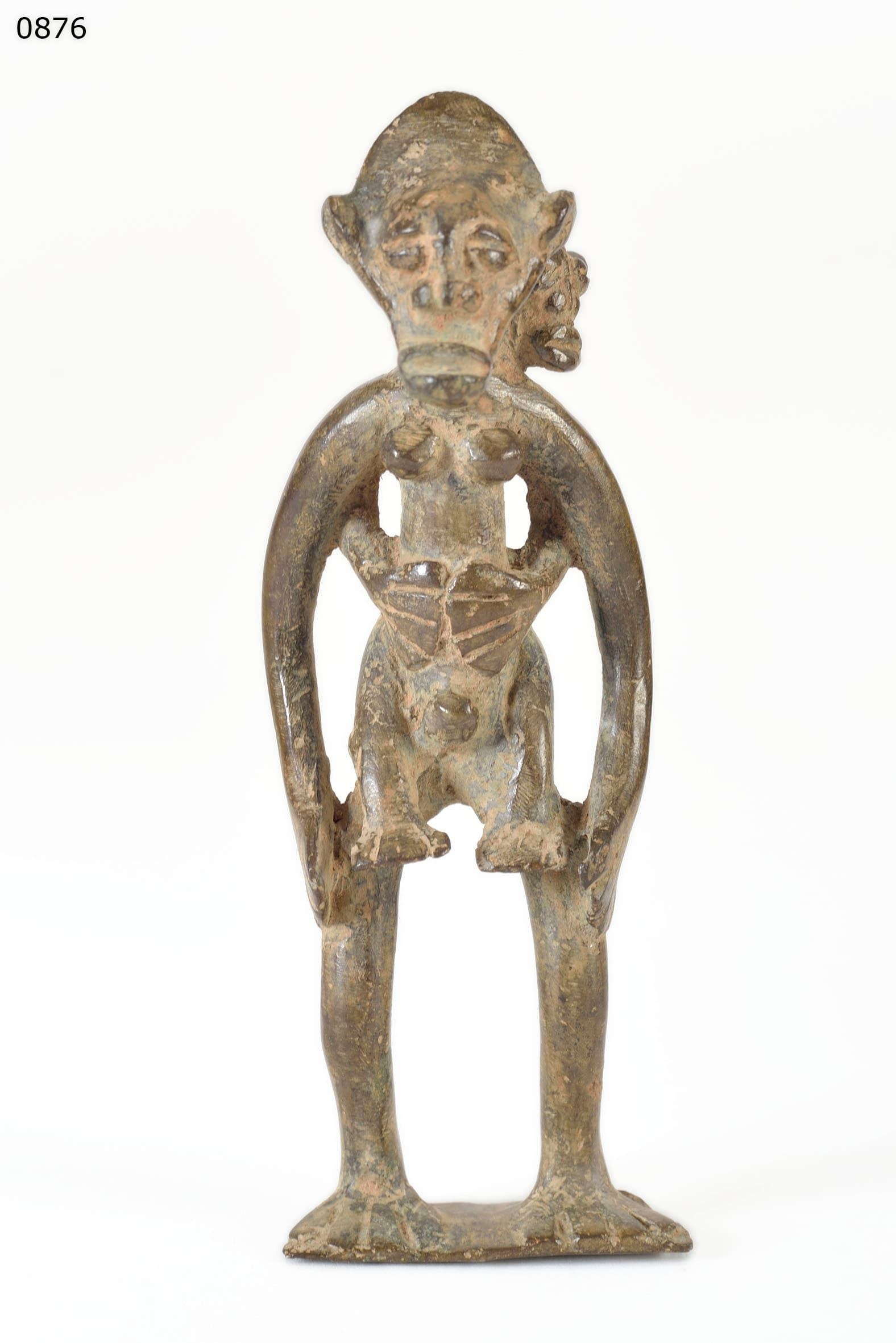
The choice of material is almost invariably limited to hard-wearing hardwood, which is often combined with cast brass amulets and iron pins in the sphere of the Sandogo divination. The fundamental difference between an activated ritual object and a profane object manifests itself in the patina development. An authentic, ritually active divination figurine exhibits an encrusted, opaque sacrificial patina that accumulates over decades through repetitive applications of animal blood, chewed kola nut juice, shea butter and millet beer. In contrast, kpelie masks, which are used for entertainment dances at the end of funerals, often have a smooth, dark lustre patina created by manual polishing and sweat abrasion.
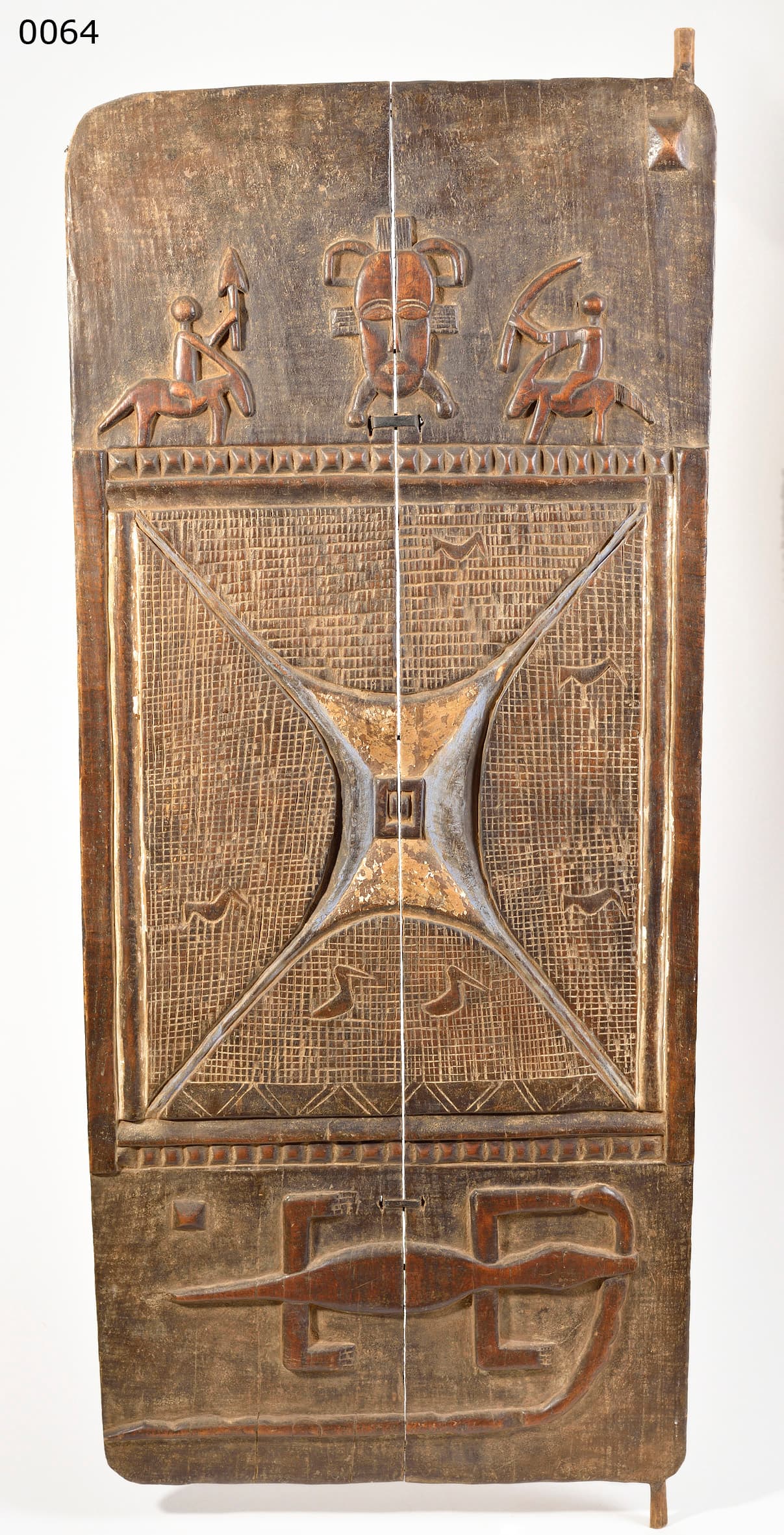
Attribution to documented master hands or workshops is often precarious due to the anonymous production conditions, but has been revalued by Glaze's research. One prominent example is a carved door (Korugo) in the collection of the Art Institute of Chicago, which Glaze attributes to the carver Nyaamadyo Koné from the Kolia workshop region. The existence of the master Sabariko Koné (Ouazomon) is also discussed, although scholars such as Karl-Heinz Krieg emphasise that stylistic congruencies alone are not an absolute proof of identity for individuals.
A profound iconographic controversy surrounds the interpretation of the Deble. In his standard work Senufo Sculpture from West Africa (1964), the American art historian Robert Goldwater defined them primarily in terms of their kinetic-acoustic function as rhythm markers in the Lô dance. Anita J. Glaze (1981) vehemently disagreed with this reductive functionalism; she argued that the formal language of the Deble represents a highly complex theological reference to the "Old Mother" and matrilineal purity.
As Senufo art became the focus of the Western art market early on, forgery criteria are highly relevant to the market. As early as the 1950s, workshops in the Korhogo region began to systematically produce for export under the direction of middlemen such as Kana. Till Förster (1988) meticulously analysed the dividing lines between ritual originals and market-oriented pieces. Today, authenticity in forensic terms is measured by factors such as natural heartwood cracks (which prove slow drying in the savannah climate) and logical traces of wear (sweat abrasion on the inner edges of the mask). Forgers often simulate ageing by burial in moist soil or artificially induced termite feeding, which, however, often shows disharmonious milling patterns under the magnifying glass that contradict the natural wood fibre.
Ritual practice
The ritual practice of the Senufo is a highly complex, performative construct in which the carved object is not understood as a static, passive work of art, but as a dynamic actor and temporary vessel for transcendent entities. The use of these objects is strictly bound to exclusive socio-religious spheres and is regulated by elaborate protocols of activation and deactivation.
In the sphere of the Sandogo divination society, the divination altar forms the spatial and spiritual epicentre. The architecture of this altar is a dense semiotic field: small-format, delicate anthropomorphs, so-called tugubele, are arranged on the altar in combination with massive iron pins, cast brass amulets, kauri snails and animal relics (often with depictions of the messenger python fo). The construction of the altar is subject to the direct instruction of the divinator, who acts as an intermediary to the madebele (bush spirits). These profane carvings are activated through ritual incantations and repetitive offerings. In acute crises - such as droughts, illness or breaks in the social matrilineage - the fortune teller orders atonement sacrifices. Animal blood (usually from chickens or goats), mixed with millet porridge and chewed kola nut juice, is poured directly over the sculptures. These organic layers accumulate over years to form the characteristic, heavily encrusted patina that physically charges the object with spiritual energy and serves as a visual archive of conflict resolution. Museums such as the Metropolitan Museum of Art have comprehensively contextualised this specific materiality in exhibitions such as "Art and Oracle".
The mask performances of the Poro League, on the other hand, unfold in public space, usually in the context of opulent funeral ceremonies for high-ranking elders or initiates. These rites serve to stabilise the social order and ensure the passage of the soul into the ancestral realm. The performance of the deble (stamping rhythm figures) is of central importance here. Initiators of the Poro carry these massive wooden sculptures, often equipped with a heavy cylindrical base, from the secret Sinzanga grove into the village. During the dances, the deble are grasped by the arms, swung in large arcs and struck heavily on the ground in a booming, percussive rhythm. This acoustic and physical shaking of the ground serves as an incantation to invite the ancestors to participate in the rites and to ritually cleanse the earth. In the female Tyekpa society of the Kufuru region, there is a regional variation: here, women balance large figurative sculptures directly on their heads during the funeral dances.
An apotropaic and deeply threatening aspect of the ritual practice is represented by the performance of the Waniugo helmet masks. These hybrid beast masks are used in highly charged nocturnal contexts to ward off witchcraft, harmful spells and malevolent spirits (so-called "soul eaters"). The dancer, whose identity is completely concealed by a dense, voluminous suit made of hemp fibres, wears the massive mask horizontally on his head. During the so-called "Firespitter" activation, smouldering tinder is placed in the torn open, toothed jaw of the mask. During the ecstatic dances, the performer breathes violently through the wood, causing sparks and clouds of smoke to shoot out of the mask's mouth. This performative act stages the mask as a fire-breathing creature that literally burns the dark energies of the bush. Young initiates also use rectangular, often chequerboard-painted kworo headdresses during their public dances on the eve of entering the sacred grove.
The life cycle of a Senufo ritual object is a defined theological process. It begins with the secret clearing of the wood by the kulebele carvers, who are protected from the inherent power of the tree by their kafigeledjo magic. After the handover, the raw object is consecrated through initial ablutions and blood sacrifices. During its active phase, it undergoes constant transformations through sacrifice and abrasion. Deactivation and disposal mark the end of this cycle. When a mask fails structurally due to termite infestation or when the Sandogo diviner realises that the spiritual entity has left the vessel, the wood loses its sacred status. The object is not considered a preservable work of art; it is often deposited in the bush, where it is left to natural decay and termites, which Till Förster (1988) describes as a deliberate theological act of returning to nature.
Historical context
The historical genesis and localisation of the Senufo are deeply inscribed in the complex migratory movements and political upheavals of West Africa. The earliest migrations of Gur-speaking groups into the present settlement area are often dated by historians to the 14th century, based on linguistic and archaeological evidence. These movements correlated strongly with the expansion of the major Bambara trade routes. However, the sources regarding the pre-colonial migrations are ambiguous; there is a dating controversy as to whether the Senufo migrated as a cohesive ethnic group or whether their identity only emerged in situ through the slow confederation of local farmers and migrating craftsmen. The late pre-colonial phase in the 19th century was characterised by catastrophic violence. The expansion of the Kénédougou empire under the Traoré dynasty led to brutal military attacks, the destruction of villages (such as Guiembe and Nielle around 1875) and forced attempts at Islamisation. These conflicts, coupled with constant raids by the Zarma, forced massive internal migrations further into Burkina Faso.
The colonial encounter with the French, who finally crushed the Kénédougou Empire in 1898 and pacified the region, marked the beginning of profound administrative and economic change. The French colonial administration forced the traditionally autonomous, decentralised Senufo structures into rigid administrative units (Cercles), established forced labour and introduced a monetary tax system, which put massive pressure on the subsistence economy.
However, the most fundamental change for the material culture and ritual art production of the Senufo was not primarily colonial, but an endogenous iconoclastic shock: the Massa movement (also known as Allah Koura). This neo-traditional cult, partly influenced by Islam, was initiated in 1946 by M'pe Dembele, a Minianka farmer. In an atmosphere of post-colonial insecurity, Massa promised radical liberation from witchcraft and social division through the destruction of all traditional objects of power. Between 1946 and the 1950s, the movement forced entire villages to empty their sacred groves. Thousands of sacred artefacts, including extremely rare large Deble rhythm stompers and Sejen hornbill sculptures, were collected in huge piles by the roadsides and partially destroyed or walled up in newly built Massa temples.
This iconoclasm was the decisive catalysing event for the market history of Senufo art in the West. The sudden availability of huge quantities of abandoned, high-quality ritual objects attracted European colonial officials, dealers and collectors such as Charles Ratton, F.-H. Lem and Carl Kjersmeier, who systematically acquired these pieces and shipped them to Paris and New York. These exports met with an enthusiastic avant-garde in the western metropolises. The reception culminated in 1963 in the epochal breakthrough exhibition Senufo Sculpture from West Africa under the direction of Robert Goldwater at the Museum of Primitive Art in New York (now part of the Metropolitan Museum). This monograph not only defined the stylistic canon of the Senufo, but also led to an exorbitant rise in international prices for Kpelie and Waniugo masks.
| Epoch | Historical Event | Influence on Senufo Art & Market |
|---|
| Pre-colonial (14th-19th century) | Bambara trade routes, Kénédougou empire. | Establishment of the Kulebele carving monopoly; Mande influences in Poro. |
| 1898 - ca. 1945 | French colonial rule. | First selective collections by ethnographers (e.g. Albert Maesen 1938-39). |
| 1946 - late 1950s Massa iconoclasm (Allah Koura). | Radical emptying of the altars; mass export of sacred originals to the West. | |
| 1963 | Senufo Sculpture from West Africa (exhibition). | Goldwater's exhibition at the Museum of Primitive Art establishes the Senufo canon and drives up prices. |
| From the 1960s onwards, the rise of the workshops in Korhogo. | Commercial mass production of Kpelie and Deble copies for the tourist and collectors' market. | |
This market success, however, gave rise to a far-reaching counterfeiting problem. As the Massa movement had destroyed or exported the majority of antique pieces, a vacuum was created that was quickly filled by commercial production. From the 1950s onwards, centralised workshops were established in the Korhogo region, where middlemen (such as the documented dealer Kana) distributed orders to local carvers. These workshops no longer produced for the Poro or the Sandogo, but explicitly for Western galleries. In his analyses, Till Förster (1988) devoted himself intensively to the separation of ritually activated and market-oriented pieces. Today, the authenticity criteria of Western forensics are based on subtle material analyses: natural heartwood cracks are required, which prove authentic, slow drying in the savannah climate, as well as specific traces of wear, such as deeply penetrated sweat and physical abrasion on the inner cheek areas of the helmets. Although forgers simulate ageing processes by burying them in mud or artificially inducing termite feeding, these manipulations often show illogical feeding paths under microscopic examination, which run across the wood fibres and cannot credibly replicate the organic decay of decades of ritual use.
Sources & References
This dossier draws on standard scholarship in Senufo studies. For deeper reading and image archives, see:
Inline citations in this dossier refer to canonical scholarly works on Senufo art; full bibliographic resolution is pending a researcher pass.