Overview
The geographical and demographic location of the Kulango (usually transcribed as Koulango in Francophone ethnographic nomenclature) is primarily centred on the savannah and transitional zones in the north-east of the present-day Republic of Côte d'Ivoire and the immediately adjacent, cross-border areas in the north-west of the Republic of Ghana. The historical and spiritual epicentre of this ethnic group is the region around the city of Bouna and the mercantile centre of Bondoukou (Tauxier 1921: 15). Current demographic surveys put the global population of the Kulango at an estimated 313,500 individuals. Of these, the vast majority of around 272,000 people live in Côte d'Ivoire, while a minority of around 44,500 individuals (often specified as Bondoukou Kulango) live in Ghana (Peoplegroups 2023: URL).
The linguistic categorisation of the Kulango language is a complex and historically controversial field within African linguistics. The language is categorised as belonging to the Gur language family (the so-called voltaic languages). This classification clearly distinguishes Kulango structurally, phonetically and grammatically from the neighbouring Kwa languages to the south and east, which include the Twi of the Akan groups or Abron (Bognolo 2007: 42). The discrepancy between the proper name (autonym) and the foreign name (exonym) of the group led to considerable taxonomic confusion in early colonial records. While the autonym largely corresponds to the term Kulango, neighbouring Mande and Akan groups were historically assigned different nomenclatures (such as Nkoran or Ngulango), which complicated the early inventories of European institutions (Boutillier 1993: 112). Only more recent collection revisions, for example in the British Museum in London, have systematically corrected these exonymic misattributions in their historical holdings of utilitarian artefacts and ritual carvings (Fagg 1970: 45).
The socio-political structure of the Kulango presents itself as a remarkably hybrid and historically stratified system that combines acephalous and strongly hierarchical elements. At its core, the Kulango are matrilineally organised; kinship, inheritance of land rights and spiritual succession strictly follow the maternal line (Boutillier 1993: 115). At the micro-sociological level of village communities, local authority is vested in the councils of elders, which implies a segmentary, largely decentralised form of government. However, this basic structure was historically overlaid by a superordinate, monarchical system. From the 17th century until the destructive Mandingo invasions in the 19th century, a centralised Kulango kingdom existed in Bouna. In this system, a monarch, the Bouna Mansa, ruled through mediation and strategic entanglements with princely families and alliances with Diula merchants who controlled the mercantile networks (Tauxier 1921: 22).
The subsistence strategy of the Kulango is traditionally based on shifting cultivation within a fragile savannah ecology that is increasingly affected by bush encroachment and land degradation. The agricultural cycle dominates the rhythm of life and the ritual calendar; the main crops cultivated are yams, maize, beans, peanuts, okra and cotton (Joshua Project 2023: URL). The relationship with neighbouring peoples is characterised by historical dynamics of assimilation and demarcation. The massive migrations of the Akan from the east (in the 17th century) and the Lobi from the north (in the 19th century) massively destabilised the cultural and territorial unity of the Kulango and forced them to constantly adapt.
There is a deep, interdisciplinary research controversy regarding the ethnological and art-historical classification of the Kulango. Early French ethnographers and subsequent generations of collectors and gallery owners often subsumed Kulango art under a "Lobi-affine" cultural axis. This classification was primarily based on geographical proximity and superficial formal similarities in the rough treatment of the wood (Labouret 1931: 89). This view is sharply criticised and refuted in contemporary scholarship, largely driven by Daniela Bognolo. Bognolo argues in favour of a strictly independent classification. She argues that although the Kulango operate geographically between the Lobi and the Senufo, their genealogical depth, their cosmology and their Voltaic-Gur linguistic foundation differ from these neighbours to such an extent that subsuming them under the Lobi canon is analytically inadmissible and art-historically misleading (Bognolo 2007: 104). The source situation on the exact predynastic migration movements that could finally prove this independence is partly ambiguous, but the autonomous consideration of the Kulango is increasingly gaining acceptance in modern curation.
| Demographic & Structural Parameters | Specification (Kulango) |
|---|
| Global population (estimate) | ~ 313,500 |
| Ivorian population | ~ 272,000 |
| Ghanaian population | ~ 44,500 |
| Language family | Gur (Voltaic), Bondoukou Kulango |
| Social structure (kinship) | Matrilineal (historically superimposed by kingship) |
| Primary subsistence | shifting cultivation (yams, maize, cotton) |
Cultural context
The religious system of the Kulango reveals a highly complex cosmological order in which basic animistic beliefs, institutionalised earth and ancestor cults and instruments of social control are inextricably intertwined. Despite centuries of contact with Islamic traders and modern Christian missionary work, the vast majority of the Kulango (surveys vary between 70 and 92 per cent) still practice their traditional ethnic religions to this day (Joshua Project 2023: URL).
The cosmological architecture of the Kulango is based on a tripartite metaphysical hierarchy. At the top is a supreme creator entity that is, however, conceived as Deus otiosus - an omnipotent but distant and remote entity that initiated the cosmos but does not interfere in the profane concerns of humans. Operational religious practice is therefore not directed at this creator god, but at two more specific spiritual categories: the revered ancestors of the matrilineal lineages and the unpredictable, numinous nature and bush spirits known as amuin (Boyer 2017: 34). Interaction with these powers requires highly specialised ritual authorities.
The ritual authorities are strictly differentiated according to function and area of responsibility. The earth priests are responsible for looking after the earth altars, which are often manifested as inconspicuous topographical anomalies (certain stone formations, old trees) in the landscape. They watch over the establishment of the agricultural calendar, agricultural fertility and the sanctioning of breaches of earth law taboos. The comias (trance divinators) act in parallel. These specialists act as psychopomp mediators between the village community on this side and the otherworldly spirit world of the amuin. Through trance states and the use of material aids (figurines, metals), they diagnose illnesses, identify social tensions and prescribe ritual countermeasures (Tandfonline 2024: URL).
One structural feature that distinguishes the religious system of the Kulango from many strongly patriarchal neighbouring peoples is the institutionalised role of women in the cult. Due to the matrilineal descent system, women not only act as peripheral observers, but also hold the highest ritual offices in certain secret societies and as priestesses for specific nature spirits. While among the neighbouring Senufo the ritual space is controlled by the strictly male-dominated Poro secret society, access to spiritual agency among the Kulango is structured much more equally (Boutillier 1993: 140).
Central initiation and transition rituals manifest themselves primarily in participation in the large masked societies, whose main task is to combat witchcraft (in the local nomenclature danifo) and restore social order. Historically dominant was the sacrobundi cult, which developed immense regional appeal in the late 19th and early 20th centuries. After its colonial suppression, the Bedu cult was formed as an adaptive successor system. For young Kulango, initiation into these alliances marks the transition into the spiritually responsible adult world and requires the learning of secret vocabularies as well as physical preparation for wearing the monumental masks (Phillips 1996: 452).
In the anthropological study of this religious structure, a striking research controversy has existed for decades. The early French colonial ethnographer Louis Tauxier argued in his monograph Le Noir de Bondoukou (1921) that the religion of the Kulango, especially in the urban environment of Bondoukou, was overlaid by a strong, irreversible Islamic syncretism. Tauxier dated this development to the dominance of the Diula traders and saw the Do mask cult as an Islamised equivalent of animist practices (Tauxier 1921: 270; Bravmann 1974: 88). The social anthropologist Jean-Louis Boutillier vehemently disagrees with this thesis. Based on extensive field research, Boutillier states that the Kulango merely instrumentalised Islam for commercial and diplomatic networks, but in their ontological core - the connection to the earth altars, the amuin cult and the matrilineal ancestral system - they retained a resilience that was completely self-sufficient from Abrahamic influences (Boutillier 1993: 155).
Inventory catalogues of large institutions document the material diversity of this belief system. For example, the Royal Museum for Central Africa (RMCA) in Tervuren - although primarily known for the Congolese region - holds comparative collections of West African masks, whose preserved sacrificial crusts attest to the enduring vitality of such anti-hexeric rituals (Volper 2016: 22).
| Religious institution (Kulango) | Primary function | Authority / actor |
|---|
| Earth altars (Tengan) | Agricultural fertility, land rights, taboo monitoring | Earth priests (often lineage-specific) |
| Amuin cult | healing, divination, defence against bush spirits | Komien (trance divinators) |
| Bedu / Sakrobundi | Purification of the community, witch-hunting (Danifo) | Mask initiates (parity) |
Aesthetic features
The canonical object typology of Kulango art is primarily divided into two strongly divergent material and style categories, which form the core of the aesthetic reception in Western museums: the metallurgical production of yellow-cast or bronze figures and the wooden standing statuary. This dichotomy not only reveals differentiated craft techniques, but also points to fundamentally different ontological concepts within the ritual world.
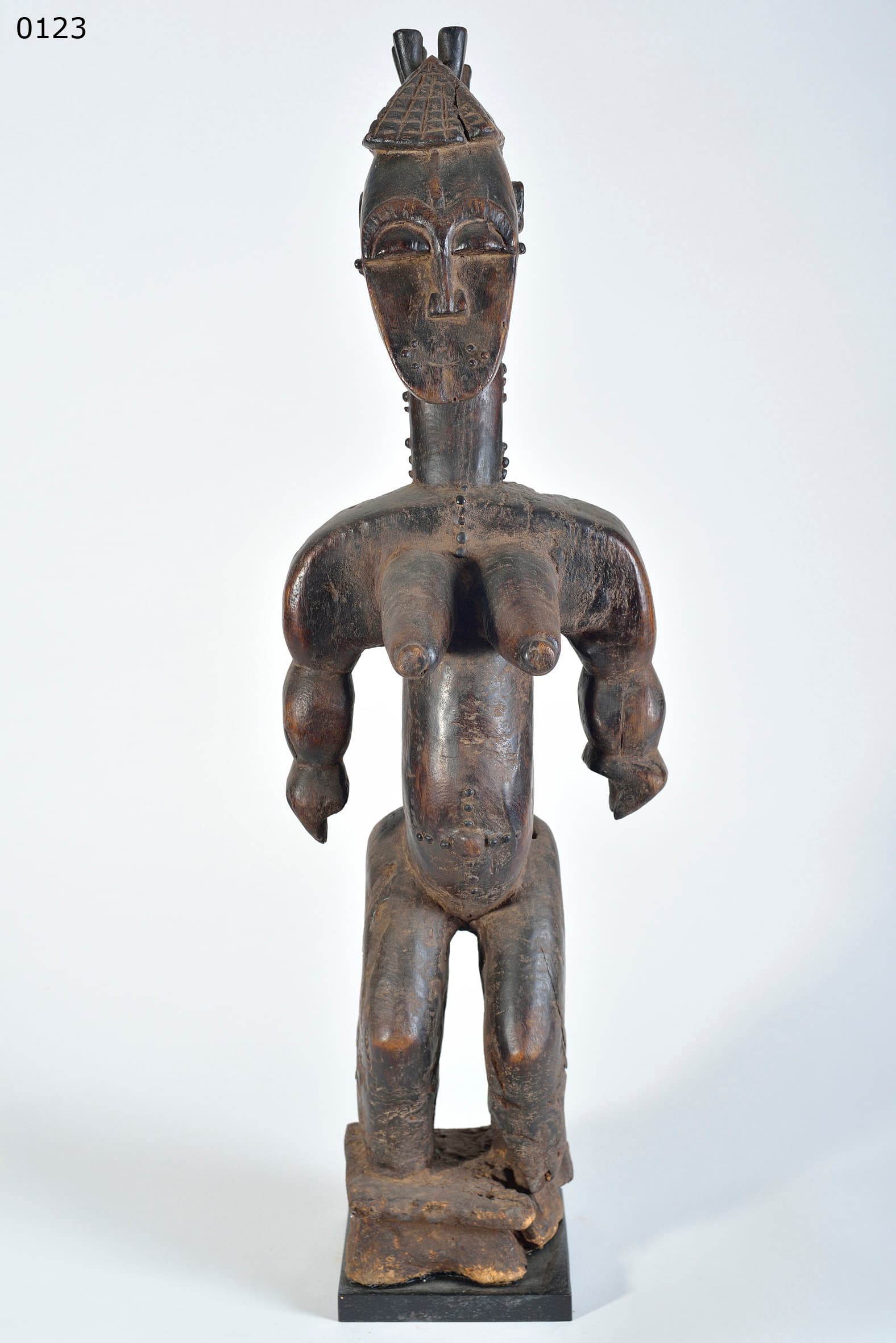
The wooden sculptures of the Kulango are defined by a strict, almost archaic canon of proportions. The figures (both anthropomorphic individual statues and ancestral pairs) appear strongly block-like and static in their frontality. Typical iconographic features include a cylindrical torso shape, short arms often attached directly to the torso and a disproportionately massive, thick neck supporting an abstracted, often triangularly tapering head (Roy 1987: 102). An essential, recurring detail is the strongly pronounced, cylindrically protruding navel. In Kulango iconography, this navel does not function primarily as an anatomical detail, but as a visual metaphor for the uninterrupted maternal line of descent (matriline), which forms the basis of social identity. The size spectrum of these wooden objects ranges from handy divination figures (approx. 15-20 cm) to monumental altar sculptures over half a metre high.
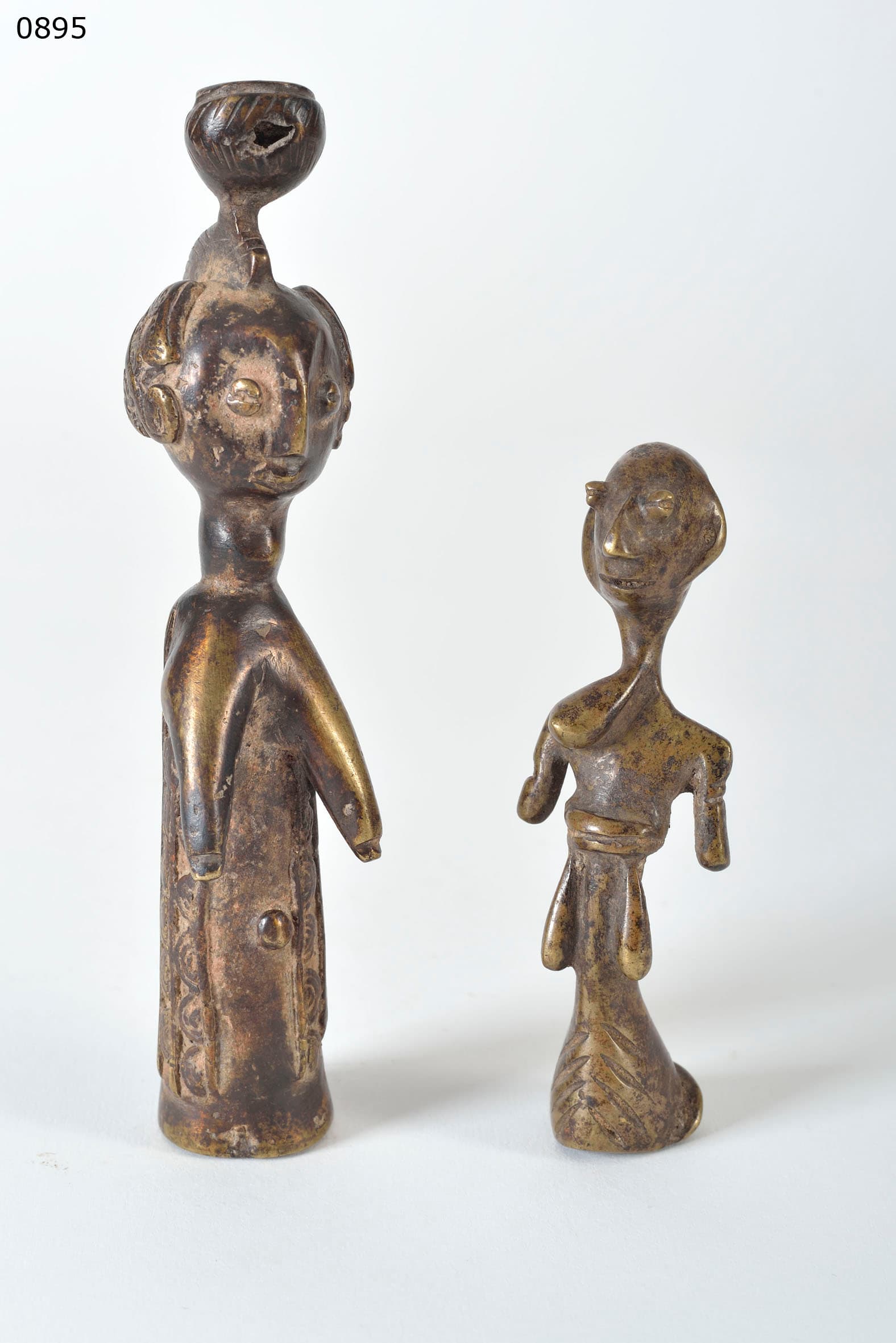
In radical contrast to the static solidity of the wood is the art of metal casting, which is carried out using the lost wax process (cire-perdue). The Kulango bronzes break with all the iconographic restrictions of wood carving. These miniatures, most of which range in size from an extremely small 3 to just under 6 centimetres, testify to a flowing, highly dynamic expressiveness. The tiny bodies perform almost choreographic gestures, have protruding, diamond-shaped heads, elaborate hairstyles and are often conceived as equestrian figures - sitting on horses or mythological crocodiles (Meyer 1999: cat. 43). The casting requires enormous precision: the wax model is coated with fine clay, fired in the kiln, whereupon the wax melts out and the liquid copper alloy is poured into the cavity (Metropolitan Museum 2023: URL).
With regard to the iconography of these bronzes, an explosive research controversy dominates the current literature. Older publications and traditional inventory catalogues described these miniature bronzes in general terms as ancestor figures or subsumed them as profane gold weights, analogous to the material culture of the neighbouring Akan (Ginzberg 2000: 112). The art historian Alain-Michel Boyer refutes this interpretation through extensive analyses. Boyer postulates that these small figures, often with amorphous or animalistic (baboon-like) features, do not explicitly represent the benevolent ancestors, but rather physical vessels for the dangerous spirits of the bush (amuin). They were deliberately designed by the casters to be abstract, restless and terrifying in order to visually capture the uncivilised, wild nature of these entities and make them ritually bindable (Boyer 2017: 58).
Despite the anonymity of African art ("anonymous tribal art") long postulated in the West, the pioneering methodology of ethnologist Hans Himmelheber, who conducted research in the region from the 1930s onwards, made it possible to identify individual master craftsmen's hands and workshops (Himmelheber 1963: 88). A canonical example of this is the so-called "Master of Essankro" (active ca. 1820-1900). A Komien wooden figure created by him (inv. no. 1986.485.1), which is now in the collection of the Metropolitan Museum of Art (New York), impressively demonstrates the individual signature of this artist through the specific treatment of the facial areas and the application of glass beads (Metropolitan Museum 2023: URL).
The ontological difference between an activated ritual object and a purely profane (or newly carved) object manifests itself visually and haptically in the patina. An activated object is characterised by a thick, encrusted and organic sacrificial patina created by the repeated application of blood, millet beer, chewed kola nuts and kaolin. This patina is also the most critical criterion for authenticity and forgery on the Western art market. While authentic sacred patina grows into the material over decades through micro-molecular layering, forgeries have artificially applied, homogeneous layers of dirt or binder ("dirt is not patina", Ehrhard 2017: 58). The African collection of the Musée du quai Branly in Paris, which systematically documents the structural ageing of West African hardwood under ritual conditions, provides an excellent museum reference for the comparison of authentic patination (Homberger & Fischer 2015: 14).
| Aesthetic criterion | wooden sculptures (standing figures) | bronze miniatures (cire-perdue) |
|---|
| Size range | 20 cm to 55 cm | 3 cm to 6 cm |
| Proportional canon | Block-like, static, thick neck, prominent navel | Flowing, dynamic, diamond-shaped heads, choreographic |
| Iconographic meaning | Ancestral representation, divination anchor for comias | Vessels for wild bush spirits (amuin), protective amulets |
| Patina type | Matt usage patina or encrusted sacrificial patina | Oxidised surface, partly abrasion through handling |
Ritual practice
The ritual practice of the Kulango is characterised by a highly formalised and life-cycle approach to invisible powers. At the centre of this practice are the intensive use of the altar by divinators and the highly performative mask dances, which ensure the physical and spiritual integrity of the village community. Each ritual object undergoes a precisely defined lifecycle from profane new carving to the status of active sacred agent to ritual deactivation and disposal.
The process of altar utilisation always begins with a spiritual crisis. When family misfortune, illness or crop failure occurs, the community consults a Komien (trance divinator). If the Komien identifies the workings of a specific bush spirit (amuin), he commissions a local carver or mould maker to create a physical recipe item. The newly completed object - whether made of wood or bronze - has no inherent power at this point; it is ritually "empty". The critical act of activation (consecration) takes place on the divinator's earth or home altar. In a complex liturgy, the priest invokes the entity and "feeds" the object. The primary offerings include the blood of chickens or goats, millet porridge, red palm oil and the secretion of ritually chewed kola nuts (Boyer 2017: 104). These ingredients not only act as food for the spirit, but also bind it substantially to the sculpture. Occasions for such sacrifices are cyclical renewal rituals, acute divination sessions or initiations.
During the active phase, the objects function as indispensable communication bridges. During divination sessions, the Komien uses the bronze miniatures in particular as oracles. The small figures are thrown and positioned in the sand; the divinator reads the causes of metaphysical disturbances from their spatial constellation and direction of fall (Roy 1987: 130).
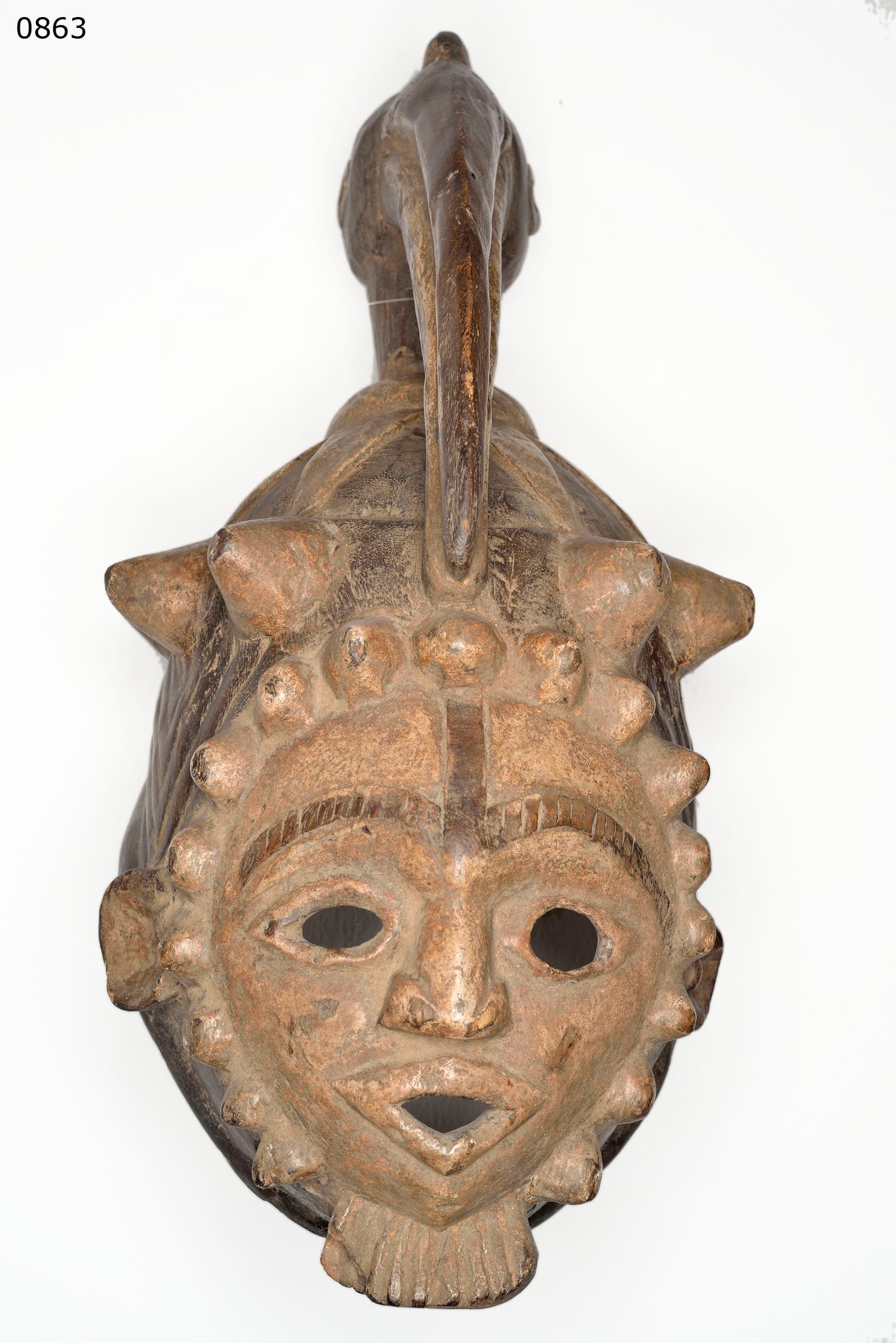
A completely different, spatially expansive performative dimension unfolds in the practice of masks. The Kulango space is famous for the massive, zoomorphic Bedu board mask, which can reach lengths of almost three metres and is traditionally divided into a female and male counterpart. The Bedu performance is not a static ritual, but a highly kinetic act. The performance mainly takes place during the month-long Zaurau New Year festival, at Thanksgiving ceremonies or at the funerals of high-ranking personalities. The masked dancer, whose identity remains hidden under a dense costume made of raffia, traverses the village boundaries in sweeping, sweeping movements. Embedded in a dense acoustic field of drum rhythms and polyphonic chants by the women, the choreography serves to actively cleanse the social space of malignant witchcraft influences (danifo) and to restore fertility (Phillips 1996: 452).
The lifecycle of a kulango ritual object inevitably ends when its spiritual power erodes. This happens when prayers remain chronically unanswered, the possessing comia dies without leaving a successor, or the wood fails structurally due to extreme insect damage. An object that has become unusable is not profanely reused or sold, but formally deactivated. Deactivation involves ritual incantations in which the spirit leaves the object. It is then disposed of in a tabooed area of the bush, far away from the village settlement. The elders metaphorically refer to this process as being "put to sleep" (Phillips 1996: 453). The object is left to decay naturally, as it is ontologically degraded back to ordinary material.
Regional variations of this practice are significantly documented. The sources show that northern Kulango groups, due to contact with the Gur peoples of Burkina Faso, practise more archaic earth cults with a focus on clay altars, while in the southern areas, due to the influence of the Abron, more elaborate sacrificial techniques with echoes of Akan gold dust practices can be found (Tauxier 1921: 190). Many historical Kulango artefacts that ended up in the Western Hemisphere - such as the holdings of the Fowler Museum at UCLA or the Congolese-West African comparative collections of the RMCA Tervuren - show strong traces of this intentional decay and weather erosion, as they were often recovered by missionaries from these disposal sites before they completely rotted away (Volper 2016: 22).
Historical context
The historical genesis and material culture of the Kulango are inextricably linked to the massive demographic upheavals, the colonial ruptures and the subsequent globalisation of the African art market. The migration history of the region is characterised by constant overlaps. The ethnogenesis of the Kulango in north-eastern Côte d'Ivoire already culminated before the 17th century in the establishment of the powerful, centralised kingdom of Bouna, which flourished through the control of regional trade routes (especially for gold and kola nuts) (Boutillier 1993: 88). The exact dating of this state consolidation remains the subject of scholarly controversy, as oral traditions, linguistic branching models and archaeological findings only partially coincide. However, it is undisputed that massive waves of invasion - initially by the Akan groups from the east in the 17th century, followed by the Lobi expansion from the north in the 19th century - profoundly destabilised the cultural and territorial unity of the Kulango (Bognolo 2007: 55). The final collapse of the old monarchical order was sealed by the campaigns of the Mandingo armies under the conqueror Samori Touré in the 1890s, immediately before the territory was integrated into the French West African colonial administration (AOF).
The colonial encounter had ambivalent, sometimes paradoxical effects on art production. On the one hand, the French administrators instrumentalised the relics of the monarchical structure as part of their "Indirect Rule" doctrine, which temporarily gave the Kulango king (Bouna-Mansa) new, administratively supported authority (Tauxier 1921: 25). On the other hand, the colonial era led to unprecedented spiritual and material disruptions. From the 1930s to the 1950s, local anti-animist prophetic movements (such as the Massa cult led by M'péni Dembélé) and intense missionary fervour shook the region. These movements ordered the systematic destruction, burning and abandonment of traditional shrines and masks. Ironically, it was often European colonial officials and Catholic missionaries who literally rescued the sculptures from the burning rubbish dumps - a brutal process of decontextualisation that formed the physical basis of many of today's European private collections and museum inventories (Convers & Clemens 1950, cited in Homberger & Fischer 2015: 42).
Parallel to this destruction, the systematic development of Kulango art for the Western market began. The German ethnologist, collector and art dealer Hans Himmelheber played a pioneering role in this process. Himmelheber travelled continuously to Côte d'Ivoire and Liberia from 1933 onwards. His methodology marked a fundamental paradigm shift in African art history: Away from the colonial view of objects as anonymous, ethnological "curiosities", towards the explicit appreciation of African carvers as individual, creative artistic personalities (Fischer 2015: 12). Himmelheber's immense archive of field notes, photographs and objects is today one of the most important focal points of research at the Museum Rietberg in Zurich.
The final commercial breakthrough and the accompanying price development of traditional West African art took place in the second half of the 20th century. Groundbreaking exhibitions, above all the epochal show "Primitivism in 20th Century Art " at the Museum of Modern Art (MoMA) in New York (1984), brought the structural affinity between African abstraction (including Kulango figures from the Fried Collection) and the Western avant-garde into the global consciousness (Rubin 1984: 530). This institutional ennoblement catapulted auction prices to unprecedented heights.
The enormous demand of the market inevitably stimulated a massive counterfeiting problem. As the block-like abstraction of the Kulango wooden figures and the surreal forms of the bronzes perfectly suited the tastes of Western modernist collectors, specialised forgery workshops were established in cities such as Abidjan. Authenticity criteria are therefore rigorously forensically defined today in order to rule out market-relevant deceptions. In the case of wooden figures, particular attention is paid to termite feeding: real termites operating in the savannah prefer to eat through the softer early wood growth rings and leave behind a specific, grooved feeding pattern; artificially simulated ageing damage with acids or drills ignores these biological wood structures. Another criterion is heartwood cracks, which are caused exclusively by extremely slow, natural desiccation (drying out) over decades in the climate of West Africa and cannot be reproduced by the rapid shock drying in the kiln of the forgery workshops (Ehrhard 2017: 192). In the case of Kulango bronzes, forensic scientists rely on lead isotope analyses (lead isotope analysis) and the examination of the oxidation layer to distinguish historical casting processes from recent zinc alloys made from industrial scrap metal (Gale & Stos-Gale 2000: 503).
| Historical epoch | Relevant events & dynamics (Kulango) | Art historical impact |
|---|
| Pre-19th cent. | Establishment of the Kingdom of Bouna, Akan migration | Establishment of ritual morphology, court art |
| Late 19th century | Mandingo invasion (Samori Touré), Lobi migration | Destruction of altars, mixing of regional styles |
| 1930s - 1950s | Massa cult, colonial oppression (Sakrobundi) | Mass extermination, "rescue" by missionaries |
| 1980s - recent | "Primitivism " exhibition (MoMA), market boom | price explosion, emergence of systematic counterfeiting workshops |