Overview
The geographical and demographic localisation of the Yaure (usually transcribed in Francophone ethnographic literature as Yohoure, Yaouré or, more rarely, Snan) forms an essential starting point for understanding their strongly syncretic material culture. The core settlement area of this ethnic group manifests itself in the central inland belt of today's Republic of Côte d'Ivoire (Ivory Coast), precisely at that highly significant ecological transition zone in which the dense equatorial Guinea forest region of the south successively merges into the tree savannah of the north, which is interspersed with gallery forests. Topographically, the population is primarily concentrated in the territory between the courses of the White and Red Bandama rivers, east of the urban agglomeration of Bouaflé. This specific location results in a significant cultural and linguistic buffer function: the Yaure are surrounded in the east and south by the far more populous Baule, who belong to the Akan language group, while the Guro and Gban (Gagu), who belong to the southern Mande language family, settle in the west and north-west.
The collection of reliable demographic data on the recent population size of the Yaure proves to be methodologically highly complex, and the source situation is ambiguous in this respect. Older anthropological standard works, collection directories and basic databases put the population historically constant at only around 20,000 individuals. More recent ethnographic estimates, however, point to an increased population of around 60,000 members. A comparison with the macro data from the most recent Ivorian census (Recensement Général de la Population et de l'Habitat - RGPH 2021) illustrates the problems of statistical recording: the census documents a total population of 29,389,150 inhabitants in Côte d'Ivoire, divided into urban (52.5 %) and rural (47.5 %) zones. However, as the governmental survey operates at the administrative level of the districts and regions (e.g. Yamoussoukro, Lacs, Marahoué) and does not show micro-ethnic subgroups in isolation in the aggregated data sets, the recent figures on the Yaure ethnic group are primarily based on linguistic extrapolations.
Linguistically, the Yaure are assigned to the large Niger-Congo language family, more specifically to the Mande branch. In older African studies, they were categorised as belonging to the historical Mande-Fu cluster, a classification that is now classified in a more differentiated way in modern linguistics as "Southern Mande". A remarkable sociolinguistic characteristic of the Yaure is their pronounced bilingualism: depending on their geographical proximity to the respective neighbouring ethnic group, the village communities communicate predominantly in Baule (Akan) or Mande. This linguistic permeability is a direct indicator of far-reaching historical assimilation processes.
The social structure of the Yaure is essentially acephalous, but exhibits rudimentary hierarchical mechanisms due to the influence of neighbouring systems. The villages are generally assigned to a primary clan (kabila) and are led by a designated local leader. However, his authority is by no means absolute, but is legitimised, controlled and, in the event of conflict, sanctioned by a council of elders. This council is made up of the representatives of the individual family lineages. The kinship system is organised in a strictly patrilineal manner; each lineage traces its lineage back to a specific, often mythically exaggerated founding ancestor, whose veneration ensures the social cohesion of the group. The traditional subsistence strategy is based on semi-permanent shifting cultivation (yams, manioc, plantains), supplemented by ritual hunting parties in the remaining forest areas. In the modern economy, this basis has shifted massively towards the cultivation of cash crops, particularly through integration into global cocoa production, which has led to significant socio-economic upheavals and a monetisation of traditional barter trade.
| Demographic and linguistic parameters | Specification and state of research |
|---|
| Territory | Republic of Côte d'Ivoire (total population according to RGPH 2021: 29,389,150). |
| Geographical centre | Central region, between the White and Red Bandama, east of Bouaflé. |
| Population estimate | Historical literature: approx. 20,000. Current estimates: approx. 60,000 |
| Language family | Niger-Congo, Mande (historically: Mande-Fu), Southern Mande subgroup. |
| Social structure | Acephalous to semi-hierarchical; patrilineal lineages, rule by councils of elders. |
| Cultural interference | Massive hybridisation by Baule (Akan) in the east and Guro (Mande) in the west. |
In the history of ethnological and art historical research, there is a virulent and still ongoing controversy regarding the classification of the Yaure, which is highly relevant for the private collector. The older Western collecting tradition and early museum cataloguing tended to marginalise the Yaure as a distinct ethnic group. Based on morphological similarities, their artefacts were often subsumed as a mere subcategory of the dominant Akan culture, and in museum inventories, for example in the early holdings of the Museum Rietberg in Zurich or the Royal Museum for Central Africa in Tervuren (RMCA), they were generally filed under the composite term "Baule-Yaure style".
More recent research approaches, significantly influenced by the American ethnographer Susan Vogel and the French researcher Alain-Michel Boyer, on the other hand, argue vehemently in favour of recognising an independent socio-cultural and artistic identity. In her groundbreaking publication Baule: African Art, Western Eyes (1997), Vogel argues that the Yaure established an independent workshop tradition with identifiable master carvers despite massive formal-linguistic interferences with the Baule. A. dates the emergence of this specific style to the assimilation processes of the 19th century, while B. (older curators) regarded the style as a mere peripheral degeneration of classical Baule art. Modern consensus building in institutions such as the Musée du quai Branly or the Metropolitan Museum of Art (Met) increasingly follows Vogel's paradigm and lists the Yaure as a distinct corpus.
Cultural context
The religious system of the Yaure is based on a highly complex cosmological order which, although structurally analogous to the systems of the neighbouring Baule and Guro, develops a distinct dynamic of its own in its ritual pragmatism and theological rigidity. At the head of the pantheon is an omnipotent creator deity, conceived as absolutely unapproachable, who is usually invoked as Bali (or syncretically referred to as Nyamien in the direct area of influence of the Baule). A central structural feature of this religion is the principle of divine distance: as Bali no longer intervenes directly in the profane, microcosmic concerns of human existence after the creation phase, the entire operative cult complex is primarily focussed on spiritual intermediaries.
These intermediaries manifest themselves in the form of yu spirits (sometimes also called yu powers). The ontology of these natural and spiritual beings is characterised by extreme ambiguity. On the one hand, as mediators between the distant creator god and humanity, they are vital protective powers that ensure agriculture, fertility and social peace. On the other hand, they are considered wild, unpredictable and highly dangerous. Conceptually, they originate from the "bush" (the untamed wilderness, asie usu among the Baule), which is in a permanent structuralist tension with the "village" (the ordered, civilised space). If ritual duties are neglected or the social equilibrium is disturbed - particularly through the death of a community member - these yu forces can unleash highly destructive energies that threaten the survival of the entire village community.
Ritual authority among the Yaure is not vested in a centralised, hereditary priestly caste, but is anchored in a network of specialised, strictly regulated male and secret societies. The absolute centre of this ritual executive is formed by the je society (often also transcribed as dye) and the associated lo initiation society. Divinators, the so-called komyen, act as diagnostic authorities within this system. They use specific trance techniques or oracle systems (similar to the Baule mouse oracle) to ascertain the will of the yu entities, identify spiritual trouble spots and prescribe exact sacrificial rites and mask performances.
The role of women in the Yaure cult complex is characterised by drastic taboos based on the paradigm of ritual vulnerability. Women are rigorously excluded from the central mask performances of the je and lo societies under threat of massive spiritual sanctions. Visual or physical contact with the activated masks is considered life-threatening; in the cosmology of the Yaure, the irrefutable premise prevails that the concentrated energetic radiation of the yu representations irreparably damages female fertility, causes miscarriages or even leads to the immediate death of the observer. Accordingly, during the culmination phases of specific mourning rites, women are evacuated to isolated areas as a preventative measure or have to hide in darkened huts.
This absolute exclusion from the sphere of the yu masks does not, however, mean a complete ritual incapacitation of women. In a significant contrast to this, women play a highly active, often initiating role in the cult of the afterlife spouses. According to the eschatological conception of the region, every person has a mystical spouse in a parallel world beyond (blolo bla for the man, blolo bian for the woman), with whom they were connected before physical birth. Worldly problems such as infertility, sexual dysfunction or marital crises are often attributed by diviners to the jealousy of this spiritual partner left behind in the afterlife. To appease this entity, women (as well as men) commission statues to care for, feed and cleanse them in intimate home shrines. Here, the woman does not function as a passive taboo subject, but as a self-sufficient spiritual actor.
There is considerable controversy within ethnological research regarding this cultural context. The French ethnographer Alain-Michel Boyer, who has been researching the Yaure since 1970 and published a fundamental monograph for the Musée Barbier-Mueller in 2016 (Les Yohouré de Côte d'Ivoire. Faire danser les dieux), postulates a hermetic separation of the sacred spheres of activity: For Boyer, the masks are pure, fear-ridden manifestations of the menacing yu forces that reign exclusively through terror, while the statues belong to a more intimate, psychologically accessible sphere.
Susan Vogel, on the other hand, attacks these rigid Western categorisations in Baule: African Art, Western Eyes (1997). Vogel argues that the boundaries between "threatening mask" and "intimate statue" are far more osmotic in the reality of life of the peoples in the centre of Côte d'Ivoire. She argues (author vs. author controversy) that Boyer and older researchers inappropriately project the Western dichotomy of "art" vs. "religion". For Vogel, from an indigenous perspective, the artwork is not a static image of a spirit, but an "animated presence" whose physical form is less important than the process of its ritual manipulation. What structurally distinguishes the religion of the Yaure from neighbouring peoples is therefore not the inventory of spirits, but the extreme focus on the burial ritual as the primary mechanism of cosmological restitution.
Aesthetic features
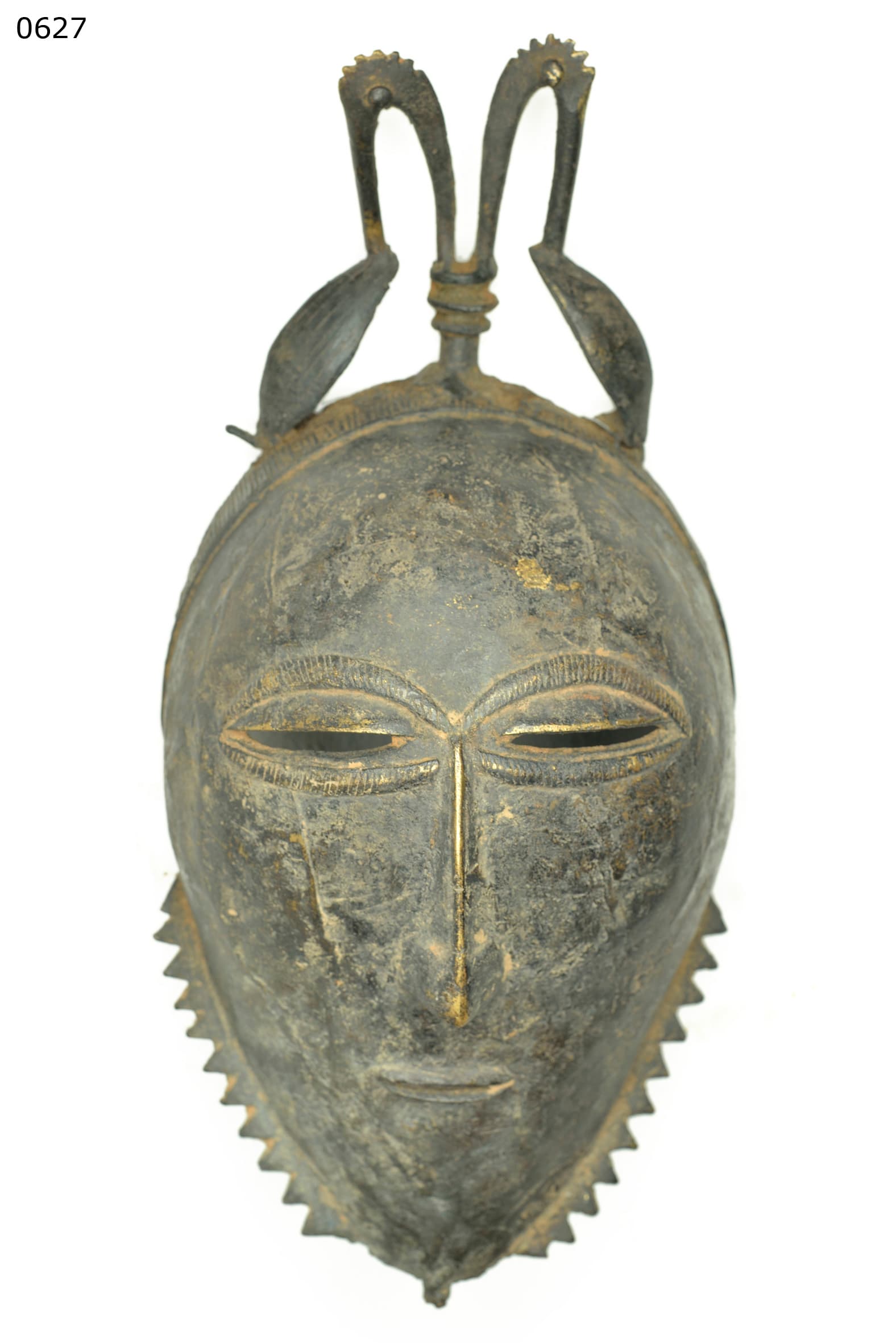
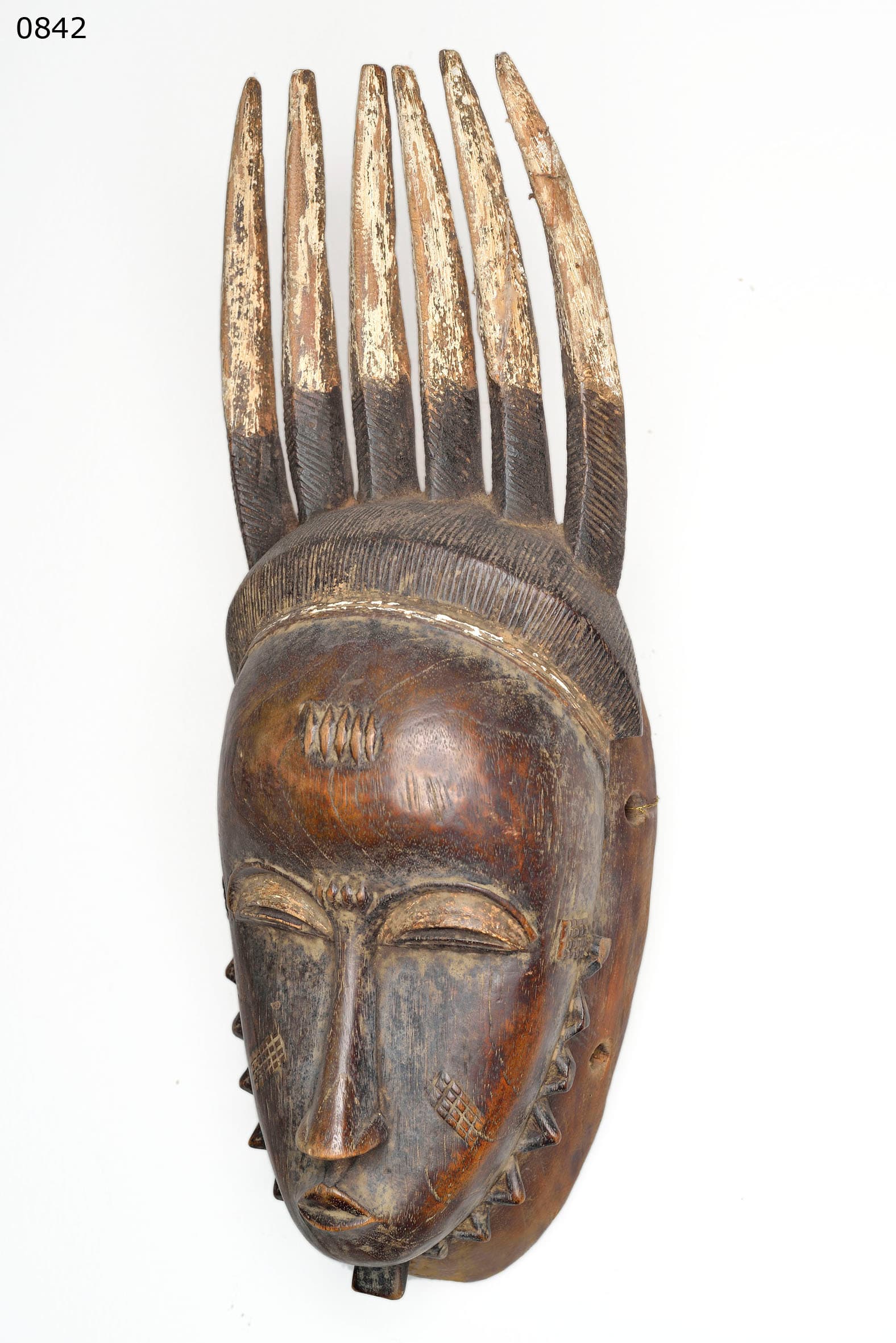
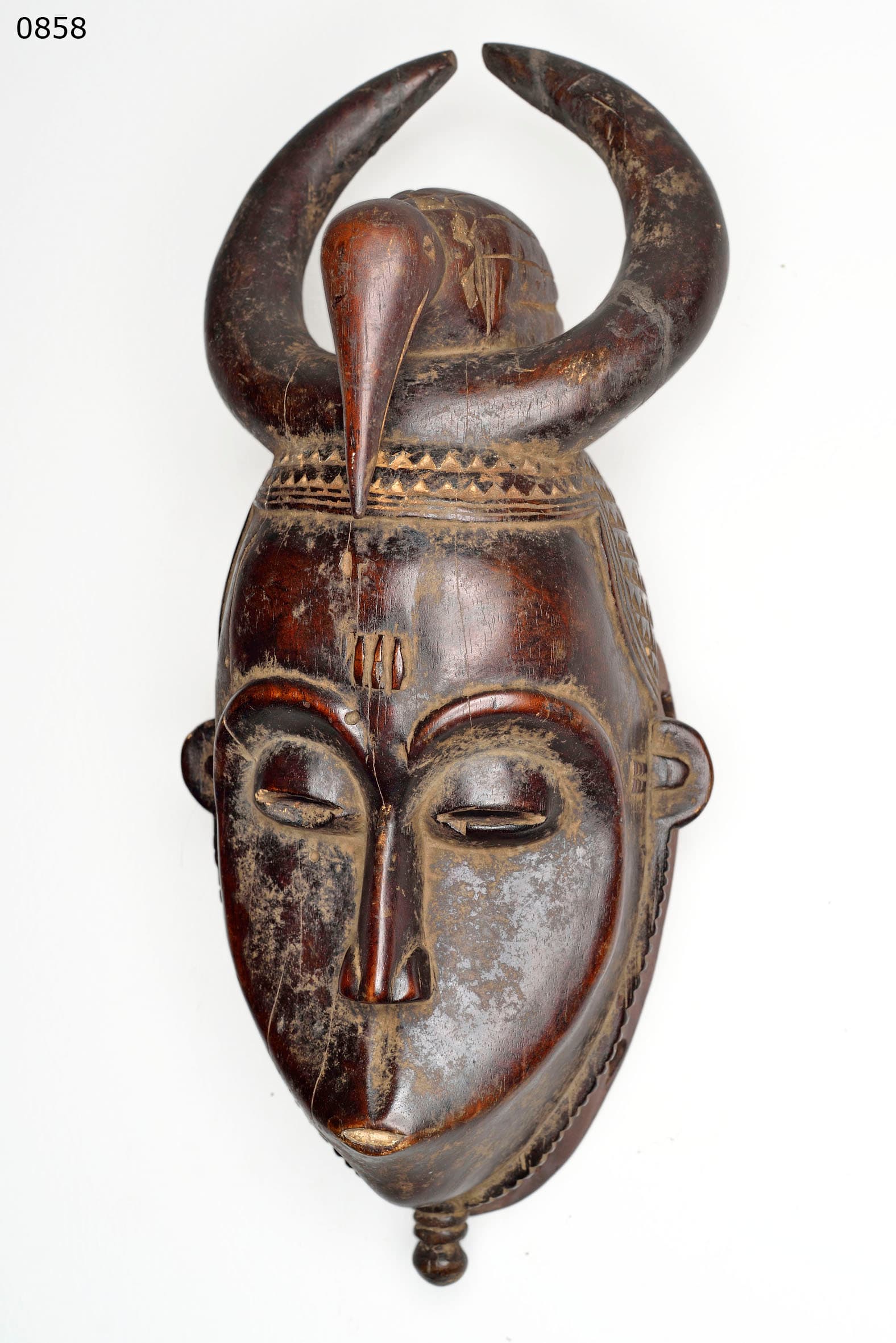
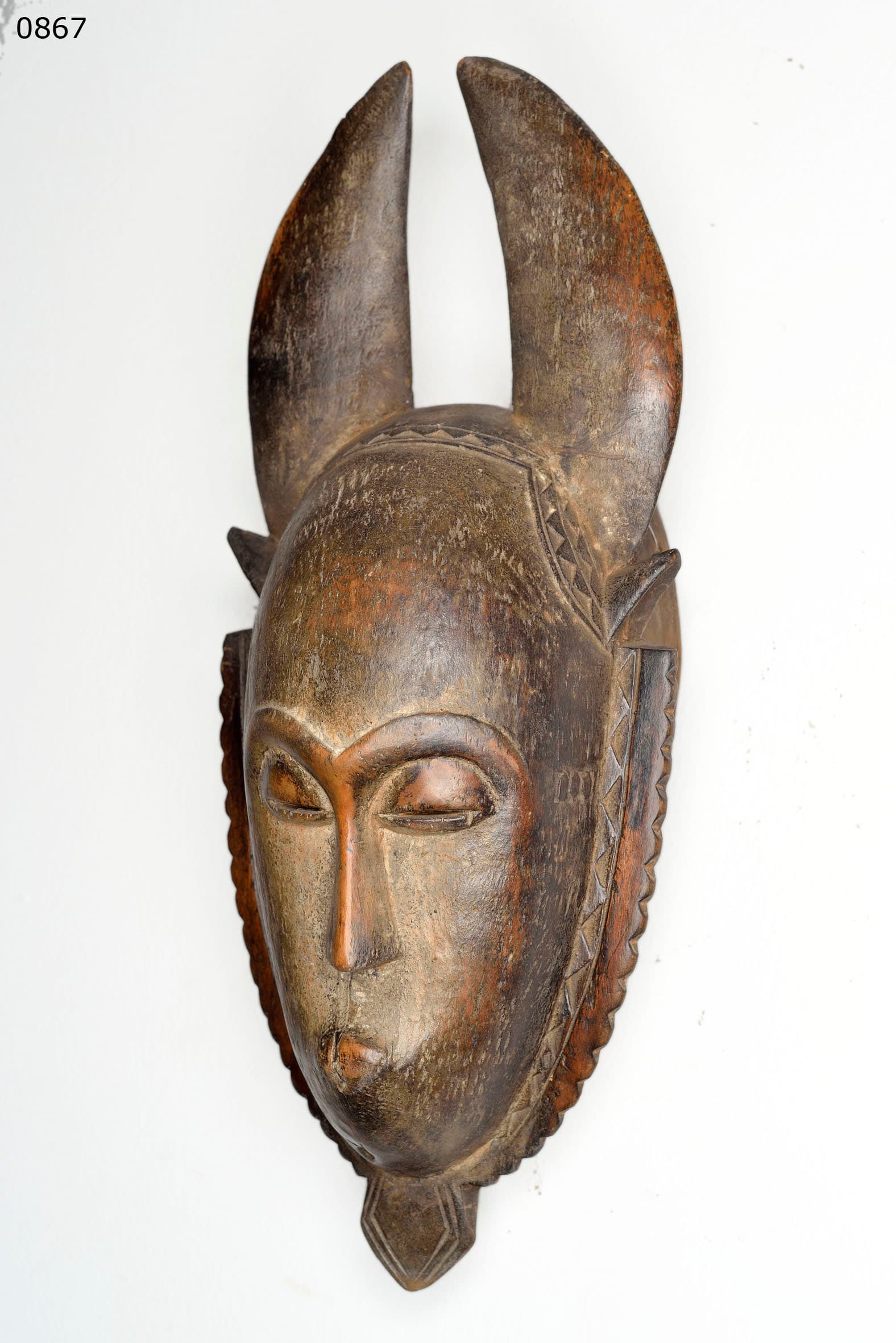
The material culture of the Yaure manifests itself in a canonical typology of objects whose formal virtuosity, delicate lines and technical sophistication are recognised as absolutely outstanding in African art history. The undisputed centre of sculptural creation and the focus of Western collectors is the face mask complex. The canon of proportions of these masks is strictly regulated and characterised by an extremely elongated, delicate and oval face shape, which is dominated by a high, protruding forehead. The eyes are usually designed as almond-shaped, half-closed slits or pierced semicircles, which lie under pronounced, curved eyebrow arches, giving the mask an introverted, contemplative expression. Another signature element is the discreetly protruding, often tube-like pointed mouth and the fine, straight nose.
The absolutely diagnostic iconographic feature that distinguishes Yaure masks at first glance from the closely related works of Baule or Guro is the jagged edge (zigzag pattern) that frames the entire oval of the face like an aureole. This element is interpreted by scholars not only as a formal decoration, but also as a metaphysical visual barrier that separates the human identity of the dancer from the dangerous spiritual presence of the mask. The masks usually have elaborate, often three-part braided hairstyles that end in complex attachments.
The Yaure masks are divided into two central ritual subtypes, which are diametrically opposed in terms of both colour and function: The je masks and the lo masks. Je masks generally have a vivid polychrome colour, which is achieved by applying natural earth pigments, red tukula powder and white kaolin. The lo masks, on the other hand, which fulfil a heavier, eschatological function in the ritual cycle, are characterised by a monochrome, dark to deep black patina. The creation of this dark patina is an elaborate alchemical process: the wood is rubbed with special plant juices (often from the leaves of Tectona grandis) and smoked over an open fire under the influence of heat, whereby the soot burns deep into the pores of the wood. The patina of authentically activated ritual objects is also often interspersed with organic encrustations - the remains of sacrificial blood, chewed kola nuts and palm wine, which were applied to the mask for spiritual "feeding".
| Subtype of mask | Aesthetic characteristics | Ritual attribution |
|---|
| each mask | Polychrome pigmentation (kaolin, red earths), dynamic attachments. | Initial purification rituals after a death, taming the yu spirits. |
| lo masks | Monochrome, deep black patina from incense and plant juices. | Final funeral ceremonies, escorting the soul to the ancestral realm. |
| zamblé type | Hybrid creature: Antelope horns combined with crocodile or dog teeth. | Specific mask dance with rapid choreography to ward off extreme dangers. |
With regard to the complex mask attachments, in particular the combination of horns curved backwards and avifaunistic (bird-like) elements, a concise iconographic controversy has emerged among experts. Susan Vogel and numerous older inventory catalogues (such as those of the Musée du quai Branly or the British Museum) traditionally identify the bird perched on the crown of many masks as a hornbill (pesan ne), a ubiquitous symbol of fertility, ancestral knowledge and the transition between worlds in the entire Akan region. In his publication for the Musée Barbier-Mueller, however, Alain-Michel Boyer strongly opposes this classification (author vs. author). Boyer argues that the motif mostly depicts the cattle egret (Bubulcus ibis). His reasoning is based on Mande cosmology: the cattle egret lives in a symbiotic relationship with the water buffalo (by picking parasites out of its fur) and is therefore understood by the Yaure as the ultimate spiritual guardian of the powerful, wild forces of nature (être-force). The source situation for the final iconographic definition thus remains ambiguous in research and requires a differentiated identification of both interpretations when cataloguing private collections.
The question of authorship was long dominated in Western art discourse by the romanticising myth of the "anonymous, instinctively creative African craftsman". As the Belgian ethnologist Frans Olbrechts methodologically initiated for the RMCA Tervuren in the 1940s (morphological manuscript analysis) and Susan Vogel later specified for the Ivory Coast, individual master craftsmen and workshops can indeed be isolated through stylistic analysis. Documented master hands are known for the Yaure. One prominent example is the so-called "Master of Buafle", whose works are characterised by an incomparable formal balance; one of his signed Gu masks (inv. RAF 510) is a prominent highlight in the collection of the Museum Rietberg in Zurich. Another artist who can be identified by name is Owie Kimoh, who was active around 1913 and whose works (including pieces that were later received at Christie's) exemplify the stylistic transition and cross-fertilisation of the Baule-Yaure border region.
For the contemporary collectors' market, forgery criteria are highly relevant, as the Yaure aesthetic became extremely popular in the 20th century. The decisive difference between an activated ritual object and a profane object (art d'aéroport, carved for tourists or dealers) lies in the ageing of the material and the traces of use. Authenticity criteria include forensic details: a genuine ritual patina shows complex, organic layers under the microscope that cannot be replicated by modern stains or shoe polish (a popular counterfeiting agent in West Africa). Other compelling indicators of age and use are traces of wear on the inside of the mask (oxidised sweat marks on the dancer's forehead and cheeks), drying cracks in the heartwood (which indicate slow air-drying in the bush, as opposed to modern drying ovens) and authentic termite feeding marks on the invisible edge areas.
Ritual practice
The performative practice of the Yaure masks is not an abstract theatre game, but an existential, metaphysical intervention that is inextricably linked to the ritual cycle of mourning, spiritual defence against danger and social restitution. If a death occurs in the village community - especially the death of a lineage elder, a chief or a high-ranking initiate - the entire cosmological and social fabric is considered to be massively destabilised. In Yaure ontology, death tears a gap in the village's protective barrier, allowing uncontrollable, hostile forces from the wilderness to enter. This crisis requires the immediate and strictly choreographed use of the mask apparatus in order to restore social balance and protect the community from further cataclysms.
The life cycle of a ritual object begins long before its public appearance. When a new mask is needed, the sculptor retreats into the bush - the space of the yu spirits - to cut and mould the wood away from profane eyes. At this point, the mask is merely a physical object. The critical transformation into an activated "être-force" only takes place through a complex consecration ceremony. The mask is kept in the sacred forest or in a special shrine that is inaccessible to non-initiates. Before the actual performance, it is "charged" by a priest or divinator. This is done through specific incantations and material offerings (libations): The blood of a sacrificed chicken is usually spread over the wood, followed by the chewing and spitting of kola nuts and the pouring of palm wine. These substances are not used as decoration, but as metaphysical nourishment that forces the spirit into the wooden mould and binds it there.
The ritual practice of coping with death follows a rigid sequencing, which is divided into two performative phases: the je celebration and the subsequent lo ceremony. Before even the first dancer enters the village, the strict taboo of gender segregation takes effect. All women of reproductive age and uninitiated children are evacuated from the ritual epicentre and must hide in locked houses or leave the village altogether, as the mere sight of the masks would destroy their fecundity (fertility). This preparation phase is accompanied by specific wooden slit drums, whose acoustic signals officially communicate the death of the chief to the neighbouring villages and mark the beginning of the state of emergency.
The first phase of the rite is dominated by the polychrome je masks. The mask dancer, whose human contours are completely concealed under a voluminous costume made of dried raffia fibres, enters the village square. The choreography of the je dance is highly dynamic, erratic and aggressive. The primary function of this performance is to physically bind the spiritual pollution created by the corpse. Through the wild dance, society temporarily converts the dangerous yu spirit from an unpredictable threat into a powerful protector of the village community. The masks act here as spiritual sponges that absorb the negative entropy and "cleanse" the village.
In the final phase of the mourning rituals, which often takes place days or weeks later, the lo masks covered in black pigment make their appearance. Their performance differs fundamentally from that of the je masks: the dance is characterised by a far more serious, slower and more controlled rhythm. The task of the dark lo dancers is of an escalatory nature; they must guide the now calmed soul of the deceased safely out of the physical space of the village and show it the way to the transcendent realm of the ancestors. Only when this escort has been completed is cosmic order restored and the ritual quarantine of the village is lifted.
There are significant regional variations within this complex. In the eastern border areas with Baule territory, the Yaure have adapted elements of the goli dance (with the characteristic flat disc masks kplekple) and integrated them into their own je/lo narrative, demonstrating the fluidity of ritual practice in this cultural zone. After the end of the rituals, the mask undergoes a phase of deactivation. It is separated from its costume, sometimes ritually washed or rubbed with cooling substances to reduce its acute heat and dangerousness before being stored again in secret. The life cycle of a Yaure mask does not necessarily end with its physical wear and tear. If the wood is irreversibly damaged by massive termite damage or climatic rot and becomes unusable for the dance, the object is not simply thrown into the rubbish bin. It is carried back into the bush, where it is returned to nature under specific rites and left to rot. Beforehand, the spiritual essence (the agency of the yu spirit) is ritually "extracted" by the divinator and transferred to a newly carved replacement mask, thereby preserving metaphysical continuity.
Historical context
The genesis of the ethnic identity of the Yaure and the development of their characteristic artistic style cannot be seen as an isolated, static phenomenon, but are the result of complex and often violent migratory movements that characterised the entire West African region for centuries. The historical foundation primarily results from the so-called great Akan migration. In the course of the rapid military rise and territorial expansion of the Ashanti empire in what is now Ghana, various dissident Akan splinter groups (including the direct ancestors of the Baule under the leadership of the legendary Queen Abla Pokou) migrated westwards from the early 18th century.
In the Bandama River region, these massive waves of migration encountered the indigenous Mande-speaking population groups living there. From the profound mixing, the partial military subjugation and the successive cultural penetration of these southern Mande groups by the organisationally superior Akan, today's Yaure crystallised as a hybrid socio-cultural construct. There are dating controversies among historians regarding the exact chronological location of this ethnogenetic synthesis: some Francophone historians place the beginning of assimilation and the formation of the specific Mande-Akan hybrid culture as early as the late 17th century, while other, more recent analyses date the definitive formation of the Yaure as a coherent ethnic group only as a consequence of subsequent waves of flight in the late 18th to early 19th century.
With the violent colonial penetration of Côte d'Ivoire by French military expeditions in the late 19th and first decades of the 20th century, Yaure society experienced a major turning point. The forced colonial pacification of the region, the administrative dismantling of traditional power structures and the violent introduction of capitalist forms of economy - in particular the forced cultivation of coffee and cocoa plantations - removed the socio-economic basis of the traditional patronage system. The local chiefs and secret societies increasingly had fewer resources at their disposal to exclusively maintain master carvers for months on end. Nevertheless, sacred art production did not collapse; rather, it adapted to the new circumstances, which sometimes led to a simplification of forms, but often also to the emergence of new, innovative sub-styles (such as the integration of western tropical helmets as insignia of power in late mask centrepieces, as documented in Museum Rietberg, Inv. 2021.379).
Parallel to this inner-African transformation, the colonial encounter initiated the mass export of Yaure artefacts to the Western hemisphere, where they were to have a lasting influence on the history of modern art. The history of their reception on the international art market began in Paris. Pioneering dealers, gallery owners and intellectuals such as Paul Guillaume (1891-1934) and Charles Ratton recognised the unsurpassed formal elegance and delicate naturalism of Yaure masks. Guillaume, who acted as an art dealer for the luminaries of the Parisian avant-garde (Amedeo Modigliani, Pablo Picasso, Henri Matisse, André Derain), no longer marketed these objects as ethnological "fetishes", but as sculptural masterpieces. The Yaure masks with their elongated faces and tiny mouths had a demonstrable, direct stylistic influence on Modigliani's portraiture. The breakthrough exhibitions of so-called "primitivism" in the 1930s finally shifted perception to the elite canon of high art.
Important early collectors recognised the potential of this specific style. The Swiss art collector Josef Müller acquired excellent Yaure masks for his collection even before 1939. The Heidelberg anthropologist Hans Himmelheber travelled to the Ivory Coast region around 1935, conducted field research and amassed a unique collection of Baule and Yaure objects. These early provenances (which today form the core of the Fondation Culturelle Musée Barbier-Mueller in Geneva) are considered the absolute gold standard on today's market, as they were collected before the mass commercialisation of African art.
| Market history milestones | Players and provenances |
|---|
| Pioneer phase (1910-1930) | Parisian galleries (Paul Guillaume, Charles Ratton) establish Yaure masks in the avant-garde (Modigliani, Picasso). |
| Ethnographic recording (from 1930) | Field research by Frans Olbrechts (RMCA) and Hans Himmelheber (collecting trips around 1935). |
| Establishment of elite collections | Josef Müller (purchases before 1939), today Musée Barbier-Mueller. Later Rockefeller Collection (Met Museum). |
| Scientific emancipation (1990s) | Susan Vogel's exhibitions (1997) differentiate the market and free the Yaure from the Baule shadow. |
Today, this historical revaluation is reflected in extreme price developments on the international auction market. At auctions organised by the market-leading houses Sotheby's and Christie's in New York and Paris, historically documented Yaure masks of outstanding quality now achieve estimated prices that reach the level of classical European art. In the recent past, for example, masterpieces (often still offered under the dual nomenclature "Baule or Yaure mask") have been valued at estimates of 350,000 to 450,000 euros. However, the market is highly volatile and sensitive with regard to provenance: while pieces with a fully documented history from the pre-war period (ex-Ratton, ex-Guillaume) achieve record sums or are knocked down for just under 1 million euros (like corresponding Gabon relics), high-priced Yaure masks fall through at auction at the slightest doubt about their ritual authenticity ("failed to sell"). Other, less prominent pieces change hands for between USD 3,000 and 8,750.
This financial increase in value has inevitably led to a widespread and technologically advanced counterfeiting problem. Today, African forgery workshops (particularly in Abidjan and Bouaké) produce Yaure replicas that are stylistically perfect and artificially aged. For museums and private collectors, forensic authentication has therefore become the most critical discipline. In addition to the aforementioned analysis of the ritual patina (which must show organic layers that have crystallised over decades and must not simply be painted on), X-ray and CT scans are increasingly being used. This forensic work looks for deep cracks in the heartwood that are invisible to the naked eye, which are evidence of the natural, extremely slow drying of the wood in the African climate. The galleries of wood pests (termite feeding) are also examined microscopically: authentic feeding runs organically along the wood fibres from the inside to the outside, while forgers often try to simulate feeding holes mechanically with heated needles. An object can only be classified as an authentic Yaure ritual object and included as such in a serious collection if it displays a harmony of stylistic perfection (canon of proportions, zigzag edge), deep ritual patina, natural ageing and documented historical provenance.