Overview
The ethnographic, demographic and linguistic classification of the Idoma represents an ongoing challenge in African studies due to historical migratory movements, interethnic amalgamation processes and a highly complex socio-political organisation. Geographically, the Idoma heartland is primarily located in the lower Benue Valley in central Nigeria (Benue State). The main settlement area extends over a habitat that ranges from open tree savannah (orchard bush) in the north to the foothills of the tropical rainforest in the south (Armstrong 1955: 91). Administratively, this area in today's Benue State is divided into nine local government areas (Local Government Areas): Ado, Agatu, Apa, Obi, Ohimini, Ogbadibo, Oju, Okpokwu and Otukpo, with Otukpo serving as the historical and administrative centre. In addition, there are historically rooted enclaves and diaspora communities in the neighbouring states of Taraba, Nasarawa, Kogi, Enugu and Cross River, which makes a clear territorial demarcation difficult (Erim 1981: 14).
The exact demographic recording of the Idoma is fraught with considerable methodological and political uncertainties. The source situation is ambiguous, as censuses in post-colonial Nigeria are highly politicised and ethnic categories in official data sets are often aggregated or manipulated in order to influence the allocation of federal funds. While older anthropological monographs and restrictive ethnolinguistic definitions assume approximately 500,000 to 600,000 individuals, more recent demographic analyses extrapolate significantly higher numbers (Kasfir 1988: 86). Based on the Nigerian census of 2006, which put the total population of Benue State at 4,253,641, as well as current growth rates for the year 2024, the population of people who actively identify as Idoma is estimated at 2.5 to 3.7 million today. This drastic discrepancy also results from the flexible nature of Idoma identity, which has historically assimilated foreign groups.
| Demographic & Administrative Structure | Data Collection & Breakdown Details |
|---|
| Primary Settlement Area | Benue State (Central Nigeria), Lower Benue Valley |
| Local Government Areas (LGAs) | Ado, Agatu, Apa, Obi, Ohimini, Ogbadibo, Oju, Okpokwu, Otukpo |
| Population estimate (NBS 2006) | approx. 1.3 million in the core area (Benue State) |
| Current projection (2024) | 2.5 - 3.7 million (including diaspora in Nasarawa, Kogi, Taraba) |
| Diaspora areas | Cross River State, Enugu State, urban centres (Lagos, Abuja) |
Linguistically, Idoma is assigned to the Idomoid language group within the branch of the Volta-Niger languages (formerly classified as Eastern Kwa) of the large Niger-Congo language family (Armstrong 1955: 91). This linguistic taxonomy demonstrates a deep historical relationship to neighbouring regional groups such as the Igede, Alago, Agatu, Etulo and Yala. Idoma itself is not a completely homogeneous language, but is divided into a continuum of distinct dialects, which research primarily divides into western Idoma (Okpokwu, Ogbadibo), central Idoma (Otukpo, Ohimini), southern Idoma (Ado) and northern Idoma (Agatu). This dialectal diversity reflects the historical migration and settlement patterns of the respective subgroups.
The nomenclature and self-designation (autoethnonym) of the group as "Idoma" suggests a pan-ethnic homogeneity that has been massively deconstructed by foreign designations (exoethnonyms) and historical research. In older colonial literature and among neighbouring groups, parts of the Idoma were often subsumed under the pejorative or generalising term "Akpoto", which refers to an indigenous pre-population of the Benue Valley that was later assimilated by the Idoma. The research controversy surrounding the classification and origin of the Idoma is primarily characterised by the historian E. O. Erim (1981). While the traditional oral tradition postulates a mythical ancestor called "Idu", from whom all Idoma are said to descend in a linear genealogy, Erim deconstructs this lineage as an ex post facto constructed political narrative. On the basis of extensive genealogical data and the analysis of kinship totems, he argues that today's Idoma are an amalgam of various ethnic groups that migrated to the Benue Valley in different waves (Erim 1981: 16). This amalgamation also integrated Igbo, Igala and Jukun factions. Representatives A date these formation processes to the 16th century, while representatives B (like Sargent) assume a continuous ethnogenetic dynamic until the 19th century.
The social structure of the Idoma is traditionally acephalous and organised in segments, but operates on a local level with a strictly patrilineal kinship system. The basic unit of society is the extended patrilocal family (extended family), which is organised into lineages (ipoopu) and finally into territorially anchored clans. Despite the primarily acephalous basic structure, in which there is no centralised, all-encompassing state authority, the sacred office of the Oche (king or district chief) exists at district level. However, the absolute power of the Oche is strictly controlled and limited by the Ojila, a democratically organised council of male elders. The succession for the office of Oche usually rotates between two rival patrilineal lines, which institutionally prevents a hegemonic concentration of power by a single family.
The subsistence strategy of the Idoma is based on a highly adapted combination of agriculture and hunting. The annual agricultural cycle is dominated by the cultivation of yams, taro (cocoa yams), manioc, sorghum and millet (Armstrong 1955: 93). Yams not only have an elementary economic value, but also a central ritual significance, which manifests itself in the annual New Yam Festival. In addition to subsistence farming, the extraction and processing of palm oil has established itself as an important commodity. Historically, hunting during the dry season was not only used to procure protein, but also had a central sociological function as a rite of passage and status symbol for men in the context of the Oglinye confederation.
Within this economic and territorial structure, the Idoma operate in a dense and historically volatile network with their neighbouring peoples. They border the expansionist Tiv in the east, the centralised kingdom of the Igala in the west, the Igbo in the south and various groups in the Benue region in the north. This relationship is characterised by inter-ethnic marriages, a lively exchange of goods on periodic rotating markets, but historically also by ritual demarcation and military conflicts over land and resources.
Cultural context
The Idoma religious system is structured by a distinct, tripartite cosmological order that interlocks metaphysical concepts with direct social control, legal executive and agrarian cycles. At the head of this pantheon is Owoicho (the supreme creator god), who is conceptualised as omniscient, omnipotent and transcendent, yet physically distant (Deus otiosus) (Kasfir 1982: 47). Owoicho is regarded as the primary cause of all being, but does not intervene directly in the mundane, everyday concerns of human beings. Consequently, no elaborate shrines or figurative representations exist for Owoicho; rather, the cultic practice is directed towards the two other operative pillars of cosmology: Aje (the earth goddess) and Alekwu (the ancestors).
Aje functions as the highest moral authority, the principle of fertility and the metaphysical equivalent of the physical territory of the Idoma. Shrines to Aje form the undisputed spiritual centre of every Idoma settlement. Serious social offences - such as incest, murder or perjury - are always regarded as "defilement of the earth", requiring complex atonement and purification rituals. The Aje cult is therefore the primary instrument for maintaining the ethical integrity of the community.
However, the most dominant, visually present and everyday aspect of the Idoma religion is the cult of the ancestors (Alekwu). The ancestors are not seen as passive deceased, but as invisible but omnipresent guardians of the social order. They monitor the moral code, administer justice, sanction misbehaviour and guarantee the continuity of the lineage. This socio-religious system is complemented by a virulent belief in unpredictable natural and spiritual beings, primarily the Anjenu (water spirits). These spirits, who reside in rivers (especially the Benue and its tributaries) or deep forests, reveal themselves in dreams and are held responsible for inexplicable illnesses, psychological dispositions, but above all for female infertility (Kasfir 1982: 48).
The ritual authorities of the Idoma reflect this differentiated pantheon exactly. The Oche (sacred king) functions not only as a political leader, but as the supreme mediator between the living, the earth (Aje) and the ancestors (Alekwu); his enthronement is an elaborate rite of passage conceived as a symbolic death followed by "resurrection" as a spiritual being. Direct, daily interaction with the ancestors is the responsibility of the priests (Ad'Alekwu or Ohiokwute), who look after the shrines and offer libations. Divinators, on the other hand, are a separate caste of specialists who are consulted through oracular practices to diagnose Anjenu possession, determine the causes of illness and determine the appropriate offerings.
Social and legal executive power is exercised through institutionalised secret societies. The Aiuta confederation was historically responsible for maintaining public order and acted as a kind of indigenous police force. The Oglinye confederation, historically an exclusive warrior and headhunting society, functioned as a central initiation instrument for young men; the acquisition of an enemy head (later sublimated by animal heads or masks) was a prerequisite for the status of a fully-fledged man. These covenants translated the metaphysical authority of the ancestors into physical power and social control.
| Cosmological Entities | Function & Domain | Cultic Manifestation |
|---|
| Owoicho | Creator God, Deus otiosus, absolute transcendence | No figurative shrines, invocation in prayers |
| Aje | Earth goddess, moral authority, fertility | Earth shrines in the centre of the settlement (Eje-Aje festival) |
| Alekwu | ancestral spirits, social control, sanctioning | Alekwuafia textile masks, ancestral figures, libations |
| Anjenu | water/nature spirits, healing, infertility, dreams | white-faced, seated wooden figures near water |
The role of women in this religious structure is strongly dichotomised and institutionally regulated. On the one hand, women are strictly excluded from the esoteric secrets of the Alekwu cult and the secret societies; incidental visual contact with certain unmasked ritual objects or the performative secrets of the ancestral masks is considered highly taboo. Such a break requires complex, animalistic purification rituals to avert infertility, illness or death (Abraham 1951). On the other hand, women dominate the Anjenu cult as adepts. Although the institutional Anjenu priests are mostly men (due to the male monopoly on divination), Anjenu is in fact a cult that centres female concerns and gives women temporary ritual authority, social visibility and psychological relief through channelled possession trances (possession).
Structurally, this religious system differs significantly from that of the neighbouring groups in the Benue Valley. Among the eastern neighbours, the Tiv, the belief in reincarnated ancestors in the form of institutional masquerades is historically completely absent (Kasfir 1985: 24). Instead, Tiv cosmology centres on Tsav (an immanent, ambivalent sorcerer power) and Akombo (ritual objects without ancestral reference). At the same time, the Idoma cosmology shares striking structural parallels with the western Igala (egwu) and the southern Igbo (mmuo), where the performative return of the dead forms the core of the festive and legal culture.
It is precisely at this point of cultural exchange that one of the most striking research controversies in African art history is ignited. The art historian Sidney Kasfir deconstructs the "One Tribe, One Style" paradigm cemented in older ethnography (e.g. by William Fagg) (Kasfir 1984, 1988). Using the example of the canonical white-faced women's masks on the Idoma-Igbo border, Kasfir demonstrates that ethnic and stylistic boundaries are highly porous. The Agbogho mmuo (beautiful girl spirit) of the Igbo and the analogue white-faced masks of the southern Idoma are hardly distinguishable morphologically and performatively. While orthodox researchers such as John Picton tend to sharply separate art styles according to linguistic isoglosses and ethnic demarcations, Kasfir vehemently argues that the Idoma are part of a fluid "cross-river corridor". In this interethnic contact zone, visual tropes (such as the white kaolin face representing otherworldly spirits) move freely across supposed borders, driven by interethnic marriages, trade networks and itinerant carving workshops. Kasfir's argumentation renders a strict attribution to "pure" Idoma or Igbo art obsolete and calls for a fluid interpretation of the style's history. Large ethnological collections such as the Musée du quai Branly in Paris now take this polyvalence into account by often classifying objects from this border region as dual or hybrid.
Aesthetic features
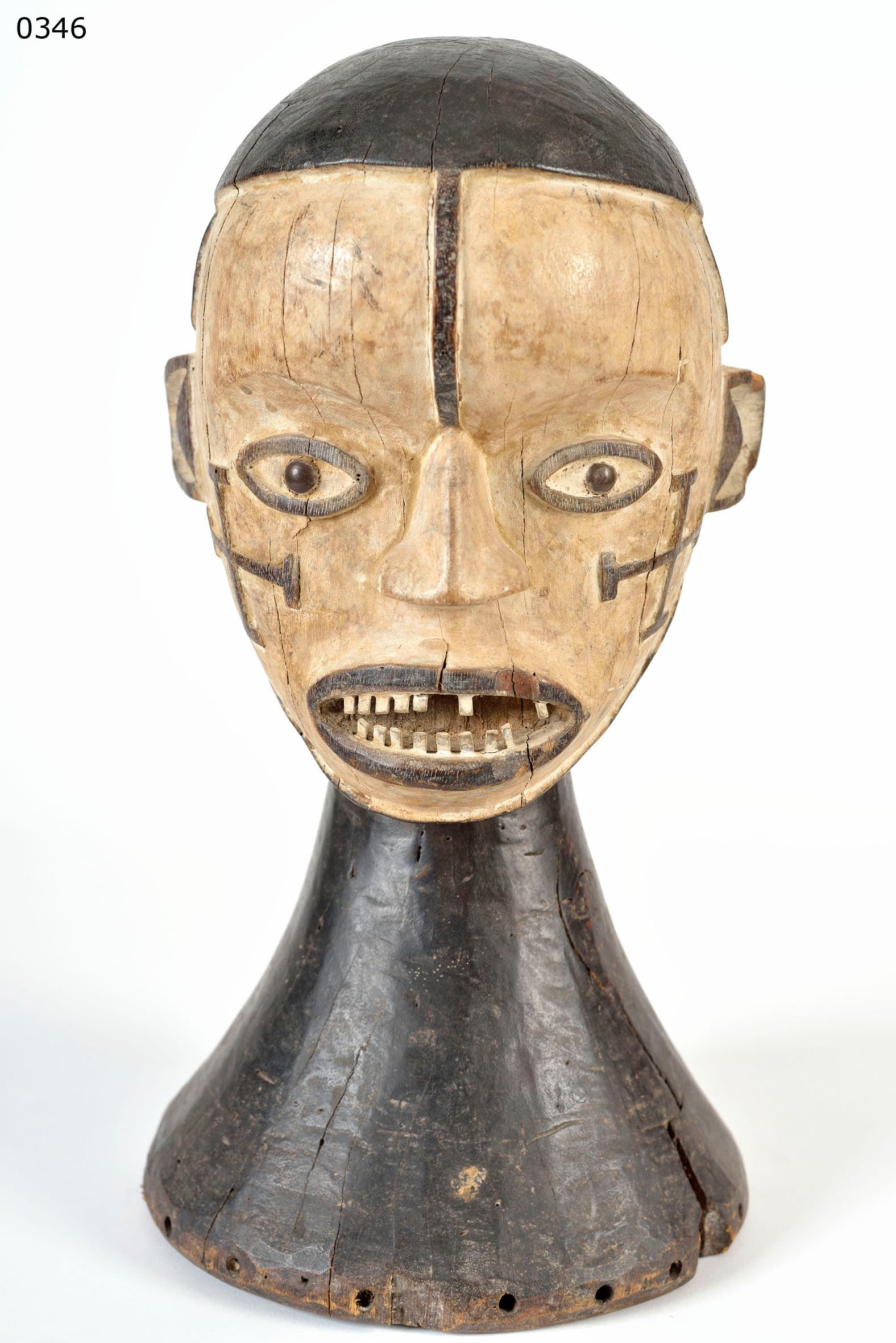
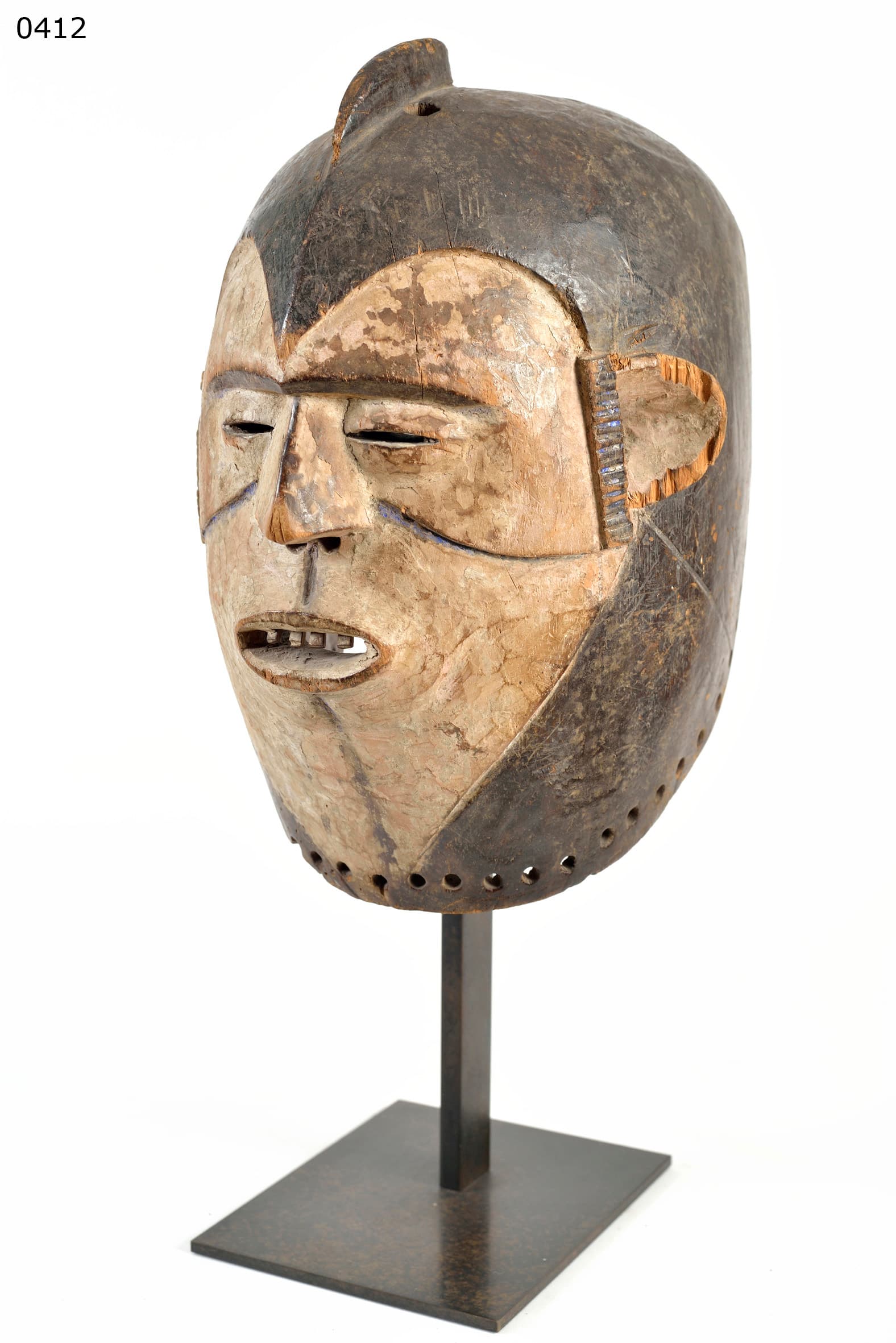
The canonical object typology of the Idoma is characterised by a remarkable stylistic heterogeneity, which is the direct result of its historical amalgamation and its geographical location in the cultural border region of the Benue Valley. This diversity manifests itself primarily in three dominant object classes, each of which has specific iconographic meanings and material characteristics: the textile Alekwuafia ancestral masks, the anthropomorphic Anjenu healing figures and the often white-faced helmet and face masks (e.g. Ungulali, Oglinye, Ichahoho).
The Alekwuafia (literally: the great/high spirit) completely defies the classic Western expectation of African sculpture, as it does without any carved wooden components. It is a voluminous, columnar textile construct (applique mask) that conceptually functions as an oversized, reanimated shroud (burial shroud) (Kasfir 1985: 20). A structure hidden inside and balanced on the wearer's head massively extends the performer vertically, resulting in the typical appearance that is reverently sung about in indigenous Idoma poetry as a "great spirit" or "bending cobra". The iconography of this textile envelope is strictly regimented and uses specific fabric applications and colour codes to visually identify the specific lineage of the reincarnated ancestor.
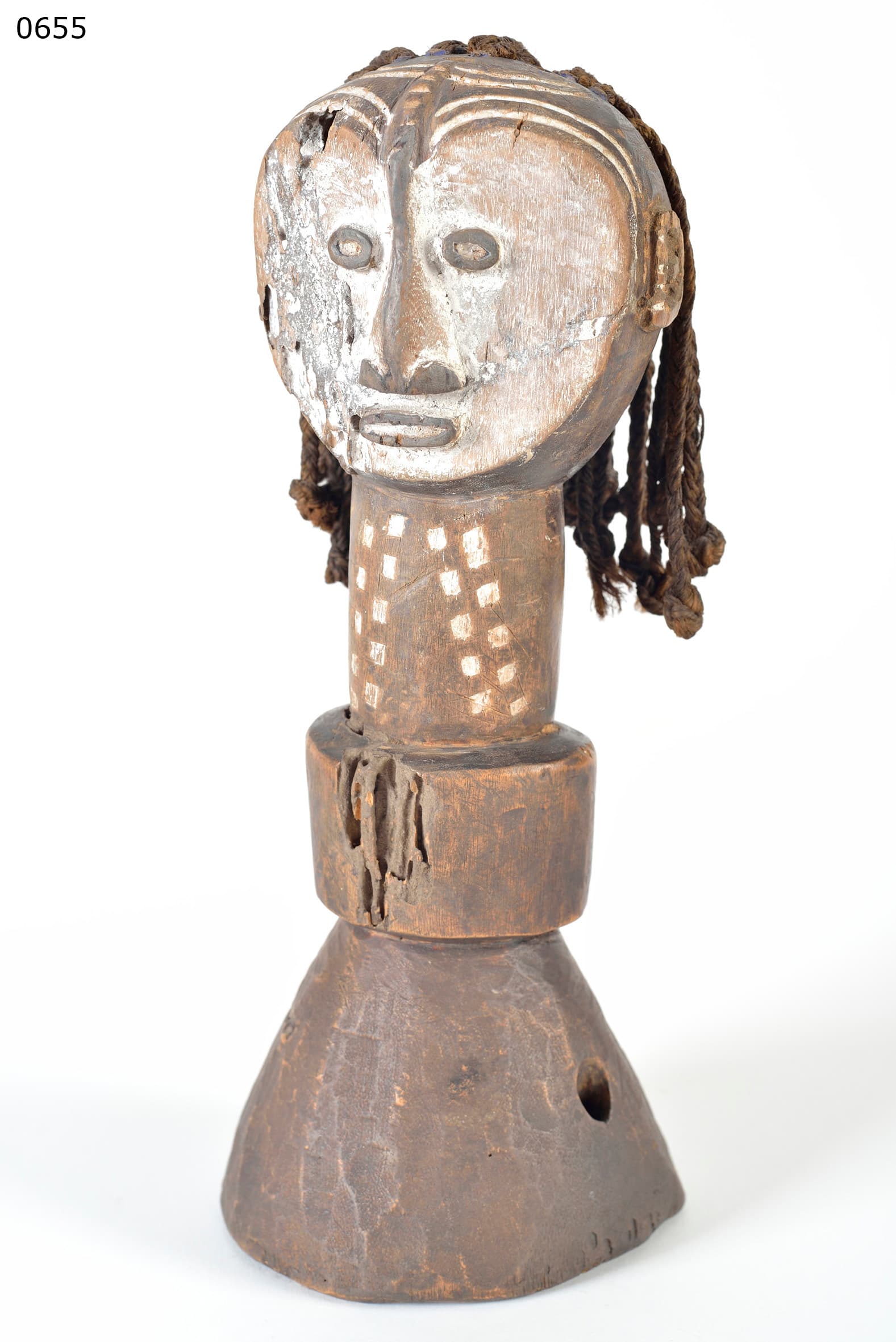
The Anjenu figures carved from wood, which serve as a physical receptacle for the unpredictable water and nature spirits, form a sharp formal and material contrast to this. The canon of proportions of these figures usually emphasises a seated, often stiff female form (frequently depicted as Maternité with a child on her lap or back), whose arms are directed upwards or forwards with open palms in a gesture of receptivity, supplication or prayer (gesture of praying) (Sieber 1961: 10). Iconographically striking are the almost architecturally conical protruding breasts, the prominently emphasised, often protruding navel (as a symbol of lineage continuity and physical attachment) and the preservation of traditional body modifications such as the sagittal crest hairstyle (a central hair comb). The size spectrum of these sculptures varies considerably, from intimate, portable altar figures (approx. 25 cm) to monumental, dominant shrine sculptures over 80 cm high. The facial features often show elaborate scarification patterns, which are concentrated at the temples and the corners of the mouth and represent local identity markers.
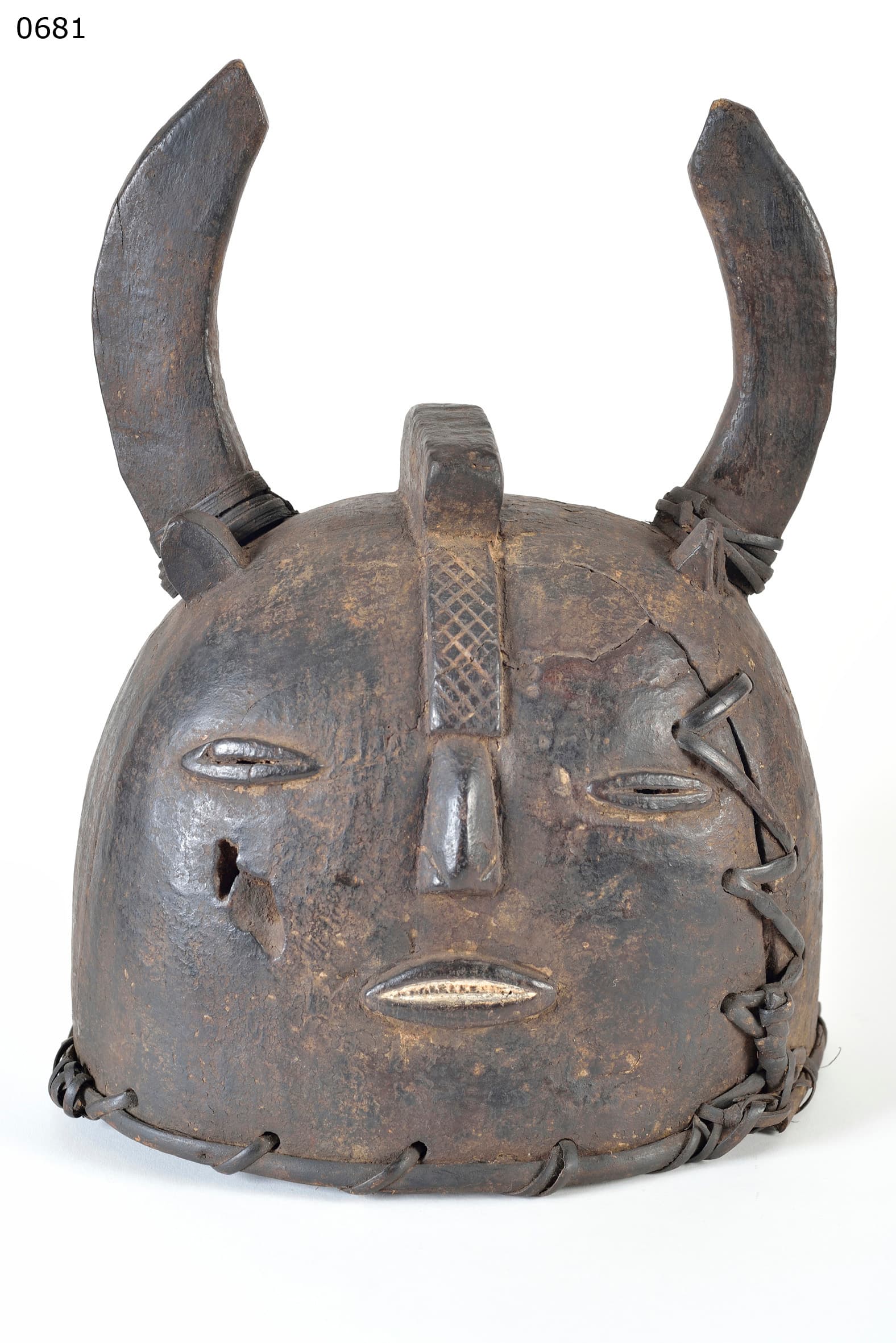
The third category comprises the carved helmet and face masks such as Ungulali, Ichahoho and Oglinye, which are strongly integrated into the performative context of male warrior and prestige alliances (Kasfir 1988: 85). The iconographic signature of the Ichahoho, for example, consists of an often starkly contrasting black and white face (primed with kaolin), aggressively bared teeth and prominent protruding horns or sharp noses that visualise youthful hubris, physical strength and martial aggression. Other masks in this group (such as Ungulali) feature complex multi-headedness or integrate zoomorphic elements (crocodiles, hornbills) that refer to proverbs and moral fables.
In terms of the choice of materials, local hardwood dominates for sculptural works, occasionally supplemented by textile remnants, beads or cowrie shells. The formation and accumulation of patina is the decisive indicator of an object's ontological status. White pigmentation (kaolin/river chalk) is used extensively to establish a direct link to the spirit realm, as white is eschatologically coded throughout the Cross River Corridor as the colour of ancestors, death and spiritual purity. Red Camwood powder (Baphia nitida) often marks transitional states or royal status. In activated Anjenu sculptures, repeated ritual libations of eggs, palm oil, animal blood and chewed kola nut create a thick, tactilely rough and often sticky sacrificial patina. This accumulated crust stands in stark contrast to the smoothed, often only slightly blackened surface of purely profane objects or newly carved works. In the understanding of the Idoma, there is an absolute difference between an unoccupied piece of wood and an activated ritual object: a newly carved work has no intrinsic power; only the ritual "activation" (through song, sacrifice and the influx of the spirit) transforms it into a sacred object capable of action (activated ritual object).
| Mask/Figure Type | Morphology & Iconography | Ritual Context & Function |
|---|
| Alekwuafia | Textile shroud (applique), elongated form, no wooden components | Reincarnated ancestor, ancestral festival (Oyioje), social justice |
| Anjenu | Seated wooden figure (often female/Maternité), raised arms, sagittal crest, conical breasts | Cult of water spirits, healing of infertility, divination |
| Ichahoho / Oglinye | White face (kaolin), bared teeth, horns, aggressive features | Warrior alliances, display of strength, death ceremonies |
| Ungulali | Helmet masks, often multi-headed, combination with zoomorphic attachments (birds) | Prestige dances, complex narrative performances |
Idoma art history offers the rare and valuable opportunity to identify specific master hands, as formal, standardising workshops or strict apprenticeship systems are historically absent and individual artistic agency (individual agency) is encouraged instead. The best-known master is Ochai of Otobi (d. ca. 1950), whose works are characterised by a bold, expressive carving style, deeply carved facial features and remarkable formal abstraction (documented by the pioneer of African art history Roy Sieber in 1958, among others). Reference works by Ochai can be found in the holdings of the Museum Rietberg in Zurich and formerly in the Museum of Primitive Art in New York. Another excellently documented master hand is Oklenyi von Akungaga (active from the 1930s to the late 1970s), who began as a self-taught artist. His stylistic signature - characterised by oval, inverted eye arches and a distinctive, often slightly open mouth with precisely carved, neat rows of teeth framed by upward curving scarification marks - is singular. Masterpieces by Oklenyi are represented in renowned institutions such as the Metropolitan Museum of Art (e.g. inv. no. 1972.74.2, a seated Anjenu with raised arms) and the Musée du quai Branly.
For private collectors and curators, forgery criteria for Idoma objects are highly relevant to the market, as the style has been copied since the 1970s. Authentic Idoma ritual objects can be verified by forensic analyses of the patina: A genuine ritual patina consists of stratified layers of organic proteins (blood, oil), whereas fakes often have monochrome chemical stains, shoe polish or industrial binders. Another criterion is natural heartwood cracks (radial cracks), which are caused by decades of uneven drying of the wood in the African climate and run organically through the carving lines; in fakes, cracks are often artificially caused and have a mechanical effect. Termite damage (termite damage) is also artificially imitated in reproductions by hollowing out the wood with tools. In authentic pieces used in the field, however, microscopic remains of the burrows and faeces left by the termites can usually be found in the burrows, and the edges of the burrow marks have darkened and rounded off over the years. Unsigned works with an artificially homogenised, "dusty" auction house patina, which lack any organic depth, usually indicate workshop replicas.
Ritual practice
The performative and ritual practice of the Idoma is characterised by a profound spatial and dynamic separation between the static, altar-based Anjenu cult and the highly dynamic, kinaesthetic performance of the Alekwu ancestral masks. This dichotomy structures the entire ritual space, the gender relationship in the cult and the life cycle of the objects from their creation to their disposal.
The Anjenu cult operates primarily in a domestical, semi-public or peripheral shrine context. An Anjenu altar is typically erected strategically near watercourses or, if this is not possible, in a specially segregated space within the family compound (Kasfir 1982: 48). The construction of the altar follows a strict ritual syntax that materialises the presence of the spirits: At the centre is the anthropomorphic, usually white-faced wooden sculpture. This is often flanked by rudimentary animal figures (leopards or lions) moulded from river clay, representing wild nature. The ensemble is surrounded by ritual paraphernalia: bottles of sacred river water, the essential eka medicinal calabash and pieces of ritual chalk.
The profane wooden figure is activated by a divinator (often male). If a woman suffers from infertility, repeated miscarriages or psychosomatic symptoms, she becomes an adept. In an intensive, often nocturnal therapeutic session, accompanied by specific chants and rhythms, the divinator summons the nature spirit from the river to take its place in the figure or directly in the adept through a possession trance. The offerings (offerings) at these altars are strictly transactional and focused on healing. The initial consultation requires minimal offerings such as kola nut or palm wine. The spirit is invoked, and in return for the requested healing or a successful pregnancy, a significant blood sacrifice - usually a goat or chicken - is promised. If the child is born healthy, the vow is solemnly honoured: The animal is slaughtered and its blood is ritually poured over the sculpture. This act, which is repeated over years and generations, generates the characteristic, encrusted and tactilely rough ritual patina that characterises the object as "powerful".
The highly political and dynamic performance of the Alekwuafia is diametrically opposed to the static shrine practice of the Anjenu, which is focussed on healing. The life cycle of this textile ancestral mask begins in absolute secrecy. It is not made by ordinary carvers, but by a specialised ritual tailor (abakpa). This craftsman does not choose his profession freely, but is called to this office by a compelling dream revelation; he works in isolation in the bush under the strictest ritual taboos, the breach of which was historically sanctioned with death (Bassing 1973). The activation - the ritual "birth" of the mask - is a lengthy process of preparation lasting several weeks, culminating in the oyioje ceremony (Kasfir 1985: 22). When the Alekwuafia finally enters the public gathering place (Ojila), it does not act as a theatrical representation in the perception of the Idoma, but as an ontological reality: it is the ancestor who has returned in the flesh from the afterlife, in its physical-spiritual essence.
The mask performance itself is a synaesthetic spectacle of power. Accompanied by esoteric, hour-long chants (Alekwu chants), which recite complex genealogies and the historical migration stories from the mythical homeland Apa in an archaic language, the "high spirit" moves majestically through the community. Regional variations of the performance are significant: in the southern Agila region there are strongly hierarchised royal masks (Unaaloko) escorted by armed attendants, while in central Idoma the Alekwuafia has a strong judicial function. The mask imposes punishments for breaches of taboo, settles land disputes and historically administered the lethal Sasswood poison ornament in extreme cases (such as murder or witchcraft) to establish the truth.
The deactivation and disposal process of ritual objects reveals the Idoma's highly pragmatic understanding of materials. An object, be it a mask or a figurine, has no inherent, eternal sacredness without the activating spirit or the nurturing community. When an Anjenu figure is structurally destroyed by severe termite infestation, or when the specific lineage of female adepts dies out and the shrine becomes deserted, the object loses its ritual agency. It is de-sacralised, stripped of its function and either left to decay naturally in the "bad bush" (a place for unholy things) or simply disposed of as profane firewood. This traditional practice of "disposal" through disregard was radically transformed and accelerated in the late 20th century by the influence of Western religious imports (Christianity, Islam). Numerous shrines were systematically abandoned or deliberately destroyed ("exorcised") by Christian converts in the course of Pentecostal revivalist movements, which paradoxically catalysed the mass influx of formerly strictly sacred objects into the networks of Haussa dealers and ultimately into the international art market.
Historical context
The historical development and formal evolution of Idoma art is inextricably linked to violent waves of regional migration, the disruptive shock of the colonial encounter and the oscillating dynamics of the Western art market. The migration history of the Idoma is deeply rooted in the disintegration of the Kwararafa confederacy (often associated with the mythical place of Apa). Between 1535 and 1625 AD, internal dynastic conflicts and massive military pressure from northern invaders forced heterogeneous groups to abandon their ancestral homeland and gradually migrate to the Benue Valley (Erim 1981: 14). Dating controversies dominate this historiographical discourse: while some historians, such as Sargent, create precise chronologies of Igala-Idoma interactions in the 17th century based on king lists, others emphasise the fundamental unreliability of oral-genealogical metrics for such precise dating. What is undisputed, however, is that these tectonic shifts led to the adaptation of foreign ritual lineages. The Idoma absorbed elements of the Jukun, Igala and Igbo, which explains the hybrid, polymorphic nature of Idoma art today.
The colonial encounter with the British administration, which was only administratively consolidated in central Nigeria in the 1920s, left deep institutional traces in the production of art. The British policy of "pacification" (pacification) enforced a rigid end to inter-ethnic warfare and banned ritual bounty hunting (headhunting) under threat of the death penalty. This led to a profound semantic and performative shift: the Oglinye mask, once the exclusive and fearsome emblem of successful warriors and headhunters, was stripped of its primary martial function by colonial legislation. Instead of disappearing completely, however, Idoma society adapted the ritual in creative ways; Oglinye transformed itself into a pure, mask-based prestige dance society that only pantomimed male aggression and valour on the festival ground (Kasfir 1988). Similarly, the legal functions of ancestral masks (Alekwuafia) were marginalised by the implementation of colonial courts (Native Courts) and relegated to a purely ritual-symbolic space.
| Historical phase | event / dynamics | impact on art & society |
|---|
| Pre-colonial (1535-1800) | Migration from Kwararafa/Apa, contact with Igbo & Igala | Hybridisation of art styles, adoption of ancestral masks |
| Colonial period (from 1920s) | British "pacification", ban on headhunting | Transformation of the Oglinye warrior society into a prestige dance |
| Early discovery (1958-61) | R. Sieber field research, first US exhibitions | Establishment of Idoma art (Master Ochai) in Western taxonomy |
| Biafra War (1967-1970) | Civil war, regional devastation, smuggling | Mass exodus of ritual objects to the Paris/Brussels market |
The market history of Idoma art in the West unfolded in two distinct, historically definable waves. Scholarly and systematic collecting began in the late 1950s, largely driven by the pioneering field research of the American art historian Roy Sieber (1958). The final breakthrough of Benue art on the elite Western art market came in 1961 with the exhibition Sculpture of Northern Nigeria at the Museum of Primitive Art in New York (curated by Sieber and Robert Goldwater). This exhibition presented the works of well-known masters such as Ochai of Otobi and Oklenyi of Akungaga to a broad international collector base for the first time and elevated Idoma art from a purely ethnographic curiosity to the status of recognised world art.
The second, much more dramatic phase of object circulation was triggered by the devastating Biafra War (1967-1970). The massive military conflicts, social upheaval and famine in south-east and central Nigeria led to a veritable exodus of ritual artefacts. Local middlemen and Haussa traders acquired or looted thousands of orphaned artefacts and smuggled them across the porous border to Cameroon on a large scale. From there, they were fed directly into the lucrative networks of the Paris and Brussels galleries. This sudden flood of high-calibre, authentically used works catalysed an enormous price development on the secondary market in the 1970s and 1980s. In the contemporary market reality, outstanding pieces from the Benue region with provenance guarantees achieve estimated prices in the high five- to six-figure euro range at auctions at Christie's and Sotheby's (as documented, for example, in the liquidation of the Durand Dessert collection in Paris in 2018).
This lucrative market dynamic inevitably gave rise to an immense and highly professional forgery problem. As Western collectors have a strong aesthetic preference for objects with pronounced ritual use and age value (age-value), specialised forgery workshops have been established in Nigeria and Cameroon that simulate precisely these characteristics. Authenticity criteria must be rigorously applied by collectors and museums today: As already explained, genuine ritual patina builds up in microscopic layers of organic materials (blood, palm oil, millet pulp) and reacts specifically to UV light, whereas forgeries often have monochrome chemical stains or industrial adhesives. Forensic analyses examine the edges of termite damage (termite damage); artificially hollowed wood shows fresh cut edges, while genuine damage shows organic earth tubes. Deep heartwood cracks (radial cracks), which are the result of a slow, natural drying process over decades, can hardly be simulated convincingly using the rapid method. The precise examination of these physical and chemical properties is essential today in order to preserve the integrity of a collection of African art.