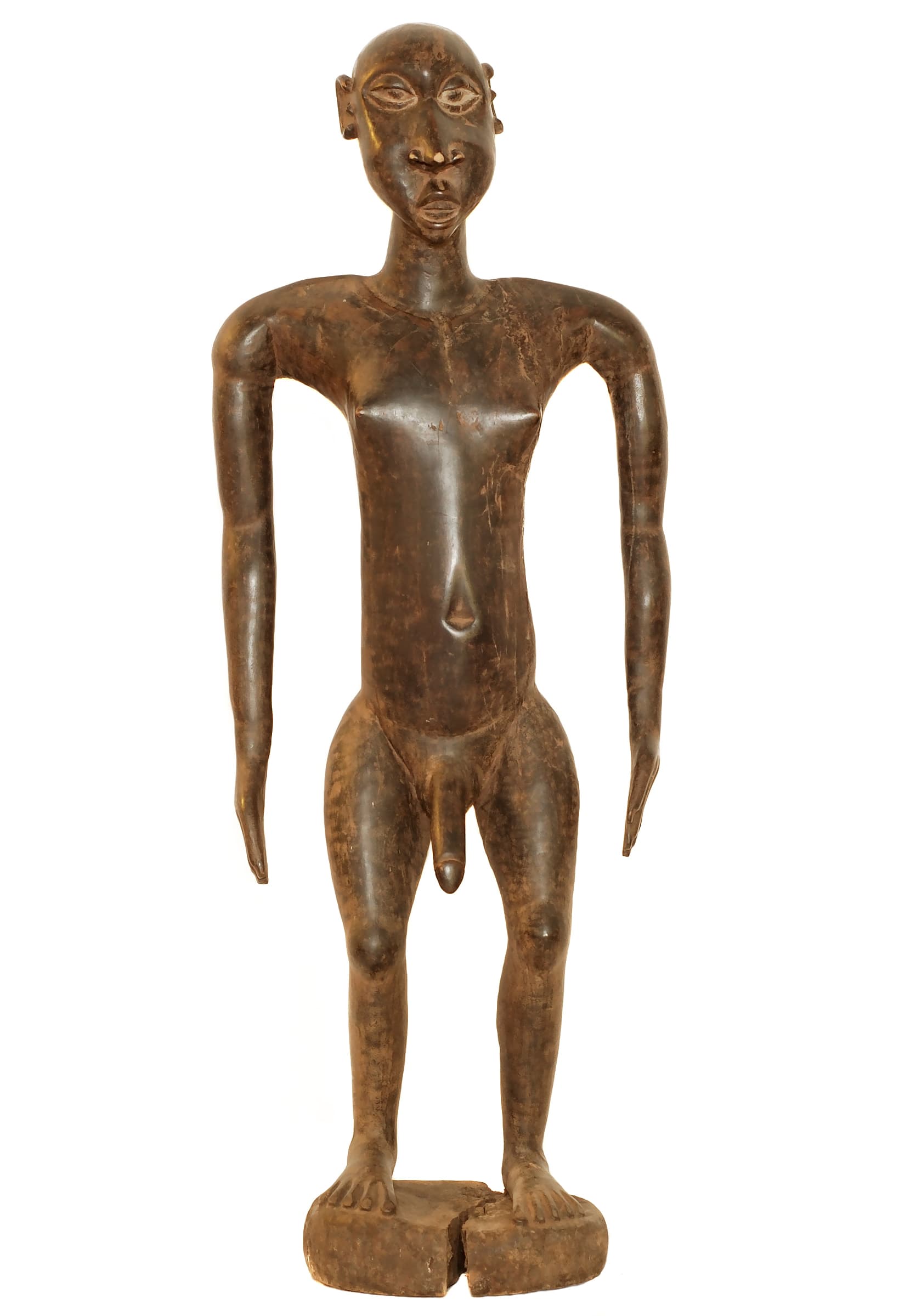
1. overview
The Tiv, an expanding and highly structured ethnolinguistic group, represent one of the most dominant demographic forces in the central Benue Valley of the present-day Republic of Nigeria, with an estimated population of 5 to 5.2 million individuals (as of 2024). Their geographical distribution is primarily concentrated in the state of Benue, but extends significantly into the neighbouring states of Taraba, Nasarawa, Plateau and Cross River as well as the western border areas of the Republic of Cameroon through historical and recent migratory movements. Linguistically, Dzwa Tiv is categorised within African linguistic research as belonging to the tivoid subgroup of the southern Bantoid languages, which in turn forms a branch of the extensive Benue-Congo language family. This linguistic categorisation is important for the study of art insofar as it separates the Tiv historically, culturally and metaphysically from the Kwa-speaking ethnic groups of southern and western Nigeria (such as the Yoruba or Igbo) as well as from the Chadian language groups of the north, which is reflected in a fundamentally different material culture.
In the historical nomenclature, which is found particularly strongly in the early colonial and ethnographic reports of the 19th and early 20th centuries, the Tiv were referred to exonymously as "Munshi" or "Munchi" by neighbouring, primarily Islamic Hausa and Fulani groups (Duggan 1932). This foreign designation is strictly rejected by the group itself and regarded as pejorative. The self-designation "Tiv" is derived etymologically and mythologically from the founding father of the ethnic group, whose two sons Ichôngo (translated: "the circumcised") and Ipusu ("the uncircumcised") constitute the two primary, all-encompassing lineages of the entire society (Bohannan 1953). Every Tiv individual is genealogically located in one of these two super-clans, which forms the basis for the entire socio-political structure of the ethnic group.
| Demographic and Linguistic Classification of the Tiv | Specification |
|---|
| Primary settlement area | Central Benue Valley (states of Benue, Taraba, Nasarawa, Cross River, Plateau in Nigeria; Cameroon) |
| Population estimate (2024) | approx. 5.0 - 5.2 million |
| Linguistic affiliation | Niger-Congo > Benue-Congo > South Bantoid > Tivoid |
| Self-designation (endonym) | Tiv (descendants of Ichôngo and Ipusu) |
| Historical foreign designation (exonym) | Munshi / Munchi (pejorative; Hausa/Fulani origin) |
| Social form | Acephalous, segmentary lineage system |
The social structure of the Tiv is classically acephalous and operates without the institution of a sacred kingship or a centralised state administration, as is prevalent among the geographically neighbouring Jukun or Igala. Instead, the society is based on one of the most densely documented segmentary lineage systems (descent groups) in West Africa (Bohannan 1952, Middleton & Tait 1958). The level of organisation is structured patrilineally; the lineage (nongo, literally: "line") precisely defines the spatial, political and legal location of the individual. Spatial units, so-called tar, correspond directly with genealogical segments (ipaven). Conflicts, alliances and legal mediations escalate or de-escalate strictly along these genealogical distances (Bohannan 1957). However, the validity and rigidity of this model is not uncontroversial in anthropological classification. A professional controversy must be explicitly highlighted here: While Paul and Laura Bohannan (1953, 1958) describe the segmentary system as absolutely determinant, symmetrical and almost mechanical in its political functioning, later analysts such as Michel Verdon (1983) argue that the Bohannan model represents an analytical over-idealisation that ignores the more fluid, pragmatic power dynamics, local patronage and individual accumulation of ritual knowledge. The sources indicate that alliances were often handled more flexibly in practice than the rigid structural model suggests.
In terms of subsistence farming, the Tiv are highly specialised in agriculture, which is why the state of Benue is still considered the "breadbasket" of Nigeria. Agricultural production is primarily focussed on yams, which enjoys ritual and economic priority, as well as millet, sorghum and various types of vegetables. The keeping of cattle or horses was historically very limited due to the endemic presence of the tsetse fly in the wetter lowlands of the Benue Valley, which is why only goats, sheep and poultry were kept as sources of protein and sacrificial animals (Bohannan 1968). This deep agrarian anchoring determines large parts of the ritual practice, which is primarily focussed on securing soil fertility and crop yields.
The relationship with neighbouring peoples was historically characterised by expansion and territorial tensions. Continuous demographic growth and the practice of shifting cultivation subsistence led to an expansive land grab that brought the Tiv into direct, often violent conflict with local groups such as the Jukun, Chamba, Idoma and later the migrating Fulani pastoralists. However, these interactions were not exclusively warlike; they functioned as transcultural contact zones in which ritual practices, mask-making and smithing techniques were exchanged. This fluidity of cultural boundaries is increasingly reflected in contemporary curatorial practice. For example, the Fowler Museum at UCLA, in cooperation with the Musée du quai Branly, has argued in the groundbreaking exhibition Central Nigeria Unmasked: Arts of the Benue River Valley (2011) that the art of the Tiv should not be analysed as a closed, isolated system, but must be understood as a dynamic node in a highly interconnected regional art and ritual ecosystem. For the private collector, this means that objects from the Benue Valley often exhibit hybrid characteristics that undermine strict ethnic categorisations.
2. cultural context
The religious system of the Tiv defies classical Western categorisations and differs fundamentally from the religions of the large forest cultures of their neighbours. In contrast to the Yoruba or Edo (Benin), who have highly differentiated pantheons of gods with specialised priesthoods for weather, war or fertility, the cosmology of the Tiv is extremely abstract, decentralised and focused on metaphysical energy flows. The sources describe the traditional religion as a form of monotheism headed by Aondo (God/Creator) (Bohannan 1969). Aondo is seen as the originator of heaven, earth and the fundamental forces of good and evil. After creation, however, Aondo withdrew to heaven and no longer intervenes in people's everyday concerns, which is why - analogous to concepts of Deus otiosus in other African cultures - he receives no direct sacrifices and is never depicted figuratively or materially in art. He is only invoked directly by the elders in the event of catastrophic, supra-regional natural phenomena such as extreme droughts.
Actual earthly life, human health, agricultural yield and social cohesion are not controlled by Aondo, but by a complex, interdependent dichotomy of two concepts: Tsav and Akombo. Tsav is a supernatural, incorporated potency inherent in certain individuals. In traditional Tiv anatomy, Tsav is physically described as a substance or growth on a person's heart that can be verified after death through a ritual autopsy (Bohannan 1958). Carriers of Tsav are referred to as Mbatsav ("people of ability"). The role of the Mbatsav is highly complex: they are the ritual authorities, priests and elders whose task it is to protect the territory (tar), generate wealth and secure the community metaphysically. At the same time, Tsav harbours enormous destructive potential. When an individual uses Tsav for selfish, power-hungry motives, it transforms into what Western anthropologists inadequately translate as "witchcraft" (Bohannan 1969). Such individuals metaphorically (and sometimes literally in Tiv conceptions) consume the "flesh" or "souls" of their own kin in order to increase their lifespan or wealth.
This is one of the most profound research controversies in Tiv ethnography (author vs. author debate): In his work, the Tiv scholar and anthropologist Iyorwuese Hagher (1990) postulates a strict, clear moral division between the positive, community-enhancing aspects of Tsav (protection, healing) and the purely negative, destructive forces of witchcraft. He argues that the Tiv philosophy intrinsically contains this good-evil divide. Historians and anthropologists such as Richard Fardon and Akiga Sai (an early, internally trained Tiv chronicler, 1939) vehemently disagree with this dualistic division. They argue that the sharp dichotomy between "good magic" and "evil witchcraft" is a recent, syncretic reading that was forced by massive Christian missionary activity - particularly by the Dutch Reformed Church of South Africa from 1911 onwards (Fardon 2014). In the original, pre-colonial cosmology, Tsav was a fundamentally ambivalent, amoral force whose ethical evaluation was solely situational, based on the consequences for the respective lineage.
The instruments with which the Mbatsav regulate the world are the Akombo (singular: Ikombo). Akombo are elusive metaphysical forces, laws of nature and at the same time the symptoms (diseases, droughts, accidents) that occur when a taboo is broken or the balance is disturbed. They materialise in specific ritual objects, emblems or shrines - from simple clay pots and feathers to carved bone pipes. The Tiv distinguish between "minor Akombo", which affect the individual (illnesses, personal misfortune), and the "major Akombo", which regulate the collective well-being of entire social groups and require elaborate initiations of the Mbatsav (Bohannan 1969).
The absolute moral authority and the ultimate instrument for controlling unlawful Tsav use is Swem. The mundane object Swem is an inconspicuous ceramic vessel filled with ashes and the leaves of the Ayande plant. Metaphysically, it represents the oath of absolute truth and justice. Anyone who swears falsely on Swem or unlawfully uses witchcraft against the lineage incurs the deadly wrath of Swem (Downes 1971).
The role of women in this highly complex ritual system is uniquely structured. Although women generally hold no institutional office within the Mbatsav and are subject to strict taboos on seeing or touching activated "Great Akombo", they are the philosophical and ritual centre of the cosmology. Anthropological analyses, in particular by Bruce Lincoln (1975), show that women are not only carriers of biological reproduction, but in the religious imagination of the Tiv they are regarded as the ultimate, greatest Akombo of all. Since the survival of the group depends on the agricultural fertility of the earth and the biological fertility of the women, both domains are ritually parallelised. Central rites of passage, especially abdominal scarification during puberty, therefore serve not to subjugate, but to ontologically transform the woman from a profane girl into a highly sacred, activated vessel that can guarantee life.
Museums that want to convey this invisible, abstract religious architecture, such as the Musée du quai Branly - Jacques Chirac in Paris, are often faced with the curatorial difficulty that the materiality of the Tiv religion consists of profane-looking elements (bones, clay, ashes, leaves) that remain completely incomprehensible without their ritual context.
3. aesthetic features
The material culture of the Tiv requires a fundamental recalibration of the Western collector's perspective. In stark contrast to the flourishing, form-rich woodcarving traditions of the Benue Valley, as found among the Idoma, Igala or Mumuye, the Tiv in the dossier explicitly exhibit a body art/scarification focus and a weak sculptural tradition. Wood sculpture was historically marginal and functionally restrictive; the aesthetic and ritual energy was centred on the transformation of the human body itself and on small-scale, performative relics.
The canonical object typology of Tiv sculpture is extremely narrow and dominated by three primary formats: the Imborivungu pipe, the Atsuku figures and iron apotropaics.
The undisputed masterpiece and most coveted collector's item of Tiv material culture is the imborivungu (literally: owl pipe). Iconographically, it functions as a hollow voice distorter (mirliton/kazoo), the body of which is worked as a stylised human figure - almost invariably female. The historical choice of material for this object is of macabre fascination, which was documented in detail in early museum registers: Authentic, highly charged Imborivungu were made from the human long bone (the femur/thigh bone) of important, deceased lineage leaders (Abraham 1933). This bone corpus formed the foundation on which the head of the figure was modelled from a thick layer of clay and beeswax. Pink or white glass beads, cowrie snails as eyes, animal hair (or human hair) and occasionally small brass bells were applied to this mass. The lower, open part of the bone was stuffed with raw cotton. Later or more profane variants of this type, which had to be created after the supply of authorised ancestor skeletons was exhausted or when colonial bans took effect, were increasingly made using the yellow casting process (brass) or from dense hardwood. The canon of proportions of the Imborivungu is strictly miniaturised; the size range is usually between 15 and 35 centimetres, as the objects had to be portable and were carried concealed during the day.
The second significant sculptural type is the Atsuku figure (singular: Tsuku). These are small to medium-sized (approx. 15 to 55 cm) wooden ancestor or ritual figures with a predominantly female connotation. Iconographically, these sculptures often have a cylindrical, block-like torso, strongly reduced, angled legs, emphasised buttocks and an oval face. Typical for Atsuku is the application of foreign materials: glazed or metallic inlays as eyes, a thick, clay-like encrusted patina on the head into which real hair was incorporated, as well as detailed, incised scarification patterns on the stomach and back. Ritually, these figures were mounted on wooden poles and positioned in front of the entrances of young brides to ensure fertility, or they were used in hunting and circumcision rites, which is why they are often symbolically associated with masculinity and virility. The Museum Rietberg Zurich houses outstanding examples of this Atsuku genre in its renowned collection of African art (especially the Bamert collection), which illustrate the stylistic reduction and dense patination of this type.
The actual, most profound aesthetic dimension of the Tiv, however, lies in the skin scarification of the women. As Bruce Lincoln (1975) elaborated on the basis of Paul Bohannan's (1956) early fieldwork, scarification is not just jewellery, but a complex cosmological diagram tattooed on the woman's belly. There is a fundamental iconographic controversy in the interpretation of these patterns (Bohannan vs. Lincoln): Paul Bohannan documented in the 1950s that the Tiv themselves claimed that the scars were purely fashionable, aesthetic in nature ("cosmetic") and subject to contemporary fashion trends. Bruce Lincoln, on the other hand, proved in 1975 that this supposedly profane aesthetic concealed a profound religious significance. The canonical design necessarily consists of two elements centred around the navel (the source of life): The vertical, descending line between the breasts is called the nongo - a term that simultaneously means "line" and "ancestral lineage" in Tiv. The concentric circles around the navel are called Kwav - which simultaneously means "age groups / future generations". The woman thus carries the visual connection between past (ancestors) and future (descendants) on her body. This iconographic rigour explains why almost all Imborivungu owls and Atsuku figures have exactly the same scar patterns: The wooden figure is a material reproduction of the most sacred of all Akombo - the female body.
The documented master hands or workshops (Master Carver) hardly exist historically in Tiv woodcarving, as the ritual dominates over the creator. One exception is the Kwagh-hir puppet theatre, which emerged from the 1960s onwards. Here, where the sacred pressure of ancestor worship was transformed into a secular, socially critical performance, the carvers effectively acted as directors and dramaturges ("playwrights"), designing highly complex, articulated figures (soldiers, policemen, mythical creatures), with the names of individual workshops becoming quite famous locally (Hagher 1990).
For the Western art market, the forgery problem with Tiv sculptures is highly relevant due to the extremely small authentic corpus from the period before 1950. The difference between an activated ritual object and a profane souvenir manifests itself in forensics. Forgery criteria primarily include patina and wood ageing. Authentic Atsuku or Imborivungu have an organically grown, often greasy or crusty patina of blood, palm oil, clay and smoke that collects in the recesses, while raised areas show abrasion (wear) from ritual handling. Counterfeiters often imitate this with uniformly applied shoe polish or bitumen, which has a chemical odour and does not fluoresce under UV light like organic material. Heartwood cracks (cracks) are another forensic feature: in old, naturally dried objects, the inner flanks of the cracks are dark in colour due to oxidation and dirt; light, "young" crack interiors indicate artificial quick-drying (oven). Finally, termite damage must be organic, irregular and run from the inside to the outside; linear, mechanically produced drill holes are clear indicators of modern, artificial ageing.
4. ritual practice
The ritual dynamics of the Tiv cannot be understood as passive worship of God or static altar use, but operates as a highly active, almost mechanical process of repair and manipulation of energies. The central concept of the ritual practice is sorun akombo ("repairing the akombo" or "setting the akombo"). An Akombo requires ritual intervention as soon as it has been violated by human misbehaviour, the breaking of taboos or the illegitimate use of Tsav, which manifests itself empirically in disease, infertility, epidemic deaths or crop failures.
The detailed description of the use of the Imborivungu reveals a sinister rite characterised by extreme secrecy. The lifecycle of this object is strictly regulated. When the object (made of bone, wood or metal) is newly crafted, it is completely profane and powerless. It only gains its ritual effectiveness when it is activated within the closed circle of Mbatsav (initiated elders), who often meet at night. Historical accounts and contemporary analyses (Downes 1971; Ikyer 2023) indicate that the absolute, initial activation of this object of power - which functioned as a guarantor of wealth, agricultural fertility and protection from rival lineages - originally required the sacrifice of human blood. The Tiv believed that a "flesh debt" (flesh debt) had to be paid for the enormous metaphysical energy of the pipe, which often led to the Mbatsav ritually claiming the life of one of their own, often intelligent and young relatives. This blood was poured into the pipe and sprinkled on the land. Only through this sacrifice did the pipe become an animated receptacle of ancestral power.
In modern practice, characterised by colonial jurisdiction and Christian missionary work, these drastic blood sacrifices were replaced by surrogates such as animal sacrifices (usually chickens or goats) and libations with palm wine or crushed yam dough. The performance of the Imborivungu is acoustic in nature: it is blown in the dark, out of sight of women and the uninitiated. The strange sound distorted by the membrane in the hollow bone (kazoo effect) is interpreted as the physical manifestation of ancestral voices blessing or warning the living (Balfour 1948).
A diametrically opposed, because highly public and visual ritual practice manifests itself in the mask and puppet performance of the Kwagh-hir theatre. Kwagh-hir emerged in the late 1950s and early 1960s as a cultural response to colonial repression and internal witchcraft tensions (Nyambuan cult) (Hagher 1990). It functions as a social corrective and secular entertainment in which puppets and masked dancers perform everyday scenes, mythical creatures and political satires. Setting up a Kwagh-hir performance is a major logistical event: at nightfall, the village gathers in a circle around an arena. The Or-Wanger (light master) illuminates the stage with burning torches while musicians drum out complex rhythms. Although the theatre is ostensibly secular, it is subject to massive ritual restrictions. The Ter Kwagh-hir (the patron and leader of the troupe) must activate strong protective Akombo and Tsav counter-magic during the performance, especially during competitions with rival villages, to protect his dancers and puppeteers from metaphysical sabotage attacks by rival Mbatsav (Hagher 1990).
The deactivation and disposal of highly sacred Akombo objects such as the Imborivungu is extremely taboo. When an emblem ceases to circulate due to the death of its owner or the territory is moved, the activated object must not simply be discarded, as the occult energy stored in the patina could be absorbed by hostile sorcerers. Downes (1971) documents that rituals that had become unusable were dismantled in secret night sessions and the magical incrustations were ritually destroyed or disposed of in rivers to finally erase the "flesh debt". This partly explains the enormous rarity of authentic Tiv cult artefacts in the West. However, the sources for systematic deactivation in the context of colonisation are complex. Many of the objects that are now kept in Western institutions such as the Royal Museum for Central Africa in Tervuren (RMCA) never underwent this regular lifecycle of ritual disposal, but were confiscated and transported away by British officials or missionaries in a fully activated state during the violent suppression of witchcraft cults in the 1930s, which theoretically leaves their metaphysical explosiveness in their country of origin unexplained to this day.
5. historical context
The historical reconstruction of the Tiv is inextricably linked to their complex migration history, which forms the demographic, social and ritual foundation of their identity. Oral traditions, as documented in 1939 by Akiga Sai in his seminal work Akiga's Story, locate the mythical ancestral home of the Tiv in Swem - a mountainous enclave historically localised on the present-day border between Cameroon, Nigeria and possibly the Congo Basin. Driven by demographic pressure and internal conflict, the Tiv began to descend from these hills into the fertile plains of the lower and middle Benue Valley in several waves of migration.
There is considerable research controversy regarding the dating and nature of this migration. While Tiv oral traditions evoke a relatively abrupt, epic migration in the late 18th or early 19th century, romanticised by mythical elements (such as the crossing of a river on the back of a giant green snake, Ikyarem), anthropological, archaeological and linguistic evidence points to a much longer, asynchronous process. More recent research postulates that the migration began as early as the 16th or 17th century and had more the character of a creeping, intergenerational agricultural expansion (shifting cultivation), in which local groups such as the Idoma, Chamba and Jukun were gradually assimilated, displaced or forced into a complex vassal relationship. This creeping infiltration of the Benue Valley is crucial for understanding the hybrid art forms of the region.
The Tiv's colonial encounter with the British administration was strikingly different from the experiences of hierarchically organised kingdoms (such as Benin or the Hausa emirates). Formal contact began in 1907/1908 through military expeditions under Lieutenant-Colonel Hugh Trenchard. The acephalous, segmentary lineage system of the Tiv proved to be an absolute administrative nightmare for the British. As there were no central rulers, councils or kings, the colonial system of "Indirect Rule" (indirect rule via local monarchs) came to nothing. The British desperately tried to install members of the neighbouring Jukun minority as authorities over the Tiv, which led to chronic, bloody revolts. To compensate for this administrative collapse, in 1948 the British finally forced the artificial creation of a centralised ruler, the Tor Tiv (Paramount Chief) - an institution previously completely alien to the egalitarian culture of the Tiv.
The impact of this violent colonial history on religious and artistic production was drastic. The shattering of the social fabric through colonial taxes, forced labour and the banning of traditional exchange marriages in 1927 led to a massive increase in witchcraft fears, as the Tiv believed that the Mbatsav were now exploiting their ritual power for selfish gain. This culminated in 1939 in the eruption of the Nyambuan cult, a messianic anti-witchcraft movement directed against both the corrupted elders and British authority (Hagher 1990). The British responded with merciless repression: hundreds of Nyambuan leaders were imprisoned and, in co-operation with Christian missionaries, there were mass confiscations and public burnings of Akombo objects and ritual art, especially the Imborivungu pipes. This historical caesura destroyed most of the older material culture of the Tiv and explains the extremely small pre-1950 corpus of authentic works on the art market today.
The market history in the West for Benue Valley art began tentatively in parallel with these confiscations in the 1930s. Early colonial officials such as R.M. Downes and linguist Roy C. Abraham not only documented the religion, but also systematically collected the confiscated artefacts. In 1932, Abraham donated a series of high-ranking Imborivungu pipes made of human bone to the British Museum in London (e.g. Inv. No. Af1932,0516.8), which made these objects accessible to Western researchers for the first time. The price trend for African art stagnated for a long time, but experienced a veritable explosion from the late 1960s onwards, driven by groundbreaking auctions (such as the Helena Rubinstein Sale in 1966) and the general commercialisation of tribal art. In the late 20th and early 21st centuries, flanked by landmark exhibitions such as Central Nigeria Unmasked (which toured from the Fowler Museum to the Smithsonian to the Musée du quai Branly in 2011/2012), the raw, abstract sculptures of the Benue Valley achieved cult status among high-calibre collectors. During this phase, art historians such as Sidney Littlefield Kasfir (1984) revised the rigid paradigm of "One Tribe, One Style"; she proved that the region's fluid art production led the colonial expectation of a "typical" tribal style ad absurdum.
The rapid commercial valorisation inevitably led to a massive problem of forgery, which must be given special attention in the dossier. As authentic Imborivungu owls became extremely rare and valuable in the 20th century, West African workshops flooded the market with reproductions. Authenticity criteria and forensics are therefore the only reliable filter for private collectors. A central criterion is the patina: genuine Tiv ritual objects have a deep, organically grown incrustation of sacrificial blood, palm oil and clay, which has been rubbed off in exposed areas as a result of ritual use (handling); forgers often simulate this by quickly burning shoe polish or bitumen into the object, which is immediately unmasked by forensic examination (chemical odour, lack of UV fluorescence of organic substances). Wood ageing is just as revealing: in authentic sculptures, natural heartwood cracks caused by slow drying over decades are darkly oxidised inside the crack and filled with fine, insoluble dust; if a crack opens to reveal bright, young wood inside, the piece has been artificially (e.g. in an oven) quick-dried. Finally, termite damage, which often falsely suggests old age to Western collectors, must run organically and irregularly from the inside to the outside; parallel, mechanically induced drill holes are an absolute exclusion criterion for the acquisition of a Tiv artefact.