1. overview
The ethnographic, linguistic and art-historical recording of those fragmented populations that operate under the collective term "Wurkum" (also Wurkun) in the discourse of the Western art market and in older colonial records poses considerable taxonomic and methodological challenges for African studies and art ethnology. Geographically, this cluster is primarily located in the Middle Benue River Valley, specifically in the topographically highly isolated and inaccessible regions of the Muri Mountains in today's Taraba State of the Federal Republic of Nigeria. These mountain ranges have functioned as a demographic and cultural refuge for centuries. The source situation regarding reliable, current demographic data is ambiguous due to the lack of census records in the remote mountain regions and the general state infrastructure deficits in Nigeria; however, conservative estimates and extrapolations from linguistic databases assume a highly fragmented total population of around 50,000 to 70,000 individuals. These are spread across a wide-ranging mosaic of independent villages and hamlets.
Linguistically, the so-called Wurkum cluster defies homogenous classification. The populations are divided into various subgroups, the most prominent of which are the Kulung, Bambur, Bambuka, Piya and Kwonci. While some of these groups speak languages that belong to the broad family of Adamawa-Ubangi languages, other groups (such as the Piya) have idioms that belong to the Chadian branch of the Afro-Asiatic language family. In the course of the 20th century, Hausa established itself as a functional lingua franca, fuelled by interregional trade and later Christian missionary work, which accelerated linguistic assimilation (McBride 1972: 29).
A central academic discourse in Benue research revolves around the glaring discrepancy between self-designation (endonym) and foreign designation (exonym). The term "Wurkum" comes from the Jukun vocabulary and literally means "people of the hills" or "hill dwellers" (Adelberger 1992: 1). It is thus primarily a topographical-political attribution by hegemonic neighbouring peoples and not an indigenous self-identification. This Jukun nomenclature was uncritically adopted by British colonial officials and later by art dealers to categorise a large number of peoples who were topographically neighbouring but had significant cultural differences. The controversies of the categorisation are explicitly marked: Marla C. Berns argues pointedly that 'Wurkum' is primarily a Western collector's category, an ethnic construct of the art market that inadmissibly homogenises the delicate sub-styles of the Bambuka, Kulung and Bambur (Berns 2011: 417). In contrast, Jörg Adelberger emphasises that the term has now been adapted by some indigenous groups as a political bracketing term to distinguish them from the Fulbe due to decades of use (Adelberger 2009: 14).
| Sub-group / ethnic group | Geographical focus | Linguistic categorisation | Art-historical sub-specification (according to Berns/Adelberger) |
|---|
| Kulung | Bambur region, Muri Mountains | Adamawa (Kuni Kulung) | Massive shoulder and yoke masks, cylindrical altar sculptures |
| Piya | Northern periphery of the Muri Mountains | Chadian | Reduced, columnar wundul figures, strong abstraction |
| Bambuka | Southwestern foothills | Adamawa cluster | Dense, encrusted patina, integration of iron spikes |
| Bambur | Central mountain regions | Adamawa cluster | Highly complex iron gongs, sacred ceramics |
The social structure of these mountain societies is historically strictly acephalous (free of rule in the sense of a lack of centralised kingdoms) and decentralised. The political, legal and ritual authority was traditionally not vested in a hierarchical ruling apparatus, such as that found among the neighbouring Jukun or Igala, but in patrilineal, exogamous clans and localised priest-chiefs. The kinship system is based on strict patrilineality, in which land rights, ritual titles and access to secret societies are inherited exclusively through the male line. This decentralisation and the division into autonomous hamlets proved to be a strategic survival advantage historically, as the hill groups were thus able to evade the expansionist ambitions of neighbouring empires more flexibly.
Subsistence farming is dominated by transhumant agriculture. The cultivation of millet, sorghum and yams forms the calorific basis of society, flanked by ritually highly regulated hunting cycles, which take place particularly in the dry season and are closely intertwined with the local cosmology. The relationship with the neighbouring peoples, in particular the Jukun in the south, the Chamba in the east and the Mumuye, was characterised by a highly complex, fluid dynamic of periodic armed conflicts, slave raiding and intensive ritual transfer of ideas. Arnold Rubin, whose comprehensive field census project was analysed posthumously in cooperation with the Fowler Museum at UCLA, proved that the geographical topology of the Benue Valley functioned as an interethnic corridor. Sculptures, mask systems and the associated incantations circulated as tradable and transferable ritual technologies between the peoples (Rubin 1969 / 2011: 293).
2. cultural context
The religious system of the Wurkum-associated peoples is characterised by a pragmatic-operational cosmology that is primarily geared towards maintaining agricultural fertility, safeguarding reproductive cycles and warding off physical and spiritual crises (disease, drought, witchcraft). At the centre of this cosmological order are not omnipresent, punitive creator deities, but localised nature spirits who reside in distinctive geographical formations (caves, springs, old trees), as well as the omnipresent ancestors of the patrilineal lineages. Although a transcendent, unapproachable creative entity is postulated in the myths in a rudimentary form, it does not actively intervene in the affairs of the living and therefore does not require an elaborate cult. The ancestors and nature spirits, on the other hand, act as direct causal agents in the explanation of the realities of life.
The ritual authorities are made up of a complex network of specialists. Priests (often identical with the elders of the respective landowner lineages) look after specific earth or ancestral altars and are responsible for the exact performance of cyclical sacrifices. Divinators act as diagnostic authorities. If a family or agrarian crisis occurs, the divinator analyses the socio-cultural imbalance using standardised oracle techniques. As a therapeutic measure, he often orders the creation of specific sculptures (kundul) to bind the irritated spirit or appease the wrath of the ancestors (Adelberger 2011: 418). Secret societies, which are almost invariably reserved for the male sphere, operate as an executive organ of ritual authority, punish socio-cultural transgressions and organise the great masked performances.
Central initiation and transition rituals manifest themselves in cyclical agrarian festivals that sanction the change of seasons, sowing and harvest. In the older, often colonially influenced missionary literature, these festivals were documented as Eku or Mam festivals (Guinter 1926: 83). These festivals involve months of preparation and culminate in performative masked appearances that mark the transition of status from adolescent initiates (who undergo circumcision and isolation in the bush) to full members of society and at the same time reconstitute the socio-political authority of the councils of elders.
The role of women in the cult is structurally ambivalent, but strictly codified in spatial and performative terms. Women are strictly excluded from the direct physical handling of activated masks and anthropomorphic ritual objects - with the exception of specific sanctifying and protective vessels, often made of ceramic. Direct eye contact with unmasked ritual objects during the liminal phase of initiations is considered highly taboo and subject to sanctions (Fardon 2011: 317). Nevertheless, women are essential participants in the rites: They act auditorily and kinetically on the peripheries of the performance through standardised songs of lamentation or jubilation, produce the millet beers (pito) necessary for libations and generate the indispensable energetic backdrop for the mask activation through their dances.
What is the structural difference between this religion and that of neighbouring peoples? The religion of the Wurkum groups completely dispenses with the elitist courtly art and centralised royal ideology found among the Jukun or the Igala of the Lower Benue. Here, ritual apparatuses serve the egalitarian management of crises and not the legitimisation of dynastic power. Exhibitions and inventory catalogues at the Museum Rietberg in Zurich and the Musée du quai Branly have made this structural divergence clear by highlighting the fact that the peoples of the Middle Benue do not use works of art as representational objects of stately splendour (such as yellow-cast heads in Benin), but as purely functional, visually highly abstracted tools in a direct, utilitarian approach to the transcendent.
Significant research controversies about the autonomy and independence of this religious system are manifested in the specialised literature. Author vs. author: In his early writings, Arnold Rubin (1969 / 2011: 294) postulates a strong centrifugal dependence of the Wurkum cults on the sacred infrastructure and nomenclature of the neighbouring Jukun, and suggests that the Wurkum merely form the periphery of a Jukun cultural space. In contrast, Jörg Adelberger (1992: 5) argues vehemently in favour of a self-sufficient, topographically deeply rooted cult grammar of the Kulung and Piya. He argues that the Wurkum merely adapted superficial formal elements and terminology (such as the term "Mam") from the Jukun, but completely re-purposed them semantically and integrated them into their own cosmic world view dictated by the mountain world.
3. aesthetic features
The material culture and formal language of the Wurkum cluster are characterised by a radical reductionism that rejects anatomical mimesis in favour of conceptual power. The canonical object typology is absolutely dominated by the cylindrical, stele-like standing figures, known in Indigenous terminology as kundul, wundul or dumbun. These sculptures, which generally range in size from 40 to 75 centimetres, are characterised by a canon of proportions of extreme geometric abstraction that has formal analogies to the art of the neighbouring Mumuye, but possesses an independent, more rigid compactness (Fardon 2011: 231).
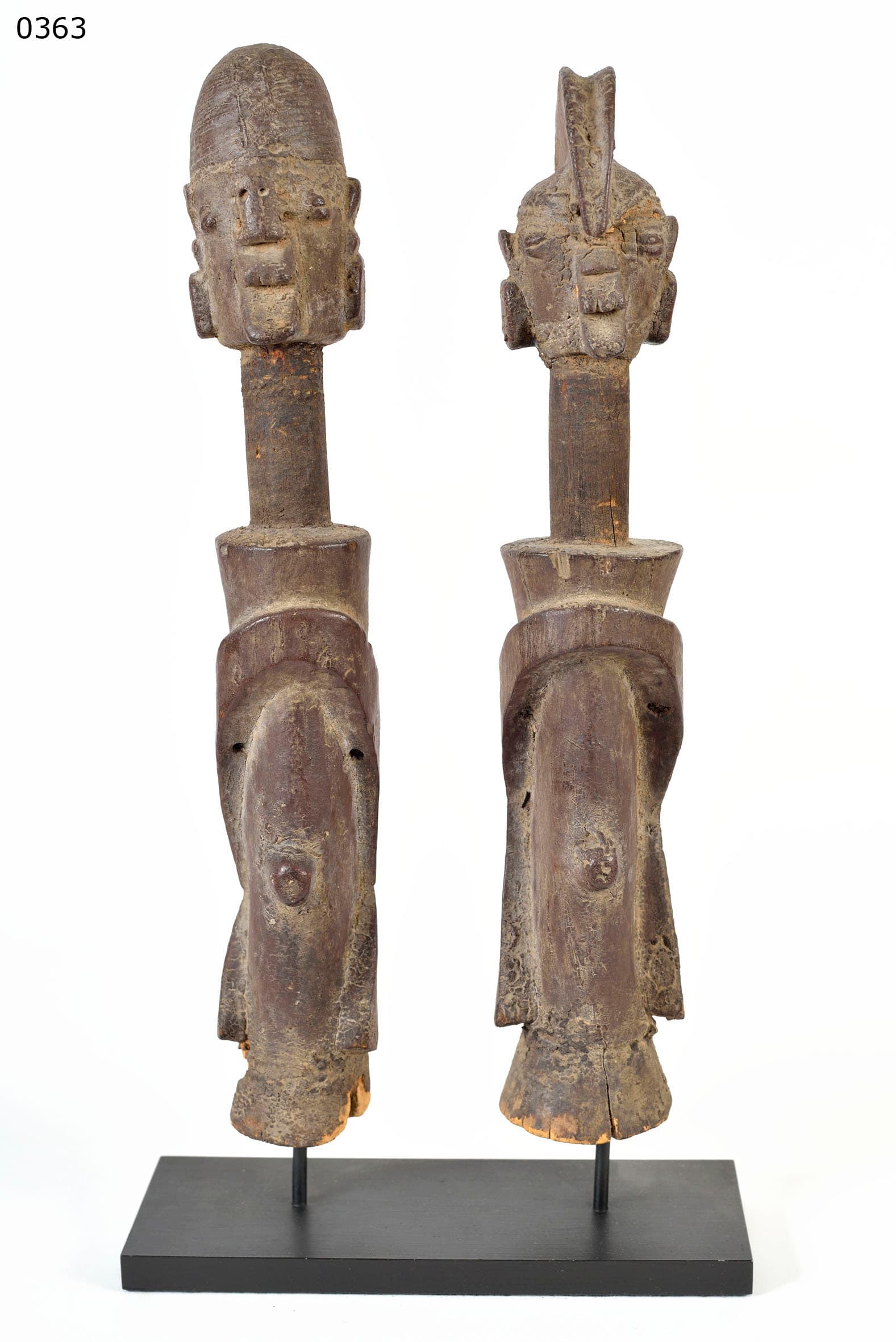
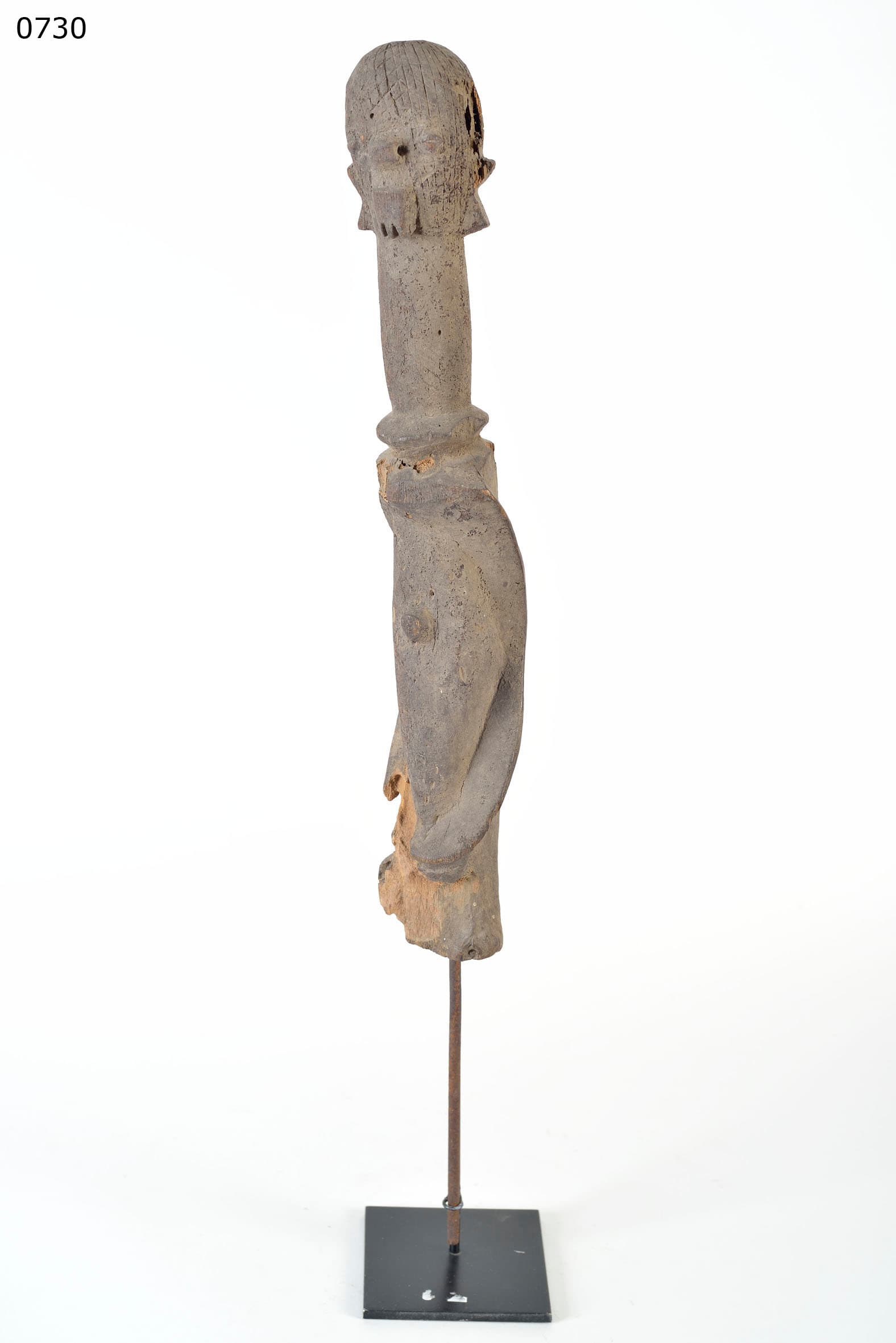
The body of the figures is elongated like a column. The arms often merge with the torso in a closed form or enclose it in strict symmetry like a corset. A rudimentary carved navel often emerges as a relief, symbolically balancing the significance of the matrilineal umbilical cord connection in a patrilineal system. The head is usually crowned by a significant crest, the face defined by flat, shield-like planes, large C-shaped ears and a pierced septum. The legs are greatly shortened in relation to the torso and often lead directly into a long, pointed iron spike (iron spike). This iron spike is not an additive pedestal for Western display cases, but an integral part of the ritual function of anchoring the figure in the sacred floor of the shrine.
| Type of object | Material | Iconographic meaning / Ritual function |
|---|
| Kundul / Wundul | Hardwood, iron spike, sacrificial exudates | Anthropomorphic altar figures, used in pairs. Protection from illness, infertility, witchcraft |
| Yoke masks | Light wood, pigments | Horizontal, theranthropic masks (hybrid of bush cow and human). Worn during agrarian rites |
| Ceremonial gongs | Forged iron | Authoritative rhythm instruments, symbols of status and communication with ancestors |
| Prestige pipes | Yellow cast iron, terracotta, wood | Elitist representation. Often with bird or human heads. Circulation in patrilineal networks |
In addition to the wooden figures, the formal repertoire includes massive iron double gongs, which serve as authoritative instruments in the cult, as well as highly complex prestige tobacco pipes. These pipes - which are often found in the collections of the British Museum (e.g. inventory number OA.11725 or African yellow castings) - feature iconographic prestige symbols such as bird heads or anthropomorphic faces and indicate interethnic, elite networks (Gebauer 1972: 28; Kasfir 2011: 208).
A crucial iconographic controversy that touches the core of attribution practice in Western museums concerns the identification of workshops and master hands documented by name. The conflict between Marla C. Berns vs. Jörg Adelberger marks a profound academic paradigm shift here: Berns (2011: 14) argues cogently, based on fieldwork data, that many of the highest quality pair sculptures traditionally considered "masterpieces of Wurkum" - particularly those pairs in which the female figure has an angular, flat crest and the male figure a rounded, serrated crest - are in fact attributable to the Chamba master carver Sompa (active in Mapeo between the 1920s and 1940s) documented by name. The Western art market and older museum catalogues wrongly subsumed these works under the style category "Wurkum" due to their place of acquisition, which for decades created the illusion of ethnic homogeneity.
The choice of materials focusses on dense, termite-resistant hardwoods (such as Iroko or mahogany). The ontological difference between a mere piece of carved wood and a ritually activated object (objet chargé) is physically evident on the surface. The development of patina is the result of decades of ritual accumulation. An authentic Wurkum patina consists of a thick, encrusted layer created by the repeated application of millet beer (pito), red ochre, palm oil, chewed kola nut and animal sacrificial blood. In kundul figures, a purely aesthetic, smoothly polished surface or a continuous black colour is a strong indicator of a profane Western reworking, depatinisation by dealers or a modern reproduction.
Forgery criteria are of immense relevance in the current art market. Forensic authenticity tests include the presence of logical heartwood cracks, which must inevitably result from natural, slow drying over decades in a tropical climate (Muller 2021: 12). Traces of biological termite feeding on the lower segments, which were stuck in the soil, are also sought. Forgers often use artificially applied, bituminous patinas or shoe polish that show no differentiated biological and mineral stratification under UV light. Reference collections in the Musée du quai Branly, in particular from the former Barbier-Mueller collection (Martin et al. 1997: 45), today define the morphological and material-technical gold standard for the examination of such artefacts.
4. ritual practice
The operational use of the kundul and wundul sculptures is deeply rooted in the healing, protection and crisis management mechanisms of the village community. The lifecycle of such an object is a complex, multi-stage process of sacralisation that begins far from the profane gaze. The carver - who often has the status of a priest himself or is a member of a local secret society - goes into the isolation of the bush to cut down the appropriate tree. This act alone requires propitiatory sacrifices to the tree nymphs to request permission to take the material. The wood is roughly hewn on site and finished in the darkness of a shrine. At this stage, the figure is still an empty vessel, a purely handcrafted product without spiritual agency.
The actual metamorphosis takes place during activation. This is carried out by a divinator or elder. Activation is a performative, ritual act in which the object is showered with specific libations. Blood from sacrificed chickens or goats is applied to the figure's head and navel, millet porridge is metaphorically "fed" to it, and it is energised by intoning genealogical incantations. Only through this act does it mutate from artefact to intermediary vessel, which is now capable of binding spiritual beings or serving as an antenna for communication with the ancestors (Adelberger 2011: 420).
In the ritual practice of Wurkum groups, these figures are almost exclusively used in pairs - one male and one female. This emphasises the fundamental cosmological necessity of duality, reproductive balance and the complementarity of the sexes to maintain the cosmic order. The altar is usually erected in a direct family context, often in the forecourt of a compound or in the sick room of a patient. The figures are rammed deep into the loamy earth using their iron spike. This vertical penetration of the earth is highly symbolic: it fixes the spiritual power at the site of the event, grounds the erratic spirits and symbolises the inseparable physical connection to the ancestral earth.
The occasions for offerings at these altars are highly specific and strongly context-dependent. Different weightings exist in the study of these occasions. The source situation is partly ambiguous, as different ethnographers documented different emphases: some researchers date the use and sacrifices primarily to the agrarian calendar in order to force rain and secure the harvest through blood sacrifices, while Berns (2011: 15) explicitly documents highly intimate, medical crises. For example, the use of kundul pairs is documented to protect a mother and her infant from malevolent spirits after a life-threatening breech birth, or for the spiritual purification of a hunter who is haunted by the vengeful spirits of an animal he has killed. When such a healing occurs, thank offerings are made to the altar.
In the mask performances, a completely different form of ritual spatialisation manifests itself. In particular, the massive, horizontal mangam or yoke masks that rest on the dancer's shoulders do not function as static altar elements, but as kinetic phenomena. Marla Berns (2011: 18) aptly describes these and similar vertical incarnations of the region as "walking sculptures". In slow, almost monolithic and unpredictable movements (often in a stoic forward or sideways stride), these massive structures stride through the village during harvest festivals, perched high above the heads of onlookers. They distribute ritual blessings, punish wrongdoers and materialise the authority of the ancestors in the physical world. Regional variants show fluid transitions here: while the Bambuka tend to emphasise vertical appearances, associated groups tend to be dominated by theranthropic horizontal forms (Fardon 2011: 317).
The deactivation and disposal of a ritual object is an aspect that often alienates Western collectors. When the efficacy of a figure expires, when the crisis remains permanently unresolved or when the wood fails structurally due to the inevitable termite infestation, the object is not conserved or musealised. It is ritually discharged and then deposited in the bush, where it rots. The bound spiritual energy is thus returned to nature. In comparative research on African altar systems, the Royal Museum for Central Africa (Tervuren / RMCA) has documented analogue deactivation processes that clearly prove this: The inestimable ritual value for the creators lay exclusively in the performative process of activation and utilisation, not in the permanent material preservation of the wood.
5. historical context
The complex historiography and formation history of the Wurkum groups is inextricably linked to the massive, violent migration and displacement movements in central Nigeria in the 18th and 19th centuries. With the proclamation of jihad by Usman dan Fodio in 1804 and the subsequent rapid expansion of the Islamic Fulani emirates, the Benue Valley became a highly contested geopolitical fault line. Under the leadership of Emir Yakubu, who founded the powerful Emirate of Bauchi, cavalry units advanced inexorably into the south. However, the topographical features of the Muri Mountains offered a decisive defensive advantage: the steep, rocky slopes made the use of horses impossible (Adelberger 2009: 14). The ancestors of today's Kulung, Bambur and Piya retreated to these inaccessible heights, built terraced defences and organised a tenacious guerrilla war. In this way, they managed to largely evade complete Islamic subjugation and the devastating obligation to pay tribute in the Trans-Saharan slave trade. The sources for the exact dating of individual settlement foundations within this retreat are ambiguous; however, oral traditions supported by linguistic stratigraphy point to a final consolidation of today's mountain settlements in the early to mid-19th century.
With the beginning of the British colonial settlement in the late 19th and early 20th centuries, the power structure changed drastically. The British "Indirect Rule" forced the independent mountain groups administratively under the dominance of the now co-operating emirs. However, a far more radical cultural transformation process began with the arrival of Western missionaries, in particular the Sudan United Mission (SUM). Missionaries such as C.W. Guinter and later Ira McBride established the first permanent mission station in Bambur in 1923 (McBride 1972: 29). Their rigorous Christian proselytism, flanked by the establishment of Western schools, disrupted and permanently eroded local art production. The following decades were characterised by an unprecedented iconoclasm: Initiation societies were banned, ancestral shrines were systematically abandoned and thousands of activated objects were burnt by the converts themselves in the course of conversion campaigns or sold to early European collectors and colonial officials as "curiosities". This religiously motivated iconoclasm marked the historical beginning of the mass de-contextualisation of Wurkum art.
| period | event / dynamic | impact on art production and the market |
|---|
| 19th century | Fulani jihad and expansion of the Bauchi Emirate | Retreat to the mountains. Art production becomes more isolationist, styles are preserved in hamlets that are difficult to access |
| 1920s-1950s | Colonial pacification & missionisation by SUM (Guinter, McBride) | Iconoclasm, burning of shrines. First "curiosities" reach Europe uncategorised. Production of ritual objects stagnates |
| Late 1960s | Field research by Arnold Rubin (UCLA) in the Benue Valley | Scientific recording and mapping of Wurkum/Mumuye art. First academic systematisation of the styles |
| 1980s-1990s | Massive wave of looting in Taraba State | Thousands of objects flock to the Paris and Brussels markets. Beginning of the "Wurkum" collector category. Prices explode |
| 2011 | Central Nigeria Unmasked exhibition (Fowler / Quai Branly) | Academic deconstruction of the term "Wurkum". Focus on master hands (Sompa) and the problem of forgery |
Market history in the West did not really take off until the late 20th century. The scientific foundation was laid in the late 1960s by the pioneering, systematic field research of UCLA scientist Arnold Rubin. His meticulous documentation was the first to decode the complex aesthetic value and semiotic density of Benue sculptures for the international art market (Gagliardi 2011: 354). However, this academic validation had fatal consequences: In the 1980s and 1990s, the enormous increase in Western demand culminated in an unprecedented, commercially organised wave of looting throughout central Nigeria, particularly in Taraba State. So-called "runners" (local buyers) plundered abandoned but still active shrines on behalf of European traders. A large part of the corpus of Wurkum figurines known today flowed into Western private collections via dealer networks in Paris and Brussels during this short decade. The breakthrough exhibitions, crowned by the major project Central Nigeria Unmasked (2011), catapulted the price trend to stratospheric heights; authentic wundul figures now fetch prices in the high five- to six-figure euro range at international auction houses such as Sotheby's and Christie's.
This immense financial market dynamic inevitably gave birth to a far-reaching, highly professional counterfeiting problem. Local workshops in Nigeria and Cameroon began to carve replicas for the western market. Criteria for authenticity are therefore no longer based on stylistic expertise alone, but must be based on strict forensic material analyses. Serious collectors and experts must distinguish precisely between an artificial patina created in a few weeks (often by burying in acidic mud, applying bitumen or smoking in fireplaces) and the genuine sacrificial layer that has been ritually built up over decades. Authentic pieces exhibit significant, intermittent termite damage exactly on those segments where they were historically stuck in the ground of the shrines, as well as deep, continuous heartwood cracks that incorruptibly verify the actual age and the slow drying process of the dense hardwood. A comparison of chemical pigment analyses (for example by infrared spectroscopy, cf. Muller 2021: 12) has become indispensable in today's museum operations in order to clearly separate modern replicas from those genuine, ritually activated objects that today form the qualitative core of the renowned Nigeria collections in institutions such as the Metropolitan Museum of Art (Met) in New York.