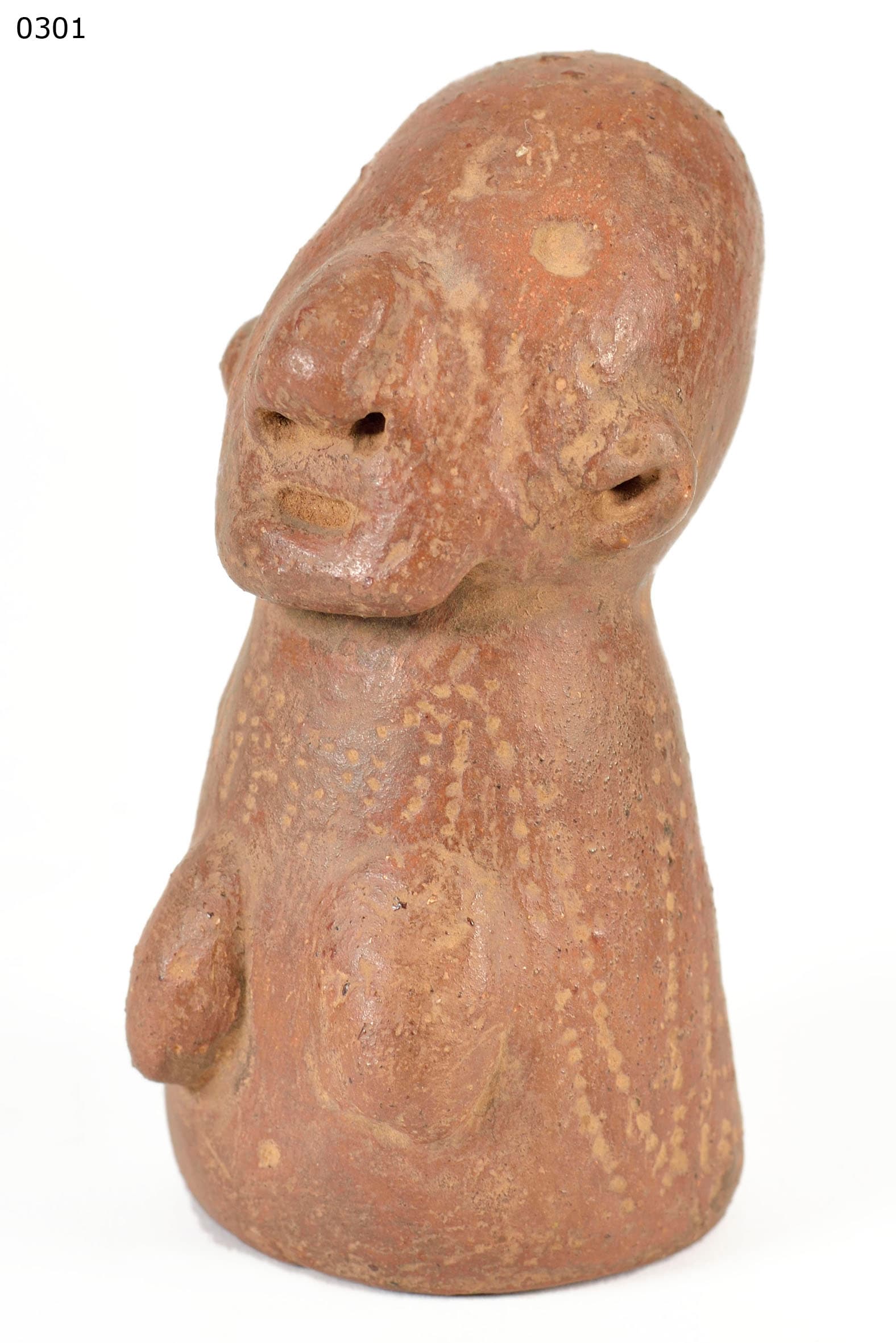
Eine ausdrucksstarke Terrakotta aus dem Inland des Nigerdeltas (12.-16. Jh., 24 cm) aus Mali - stilisierter Körper, hervortretende Augen, Torso und Schultern mit Reihen eingedrückter Punkte verziert und eine kniende oder sitzende Haltung. Die Patina zeigt eine Mischung aus warmem, geglättetem Terra-Sigillata-Schlicker und verkalkten Oberflächen, die für den anaeroben Schlamm der Niger-Ebene charakteristisch sind.
1. Die Ästhetische Typologie von Djenne-Jeno
Diese Figur verkörpert die charakteristische Ästhetik des Nigerdeltas.
- Reptilienartige Verlängerung: Die längliche, fast reptilienartige Kopfform und die tief eingeschnittenen, parallelen Augen sind charakteristisch für Stücke, die den alten Werkstätten von Djenne-Jeno und Tenenkou zugeordnet werden.
- Trance-State-Muskulatur: Das nach oben gerichtete Kinn, die gekreuzten Arme und die angespannte Muskulatur legen eine Interpretation als Ausdruck von Hingabe, Gebet oder Trauer nahe - im Kontrast zur statischeren Gestaltung anderer afrikanischer Keramiktraditionen.
2. Körperschmuck und Ahnenverehrung
Die Reihen kleiner eingedrückter Punkte, die über die Schultern und die Oberarme laufen, sind bewusster Schmuck, keine Darstellung von Krankheit. Ob sie Skarifizierung, Tätowierung, Perlenschmuck oder ein Kleidungsstück wiedergeben, ist für die Figuren des Niger-Binnendeltas nicht geklärt; vergleichbare Punktbänder finden sich auf vielen ausgegrabenen Stücken.
- Körpermarkierung: Punktbänder dieser Art folgen den Linien des Körpers und werden als Zeichen von Status oder Schmuck der dargestellten Person gelesen.
- Votivfunktion: Figuren dieses Typs standen vermutlich in Schreinen oder Hausnischen als Mittler zwischen den Lebenden und ihren Ahnen.
3. Schwemmgutbestattung und historische Einordnung
Die Patina spricht für eine alluviale Bestattung in den Überschwemmungsgebieten des Niger.
- Zyklische Überflutung und Aushärtung: Durch zyklische Überflutung und Aushärtung des Schlamms entstanden vermutlich die dicke Kalkkruste und der Schlickabbau auf der Oberfläche.
- Diagnostische Taphonomie: Diese spezifische chemisch-mechanische Verwitterungssignatur ist vereinbar mit einer Datierung in das 12. bis 16. Jahrhundert.
Zusammenfassung
Diese Figur, die eine ausgeprägte psychologische Intensität mit einer detaillierten keramischen Ausführung verbindet, gilt als bedeutendes Zeugnis der mittelalterlichen malischen Kunst. Ihre charakteristische Anschwemmungsalterung unterstreicht ihre archäologische Bedeutung.
KI-unterstützt erstellt aus Sammlungsgutachten, Objektfotografie und eigener Recherche, redaktionell geprüft. Fehler sind möglich — Hinweise darauf sind uns willkommen. Zum Verfahren →