Was uns das Objekt erzählt.
Gestützt auf Feldforschung, Museumsbestände und Fachliteratur — erzählt mit Respekt vor dem Kontext, in dem dieses Objekt entstand.
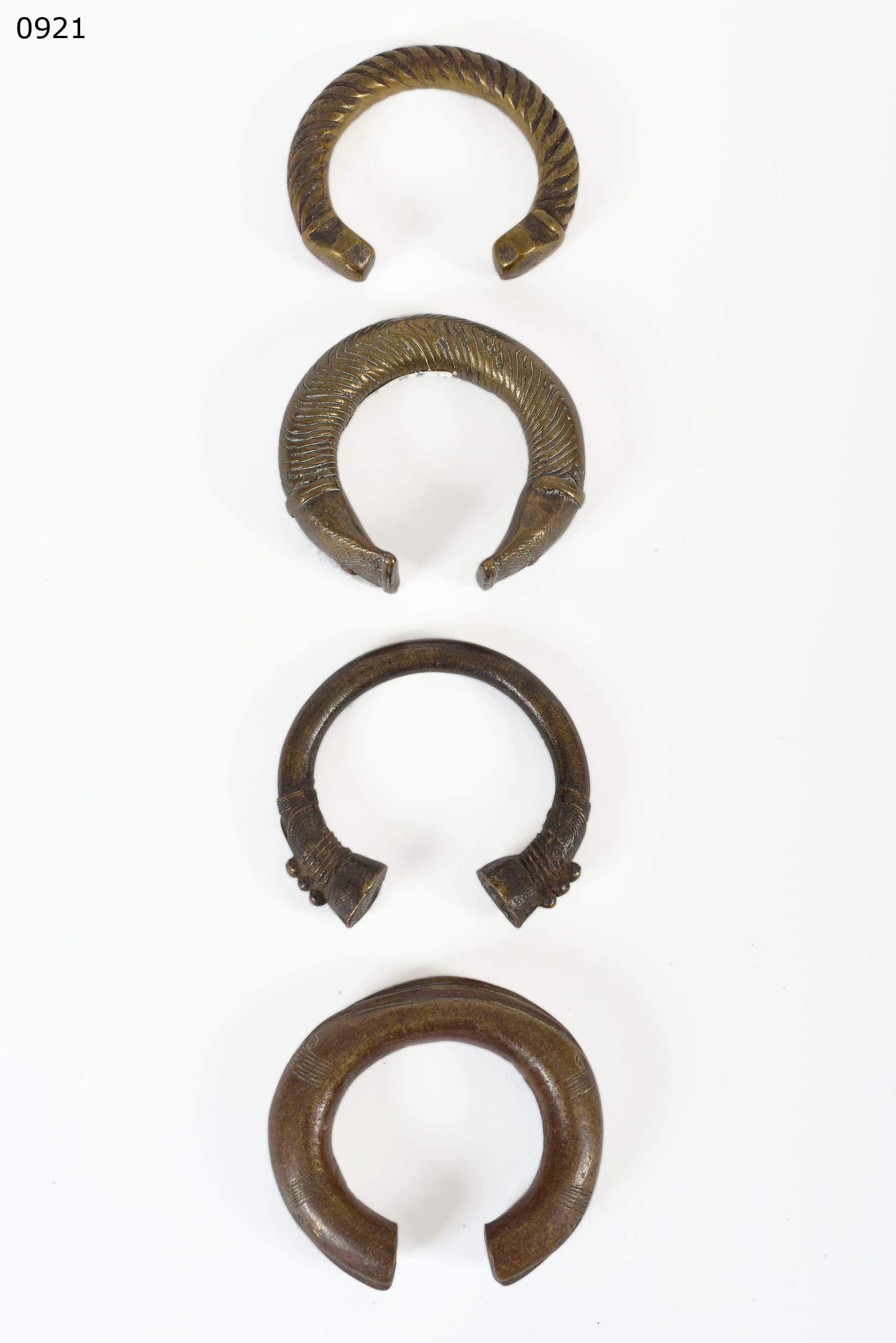
WEST AFRICA Two Brass Anklets — Flared Cylinder & Ribbed (8/10 cm)
This pair consists of a tall, hollow cylindrical cuff with dramatically flared rims and a heavy, bulbous anklet with pronounced horizontal ribbing. The metal bears a dry, earthy oxidation crust, masking the underlying brass.
1. Aesthetic Style and Regional Traits
These two objects represent distinct typologies of West African lower-limb adornment. The tall, flared cylindrical anklet operates as a piece of bodily architecture, turning the lower leg into a rigid, metallic pillar. The dramatic flaring at the top and bottom edges is designed to prevent the sharp brass from cutting into the skin, while visually expanding the diameter of the ankle. The second, horizontally ribbed anklet utilizes mass and repeating volume to achieve a similar visual dominance.
2. Ritual Function and Bodily Restriction
In many regional contexts (such as the Igbo, Dan, or Lobi), heavy cylindrical anklets were the ultimate markers of marital and economic status. Because they restricted the wearer's ability to walk normally, forcing a slow, shuffling gait, they were highly prestigious — proving that the woman did not need to engage in agricultural labor. Once hammered onto the leg by a blacksmith, they were often worn for life, functioning as a permanent, physical manifestation of a family's localized wealth and power.
3. Physical Patina and Age Verification
Unlike bracelets worn on the wrist, which are constantly buffed by hands and clothing, anklets are exposed to the dust, mud, and moisture of the ground. The dry, earthy, and heavily oxidized patina on these objects perfectly reflects this environmental reality. The metal shows significant surface degradation and cuprite formation, suggesting they were either buried after the wearer's death or stored in an earthen shrine, confirming their early 20th-century historical provenance.
Summary
These brass anklets represent the extreme lengths to which West African elites went to physically embody their wealth through somatic restriction. Their dry, earth-encrusted patinas and architectural forms make them powerful ethnographic records of status and bodily modification.