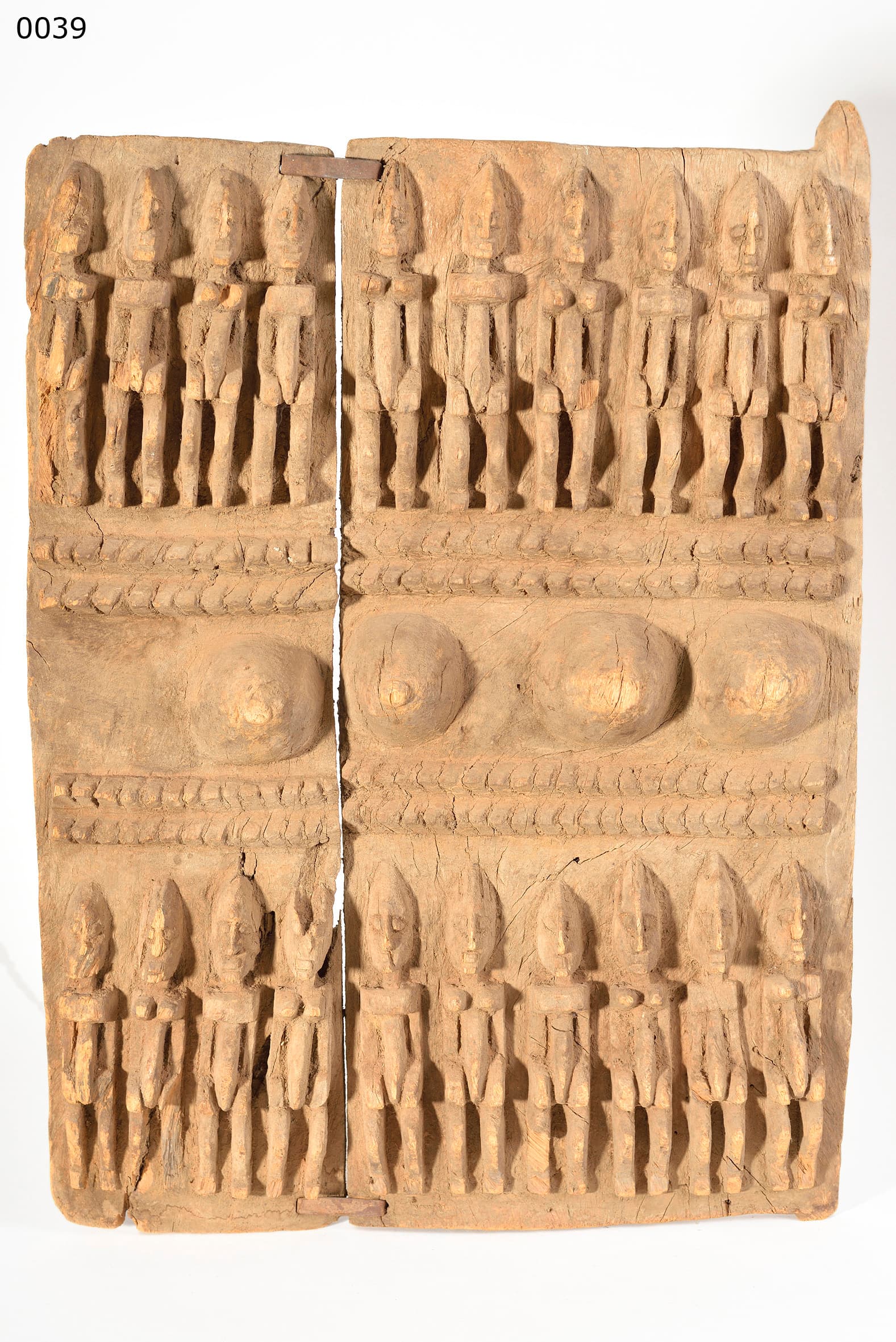
A heavy rectangular wooden granary shutter (19th C. – 1st half 20th C., 54 cm) from the Dogon of Mali — carved in high relief with rows of human figures holding their arms raised to the sky.
1. The granary as the center of the universe
For the Dogon, the granary is the most important architectural structure in the village.
- Not Just a Silo: It is a physical scaled-down model of the universe, referred to as the "Sanctuary of Food" — representing the survival of the lineage. These heavy wooden doors and shutters are installed to protect the harvest from physical thieves and, more importantly, from spiritual contamination.
2. Iconography of the Nommo
The most prominent feature of this shutter is its rows of human figures with their arms raised straight to the sky.
- The Prayer Gesture: These represent the Nommo (the primordial hermaphroditic ancestors created by the high god Amma) or human priests in the act of praying for rain.
- Life and Death in the Sahel: In the harsh arid environment rain is the ultimate arbiter of life and death — so the multiplication of these figures acts as a continuous carved prayer for precipitation.
3. Multiplication as magical plea
- Each Figure a Prayer: The repetition is not decorative. Each added figure is an amplified plea for the multiplication of the family lineage and the multiplication of the grain inside the silo.
- A Wooden Prayer Book: By fixing the Nommo prayer-gesture in permanent relief on the granary door, the Dogon turned a utilitarian closure into a continuous invocation for rain, harvest, and lineage.
Summary
This shutter is a wooden prayer book. It transforms a utilitarian door into a continuous carved invocation — asking, year after year, for the rain and harvest that keep the lineage alive.
Written with AI assistance from the collection appraisal, object photography and our own research; editorially reviewed. Mistakes are possible — corrections are welcome. How we work →