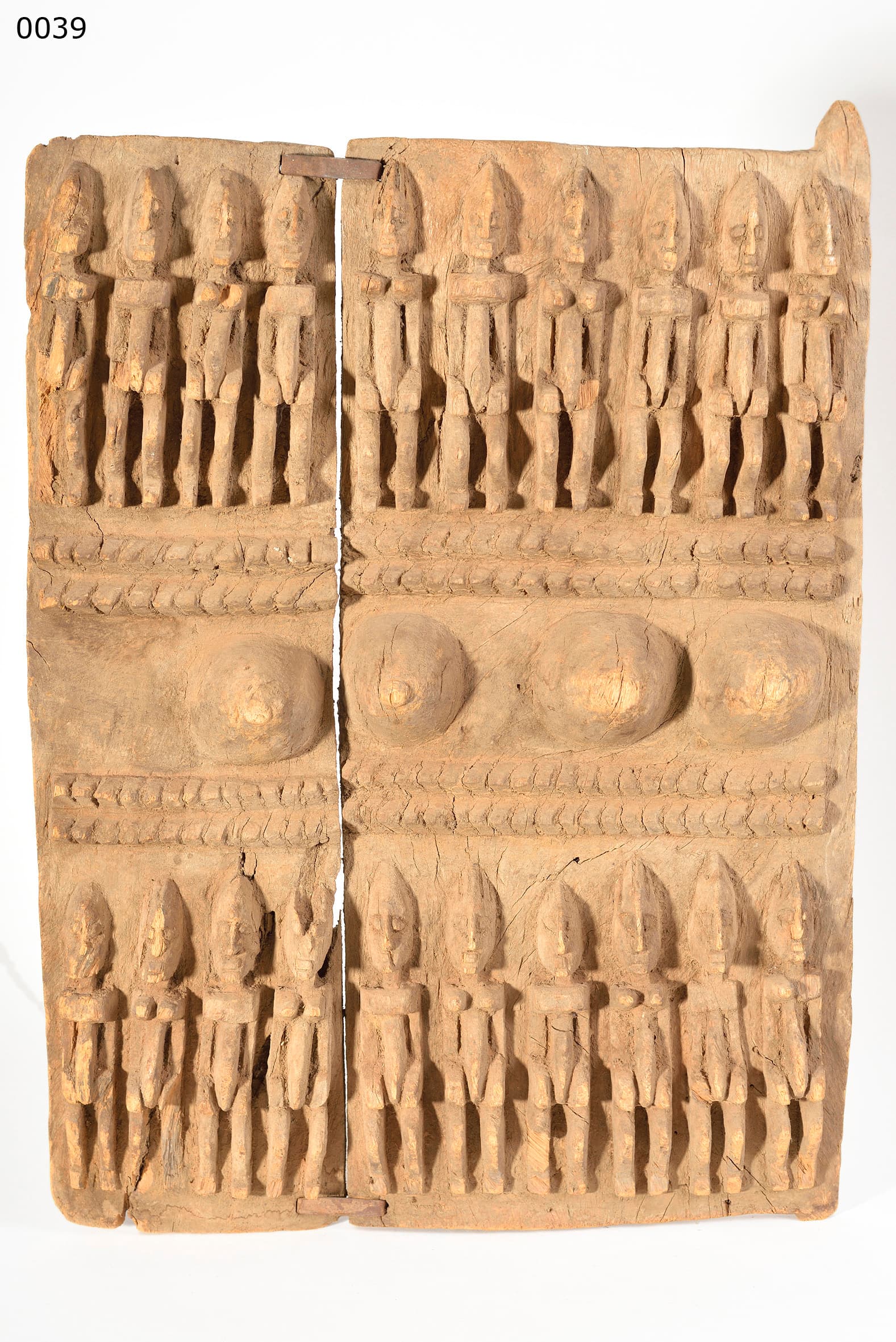
A heavy rectangular wooden granary shutter (19th C. – 1st half 20th C., 48 cm) from the Dogon of Mali — carved in high relief with prominent stylized female breasts.
1. The granary as the center of the universe
For the Dogon, the granary is the most important architectural structure in the village.
- Not Just a Silo: It is a physical scaled-down model of the universe, referred to as the "Sanctuary of Food" — representing the survival of the lineage. These heavy wooden doors and shutters are installed to protect the harvest from physical thieves and, more importantly, from spiritual contamination.
2. Fertility and the maternal granary
- The Breasts: Prominent stylized breasts are carved in high relief. In Dogon thought the granary is conceptually female — it nurtures and feeds the family from its "belly" just as a mother does.
- Making the Metaphor Explicit: The carved breasts materialize the container of food as a nursing body.
3. The carved body metaphor
- A Feeding Body: By displaying the maternal form on the outside of the silo, the household declares that the stored millet is the family's mother-substance — a gift that sustains every member of the lineage.
- Architecture as Anatomy: The maternal iconography fuses architecture with anatomy, asserting that the granary itself is the ancestral matriarch.
Summary
This shutter reframes a utilitarian door as the torso of the village's feeding mother. The maternal iconography fuses architecture and anatomy, asserting that the granary itself is the ancestral matriarch.
Written with AI assistance from the collection appraisal, object photography and our own research; editorially reviewed. Mistakes are possible — corrections are welcome. How we work →