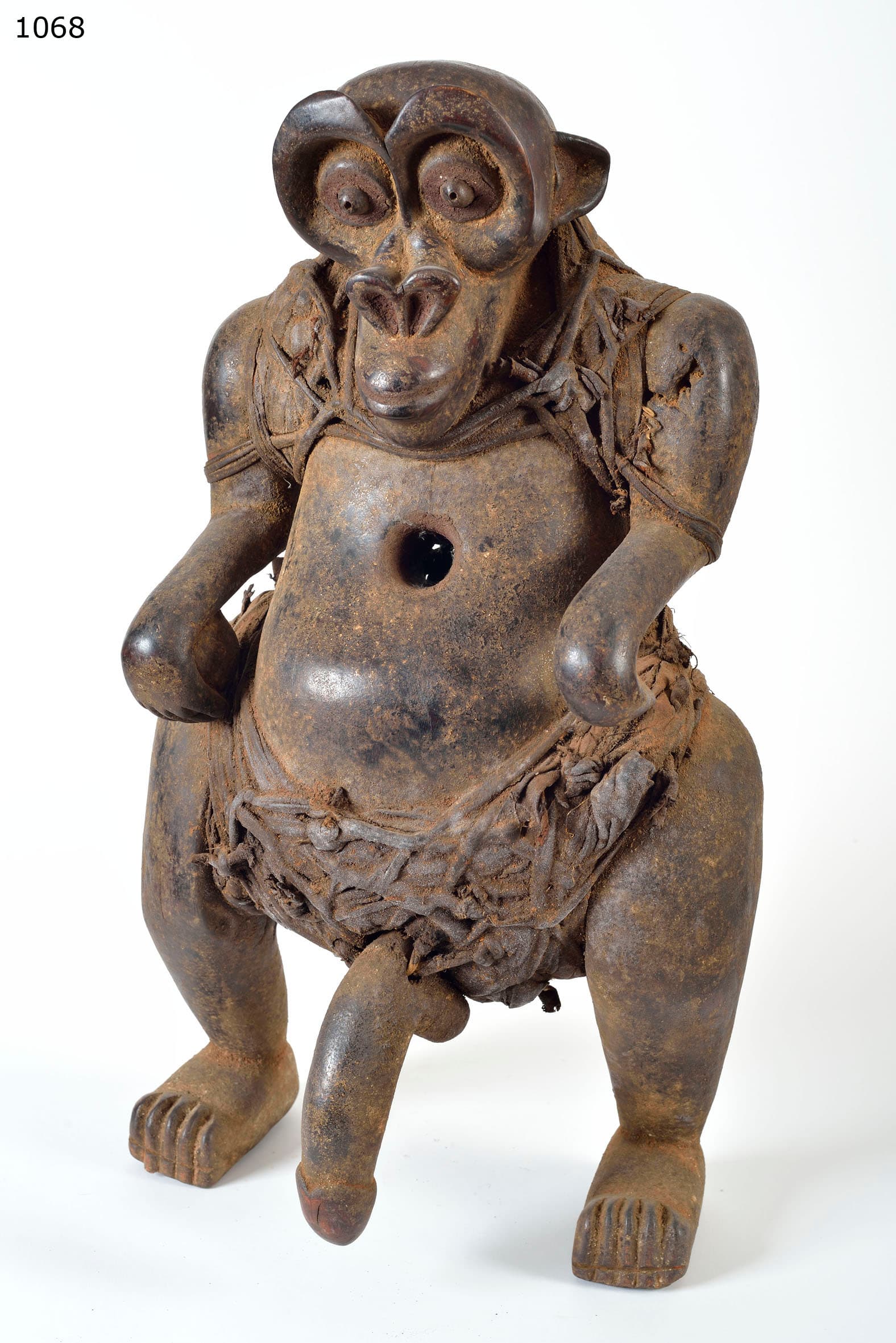
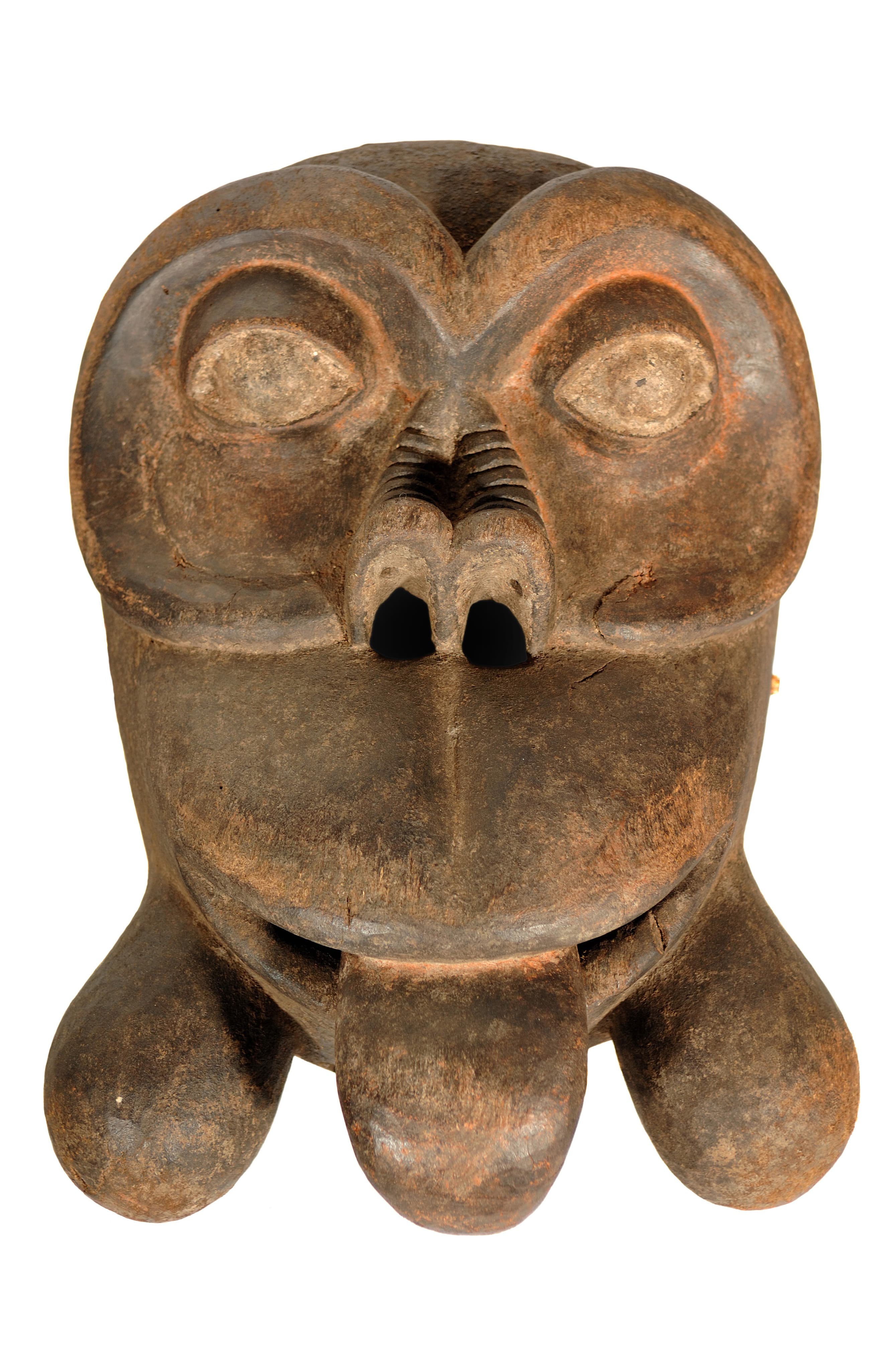
The Fang are a Central African people of Gabon, Equatorial Guinea and Cameroon, known for byeri reliquary figures and ngil/ngontang masks with concave, heart-shaped faces.
Overview
The geographical distribution area of the Fang extends across the dense equatorial rainforests of Central Africa and primarily spans three modern nation states: the mainland region of Equatorial Guinea (Río Muni), the north and estuary region of Gabon and the southern province of Cameroon. Current demographic estimates put the total population of the ethnic group at approximately 2.3 to almost 3 million individuals, whereby the demographic and political dominance varies considerably depending on the nation state. In Equatorial Guinea, the Fang, with an estimated 1.39 to 1.5 million members, make up over 85 per cent of the total population and thus represent the absolute demographic majority compared to indigenous island groups such as the Bubi on Bioko. In Gabon, whose total population is estimated at around 2.6 million, they form the largest of over forty ethnic groups with around 672,000 individuals (around 29 per cent), while in Cameroon they represent a territorial minority in the southern forest regions with around 211,000 members.
The linguistic categorisation of the Fang clearly places them in the extensive Bantu language family, specifically in the Northwest Bantu groups (according to the Guthrie classification). However, the language structure has special features that have led to intense debate among researchers. In contrast to many classical Bantu languages, Fang is dominated by monosyllabic words and has a highly complex, rich tonal system. Nevertheless, linguistic analyses show regular sound shifts from Proto-Bantu, such as the reduction of multi-syllabic word structures (C1V1C2V2 to CVC), which confirms beyond doubt that Fang belongs to the Bantu family. The nomenclature of the ethnic group is historically extremely complex and strongly dominated by exogenous terms. While the strict self-designation (autonym) of the group is Fang, the French colonial administration established the term Pahouin early on, which dominated Francophone literature for a long time. In early German-language ethnography, however, largely influenced by Günter Tessmann's pioneering and comprehensive monograph from 1913, the term Pangwe was canonised. These foreign designations are considered obsolete in contemporary ethnographic and art historical research, but inevitably appear in historical provenance research and in older inventory catalogues of large institutions such as the Metropolitan Museum of Art (Met) or the Musée du quai Branly.
The social structure of the Fang is decidedly acephalous and patrilineal in organisation. Pre-colonial times, there was no overarching state authority, no kingship and no centralised power structure. Instead, society was based on an extremely segmented, decentralised order of exogamous, scattered clans (ayong), which in turn were subdivided into local lineages (movók-me'bot). These clans were linked by fictitious or real blood relations, which were traced back to a common mythical ancestor. The subsistence strategy was primarily based on semi-nomadic shifting cultivation, which was supplemented by intensive hunting. This economic necessity to constantly open up new agricultural areas and hunting grounds explains the historical mobility and the rapid, expansive territorial expansion of the Fang in the 19th century. In the course of this expansion, relations with neighbouring ethnic groups were often characterised by asymmetrical power relations. Established groups such as the Kele were successively pushed out of their ancestral territories, while other groups, such as the Makina, were partially assimilated into Fang society. Pygmy groups (such as the Baka) were also integrated into complex, often clientelistic dependency relationships as specialised hunters and spiritual mediators.
The classification of this specific social order is the subject of a long-running research controversy. In his seminal 1955 study (Sociologie actuelle de l'Afrique noire), the French sociologist Georges Balandier argued that pre-colonial Fang society had formed a coherent unit that had been plunged into a fundamental structural crisis and social dislocation by colonial contact and rapid migration. The American anthropologist James W. Fernandez vehemently disagreed. Fernandez interpreted the structural decentralisation, the fragmentation of the ayong and the constant spatial dispersion not as a pathological deficit or crisis phenomenon, but as a dynamic, intentional state. According to Fernandez, the constant tension between cohesion (through ancestor worship) and dispersion (through migration) corresponded to the pan-Central African ideal of local autonomy and prevented the emergence of despotic centralised powers. The source situation is ambiguous with regard to the exact pre-colonial balance of power, as written records only exist with the onset of colonial administration and Presbyterian missionary work from the middle of the 19th century.
| Demographic distribution | Estimated population (2024/2025) | Proportion of national population | Territorial / political centre |
|---|
| Equatorial Guinea | ~1,395,000 | > 85 % | Río Muni (mainland region), increasingly Bioko |
| Gabon | ~672,000 | ~ 29 % | Woleu-Ntem Province, Estuaire |
| Cameroon | ~211,000 | < 1 % | Southern Province (close to the border with Gabon) |
Cultural context
The pre-colonial religious system of the Fang was a highly complex cosmological order based on ancestor worship, which differed significantly in structure from the centralised priestly hierarchies of West African societies (such as the Yoruba or the Kingdom of Benin). At the head of Fang cosmology was the absolute creator deity Mebe'ge (or Zambe), a classical Deus otiosus. After the creation of the universe, the earth and the first humans, this entity withdrew completely from worldly affairs and no longer actively intervened in the fate of the living. Consequently, Mebe'ge was not directly worshipped and there were neither temples nor specific rituals addressed to the creator. Instead, the operative ritual, social and magical power lay exclusively with the ancestors (bieri or byeri), who functioned as immanent, active mediators between the invisible spirit world and the physical sphere of the living.
In the absence of an institutionalised, superordinate priestly caste, ritual authority was decentralised to the respective lineage elder (esa). He acted as the guardian of the relics and as the primary divinator of his clan. The religious and social backbone of the Fang was the Byeri cult, an exclusive initiation society that practised the systematic preservation and veneration of the skulls and long bones of important ancestors. These ancestors included founders of lineages, outstanding warriors, talented blacksmiths and exceptionally fertile women who had made significant contributions to the survival of the group during their lifetime. The Ngil secret society existed in parallel with the inward-looking family Byeri cult. This functioned as an executive, inter-village and inter-clan justice and police organisation. Its primary function was the rigorous combating of harmful spells (evur), the prosecution of witchcraft and the violent restoration of social order after serious offences or unexplained deaths. While Byeri ensured the biological and social reproduction of their own lineage, Ngil regulated the external administration of justice and pacified conflicts between rival groups.
The role of women in the traditional cult was ambivalent and is the subject of constant revision in modern ethnography. Traditionally, Melan (the central initiation into the Byeri cult) and Ngil were considered strictly male domains. Women and the uninitiated were strictly excluded from the rituals and were not allowed to see the relic figures; offences were drastically sanctioned. Nevertheless, women were not completely banned from the spiritual economy. The skulls of exceptionally fertile or influential women were included in the reliquaries (nsekh), emphasising their posthumous metaphysical relevance for the clan. In the course of the 20th century, the Fang also adapted the Bwiti cult, which originally came from the southern Mitsogho. This developed into a syncretic religion in which traditional ancestor worship merged with Christian (often Catholic) elements and the ritual consumption of the hallucinogenic iboga plant. In Bwiti, women experienced a significant revaluation and took on central roles as initiates, healers and visionaries, which represented a clear break with the patriarchal structures of the old Byeri.
A central research controversy that still characterises the interpretation of this religious system today manifests itself in the discourse between early evolutionists and modern cultural anthropologists. In his pioneering work, Günter Tessmann (1913) still strongly classified the religion of the Fang from a Eurocentric perspective as a primitive "animistic ancestor cult", which was primarily based on fear of the dead and magical thinking. James W. Fernandez fundamentally contradicted this deficient interpretation in his monumental monograph Bwiti: An Ethnography of the Religious Imagination in Africa (1982). Fernandez rejected the reduction to a simple death cult and instead emphasised the highly complex "architectural metaphorics" of Fang cosmology. Fernandez argued that the rituals, dances and sacred objects served to temporarily "centre" the social space that had been fragmented by constant migration. The religion of the Fang was therefore a creative act of "religious imagination", which was intended to generate a deep sense of metaphysical wholeness and vitality (vitality). Objects in collections such as the Musée Royal de l'Afrique Centrale (Tervuren/RMCA) or the Rietberg Museum Zurich impressively document this practice of materially anchoring the invisible in physical space.
| Cult / Secret Society | Primary Function | Participation | Material Manifestation |
|---|
| Byeri | Ancestor worship, securing fertility and lineage cohesion | Male elders, initiates (Melan) | Bark containers (nsekh) with guardian figures (eyema) or heads (añgokh-nlô) |
| Ngil | Inter-clan justice, witch-hunting (evur), social control | Special male cult functionaries (ngengan) | Elongated, whitewashed wooden masks made of light tropical wood |
| Bwiti (historically younger) | Syncretic healing, spiritual visions (iboga consumption) | Men and women | Syncretic altars, harps (ngombi), syncretic iconography |
Aesthetic features
The art of the Fang is received in international discourse as one of the absolute highlights of African sculpture, characterised by a strict, perfectly formed canon that has been handed down over centuries. The canonical object typology is primarily divided into two fundamental categories that follow completely different ritual and aesthetic principles: the static Byeri relic figures and the highly dynamic masks of the secret societies, especially the Ngil.
The Byeri sculptural tradition includes both full-figure guardian figures (eyema byeri, usually 30 to 60 centimetres in height) and isolated heads with elongated necks (añgokh-nlô-byeri). A universal iconographic feature of the full figures is their extreme physiological and compositional tension. The canon of proportions of the Fang is highly artificial and based on the principle of "paedomorphism": a disproportionately large, often infantile-looking head with a domed forehead rests on a muscular, adult torso. The legs are usually very shortened, bent and have extremely emphasised, bulging calves, giving the figure an attitude of constant readiness to jump or latent kinetic energy. This physical tension contrasts strikingly with the completely static, expressionless and self-contained facial features. The eyes are often shaped as half-closed slits or coffee bean moulds, the mouth is closed and pushed forward into a slight pout. The favoured material for these guardian figures is dense, hard tropical wood. The patina that is highly prized in collections today - a deep black, lacquer-like or rich reddish-brown crust that allows the wood to literally transpire - is not an aesthetic end in itself on the part of the carver, but the resulting product of decades of ritual anointing. The figures were continuously rubbed with palm oil and ba (a ritual red powder made from crushed padauk wood and oil) to protect the wood from insect damage and to nourish the spiritual "heat" of the ancestors.
A massive iconographic discourse, which divided ethnographic and art historical experts, was sparked by the sexuality of the Byeri figures. In his standard work La statuaire fang du Gabon, Louis Perrois (1972) argued that the sexual ambivalence of many figures - for example the combination of masculine, muscular torsos with prominent breasts, or the lack of genitalisation or its strong abstraction - represented a deliberate "neutralisation". According to Perrois, the ancestor transcends biological gender in death and becomes a neutral, asexual entity. James W. Fernandez (1977) vehemently disagreed with this interpretation. Fernandez did not read the morphological ambiguity as a neutralisation, but in the context of Bwiti and Byeri cosmology as a conscious representation of a metaphysical hermaphroditism. This fusion of male and female attributes symbolises cosmological completeness, total fertility and the transition of the ancestor into a liminal stage between the sexes. Alisa LaGamma, curator at the Metropolitan Museum of Art, supported this view in her analysis (2007) of the famous seated female figure of the Okak group (Met inv. no. 310870) and emphasised the Fang carvers' masterful ability to keep bipolar opposites in perfect balance.
The formal classification of Byeri sculpture is traditionally divided into regional sub-styles, although the geographical and ethnic boundaries are fluid. The most important manifestations include the Betsi style in southern Gabon, which is famous for the production of isolated heads (añgokh-nlô) with a spherical forehead and heart-shaped face. The Ntumu style in northern Gabon and southern Cameroon is characterised by strongly elongated, cylindrical torsos. The Okak style (Equatorial Guinea) is characterised by compact, block-like and squat proportions with a rougher patina. The Mvaï sub-style from the Ntem Valley occupies an outstanding art-historical position. Research (in particular Perrois 2001) has identified individual, documented master craftsmen here, which massively contradicts the colonial thesis of purely anonymous "tribal art". The so-called "Master of Ntem" created figures of unparalleled sculptural quality, characterised by broad shoulders, detailed coiffures and an almost cubist, geometric distribution of volume. A canonical masterpiece by this hand is now in the Brooklyn Museum (inv. no. 51.3). However, the validity of this strict sub-style classification according to "sub-tribes" was criticised by Fernandez (1977), who pointed out that the high mobility of Fang carvers led to a constant mixing of styles.
The Ngil masks form the aesthetic and material counterpart to the heavy Byeri sculpture. Carved from extremely light, soft wood (often ceiba or fromager), they reach monumental sizes of 50 to over 70 centimetres. They are characterised by strongly elongated, heart-shaped faces that are whitewashed all over with white kaolin - the colour of death and the spirit world in the entire Central African region. The facial features are reduced to a minimum: tiny, incised eye slits, an extremely long, fine nose line and a narrow mouth drawn up to the chin.
The fundamental difference between a sacred, activated ritual object and a profane piece of wood lies in the ritual charge. A freshly carved Eyema byeri possessed no inherent power; it was a purely profane workpiece until it was sacralised through physical contact with the ancestral relics, placement on the bark container and the initial anointing with sacrificial blood and magical substances. Forgery criteria are of critical importance in the case of fang objects due to their enormous market relevance. Today, authenticity is verified by detailed forensic analyses of the patina (palm oil penetration depth), the examination of microscopic heartwood cracks and the identification of authentic traces of tropical xylophages (termite feeding). Modern forgery workshops in Libreville and Yaoundé, which have been operating since the 1960s, attempt to simulate these signs of ageing by means of chemical baths and artificial weathering, but often fail due to the complex stratigraphic depth of a ritual patina that has grown over generations.
Ritual practice
The ritual activation, use and eventual deactivation of the cult objects differed fundamentally between the hermetic, familial framework of the Byeri ancestor cult and the public, terrorising judicial performance of the Ngil covenant.
The physical and conceptual structure of a functional Byeri altar was always conceived in two parts. The functional base was the nsekh, a cylindrical, sewn container made of bark. According to historical sources (Gabus 1961, Raponda-Walker & Sillans 1962), the bark of the Olax viridis tree (locally called ekobe) was primarily used for this purpose, as it emitted a strong, characteristic garlic-like odour, which was presumably intended to repel insects. The carefully cleaned skullcaps, long bones and sometimes teeth of the ancestors rested in this container. The wooden guardian figure (eyema) or the isolated head (añgokh-nlô) was firmly attached to the lid of the container by a peg attached to the buttocks or neck. Contrary to earlier assumptions, this wooden figure did not act as a naturalistic portrait of a specific deceased person. Its primary ritual function was apotropaic: it acted as a symbolic guardian, shielding the physical remains and the spiritual energy of the ancestors bound within from unauthorised access by women, non-initiated children and hostile harm wizards. The relic containers were kept in the darkest, furthest reaches of the Lineage Elder's residence, strictly hidden from everyday view.
The continuous re-activation and care of these objects required a cyclical rhythm of offerings. In order to maintain the "heat" and the apotropaic power of the ancestors, the figures were periodically manipulated as part of intra-family propitiation rites. The occasions for these offerings were manifold: the start of the planting season, the departure on a long hunting or trading expedition, the settlement of inheritance disputes or the request for fertility in the event of persistent childlessness. The offerings included the ritual pouring of fresh palm oil, melted copal resin and occasionally the blood of sacrificed chickens or goat pecks over the wooden figures. Additional decorations with red parrot feathers or brass rings on the necks and wrists emphasised the status of the objects and acted as conductors for spiritual energies.
A specific, highly theatrical regional variant of the ritual practice took place during the Melan initiation rites, in which young men were introduced to the secrets of the Byeri cult. The historical sources, largely documented by missionaries such as Father Trilles (1901) and later analysed by Louis Perrois and Alisa LaGamma, prove that the relic figures were temporarily removed from their bark containers for this specific occasion. In the pale glow of the nocturnal fire, the statues were moved by the cult elders like puppets over a reed screen. The young novices, whose perception had been massively altered by the ritual consumption of the hallucinogenic iboga root, were given a scenic demonstration of the metaphorical resurrection of the ancestors and their physical presence through this choreographed performance. This kinetic manipulation of the figures stands in stark contrast to their otherwise rigid, static preservation.
The masked performance of the Ngil secret society, on the other hand, did not operate in the family's hidden space, but in the public, frightening space of the entire village. According to early ethnographers, the Ngil cult functionary (ngengan) only appeared at night. His arrival was heralded by deafening noise, the beating of drums and the glow of torches. The mask itself was only part of a massive, expansive costume made of bast fibres, leopard skins and monkey skulls, giving the wearer a superhuman, terrifying stature. The white kaolin colouring of the mask signalled to the villagers the undoubted presence of a judging spirit of the dead. The ritual activation of the mask was strictly bound to its legal purpose: The prosecution of damaging spells (evur) and the identification of sorcerers. The "offerings" in this context consisted of the confiscated goods, fines or animals of the condemned, which the secret society demanded as compensation for the restoration of the cosmic and social order.
The lifecycle of a cult object often ended with a dramatic, deliberate deactivation. The objects were not designed to last forever; their relevance was tied to the existence and beliefs of the lineage. When a clan died out, was absorbed into another structure through migration or - which increased massively from the late 19th century onwards - collectively converted to Christianity, the figures abruptly lost their sacred status. The bones of the ancestors, which were considered essential, were either secretly buried in the ground or burnt under pressure from the missionaries. The masterfully carved guardian figures, now empty, profane wooden shells with no ritual connection, were freed from their magical context (desacralised). As they now only had representative, but no longer spiritual value, they were often willingly sold by the Fang to European traders, colonial officials or missionaries. This process of desacralisation explains the immense density of excellently preserved, authentically patinated Byeri figures in early Western museum collections, such as the Musée des Arts Africains, Océaniens, Amérindiens in Marseille. In museum contexts, ignorance of ritual practice often led to curatorial errors: in the 1960s, for example, an isolated Byeri head (collected by Trilles in 1901) was mistakenly rammed into the bottom of an upturned bark container at the Musée d'ethnographie in Neuchâtel - an "ethnographic hypercorrection" that had nothing to do with the original ritual configuration.
Historical context
The historiography of the Fang is dominated in scholarly discourse by a protracted and intense controversy regarding their migration history and ethnogenetic origins. According to the Fang's own oral tradition (known as the Dulu Bon be Afri Kara - the journey of the children of Afri Kara), their ancestors migrated from vast savannah-like regions in the far north-east before reaching the dense equatorial rainforest. These oral traditions prompted the German ethnographer Günter Tessmann to formulate the so-called "Sudan hypothesis" in 1913. Tessmann speculated that the Fang were originally a Nilotic or Sudanese people who were pushed into the Congo Basin by warlike events (possibly by the expansion of Islamic empires in the north). The linguist and art historian Louis Perrois vehemently disagreed with this exogenous theory. Based on their linguistic and material culture, Perrois placed the Fang historically firmly in the ancestral Bantu language area, thereby devaluing the oral traditions of origin from the north as mythical exaggerations.
However, recent research in genetic forensics has reignited this seemingly settled debate with surprising results. A large-scale interdisciplinary study (Hombert & Van der Veen 2007) detected the Y chromosome haplogroup R in around 17 per cent of the Fang population tested. This specific genetic signature is otherwise extremely rare in the populations of Central Africa, but occurs more frequently in regions of northern Cameroon and, strikingly, in Egypt. This genetic evidence correlates strikingly with the Fang's oral claim of being "non-Bantu" and originating from the north. Nevertheless, neighbouring ethnic groups such as the Punu and Ndumu also share these genetic markers, although they cultivate completely different migration myths. The source situation therefore remains ambiguous with regard to the exact geographical origin, although a slow, intermittent migration from the regions north-east of the Sanaga River towards the Ogooué Basin between the 17th and 19th centuries is now considered certain.
Physical contact with European colonial powers (primarily the French in the Gabon estuary and the Germans in Cameroon) in the 19th and early 20th centuries drastically and irreversibly changed the Fang's way of life and the production of their ritual art. Between 1880 and the late 1920s in particular, the French colonial administration waged a rigorous and often brutal campaign against the traditional secret societies of the region. The Ngil League, whose cross-village and cross-clan jurisdiction was in direct competition with the colonial judicial monopoly, was successively banned for alleged "ritual murders". The society's leaders were persecuted, and by the end of the 1920s the practice of ngil had been completely eradicated in the French territory. This violent intervention led to the abrupt and irrevocable end of Ngil mask production in its authentic ritual context; all original museum specimens inevitably date from before 1920. At the same time, massive psychological and social pressure from Christian institutions (especially the American Presbyterian Mission, MPA) led to the mass abandonment of Byeri ancestor worship, which brought art production to a further standstill.
Paradoxically, at the exact historical moment when its ritual basis in Africa was destroyed, the art of the Fang experienced an unprecedented aesthetic rise in the Western market. In the 1910s and 1920s, Fang sculptures, now completely abstracted from their religious and bloody ritual context, became the ultimate aesthetic projection surface for the Parisian avant-garde. Visionary dealers and collectors such as Paul Guillaume, Joseph Brummer and Charles Ratton recognised the formal brilliance of the sculptures and established the figures in the studios of artists such as André Derain, Jacob Epstein and Georges Braque. The final curatorial and institutional breakthrough came in 1935 with the epochal exhibition "African Negro Art" under the direction of James Johnson Sweeney at the Museum of Modern Art (MoMA) in New York. Here, for the first time, Byeri heads (partly from the Ratton Collection) were celebrated not as ethnological curiosities, but as masterpieces of world art with equal status. This early canonisation is reflected in the historical price trend: today, documented masterpieces by Fang - such as pieces from the Vérité collection, exhibits with provenance by Paul Guillaume or the "Master of Ntem" from the Barnet collection auctioned by Sotheby's in 2018 - achieve prices in the multi-digit million range at international auctions.
A profound art-historical controversy (author vs. author), which significantly shaped the history of the reception of Fang art, was sparked by the famous "Ngil mask mythology". For decades, early critics such as Guillaume Apollinaire and later art historians such as William Rubin maintained the claim that Pablo Picasso had been directly inspired by an extremely rare Fang Ngil mask from the French Congo for the radical redesign of the faces in his key proto-Cubist work Les Demoiselles d'Avignon (1907). Modern art historians and provenance researchers are increasingly dismantling this thesis. Joshua I. Cohen (2017) and the collector Alain Moreau (2025) demonstrate that the sources for a direct encounter between Picasso and a genuine Ngil mask before 1907 are extremely thin. Moreau argues that Picasso's abstraction was primarily derived from medieval Catalan frescoes and Iberian sculpture, while African influences were more likely to be traced back to Dan or Pende masks. As Ngil practice had already been severely decimated by 1900, only a handful of these masks circulated in Paris before 1907; the Vlaminck/Derain specimen in the Centre Pompidou often cited in Picasso's reception was already acquired around 1905 and has been identified in recent research (Cohen 2017, Art Bulletin) as a Ngontang mask from Gabon - it is therefore not considered reliable evidence of a Ngil model for the Demoiselles d'Avignon.
This extreme increase in market value gave birth to a highly specialised, lucrative forgery industry in West African workshops, primarily in Libreville and Yaoundé, from the 1960s onwards. The authentication (forgery problem) of Fang sculptures is therefore no longer based solely on stylistic connoisseurship, but on advanced micro-analytical forensics. Microscopic visual inspections look for specific, age-related cracks in the heartwood and authentic traces of tropical xylophages (such as termites), which leave behind a feeding pattern that can only be created by decades of storage in the warm, humid environment of the rainforest. Today, high-tech chemical-physical methods are standard in museum laboratories: X-ray fluorescence analysis (XRF) is used to date metal applications (such as brass nails or copper eyes) in order to determine whether the alloy is historically accurate. Infrared reflectography (IR) and transmission electron microscopy (TEM) are used to analyse the deep resin and oil layers of the patina that have built up over decades. Another decisive absolute dating tool for wooden objects is the radiocarbon method, which utilises the so-called "bomb peak" effect: wood that grew after the global atmospheric nuclear tests of the 1950s and 1960s has significantly and unnaturally elevated C14 levels. This forensic evidence separates modern, skilfully patinated forgeries from pre-colonial originals of the Fang without any doubt and in a way that is legally binding.
| Forensic method | Analytical focus with catch objects | Aim of authentication |
|---|
| Visual microscopy | Xylophage tracks (termite feeding), heartwood cracks | Detection of natural ageing in a humid tropical environment |
| X-ray fluorescence analysis (XRF) | Metallic applications (copper eyes, brass rings) | Identification of historical alloys vs. industrial metal |
| Radiocarbon dating (C14) | Cellulose of the wood ("bomb peak" effect of the 1950s) | Undoubted exclusion of re-carvings (post-1950) |
| Infrared spectroscopy (FTIR) | Organic polymers of the patina (palm oil, copal) | Distinction between ritually grown patina and modern stain |
Sources & References
This dossier draws on standard scholarship in Fang studies. For deeper reading and image archives, see:
Inline citations in this dossier refer to canonical scholarly works on Fang art; full bibliographic resolution is pending a researcher pass.