Overview
The Ibibio (also Ibom; occasionally Ibio-ibio in older literature) are among the oldest and most populous ethnolinguistic groups in south-eastern Nigeria. Their primary area of settlement is concentrated in the present-day state of Akwa Ibom and extends into parts of Cross River State and the eastern fringes of Abia State. Topographically, this region is divided into a southern zone of extensive mangrove forests and estuaries of Bonny Bay, and a northern zone of dense Cross-Niger transitional forests. As geographical and historical trade routes, the Imo River to the west, the Cross River to the east and the Kwa Ibo River run centrally through the territory; fragile ecosystems such as the Stubb Creek Forest Reserve attest to the region’s high biodiversity.
Current demographic estimates place the core Ibibio population at between 7 and 8.5 million individuals, making them Nigeria’s fourth-largest ethnic group (after the Hausa-Fulani, Yoruba and Igbo). According to projections, Akwa Ibom State has a population of around 5.5 million; the median age of the population is approximately 18.4 years — a demographic profile that underscores the continuing relevance of initiation rites and the lineage-based social order.
Linguistically, Usem Ibibio is classified within the Lower Cross subgroup of the Benue-Congo branch of the Niger-Congo language family. It forms a dialect continuum with the related languages of Annang, Efik, Eket (Ekid) and Oron — a grouping referred to in older literature as the ‘Ibibio-Efik cluster’. The etymology of the self-designation Ibibio is traditionally translated as ‘short/concise’, which refers not to physical stature but to a precise, pragmatic style of social interaction.
The traditional social structure of the Ibibio is acephalic: there was neither a sacred kingship nor a centralised bureaucracy. Power structures are distributed rhizomatically across kinship systems and secret societies. The kinship system is primarily organised along patrilineal lines, but incorporates significant matrifocal elements that strengthen the socio-political position of women. The household (ufok) forms the basis; several households of an agnatic line form a lineage (ekpuk), which, as a permanent metaphysical and legal entity, encompasses both the living and the ancestors. The highest autonomous political unit is the village under a chief (obong idung or Obong Ikpaisong) and a council of family heads (Mbong Ekpuk); the traditional court and decision-making body is the assembly (Afe or Esop Ikpaisong). The actual executive power, however, lies with the ritual secret societies.
Economically, subsistence has historically been based on agriculture, fishing and trade. The region lies at the heart of Nigeria’s ‘Palm Belt’ — the oil palm is an essential economic and ritual factor — supplemented by the cultivation of yams (a prestigious ‘masculine’ crop), taro, cassava and plantains. Since the 1960s, the region has become Nigeria’s most important centre for oil and natural gas production, creating a sharp dichotomy between traditional agrarian subsistence and globalised commodity capitalism.
The classification of the Ibibio and their subgroups (Annang, Efik, Eket, Oron) is the subject of an ongoing ethnohistorical controversy. Earlier colonial research — notably Percy Amaury Talbot (1926), the 1953 colonial census, Daryll Forde and G.I. Jones (1950), and later Ekanem (2000) — subsumed the Annang, Efik and Oron as dialectal subgroups of an ‘Ibibio proper’ continuum, whose differences were merely geographical variants (homogenisation thesis). More recent research (Noah 1988; Ukim 2020; with reference to Jeffreys 1935) strongly contradicts this: The classification as “sub-dialects” is a construct of colonial convenience; the decisive factor is the role of European missionaries, who imposed the Efik dialect as the written language and thereby created an artificial Efik hegemony over the demographically larger Ibibio (autonomy thesis). Today, the Annang and Oron in particular insist on a strict separation from core Ibibio. This uncertainty regarding classification is reflected in the collection catalogues of the Royal Museum for Central Africa (RMCA) in Tervuren and the Musée du quai Branly, where many objects are broadly labelled as ‘Cross-River Region’ or ‘Ibibio Complex’ — a museum-wide caution that takes the classification dispute seriously.
Relations with neighbours have historically been ambivalent: despite rivalries, close kinship and linguistic ties exist with the Annang and Efik (the Efik migrated from the Ibibio heartland to the coast); relations with the Igbo, who settled to the north-west, were often marked by conflict, particularly due to the expansion of the Aro Confederation, which in pre-colonial times displaced Ibibio lineages further south from their original centre in Ibom (near Arochukwu).
Cultural Context
The Ibibio religious system forms the ethical and metaphysical foundation of social order, jurisprudence and artistic production. The cosmology is structured hierarchically and dualistically. At the apex stands the creator deity Abasi — in some lineage traditions differentiated into Abasi Enyong (God of Heaven) and Abasi Isong (God of Earth); in other traditions (prominent in the southern Efik-Ibibio region), Abasi appears in tandem with his consort Atai, who, in the creation myth, secured the permanent settlement of humanity against Abasi’s resistance. In both traditions, Abasi is regarded as a classic deus otiosus — omnipotent but aloof — who does not receive elaborate direct sacrificial offerings.
Religious interaction instead focuses on nature and spirit beings (ndem) — including Ndem Isiong (fertility of the land) and Ndem Ndua (trade in the markets) — as well as primarily on the ancestors (ekpo). Ibibio ontology is eschatologically bipolar: individuals who led ethically irreproachable lives and died a natural death surrounded by their family are transformed into benevolent ancestors, enter the underworld and await their reincarnation within their own lineage. In contrast, those morally rejected — criminals, suicides, victims of disfiguring tropical diseases — are denied access to the underworld; historically, their bodies are not buried but disposed of in the ‘evil bush’ (Bad Bush), a tabooed stretch of woodland. The souls of these outcasts (ekpo onyon, idiok ekpo) are condemned to wander as homeless spirits and bring misfortune upon the living. This ethical-ontological concept of cosmic justice also forms the basis of Ibibio ecology: land and water are regarded as sacred resources lent by Abasi, the misuse of which entails spiritual defilement.
The administration of this cosmological system lies with strictly organised secret societies, which assume the roles of the executive, legislative and judicial branches in this acephalic society. The most influential institution is the Ekpo society (also Ekpo Nyoho), a men’s society that acts as the physical vessel and mouthpiece of the ancestors and exercises social control through masked performances. Ekpo is flanked by the Idiong society, the guild of diviners and healers (abia idiong), whose status is symbolised by a leather Idiong ring or a crown; they diagnose the spiritual causes of illness and social misfortune. In the southern region (particularly Calabar), the Ekpe society dominates — the ‘Leopard’ as an invisible forest spirit, whose presence is suggested acoustically by roaring instruments; historically, Ekpe functioned as a kind of ‘central bank’ and commercial court, which in the 18th century stabilised the slave and palm oil trade with European partners. Other societies include the Ekong society (historically a warriors’ association), the Obon society (musical processions and ceremonial duties) and the female Ebre society, which monitors moral standards among women and can intervene with collective sanctions in the event of misconduct by men.
The role of women is most prominently manifested in the Mbopo initiation ritual (known as Nkuho among the Efik, often referred to internally as ekuk mbopo) — the so-called Fattening Room. Before marriage, young girls are placed in ritual seclusion for several weeks to months, fattened with high-calorie food (corpulence symbolises prosperity and fertility) and instructed in domestic economy, sexuality, dances and the secrets of female social associations. The initiation culminates in a ceremonial public dance, during which the graduate, adorned with red Ndom powder, body paint and Nsibidi symbols, is presented as a nubile woman. Jill Salmons has shown that successful Mbopo graduates are often initiated into the secrets of the water spirit Mammy Wata, which confers upon them their own spiritual authority.
Structurally, the Ibibio religion differs from that of the Igbo in the more extreme degree of institutionalisation of ancestor worship within a dualistic mask typology that functions as a physical parliament — whereas among the Igbo, earth deities (Ala) and personalised shrines (Ikenga) dominate, the Ibibio system is primarily focused on the eschatological separation of good and evil souls. The intercultural exchange between the two systems has been documented in particular by Eli Bentor, who demonstrated the integration of Ibibio elements into the Ikeji festival of the Igbo-Aro traders.
A profound research controversy concerns the primary function of the Ekpo society. Percy Amaury Talbot (Life in Southern Nigeria, 1923) and G.I. Jones (1984) interpreted Ekpo through a functionalist lens as an instrument of social control: In the absence of a formalised pre-colonial police force, the masks — particularly the intimidating idiok ekpo — functioned as a ‘tactic of terror’ to sanction deviant behaviour; in a Durkheimian interpretation, religion here is ‘divinised society’, the ancestors being projections of social power. Rosalind Hackett (1989), Jill Salmons and Keith Nicklin criticise this reduction as Eurocentric and simplistic: the ekpo is primarily a genuinely religious institution, whose performance is based on an indigenous cosmology of the real presence of spirits; the legal function is a derivative of spiritual authority, not the other way round. This debate is essential for contextualising any Ekpo mask — it determines whether the object is interpreted primarily as a legal relic or as a sacred interlocutor.
Aesthetic Characteristics
The material culture of the Ibibio is the direct visual manifestation of their dualistic cosmology — the aesthetic characteristics translate metaphysical states (purity versus corruption) into formal plasticity. This correlation between physical appearance and moral quality forms the core of the Ibibio canon of proportions.
The most significant group of objects are the Ekpo ancestral masks, which fall into two diametrically opposed subtypes. Mfon Ekpo (the ‘beautiful spirits’) represent the souls of morally upright ancestors; they are characterised by tranquillity, symmetry and grace, with light pigmentation (mostly white kaolin/Ndom), oval facial forms, narrow almond-shaped eyes, flawless surfaces and elaborate, often three-part braided hairstyles; the Metropolitan Museum and the Michael C. Carlos Museum (Emory) house excellent examples. In stark contrast are the Idiok Ekpo masks (‘malevolent spirits’): dark, often black patina (charcoal/soot), extreme asymmetry, bared teeth, often an articulated movable lower jaw. A specific forensic-medical iconography is the ibuo-akwanga (“twisted-nose”) — the depiction of the destruction of the nasal septum caused by gangosa (a vitamin deficiency disease), which in Ibibio moral economy was interpreted as divine punishment for moral decay. The “leader of the dark masks” is identified as Akpan Idiok, his counterpart as Adiaha Unak, recognisable by extremely distorted facial proportions.
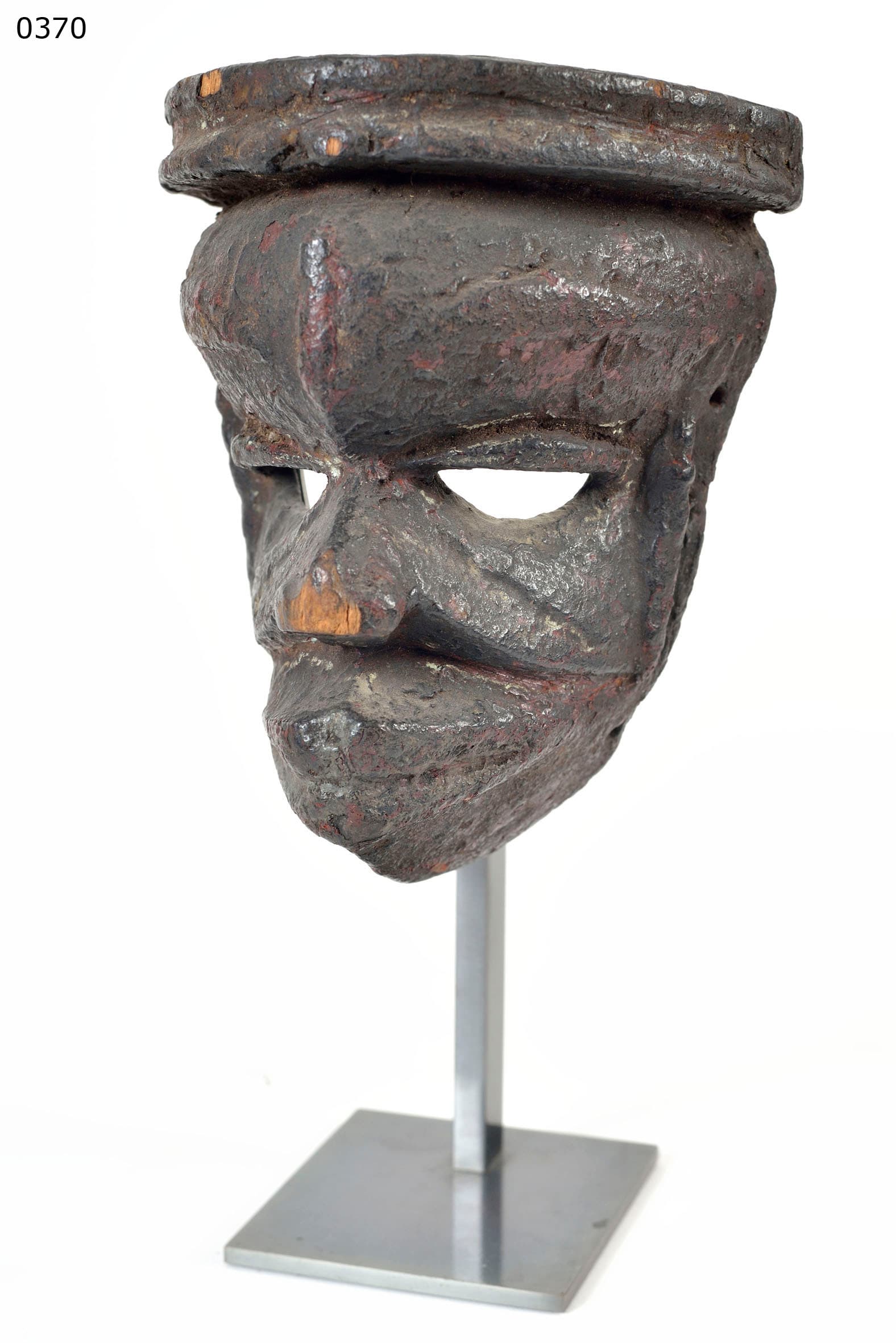
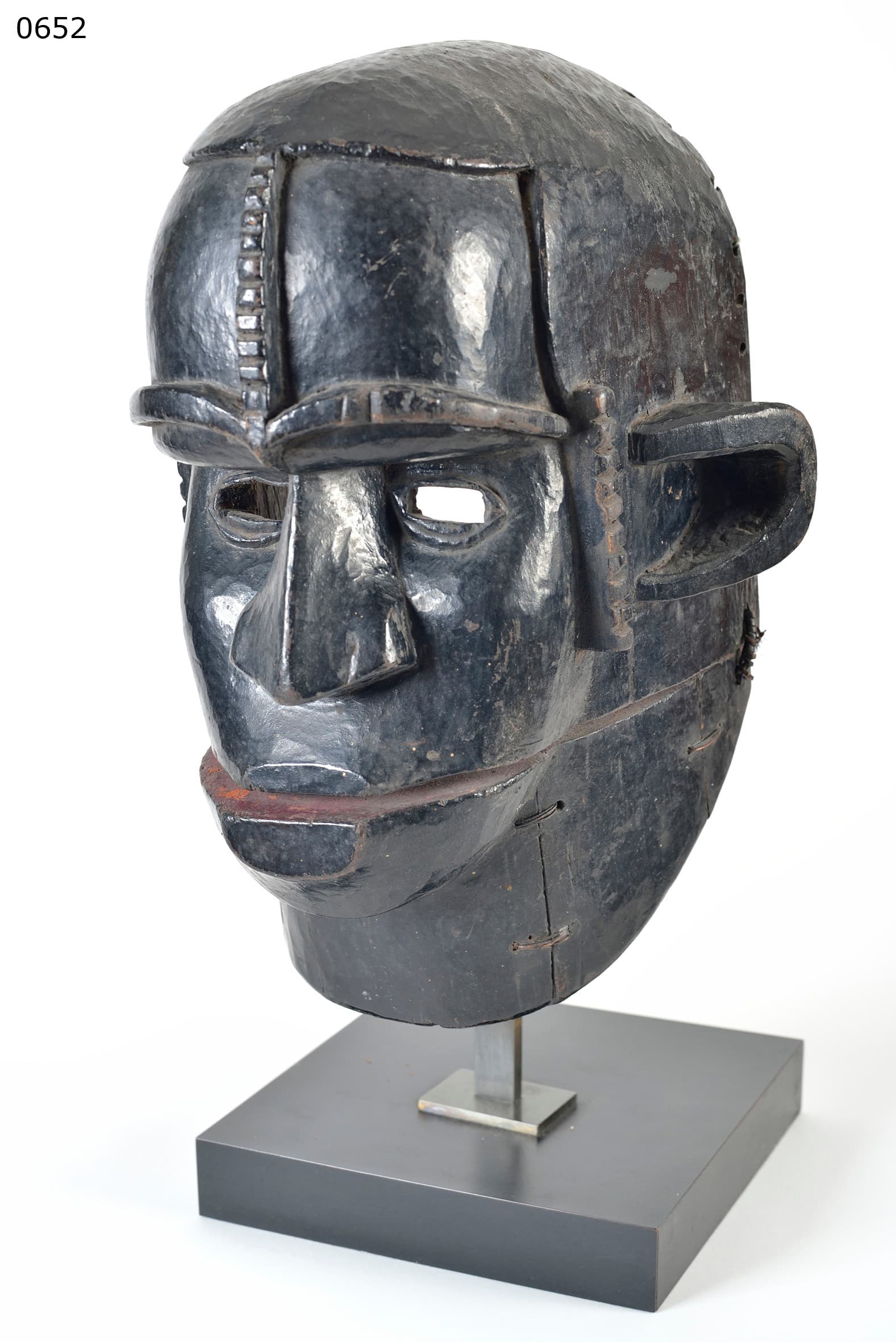
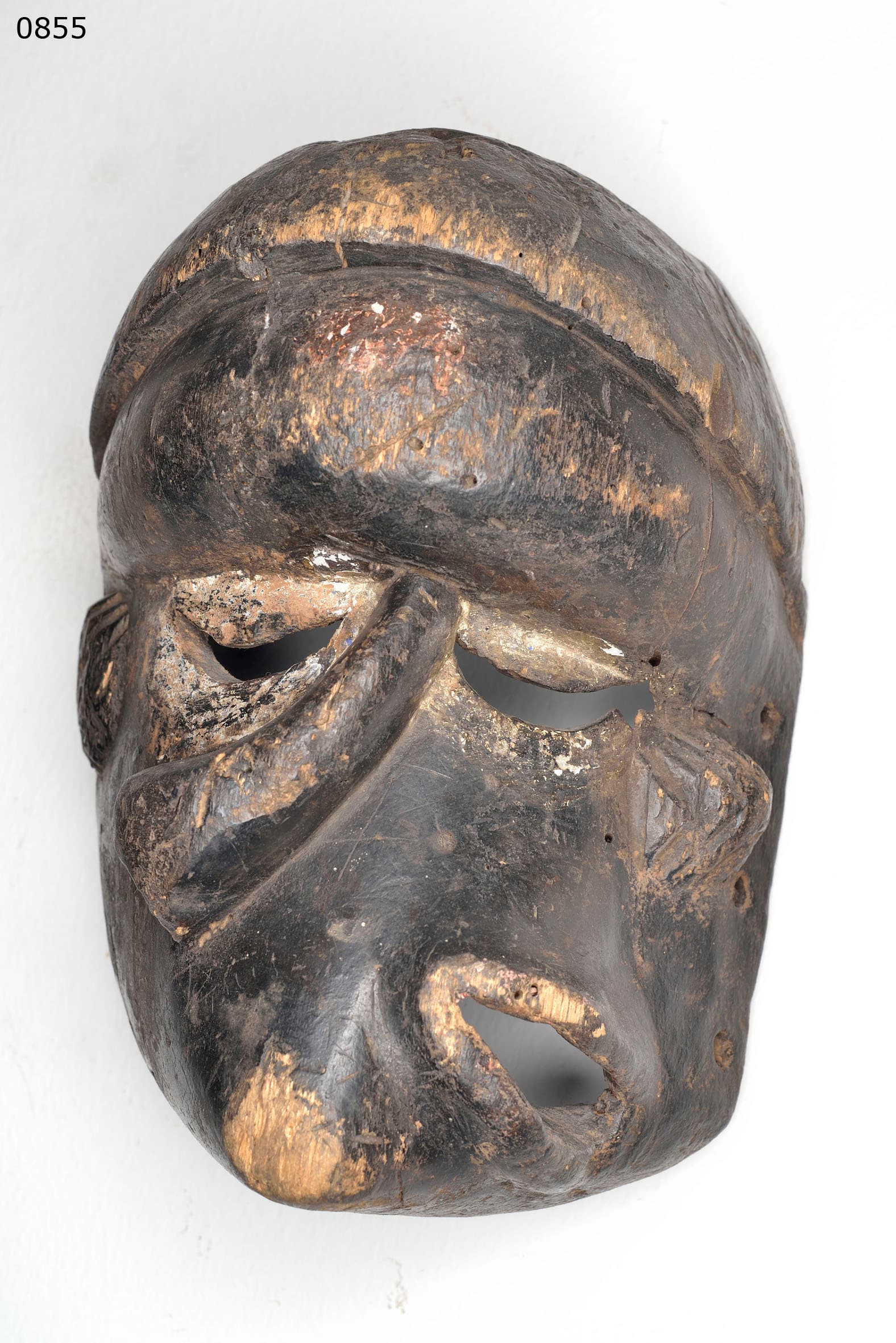
The collection contains four Ekpo masks that exemplify this duality. The Sickness Mask No. 855 (28 cm, wood) is a paradigmatic Idiok Ekpo example featuring ibuo-akwanga/Gangosa iconography — it visualises the spiritual consequence of ethical transgression, not the mockery of the sick, but the apotropaic warding off of the depicted suffering. The Clap-face mask No. 652 (38 cm, wood), with its mechanically articulated, string-operated lower jaw, also belongs to the Idiok type; the resonant snapping during the performance reinforces the spirit’s menacing presence and testifies to the technical sophistication of the region’s master carvers. Masks No. 370 (17 cm) and No. 1166 (31 cm) complete the ensemble — No. 370 is typologically ambivalent due to its small size (small for an Ekpo face mask, possibly to be classified as an Ogbom miniature or an Idiong divination amulet), No. 1166 conforms to the standard medium-sized Ekpo type, presumably Mfon.
In addition to the Ekpo masks, the canonical typology includes further distinct forms. Oron Ekpu figures are considered the oldest surviving wooden sculptures in Nigeria: columnar in form, carved from a single hardwood trunk, with an elongated, bearded head set upon a narrow torso and a distinctive ‘onion belly’; they serve as ancestral portraits in Oron community houses, where figures representing up to fourteen generations are displayed. Eket ancestral masks deviate radically from the Ibibio canon: perfectly round, disc-like faces, broken down into concentric circles and abstract polygons — almost avant-garde and geometric. Ogbom dance headdresses honour the earth goddess Ala and are particularly common among the Eket; they depict idealised female figures with full breasts and the stylistically characteristic subnasal prognathism (protruding mouth), a motif that spread as far as Igbo regions. Idiong figures have a compressed torso and an oversized head, which marks the seat of clairvoyance, often with cowrie shells or ritual gourds as attributes. Ekon puppets (articulated wooden figures for satirical performances) caricature social types — ‘wicked old women’ with sagging breasts, corrupt dignitaries. Finally, Mbopo sculptures celebrate the initiates of the Fattening Room: plumper proportions, elaborate scarifications, Nsibidi patterns and traditional hairstyles.
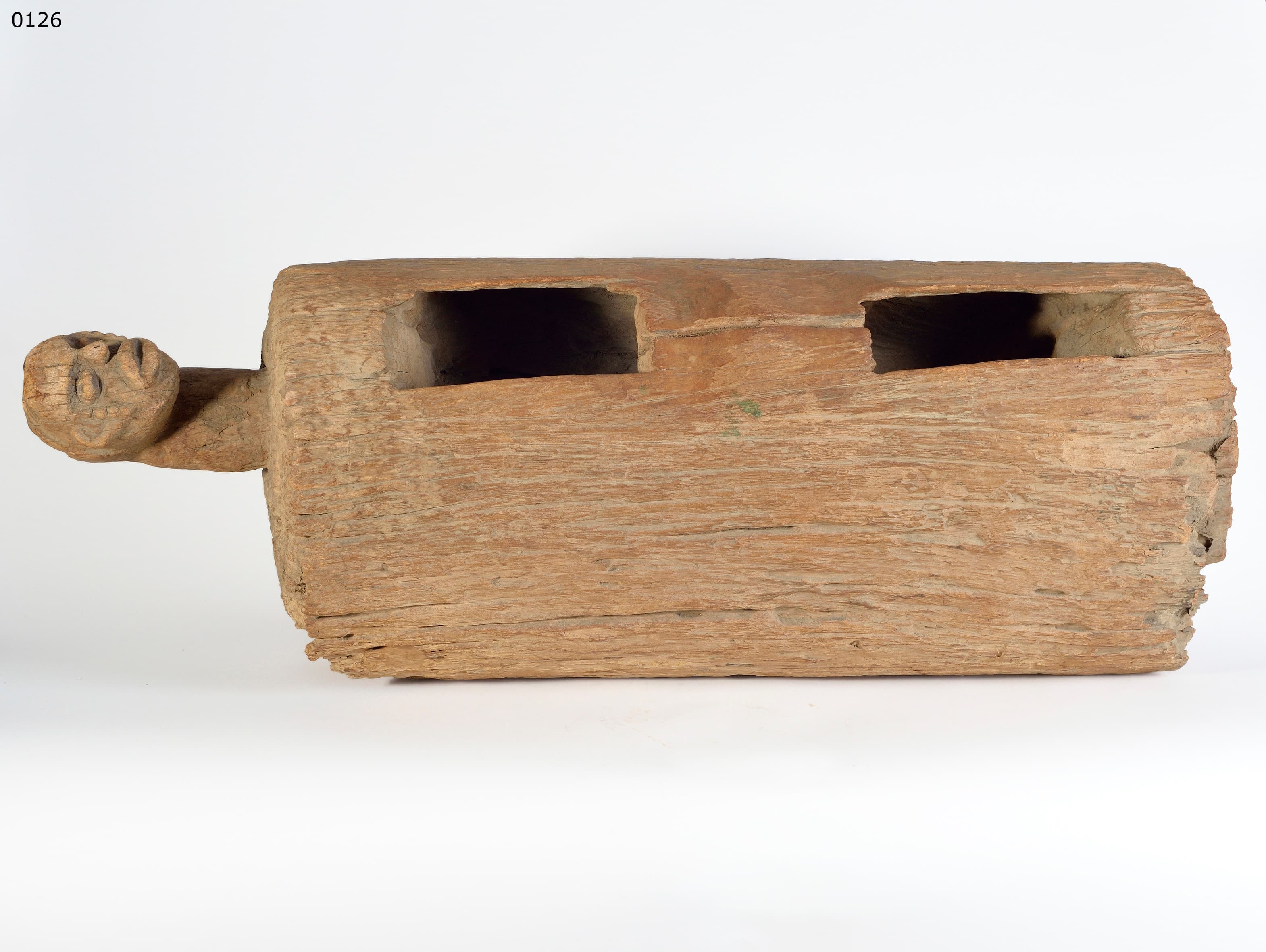
Two further types of collection pieces complement the mask ensemble: the shrine-altar No. 2 (40 cm, wood/bone) is an Idiong altar ensemble — carved wood assembled with animal (historically partly human) bones, sacrificial matter and magical substances; its thick patina of palm oil, blood and plant juices bears witness to its ritual charge as an active reservoir of power. The ritual drum No. 126 (102 cm, wood), with its monumental size, is an Ibit of the Ekpo processions; its rhythm is the ‘voice of the spirits’, which dictates the movements of the masked dancers and induces a trance in the abia idiong. Outside of ceremonies, such drums are kept in sacred forests (Akai), which are strictly off-limits to the uninitiated.
The range of materials is ritually coded: For dynamic dance masks, light wood from the Okwe tree (Ricinodendron heudelotti) is preferred, whilst permanent altar sculptures and the Nwa-ekpo mask type are made from hardwood (Funtumia elastica, locally known as Mba); for Oron ancestral figures, the Oko tree is used due to its resistance to pests. The canon of proportions is metaphysically determined — the head is almost always exaggerated in relation to the torso, as it represents the seat of the soul, the mind and spiritual presence.
In the 1930s, under the influence of colonial demand, the Annang subgroup developed a carving style documented as the Modern Annang Style: G.I. Jones described how carvers in Ikot Ekpene moved away from traditional skin-covered objects and produced free-standing figures in soft wood, painted with clear varnish — an economic compromise between Ibibio tradition and Victorian-naturalistic taste. This style is to be distinguished, both historically and aesthetically, from the ritual-oriented core canon.
The decisive ontological difference between an activated ritual object and a profane carving lies in the stratigraphic patina: over the years, ufofob (high-proof, locally distilled gin), palm wine, red palm oil, sacrificial blood, egg residues, ash and soot from the shrine fires accumulate to form a deeply encrusted sacrificial patina; the wear marks on the forehead, cheekbones and chin reveal smoothed, darkened contact zones where the wearer’s skin rubbed against the wood for years. Forgers simulate this stratigraphy through potassium permanganate oxidation (for a dark patina) or by burning in lemon juice (for craquelure effects); chemical spectroscopy, however, reveals the absence of organic lipids (animal blood, palm oil, human sweat), and the interior of an authentically worn mask invariably shows the smoothed contact zones, which are almost impossible to reproduce artificially with any degree of accuracy. Genuine termite damage follows the cellulose structure of the heartwood with irregular sawdust residues — in contrast to the mechanical drill holes of modern imitations — and deep radial cracks in the heartwood arise as a natural reaction of tropical wood to the drastic changes in humidity in European collections.
Ritual Practice
The life cycle of an Ibibio ritual object is a formalised, transcendent process that describes its ontogenesis from a profane block of wood to an animated sacred resonating body, culminating in ritual deactivation in the Bad Bush.
The creation of a mask or figure begins in strict isolation. During the creation of sacred objects — particularly the idiok ekpo masks — the carver is subject to strict taboos; any contact with uninitiated persons and women is forbidden, so as not to ritually defile the material prematurely. The finished work is initially ontologically neutral: a dormant artefact without inherent spiritual power.
The activation takes place in the hidden chambers of the Ekpo Lodge, a building found in every Ibibio village and kept closed to uninitiated villagers under threat of draconian punishment. Here, the masks and paraphernalia are placed on special altars — such as Shrine Altar No. 2 in the collection — which function as interdimensional points of contact with the ancestors. The activation is performed through libations and blood sacrifices: The abia idiong recite invocations and offer specific substances — ufofob (high-proof local gin), palm wine, red palm oil. The essential life force is transferred through the blood of sacrificial animals (mostly chickens), which is poured directly onto the sculpture or mask, flanked by eggs as a symbol of cosmological balance. Symbolic objects such as elephant tusks (nnʌk eniin) and gourd cups (ukpok) mark the shrine space (Iso Ekpo). The cyclical accumulation of these liquids, together with ash and soot from the shrine fires, creates over the years the characteristic encrusted sacrificial patina — the metaphysical seal of the ancestors’ presence.
The performance (mbop) is tied to the agricultural calendar. The Ekpo ceremonies take place at the end of the harvest season and dominate village life for exactly three weeks. The performance begins with a rite of spatial sacralisation: the mask-bearers draw magical circles in the sand of the village square, within which they line up to summon the spirits from the underworld as witnesses. As soon as an initiate pulls the mask over his face, a complete spiritual metamorphosis takes place — he loses his human identity and, according to indigenous belief, becomes possessed by the soul of the ancestor. This incorporation grants him total legal and social immunity: it is not he who acts, but the spirit.
The choreography sharply distinguishes between the two types of mask. The Mfon Ekpo masks appear in broad daylight; their movements are calm, controlled and graceful. They walk with dignity across the market square and interact benevolently with the villagers — representations of peace and integrity. The Idiok Ekpo masks (such as the Sickness mask No. 855 and the Clap-face mask No. 652) enter the square at dusk; they wear jet-black raffia costumes, are armed with machetes, sticks or symbolic weapons, and move with explosive, chaotic energy. Eyewitness accounts describe the masked dancers swarming ‘like angry wasps’, charging into the crowds and occasionally engaging in wild fights amongst themselves. The acoustic presence of the Clap-face masks is created by the loud snapping of their jaws. The rhythmic foundation of this performance is provided by the ritual drum Ibit (collection no. 126) — its “voice of the spirits” dictates the movements and induces a trance in the abia idiong; outside the ceremony, it is kept in sacred forests (Akai).
Running parallel to the mask cycle is the women’s ritual of the Mbopo (known among the Efik as Nkuho, internally as ekuk mbopo). Young girls are withdrawn to the Fattening Room, fed a high-calorie diet and instructed in marital duties, dances and social secrets. The initiation culminates in a public dance with red Ndom powder and Nsibidi body markings; successful graduates are, as Jill Salmons has documented, often initiated into the mysteries of the water spirit Mammy Wata.
At the end of the three-week festivities, the masks are returned to the Ekpo lodge, where they remain in a state of latent potency until the next cycle. The deactivation or disposal of an object is a metaphysically consistent step: When, in the humid tropical climate, termites structurally decompose the wood, or when diviners determine that the specific ancestor has left the vessel, the object is ritually discharged and often simply thrown into the Bad Bush — the tabooed patch of woodland considered the dwelling place of the ekpo onyon. Noteworthy is the indigenous philosophy of conservation, which stands in contrast to Western museology: damaged sacred objects are traditionally often not repaired, as human intervention would distort their spiritual integrity. It was precisely this moment of ritual deactivation — the transition from sacred object to meaningless wood — that historically constituted the narrow window of opportunity in which colonial officials, missionaries and early collectors such as Webster Plass could acquire objects without provoking open religious conflict.
For the six collection objects, this life-cycle matrix implies a nuanced contextualisation: the shrine-altar No. 2, as an Idiong altar with a bone assemblage, stands at the pole of active ritual charge; the drum No. 126, as the acoustic backbone of the mbop; the Idiok masks No. 855 and No. 652 as active vessels of Idiok-ekpo presence; the small mask No. 370 and the standard mask No. 1166 in the typological ambivalence between Idiong amulet, Ogbom miniature and Mfon-ekpo face mask.
Historical Context
The migration history of the Ibibio is at the heart of a major ethnohistorical dating controversy. The Neolithic Expansion Hypothesis, supported by archaeological evidence regarding the spread of Sahelian agriculture following the aridification of the Sahara, dates the arrival of the Proto-Ibibio in the Cross River Basin to around 7000 to 3500 BC; this view posits the Ibibio as the indigenous original inhabitants of south-eastern Nigeria, whose cultural substrate had a lasting impact on the region. The Late Medieval Cameroon Migration Hypothesis, supported primarily by linguistic data and the oral traditions of the Afaha lineage, locates the original homeland in Usak Edet in present-day Cameroon; according to this, the Ibibio initially settled in Ibom (near Arochukwu), but were subsequently driven further south into their present-day settlement area between 1300 and 1400 AD as a result of the ‘Ibibio War’ against the expanding Igbo. The evidence remains ambiguous — modern reconstructions tend towards a synthetic interpretation that combines an early substrate settlement with later Aro-induced waves of migration.
The most radical upheaval in social structure and artistic production occurred in the late 19th and early 20th centuries as a result of the colonial encounter with the British Empire. The British administration viewed the executive power of the Ekpo and Idiong societies as a direct threat to its colonial legal monopoly. The consequences were punitive expeditions that confiscated masks, altars and paraphernalia as ‘spoils of war’ and transported them to European museums — a practice analogous to the acquisition of the Royal Museum for Central Africa (RMCA) in Tervuren. At the same time, Christian missionaries were engaged in the destruction of local shrines and the erosion of Bünde authority; converts refused to participate, which undermined the village’s spiritual consensus. Percy Amaury Talbot, a British colonial official between 1912 and 1916, collected over 80 boxes of ethnographic material during his tenure and, with his publications Life in Southern Nigeria (1923) and later works (1926), produced the first systematic documentation of the Ibibio secret societies; his collection forms the core of the British Museum’s Nigeria collection.
Colonial history also exerted a transformative influence on artistic production. As the ethnographer G.I. Jones documented in Ikot Ekpene (Annang region), local carvers responded to the rising demand from colonial officials, missionaries and tourists by establishing a local mass industry — the Modern Annang Style featuring light wood, clear varnishes and naturalistic facial features, an astute economic compromise between Ibibio tradition and Victorian naturalism. In the 1970s, Keith Nicklin and Jill Salmons — in response to the loss of traditional forms such as skin-covered masks — developed the Ethnographic Retrieval Method: they collaborated with local artists to revitalise forms that were in the process of disappearing, both for museums and for the local community.
Organised resistance to colonial appropriation emerged early on. In 1928, Ibibio activists founded the Ibibio State Union — one of Nigeria’s first modern socio-cultural and political organisations — which demanded recognition as a sovereign nation from the British and awarded overseas scholarships. The Biafran War (1967–1970) marked a traumatic turning point: as part of the embattled south-east, the region was strategically central, and during the occupation of the Oron Museum, hundreds of irreplaceable Ekpu ancestral figures were looted or destroyed; many later appeared on the international art market and remain the subject of restitution debates to this day.
The market history of Ibibio art in the West ran parallel to the discovery of ‘Art Nègre’ by the European avant-garde. Early collectors such as Webster and Margaret Plass assembled significant collections after the Second World War, which were later donated to the British Museum. The Swiss collector Han Coray acquired pieces that are now housed in the Museum Rietberg in Zurich; the Dadaists particularly appreciated the expressive power of the Idiok Ekpo masks, which they interpreted as a liberation from bourgeois ideals of beauty. The breakthrough to recognised ‘high art’ came in 1962 with the exhibition Nigeria – 2000 Years of Sculpture, curated by William Fagg at the Kunsthalle Basel, which revealed the mastery of Nigerian sculpture to a global audience. The subsequent price trend on the secondary market has been exponential — and provenance linked to historical collecting giants such as Helena Rubinstein, Allan Stone, Paolo Morigi, Arman or William S. Arnett has become the decisive measure of value.
The current curatorial debate focuses on forensic authenticity testing and restitution ethics. The Metropolitan Museum of Art (Michael C. Rockefeller Wing), the Michael C. Carlos Museum (Emory), the Fowler Museum at UCLA and the Musée du quai Branly have systematically catalogued their Ibibio collections and now strictly distinguish between Ibibio, Annang, Eket and Oron. For the present collection — Shrine Altar No. 2, Ritual Drum No. 126, and Masks Nos. 370, 652, 855 and 1166, all dated to the first half of the 20th century — this context necessitates a nuanced classification: Chronologically, the objects fall within the height of colonial and missionary ‘pacification campaigns’, that is, a period in which many cult objects were removed from their ritual contexts under the asymmetrical power relations of Western actors. For local preservation initiatives in Akwa Ibom and for the Ibibio diaspora, these works represent not merely aesthetic artefacts, but looted spiritual archives and historical legal documents of their ancestors, the repatriation of which is increasingly being demanded as an act of historical justice.