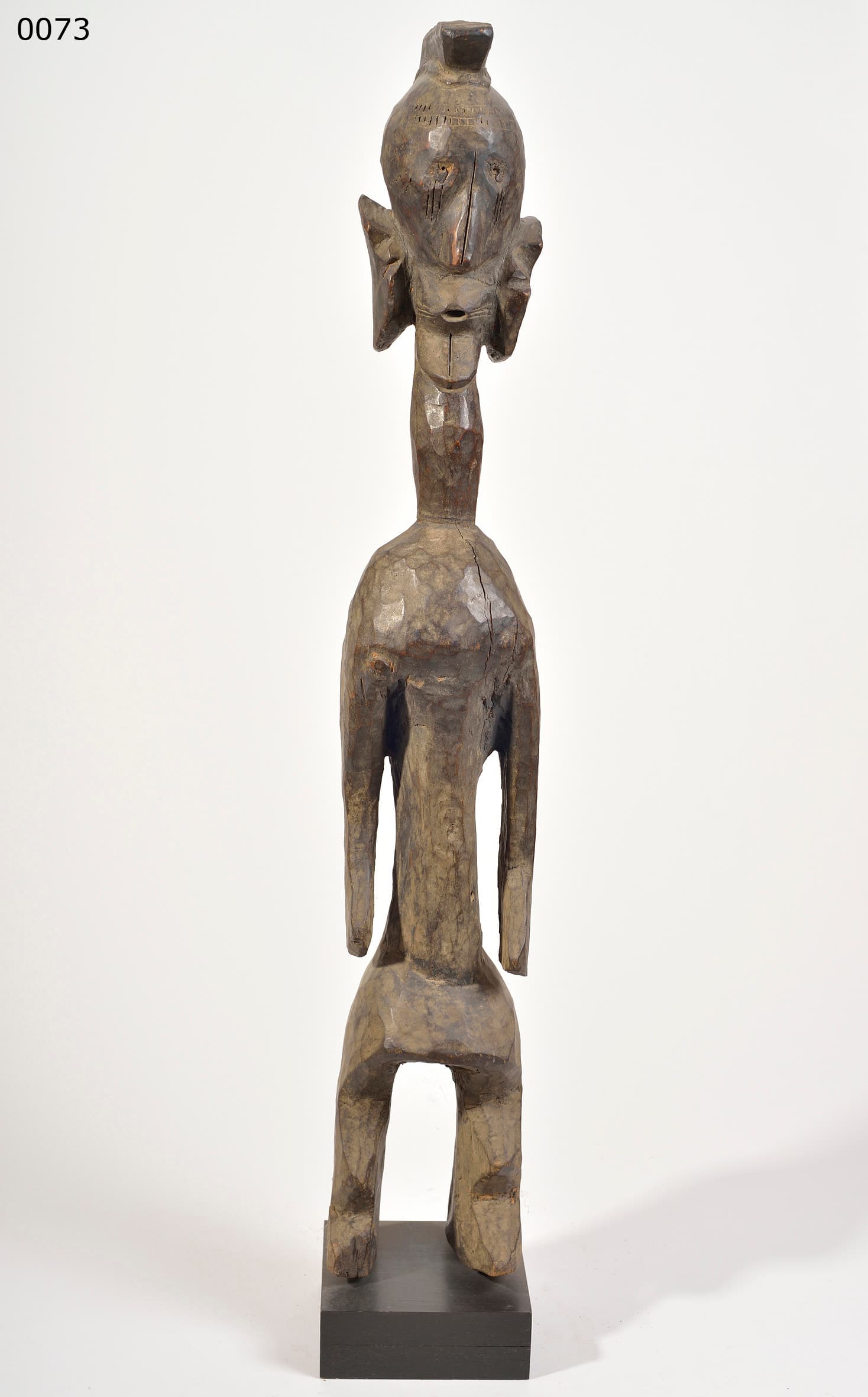
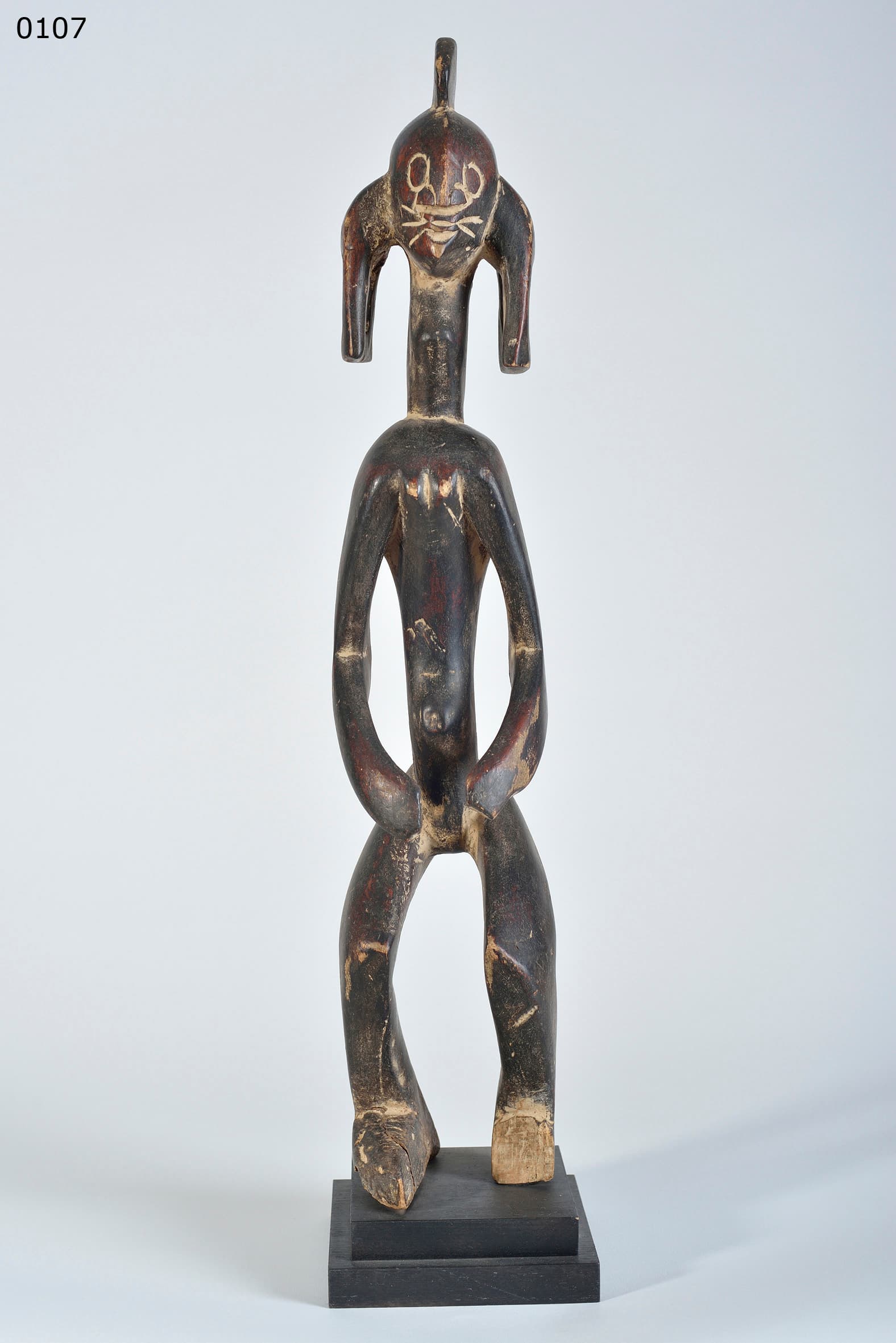
Eine hoch aufragende hölzerne Ahnenfigur (1. Hälfte 20. Jh., 78 cm) von den Mumuye aus Nigeria - aufragender, säulenartiger Torso, flankiert von geschwungenen, bandartigen Armen, abstrakter Scheitelkopf mit markanten, stilisierten Ohren, das dunkle Holz stark verkrustet mit einer krustigen, oxidierten Schreinpatina.
1. Der Zenit der proto-kubistischen Abstraktion
Die Mumuye-Skulptur wird allgemein für ihre revolutionäre Verwendung des negativen Raums gefeiert.
- Leere als Material: Anstatt einen massiven Block zu schnitzen, schnitzt der Künstler das Holz zwischen Torso und Armen weg, so dass sich die Gliedmaßen wie Bänder um die leere Luft winden.
- Kinetische Schwerelosigkeit: Die Technik verleiht einer schweren Hartholzfigur ein Gefühl der latenten Bewegung - entgegen der monolithischen Konvention der meisten afrikanischen Schnitzereien.
2. Die Vabo-Gesellschaft und der polyvalente Schamanismus
Bei diesen Statuen handelt es sich um polyvalente spirituelle Instrumente, nicht um Denkmäler mit Namen von Vorfahren.
- Versteckt im Tsafi: Sie werden in speziellen heiligen Hütten aufbewahrt und von den Ältesten der Vabo-Gesellschaft nur bei Bedarf hervorgeholt.
- Regen, Heilung, Gerechtigkeit: Dieselbe Figur kann eingesetzt werden, um Krankheiten zu heilen, einen Dieb zu identifizieren oder - was im trockenen Benue-Tal besonders wichtig ist - die für das Überleben der Landwirtschaft notwendigen starken Regenfälle herbeizurufen.
3. Schamanische Verkrustung und Benue-Verwitterung
Die stark veränderte Oberfläche spiegelt ein aktives Schreinleben wider.
- Libationsstratigraphie: Wiederholte Anwendungen von Hirsebier, Opferblut und gekauter Kolanuss, die bei Wahrsagerriten auf die Figur gespuckt wurden, haben eine dicke, krustige Patina gebildet.
- Abgeschwächte kubistische Ränder: Die ursprünglich scharfen proto-kubistischen Ränder sind durch eine langjährige Handhabung weicher geworden – was für eine rituelle Herkunft aus der ersten Hälfte des 20. Jahrhunderts spricht.
Zusammenfassung
Ein Ausdruck des dynamischen negativen Raums und der kubistischen Abstraktion: Diese 78 cm große Mumuye-Figur veranschaulicht die kinetischen Qualitäten der nigerianischen Kunst. Ihre ausgeprägte, krustige Patina und ihre fließende Architektur machen sie zu einem bemerkenswerten ethnografischen Objekt.
KI-unterstützt erstellt aus Sammlungsgutachten, Objektfotografie und eigener Recherche, redaktionell geprüft. Fehler sind möglich — Hinweise darauf sind uns willkommen. Zum Verfahren →