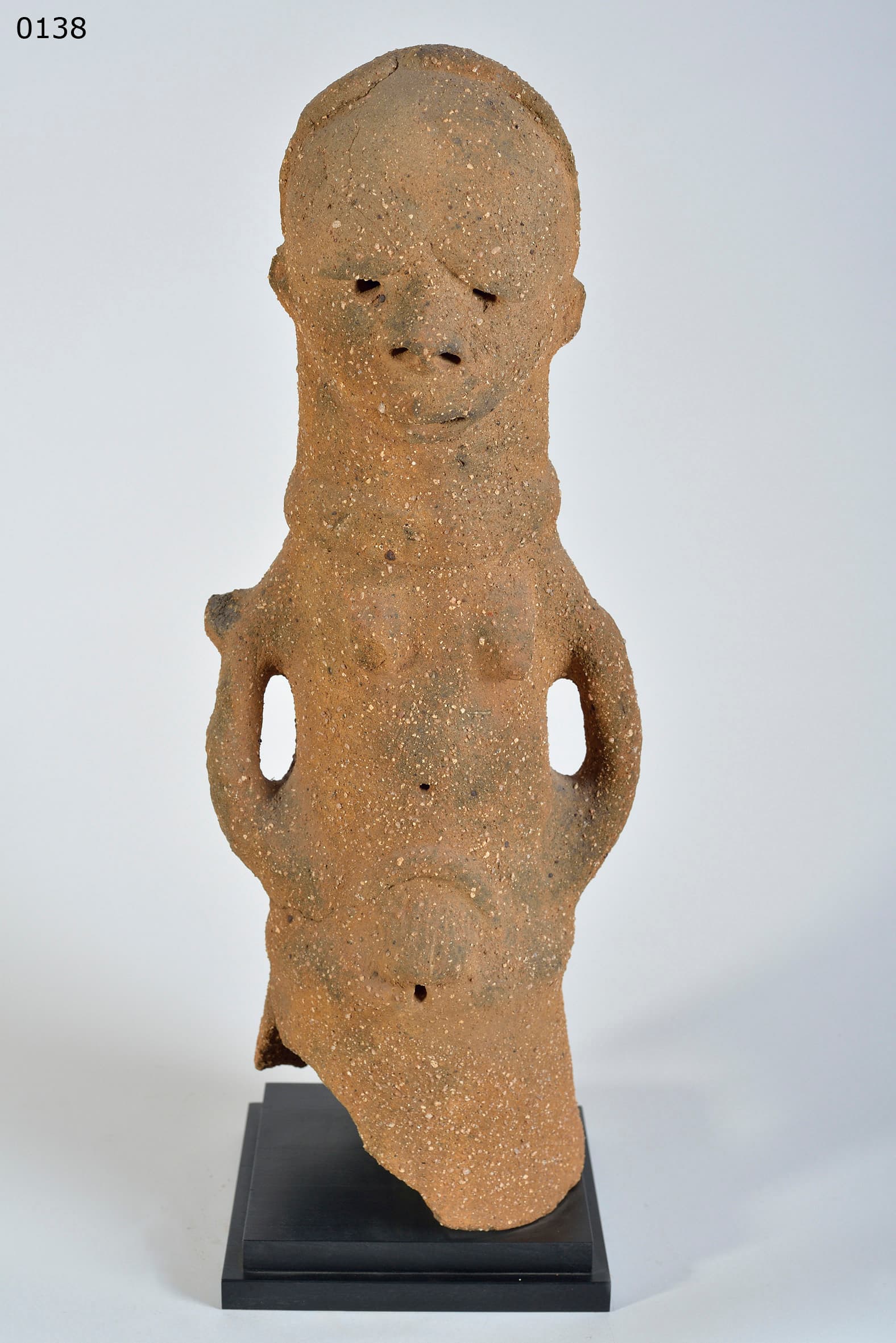
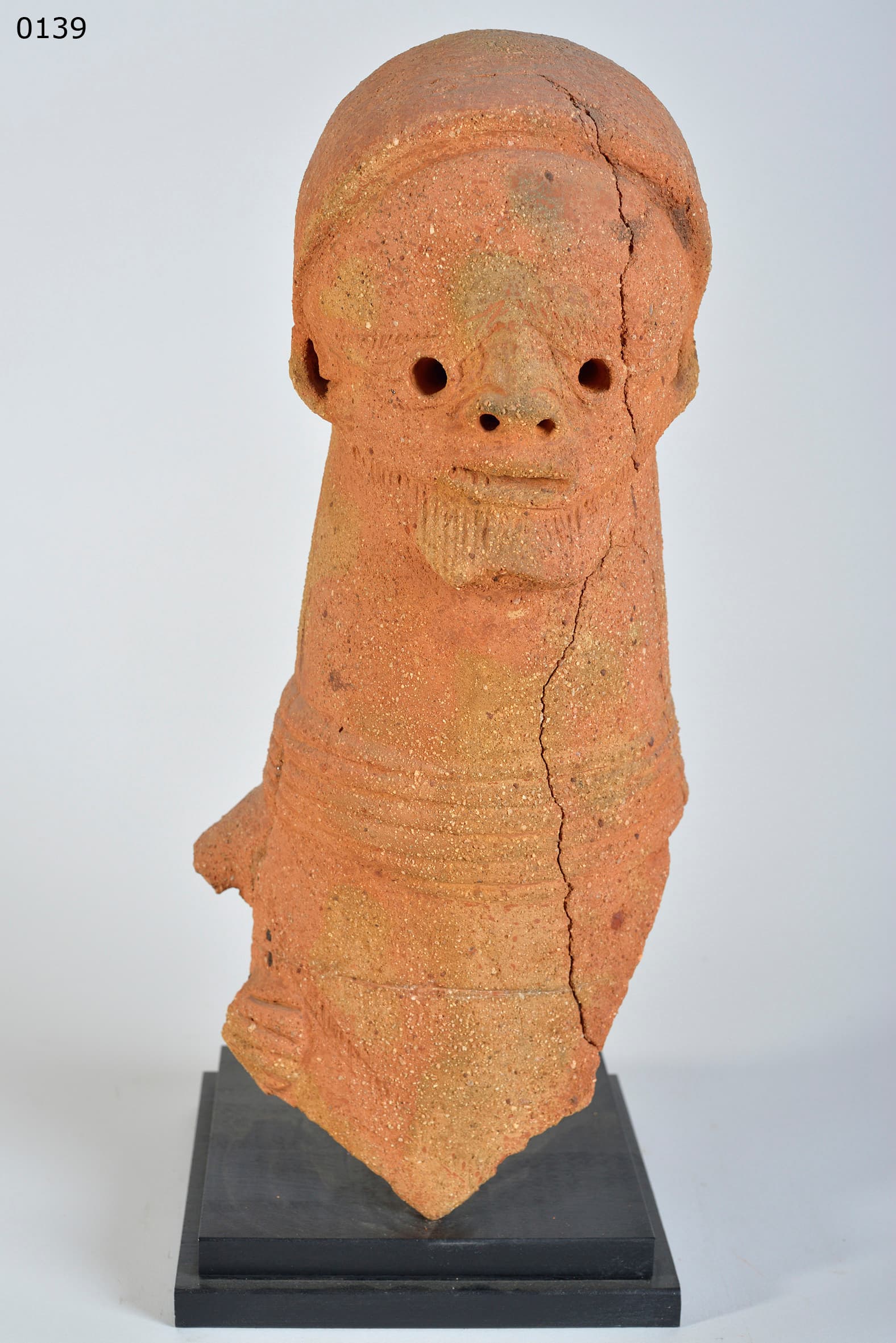
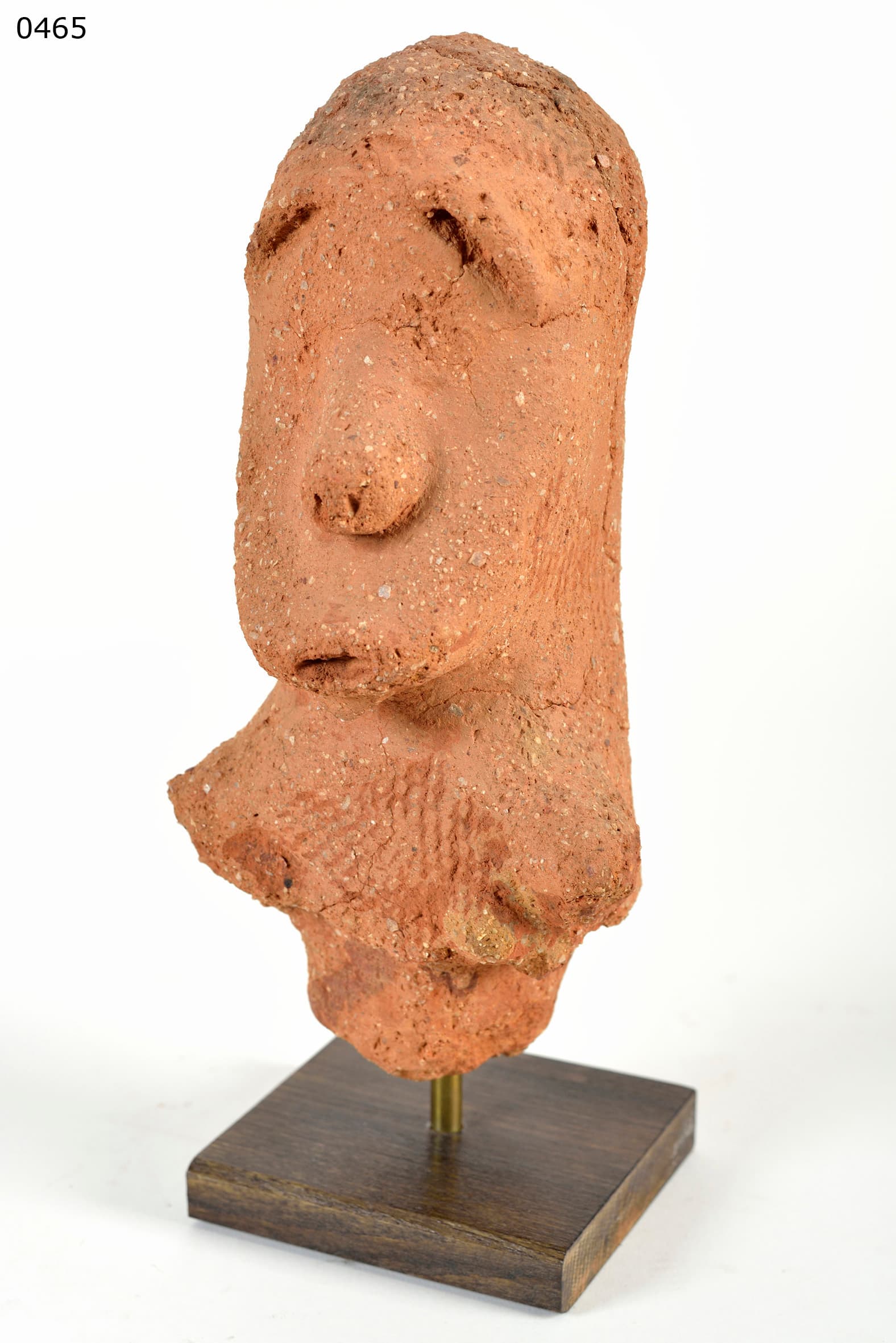
Ein alter, stark verwitterter Sokoto-Terrakottakopf (~2000 Jahre alt, 23 cm) aus Nigeria - charakteristisch für den Sokoto-Stil sind der überhängende, schwere Stirngrat und die tief eingeschnittenen Augenschlitze, mit einer hervorstehenden, vereinfachten Schnauze oder einem Kiefer. Der grobe, blass-orangefarbene Ton ist stark verwittert und hat eine bröckelige, sandige Textur mit deutlicher Bodenverkalkung.
1. Die Sokoto-Ästhetik der Eisenzeit
Die Sokoto-Terrakotta-Tradition im Nordwesten Nigerias, die zeitgleich mit der berühmten Nok-Zivilisation (ca. 500 v. Chr. bis 200 n. Chr.) entstand, stellt eine eigenständige parallele Ästhetik der Eisenzeit dar.
- Strenger Minimalismus: Während in der Nok-Kunst durchbohrte dreieckige Augen und kunstvolle Frisuren im Vordergrund stehen, bevorzugen die Sokoto-Künstler einen strengen, schlichten Minimalismus.
- Überhängende Augenbrauen: Das entscheidende Merkmal ist die massive, schwere, überhängende Augenbraue, die tiefe, dramatische Schatten über die schmalen Augenschlitze wirft - das menschliche Gesicht wird in eine fast zylindrische oder phallische Form gestreckt, die eher rohe, unnachgiebige architektonische Masse als raffinierten Naturalismus ausstrahlt.
2. Votivgaben und Fragmentierung des Heiligtums
Wie die Nok-Terrakotten werden auch die Sokoto-Terrakotten fast ausschließlich als Fragmente gefunden.
- Monumentale Originalkörper: Archäologische Befunde legen nahe, dass diese Köpfe ursprünglich auf vollen monumentalen Körpern saßen - schweren Statuen, die vermutlich in komplexen landwirtschaftlichen und heilenden Schreinen verwendet wurden.
- Absätzliches Zerbrechen: Die absichtliche stilisierte Verzerrung deutet eher auf Darstellungen übernatürlicher Gottheiten oder vergöttlichter Vorfahren als auf gewöhnliche Menschen hin - wenn Schreine verlassen wurden oder Rituale die Freisetzung spiritueller Energie erforderten, wurden die Figuren wahrscheinlich absichtlich zerbrochen und vergraben.
3. Grog-Temperierung und jahrtausendealte Verkalkung
Der physische Zustand zeigt charakteristische Merkmale, die mit einer langen unterirdischen Alterung vereinbar sind.
- Quarz- und Gesteinstemperierung: Um zu verhindern, dass der dicke, schwere Ton beim Brennen im Tagebau explodiert, temperierten die Töpfer von Sokoto den Ton stark mit grobem Quarzsand und zerkleinertem Gestein - das heute aus der erodierten Oberfläche herausragt.
- Gehärtete Kalkablagerungen: Jahrhunderte in saurer nigerianischer Erde haben den ursprünglichen Schlicker abgetragen und eine hochporöse Oberfläche mit gehärteten weißen Mineralablagerungen hinterlassen, die als typische Altersindikatoren gelten.
Zusammenfassung
Dieser Sokoto-Kopf ist ein eindrucksvolles, strenges Beispiel alter westafrikanischer Keramiktechnik. Seine schwere geometrische Abstraktion und die ausgeprägte geologische Verkalkung, die für ein hohes Alter spricht, machen ihn zu einer archäologischen Antiquität von bedeutendem historischem Interesse.
KI-unterstützt erstellt aus Sammlungsgutachten, Objektfotografie und eigener Recherche, redaktionell geprüft. Fehler sind möglich — Hinweise darauf sind uns willkommen. Zum Verfahren →