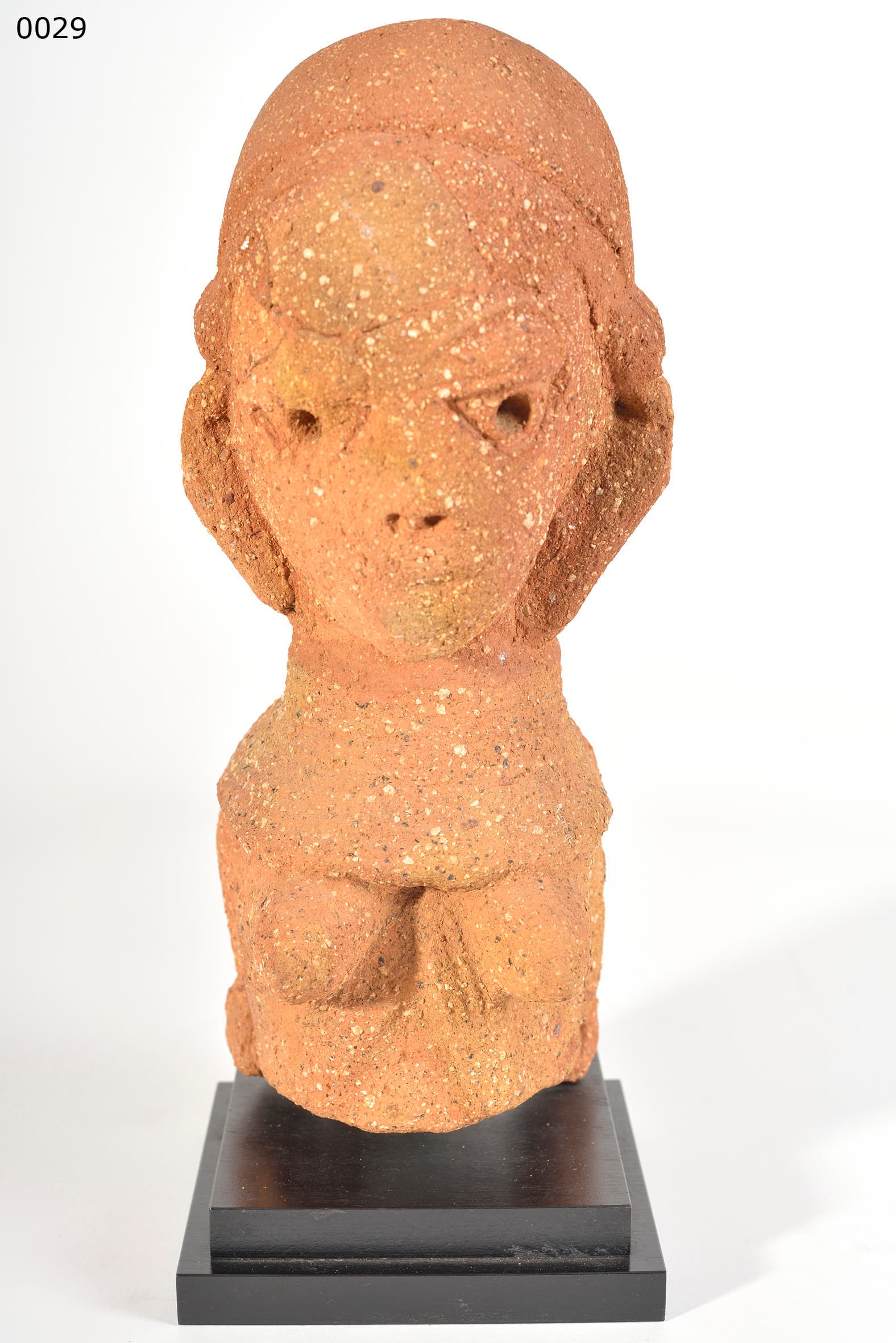
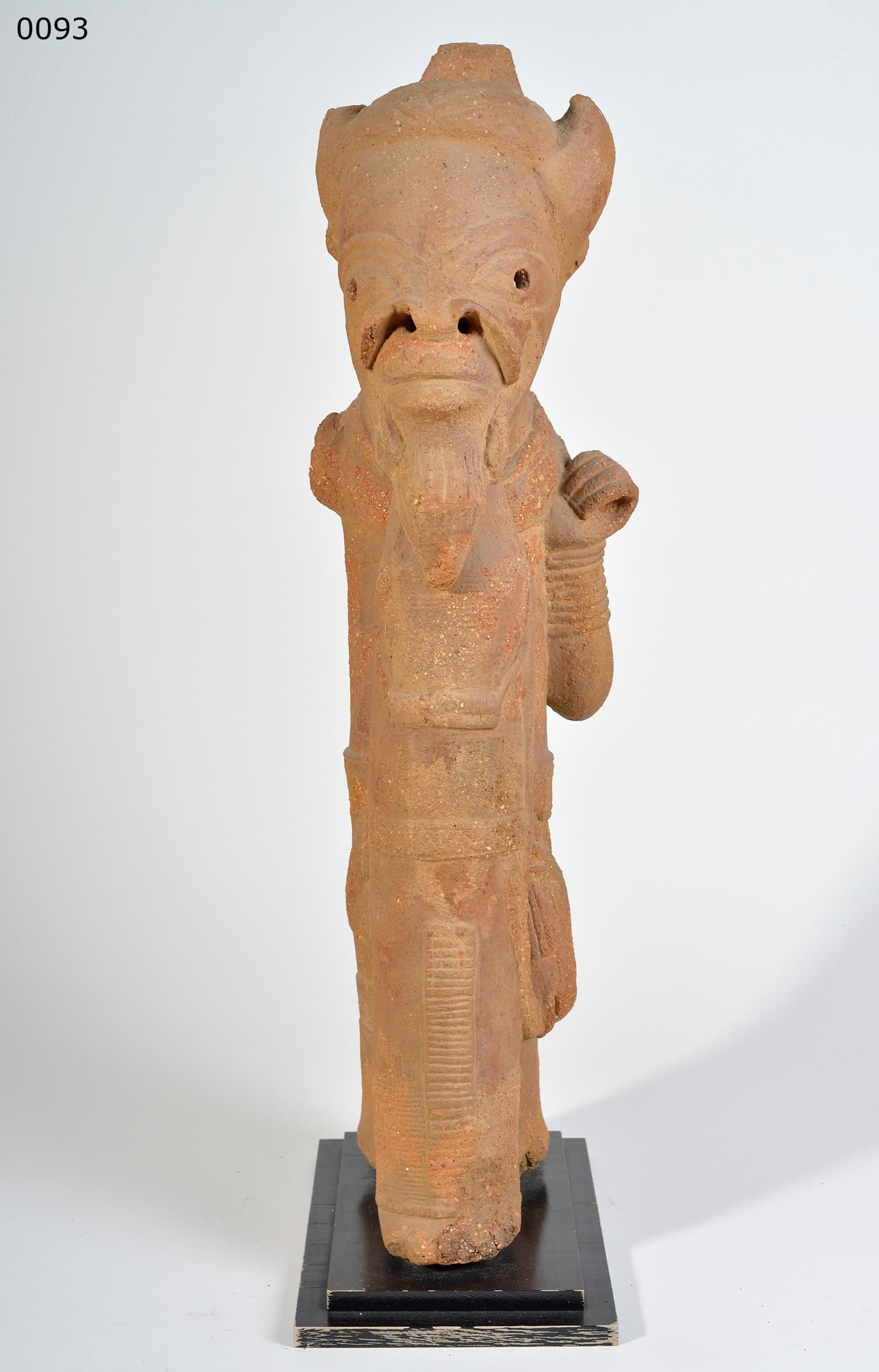
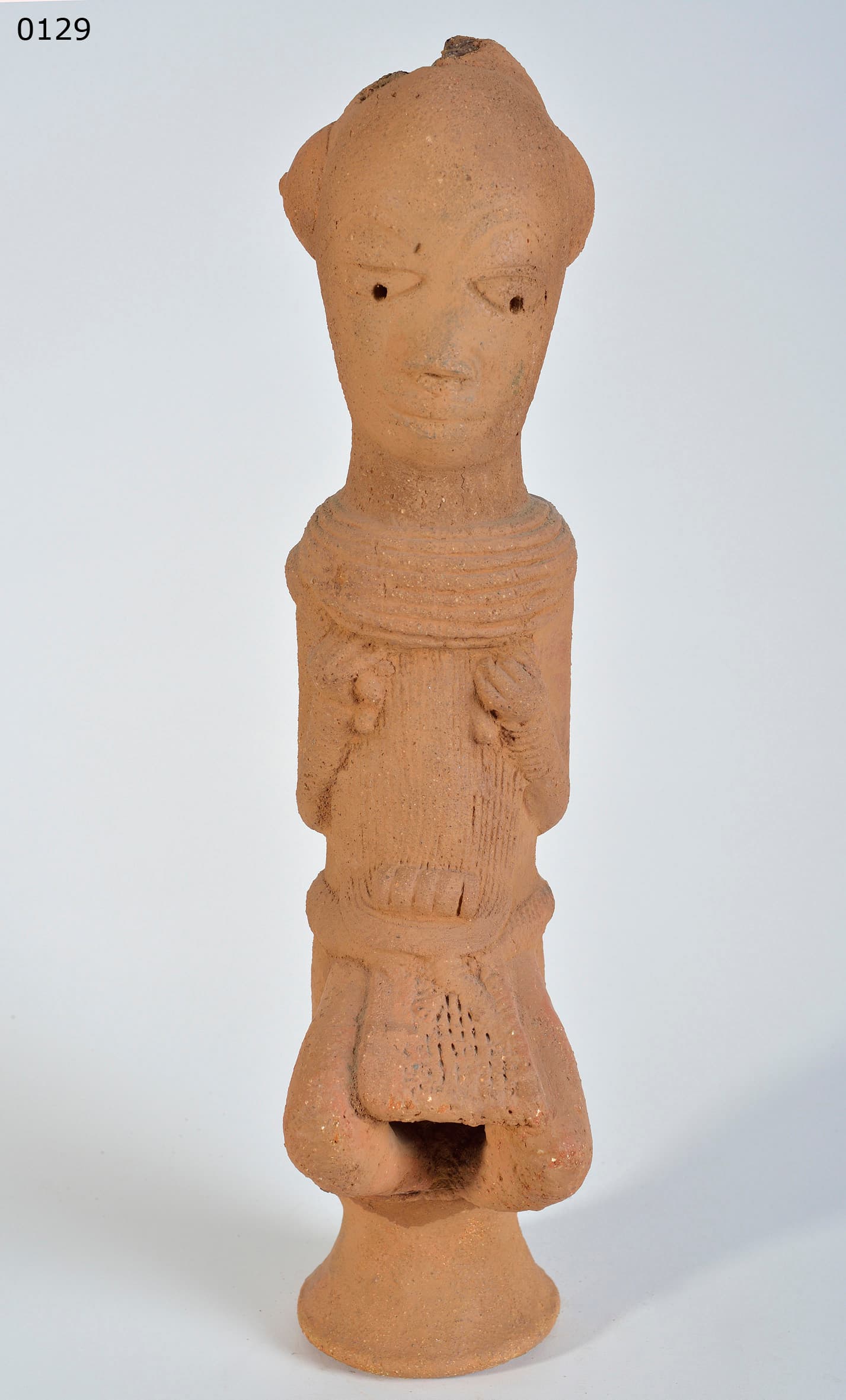
Eine antike Nok-Terrakottabüste (~2000 Jahre alt, 22 cm) aus Nigeria - ein abgestumpftes Fragment mit einer schweren Stirn, klassischen dreieckigen Nok-Augen und stark aufgeworfenen Lippen. Der Körper aus grobkörnigem Ton ist mit einer dicken, blassen, irdenen Verkalkung bedeckt. Teil eines Trios von Nok-Stücken in der Sammlung (0456, 0458, 0459).
1. Das morphologische Genie der afrikanischen Eisenzeit
Die Nok-Zivilisation (ca. 1500 v. Chr. - 500 n. Chr.) schuf den grundlegenden Entwurf für die skulpturale Abstraktion in Subsahara-Afrika.
- Schwere Augenbrauen-Typologie: Dieses Fragment repräsentiert den eher blockhaften, volumetrischen Nok-Kopftypus - definiert durch eine schwere, überhängende Augenbraue, die die tief durchbohrten, dreieckigen Augen überschattet.
- Technik durch Durchbohrung: Die tiefe subtraktive Durchbohrung war sowohl stilistisch - sie schuf dramatische dunkle Hohlräume - als auch eine geniale technische Notwendigkeit, die es ermöglichte, dass die Hitze während des Brennens entweichen konnte, um zu verhindern, dass der dickwandige Ton zerbricht.
2. Die standardmäßig fragmentierte Büste
Dies ist die am häufigsten anzutreffende Form im Nok-Korpus - ein Büstenfragment, das von einer einst vollständigen Skulptur abgetrennt wurde.
- Agrarschrein-Ursprung: Ursprünglich das krönende Porträt einer massiven, ganzkörperlichen Ahnenfigur, die in den Freiluft-Agrarschreinen der frühen Eisenverhüttungsgemeinschaften aufgestellt wurde.
- Rituelle Enthauptung: Bittet um Regen und Fruchtbarkeit; archäologischer Konsens deutet darauf hin, dass die Figuren absichtlich zerbrochen wurden, wenn die Schreine verlassen wurden - die Kopffragmente (der Sitz der spirituellen Essenz) wurden getrennt vom Körper aufbewahrt oder gelagert.
3. Jahrtausendalte Verkalkung und Quarzgrog
Die physische Geologie garantiert ein hohes Alter.
- Grog-temperierter grober Ton: Der Ton ist stark temperiert mit großen Brocken von Quarzgrog, die auf den erodierten Oberflächen sichtbar sind - die wesentliche Nok-Töpfertechnik zur Vermeidung von Fehlern beim Brennen in offenen Gruben.
- Tief vergrabene kristalline Kruste: Zwei Jahrtausende tiefen Vergrabens in saurer nigerianischer Erde haben den Schlicker abgetragen und das Fragment in einer harten weißen kristallinen Verkalkung begraben, die dauerhaft mit der porösen Terrakotta verbunden ist.
Zusammenfassung
Diese Nok-Büste repräsentiert das klassische fragmentarische Überlebensmuster der westafrikanischen Eisenzeit - ein stirnlastiges Ahnenporträt, das vor der Zerstörung seines Schreins gerettet wurde. Ihre tiefe, 2.000 Jahre alte Verkalkung und ihre grobkörnige Struktur machen sie zu einer archäologischen Antiquität von höchster globaler Bedeutung.
KI-unterstützt erstellt aus Sammlungsgutachten, Objektfotografie und eigener Recherche, redaktionell geprüft. Fehler sind möglich — Hinweise darauf sind uns willkommen. Zum Verfahren →