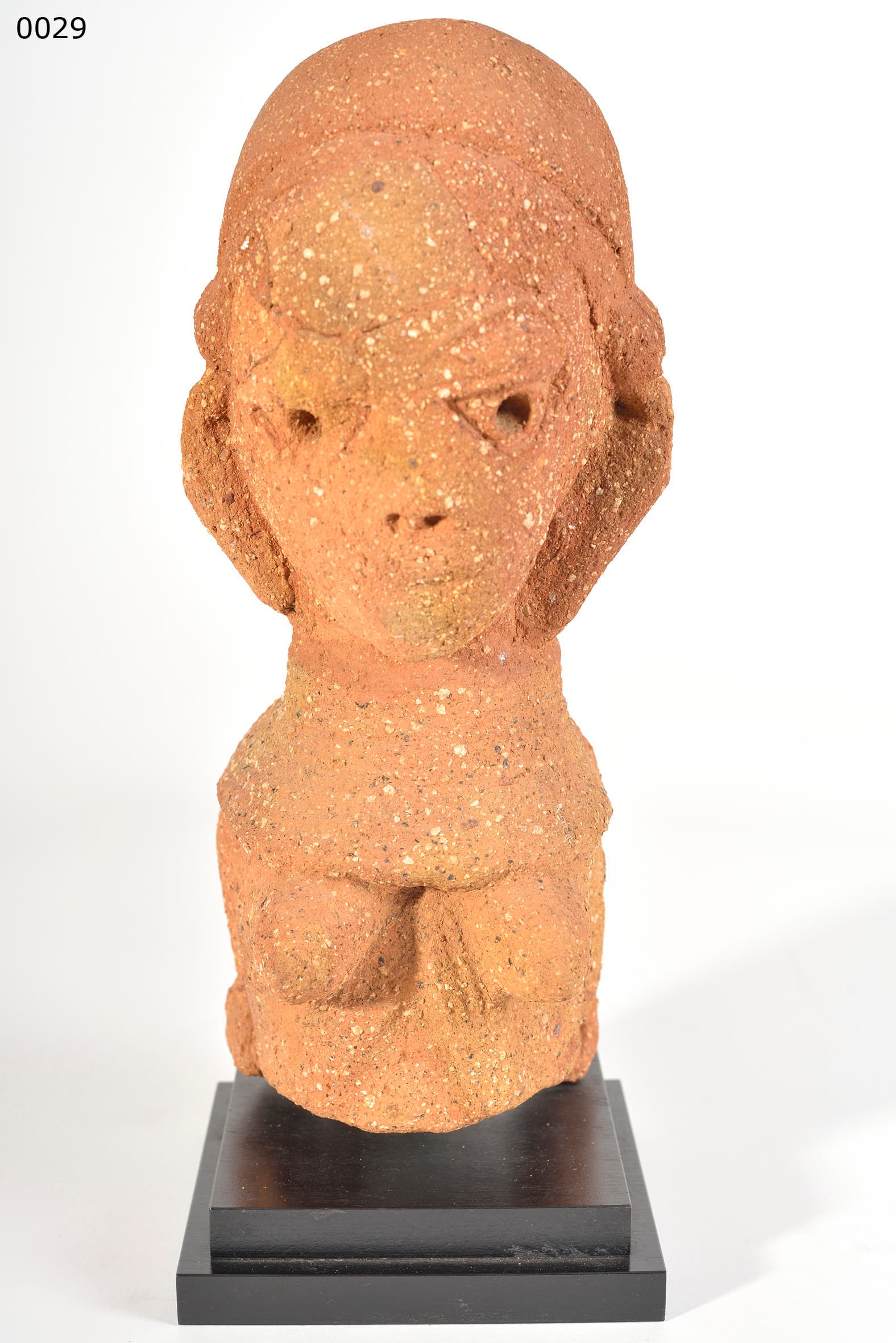
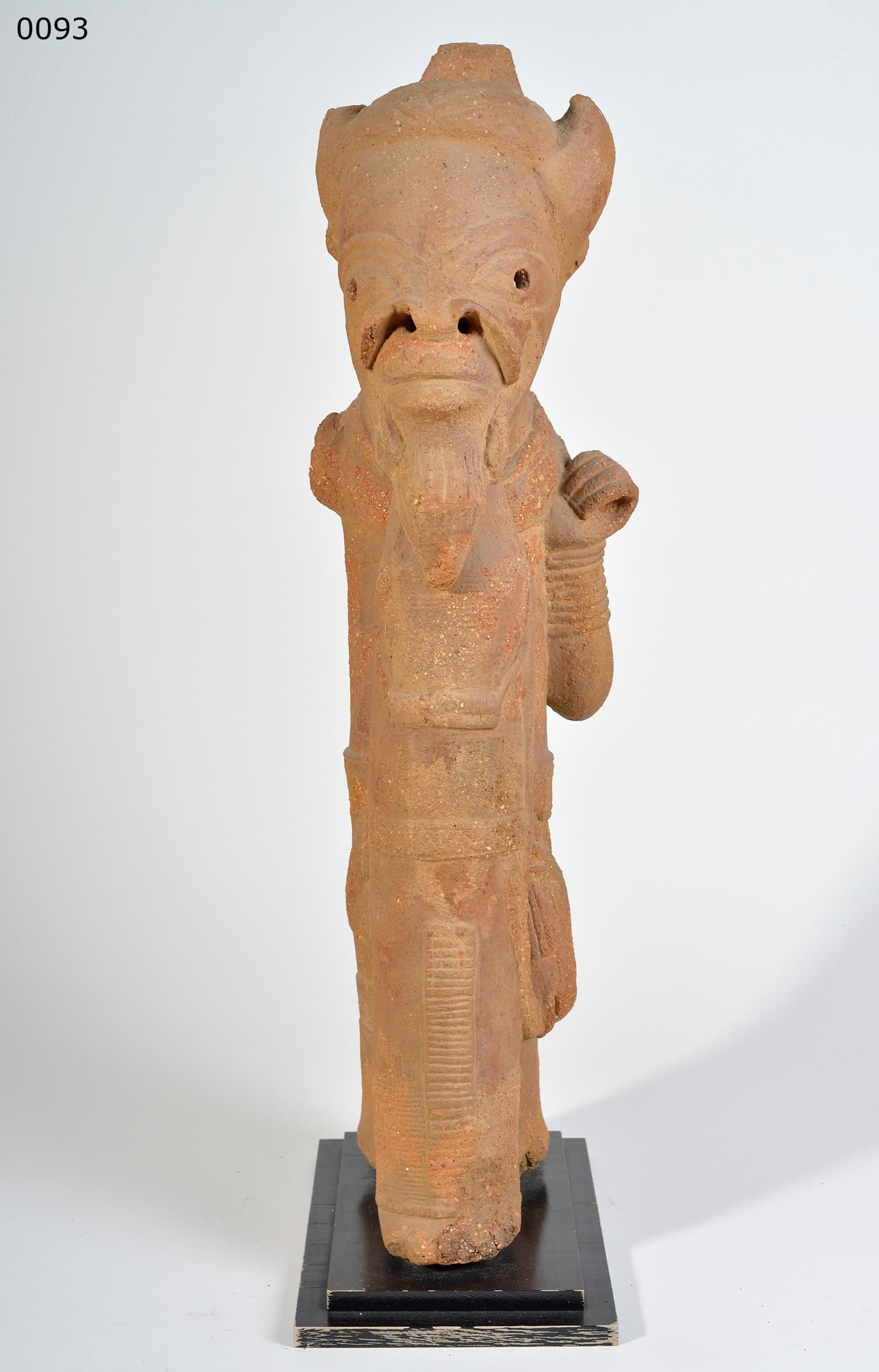
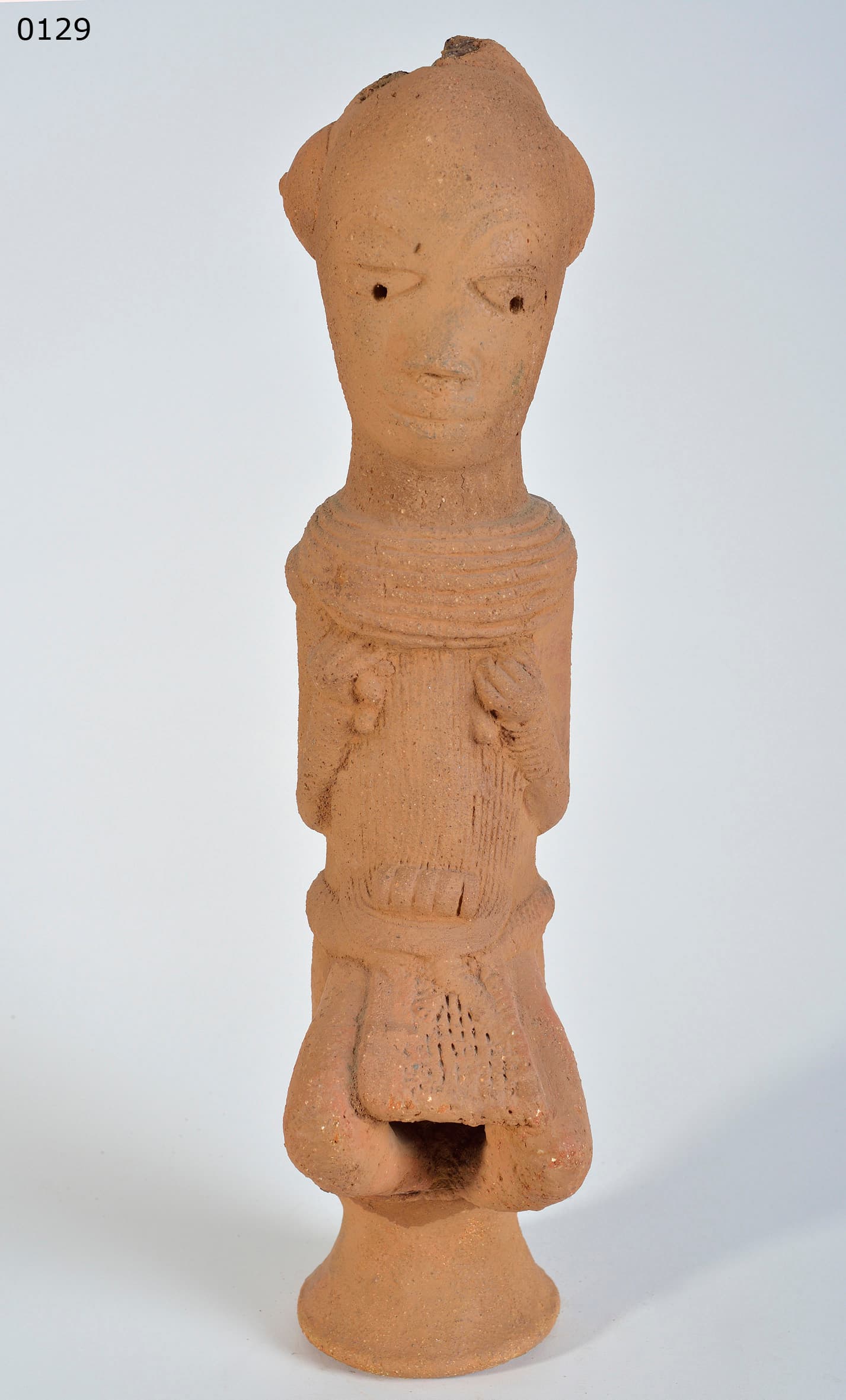
Eine seltene Nok-Terrakotta-Altarfigur (~2000 Jahre alt, 29 cm) aus Nigeria - eine sitzende/kniende Figur mit um die Beine geschlungenen Armen, länglichem röhrenförmigem Schädel, klassischen durchbrochenen dreieckigen Augen und schweren aufgeworfenen Lippen. Der grob gebrannte Tonkörper ist mit einer dicken, hellen Tonverkalkung bedeckt. Teil eines Trios von Nok-Stücken in der Sammlung (0456, 0458, 0459).
1. Das morphologische Genie der afrikanischen Eisenzeit
Die Nok-Zivilisation (ca. 1500 v. Chr. - 500 n. Chr.) schuf den grundlegenden Entwurf für die skulpturale Abstraktion in Subsahara-Afrika.
- Ganzkörperliches Überleben: Wie 0456 ist diese Figur äußerst selten, da sie ihre komplexe sitzende Körperhaltung mit um die Beine geschlungenen Armen beibehält - die meisten Nok-Stücke sind nur als fragmentierte Köpfe erhalten (vgl. 0458).
- Kompositorische Einheit: Der Künstler hat eine kompakte, in sich geschlossene Silhouette geschaffen - der röhrenförmige Schädel, die dreieckigen Aussparungen für Augen und Mund und die Gliedmaßen, die den Torso umschließen, bilden eine dichte, architektonisch solide Masse, die so konstruiert ist, dass sie das Brennen in offenen Gruben und Jahrtausende der Bestattung übersteht.
2. Wächter des landwirtschaftlichen Heiligtums
Diese massiven Figuren waren in der nigerianischen Eisenzeit wichtige Bestandteile großer landwirtschaftlicher Heiligtümer unter freiem Himmel.
- Vergöttlichte Ahnen oder Erntegeister: Sie wurden in der Erde von Schreinen früher Eisenschmelzgemeinschaften aufgestellt und stellten vergöttlichte Ahnen oder Geister der Ernte dar.
- Beabsichtigtes rituelles Zerbrechen: Sie wurden angefleht, um Niederschlag und Fruchtbarkeit zu gewährleisten; wenn Schreine verlassen wurden, wurden die Figuren nach archäologischem Konsens absichtlich zerbrochen, um ihre spirituelle Energie wieder in die Erde zu entlassen.
3. Jahrtausendalte Verkalkung und Quarz-Grog
Die physikalische Geologie spricht für ein hohes Alter.
- Quarzgrog-Temperierung: Der Ton ist stark temperiert mit großen Brocken von Quarzgrog, die auf den erodierten Oberflächen sichtbar sind - eine wesentliche Voraussetzung für die Verhinderung von Fehlern beim Brennen von dickwandiger Keramik im offenen Brennofen.
- Kristalline Grabkruste: Zwei Jahrtausende des tiefen Vergrabens in saurem Boden haben den Schlicker abgetragen und die Figur in harter weißer kristalliner Verkalkung begraben, die sich dauerhaft mit der porösen Terrakotta verbunden hat.
Zusammenfassung
Diese sitzende Nok-Figur, bei der die Arme die Beine umschließen, ist ein bemerkenswertes Überbleibsel aus der westafrikanischen Eisenzeit - eine Seltenheit, weil sie ihre vollständige Körperhaltung bewahrt hat. Ihre geologische Verkalkung und ihre grobkörnige Struktur sprechen für ein hohes Alter und machen sie zu einem bedeutenden archäologischen Zeugnis.
KI-unterstützt erstellt aus Sammlungsgutachten, Objektfotografie und eigener Recherche, redaktionell geprüft. Fehler sind möglich — Hinweise darauf sind uns willkommen. Zum Verfahren →