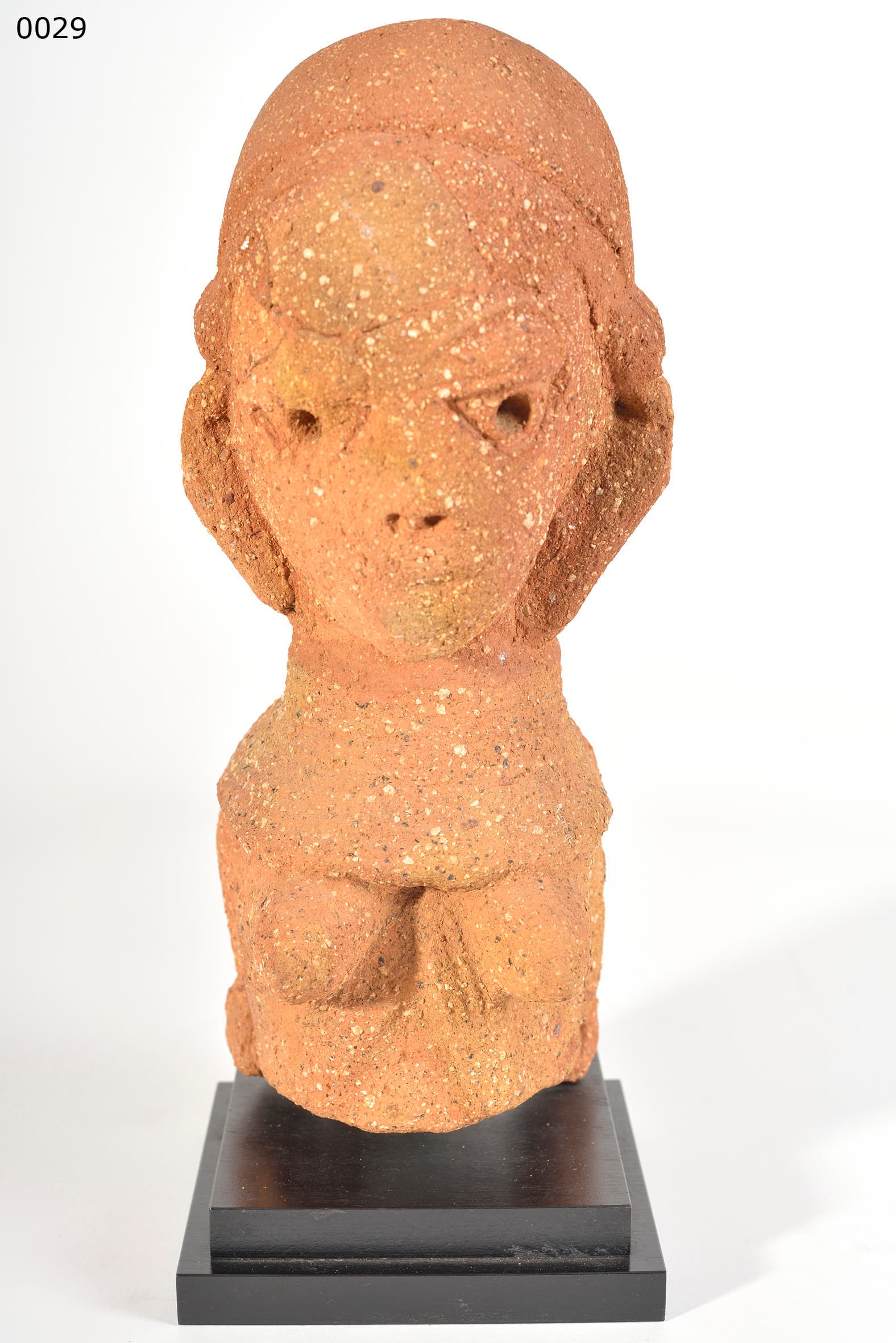
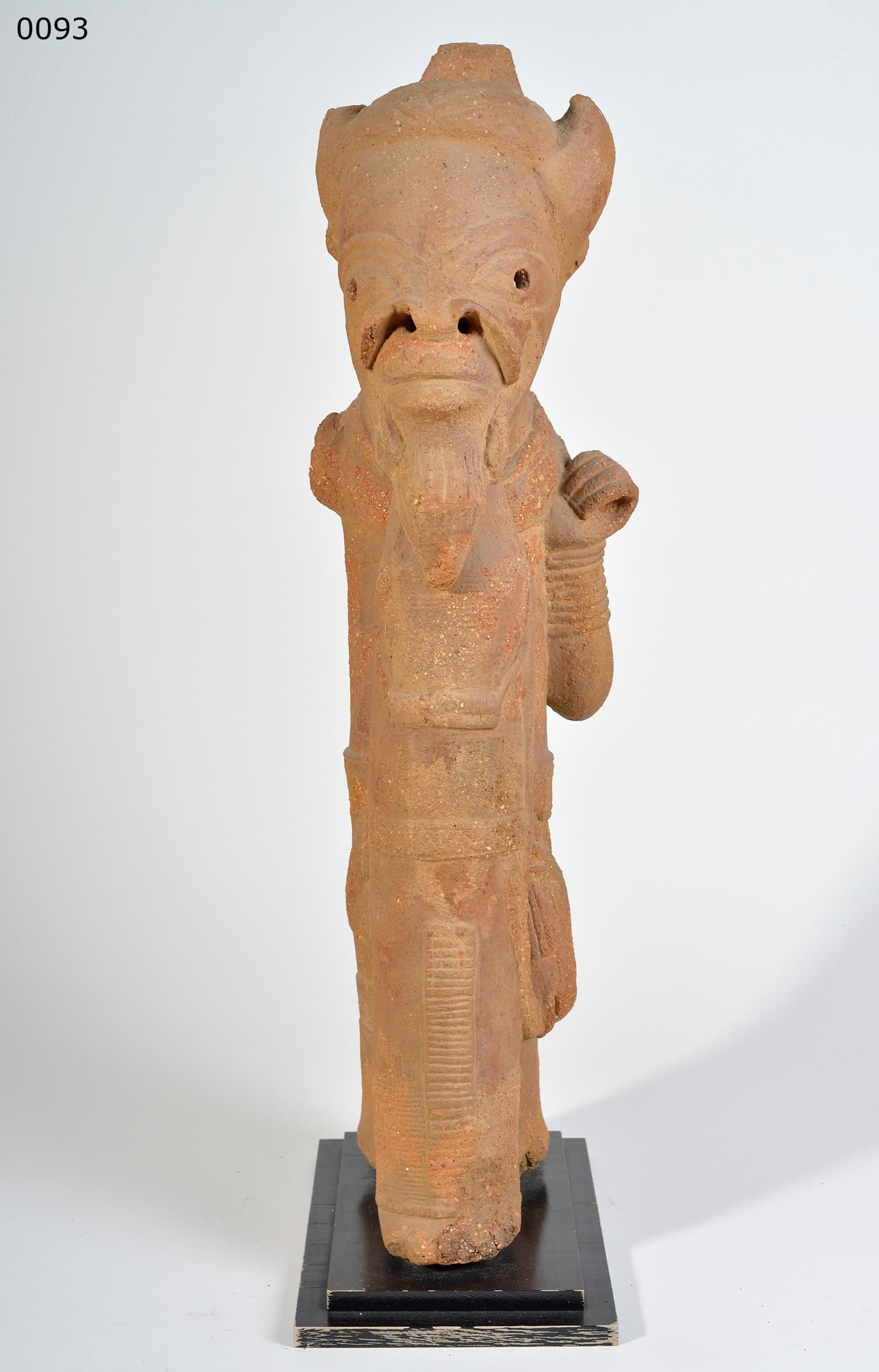
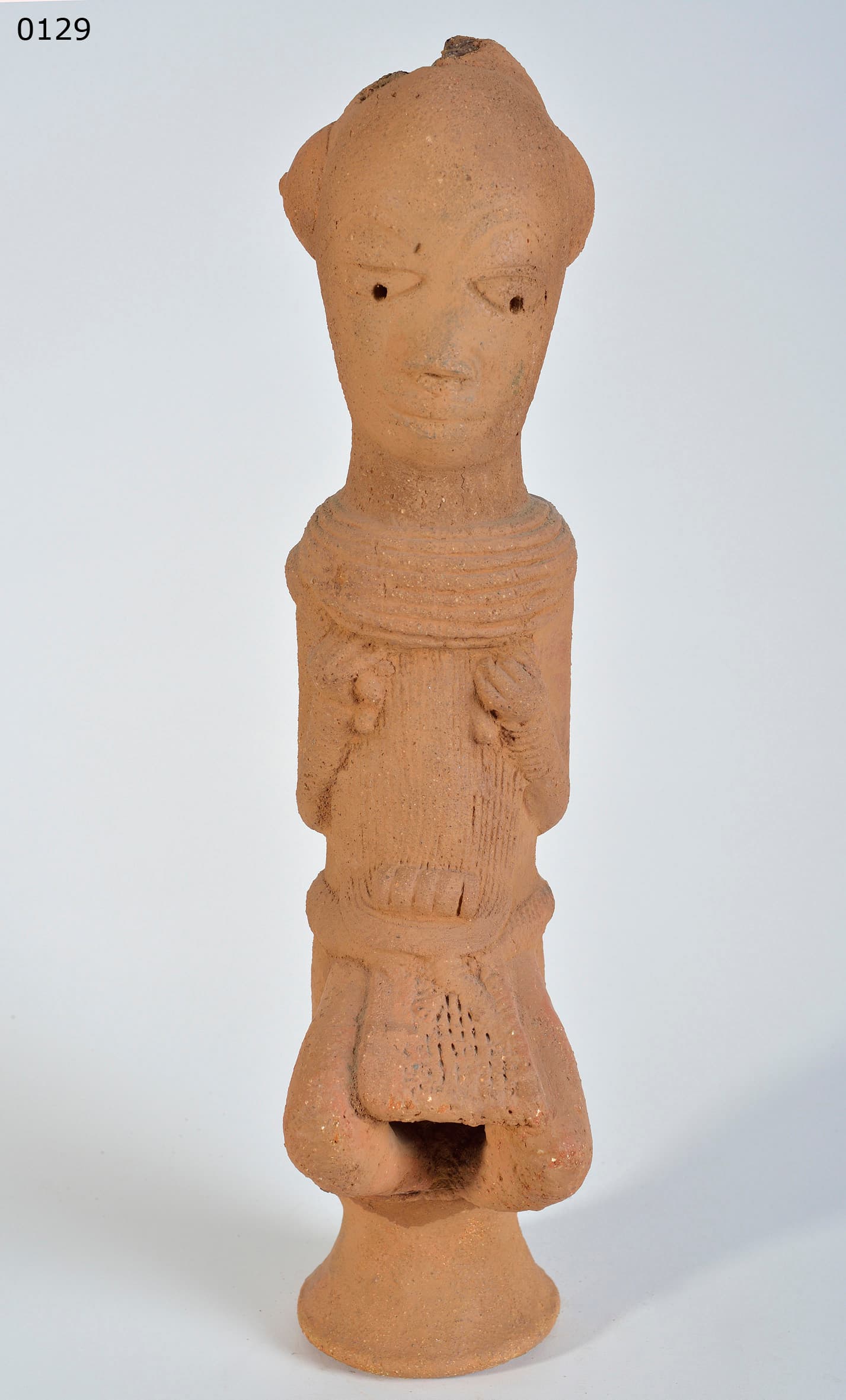
Eine massive Nok-Terrakotta-Altarfigur (stilistisch auf ca. 2000 Jahre geschätzt, 70 cm) aus Nigeria - eine kniende Person mit stark stilisiertem, länglichem Kopf, durchbohrten, dreieckigen Augen und einer kunstvollen, mehrstufigen, gewundenen Halskette. Der stark degradierte, grob gebrannte Ton ist vollständig mit einer dicken weißen kristallinen Bodenverkalkung überzogen, wobei der rechte Arm in einer Geste des Flehens erhoben ist.
1. Die kolossale Spitze des eisenzeitlichen Tons
Die Nok-Kultur (ca. 1500 v. Chr. - 500 n. Chr.) gilt als ein früher Ursprung der Monumentalskulptur in Afrika südlich der Sahara.
- Strukturtechnik im Maßstab: Der Fund einer relativ intakten Figur mit einer Größe von 70 cm gilt als außergewöhnlich – fortschrittliche Wulsttechniken stützen den schweren, langgestreckten, röhrenförmigen Schädel.
- Die tiefe subtraktive Durchdringung der dreieckigen Augen und des Mundes erzeugt ausgeprägte Schatten und diente vermutlich als Entlüftungsöffnung, um ein Zerspringen des massiven, dickwandigen Tonkörpers beim Brand zu verhindern.
2. Kniendes Bittgebet und das Erdheiligtum
Das Überleben des Torsos offenbart die tiefe Haltung der Figur - kniend auf der Erde mit einem erhobenen Arm.
- Haltung der Ehrerbietung: Wird oft als Zeichen der Ehrerbietung, der rituellen Konzentration und der Erdung der Kraft im Boden interpretiert.
- Zentrale Gottheit eines landwirtschaftlichen Schreins: Diese massive Statue könnte als Darstellung einer zentralen Gottheit oder als Ahnenanker eines landwirtschaftlichen Schreins gedient haben – es wird angenommen, dass frühe Gemeinschaften solche Figuren baten, die Fruchtbarkeit des Bodens zu fördern, Regen zu bringen und Schutz zu bieten; die aufwendige mehrstufige gewundene Halskette deutet auf einen elitären oder vergöttlichten Status hin.
3. Spuren lang anhaltender geologischer Verkalkung
Das hohe Alter spiegelt sich in der physischen Beschaffenheit wider.
- Grobe Quarzgranulat-Packung: Der Ton ist mit groben Quarzgranulatbrocken gemagert – eine Technik, die für die Stabilität solcher großformatigen Keramiken als erforderlich gilt.
- Kristalline, vom Boden absorbierte Kruste: Die Lagerung in der sauren Umgebung des Jos-Plateaus hat den ursprünglichen glatten Schlicker weitgehend erodiert – die hochporöse Oberfläche absorbierte im Laufe der Zeit Mineralien, was zur Bildung einer dicken, harten, weißen, kristallinen Verkalkung führte, die als charakteristisches Altersmerkmal gilt.
Zusammenfassung
Mit einer Höhe von 70 cm stellt diese bemerkenswert gut erhaltene Nok-Altarstatue ein bedeutendes Zeugnis der afrikanischen Eisenzeit dar. Ihre ausgeprägte geometrische Gestaltung und die dichte geologische Verkalkung sprechen für ihren hohen dokumentarischen und kunsthistorischen Wert.
KI-unterstützt erstellt aus Sammlungsgutachten, Objektfotografie und eigener Recherche, redaktionell geprüft. Fehler sind möglich — Hinweise darauf sind uns willkommen. Zum Verfahren →