Overview
The ethnographic and art-historical survey of the Dakakari, called Lelna (singular: K'lela) in their indigenous self-designation, reveals one of the most fascinating and at the same time least systematically researched cultures in West Africa. Geographically, this ethnic group is located in the north-west of today's Federal Republic of Nigeria, with a primary centre of settlement in the topographically challenging, hilly foothills of the Zuru Federation (Zuru Emirate), which are administratively assigned to Kebbi State and Sokoto State. Recent demographic data puts the Lelna population at approximately 300,000 individuals, although this figure is subject to constant fluctuation due to urban migration and the deep integration of the male population into state institutions. Within the complex Nigerian state structure, they thus form a demographic minority that belongs to the 18 per cent of the total national population that does not belong to the seven dominant macro-ethnic groups (such as Yoruba, Igbo or Hausa-Fulani).
Linguistically, the C'Lela (also Lela) spoken by them is categorised as belonging to the extensive Niger-Congo language family, more specifically the Benue-Congo branch. This linguistic classification implies a deep historical and cultural relationship to neighbouring groups of the so-called Middle Belt region, in particular to the Kambari and the Dukawa (Hun-Saare), which manifests itself in shared socio-cultural institutions and ritual vocabularies, among other things. Glottochronological studies point to a slow separation and differentiation of these language groups within the Zuru region, with C'Lela today functioning as the core identity of the group, even though Hausa has become widespread as a lingua franca.
The nomenclature of the ethnic group already marks the first far-reaching classification controversy in ethnographic and museological literature. The sources are ambiguous with regard to the historical genesis of the ethnonym, but the term "Dakakari" (in colonial documents often Dakakeri or Lela-Dakakari) is increasingly identified in modern research as an exonym that was primarily coined by the dominant Hausa and consequently adopted uncritically by the British colonial administration. In the historical inventory registers of large Western institutions, such as the British Museum or the Musée du quai Branly - Jacques Chirac, this exonym is still firmly anchored today. Recent anthropological and sociolinguistic studies, however, call for the exclusive use of the autonym Lelna in order to do justice to the indigenous construction of identity and to deconstruct colonial epistemological dominance.
The social structure of the Lelna presents itself as a hybrid construct that combines both acephalous and hierarchical elements. The kinship system is organised in a strictly patrilineal manner, which means that descent, inheritance and ritual affiliation are passed down exclusively through the paternal line. At local level, there is no absolute autocratic central authority; instead, political, legal and ritual decision-making is the responsibility of an institutionalised Council of Elders. This council moderates village life, sanctions violations of norms and nominates the holders of ritual offices. In contrast to the highly centralised and hierarchical kingdoms of the Yoruba or Benin in southern Nigeria, the Lelna retained a decentralised autonomy for a long time, which was only imposed with formal superstructures (such as the Zuru Emirate) under pressure from external Islamic emirates and later by the British administration.
The economic subsistence of the Lelna is historically based on a dual system of extensive rain-fed agriculture and organised hunting. Agricultural production is closely linked to one of the most remarkable social institutions of the ethnic group: the Golmo system. This is an obligatory, multi-year bride service (Bridal Service). Young men are grouped into age groups (age sets) and are obliged to carry out heavy agricultural labour in the fields of their future wives' families for years. This system fulfils far-reaching structural functions: It guarantees the older generations a reliable labour force, regulates the transition of youth into the status of adult men and forms unprecedented resilience and solidarity within the age cohorts through extreme physical strain.
Craft production within this subsistence economy is subject to a strict gender dichotomy that has far-reaching effects on material culture. While metalworking (blacksmithing) and woodworking were the exclusive domains of men, the processing of clay - and thus all ceramic production - was the exclusive domain of women. This gendered division of labour is not only an economic necessity, but also deeply rooted in the religious taboo system, which makes Dakakari ceramics in Western collections (such as the Saint Louis Art Museum or the Fowler Museum at UCLA) one of the rare examples of African sacred sculpture created by female master craftswomen.
| Basic Demographic & Cultural Data of the Lelna (Dakakari) | Specification |
|---|
| Core Geographic Area | Northwest Nigeria, Kebbi State & Sokoto State (Zuru Emirates) |
| Estimated population | ~300,000 individuals |
| Linguistic classification | C'Lela (Niger-Congo language family, Benue-Congo branch) |
| Social organisation | Patrilineal, councils of elders (partially acephalous) |
| Central social institution | Golmo (institutionalised bride service of the age groups) |
| Religious demography (estimate) | 50 % autochthonous religion/syncretism, 30 % Islam, 20 % Christianity |
The relationship with the neighbouring peoples has historically been characterised by a mixture of assimilation and separation. The Lelna themselves are ethnogenetically considered to be the product of successive waves of migration from the north, which penetrated into the territory of the Achipawa - presumably the oldest autochthonous population group in the Zuru region. This led to a profound cultural and linguistic hybridisation. At the same time, the Lelna sharply differentiated themselves from the expanding Hausa and Fulani groups, which is still reflected in today's language: The C'Lela phrase àzá há-kòrínnò ("people of traditional religion") includes neighbouring Kambari and Dukawa, but explicitly excludes Hausa and Fulani. This construction of identity through religious and ritual exclusivity forms the foundation for understanding their material art production.
Cultural context
The religious system of the Dakakari defies simplistic categorisation and manifests itself as a highly complex, stratified structure of cosmological distance and ritual immediacy. The basic cosmological order of Lelna postulates the existence of an omnipotent, yet transcendent and distant creator god. This Deus otiosus does not intervene directly in the profane concerns of humans, creating an ontological vacuum that must be filled by a dense network of intermediaries. This intermediary function is primarily assumed by the ancestors, referred to in the C'Lela as øknu, who form the absolute centre of ritual and material practice.
However, the elevation of a deceased person to the sacred status of an øknu is not an automatic process, but is tied to strict socio-moral pre-requisites. An individual must have led a life of moral integrity and conformity to the norms, have reached an advanced age (as a sign of spiritual blessing) and must have fathered offspring in order to ensure the continuity of the patrilineal line. Only those who fulfil these criteria are posthumously venerated as capable ancestors who are able to convey the prayers, petitions and sacrifices of the living to the Creator God. Remarkable here is the theological view that the øknu are, in principle, benevolent entities that are expected to bring about exclusively positive interventions (fertility, harvest blessings, health). In the event of individual or collective crises, specific ancestral shrines are visited in order to restore the cosmic balance through libatory acts.
Complementary to pure ancestor worship, there is a second, far more ambivalent pillar of the religious order: the M'gilø cult. This secret society is considered one of the oldest and most powerful institutions in the entire Zuru region. At the centre of the cult is a powerful, autonomous nature or spirit being complex which, in contrast to the benevolent ancestors, has an explicitly judging and punitive function. The M'gilø spirit has the authority both to reward and to impose draconian sanctions. The ritual authorities of this covenant are recruited from local priests who act as custodians of regional shrines (such as the Germache Shrine) and are appointed to their office by the secular Council of Elders. These priests are under the hierarchical leadership of a high priest, the Gom-Vum-Magileu.
The social function of the M'gilø priests goes far beyond the purely ritual fulfilment of duty; they act as diviners, healers and the highest juridical authority. They settle complex land use conflicts, intervene in unresolvable marital disputes and are the exclusive authority in the identification and judgement of witchcraft accusations by communicating directly with the M'gilø spirit through trance and divination. This ritual specialisation is also evident in the field of traditional medicine, where healers preserve specific botanical knowledge and rituals in the indigenous C'Lela language, for example for the treatment of malaria or pregnancy complications, thus consciously distinguishing themselves from Islamic or Western practices.
What makes the religious and artistic system of the Dakakari structurally very different from the traditions of neighbouring peoples (such as the Yoruba, Igbo or the Tiv) is the absolute ritual monopoly position of women in the materialisation of the sacred. While in most West African cultures the production of ritual masks and altar figures is exclusively in the hands of male carving guilds, the creation of sacred terracotta sculptures is the exclusive responsibility of women among the Dakakari. Although all Dakakari women master the production of profane utility ceramics, the esoteric, ritual knowledge for shaping the funerary sculptures is limited to a few specialised potter families. This knowledge is passed on from mother to daughter in the direct maternal line, which makes the women the sole custodians of the material ancestor cult.
In the interpretation of the iconographic significance of these funerary sculptures, there is a sharp research controversy regarding the ontological status of the beings depicted. The source situation here is discursively ambiguous. Representatives A (e.g. curatorial positions of the Saint Louis Art Museum, SLAM) interpret the anthropomorphic sculptures primarily as representations of "Bush Spirits" (nature spirits). According to this interpretation, the figures materialise otherworldly protective powers that escort the spirit of the deceased on its dangerous transit to the ancestral world and guarantee it a safe passage. Some of the artefacts in the Musée du quai Branly - Jacques Chirac also refer to the protective, village-like functions of these entities.
In contrast, representative B (including Allen Bassing and Karl-Ferdinand Schaedler) formulates a completely divergent thesis. They emphasise that the figures in the local C'Lela idiom are explicitly referred to as "sons of the grave". Schaedler and Bassing argue that these sculptures do not represent nature spirits, but symbolise servant figures or followers who follow the elite deceased (who held a leadership position during his lifetime) into the afterlife in order to serve him there in an appropriate social position. A sub-thesis of this school of thought even sees in the sculptures the evoked representation of the ancestors themselves.
Initiation into the cult and the rites of passage are closely linked to death and post-mortem rites. The sculptures play a central role in the second burial rites, which take place weeks or months after physical death and only mark the final transition of the spirit into the status of an øknu. Despite the massive influence of Sunni Islam, which has penetrated the region via the Hausa since the 19th century, and Christian missionary work (United Missionary Society from the 1920s, Catholics from 1951), a strong religious syncretism has been preserved. Over 50 % of the Lelna continue to practise aspects of this indigenous religion, which ensures that the Dakakari cemeteries and the ritual potters retain their cultural relevance.
Aesthetic features
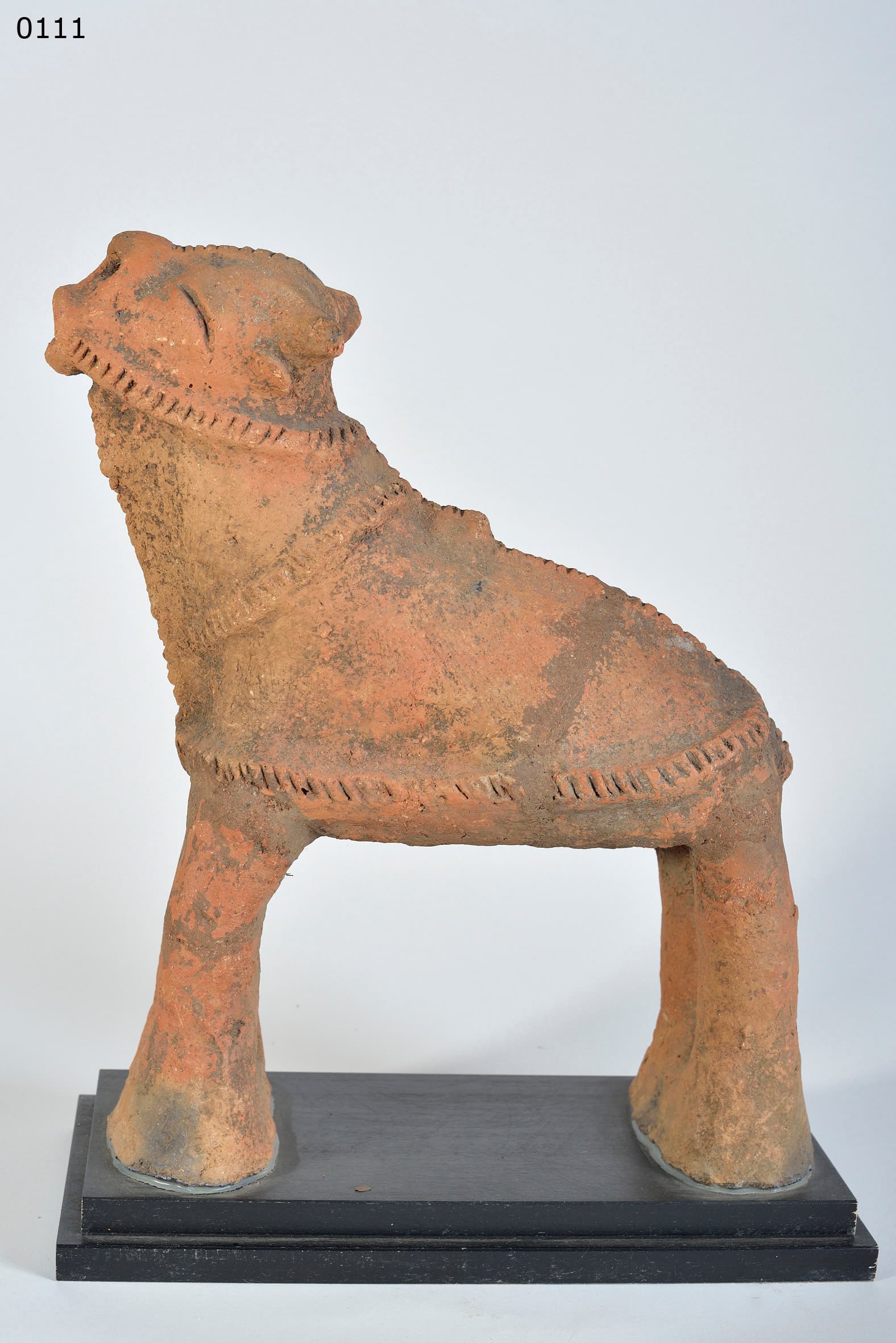
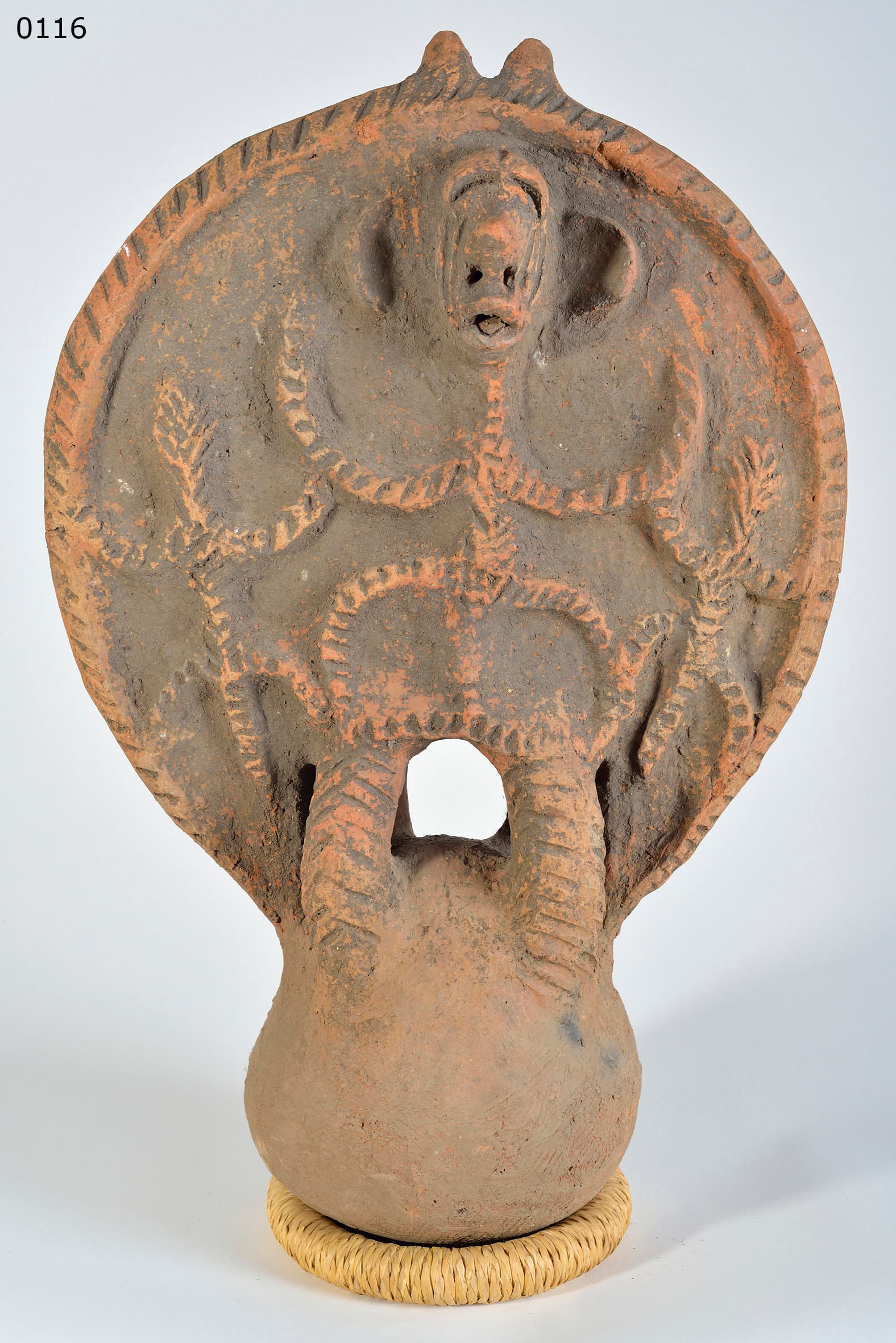
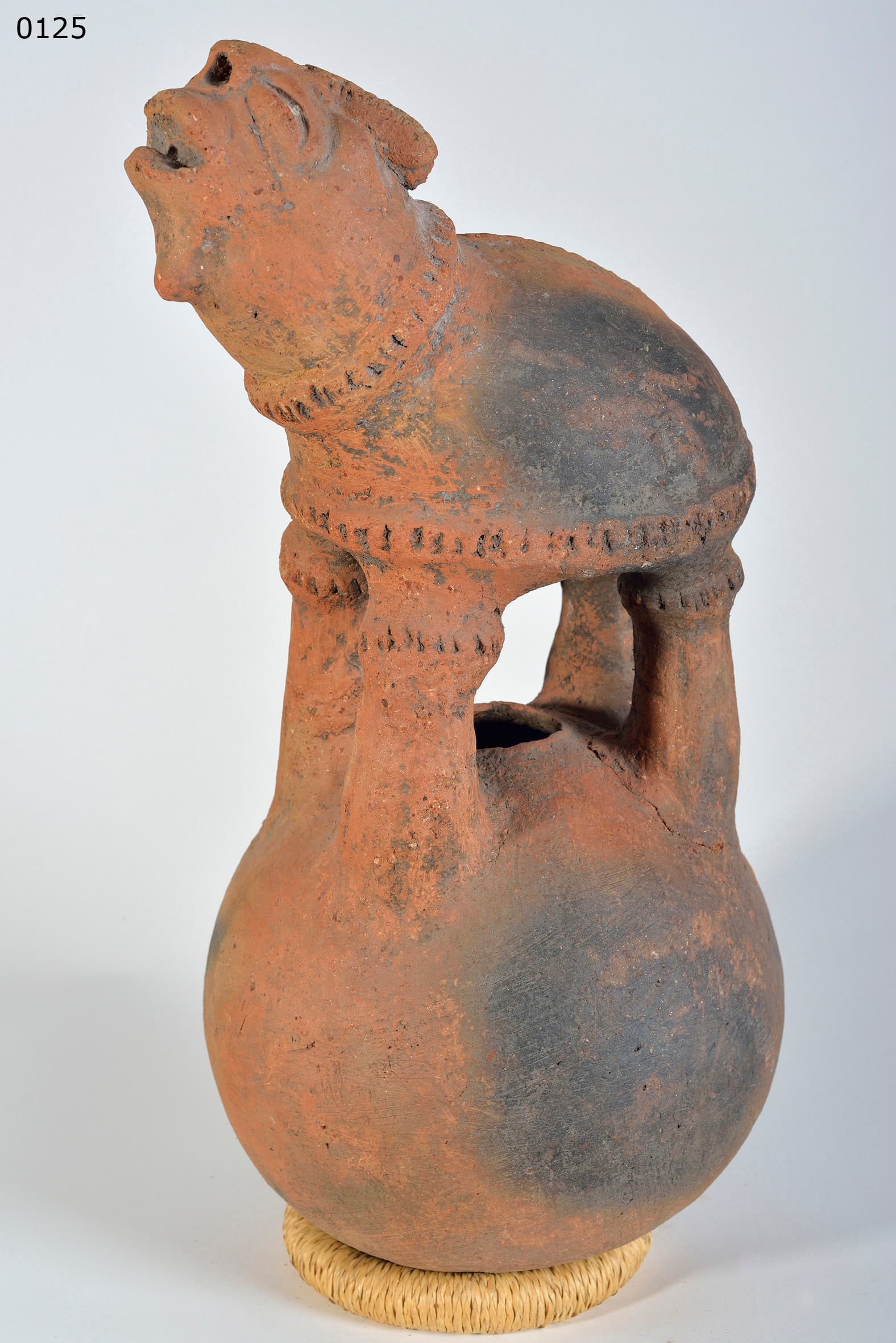
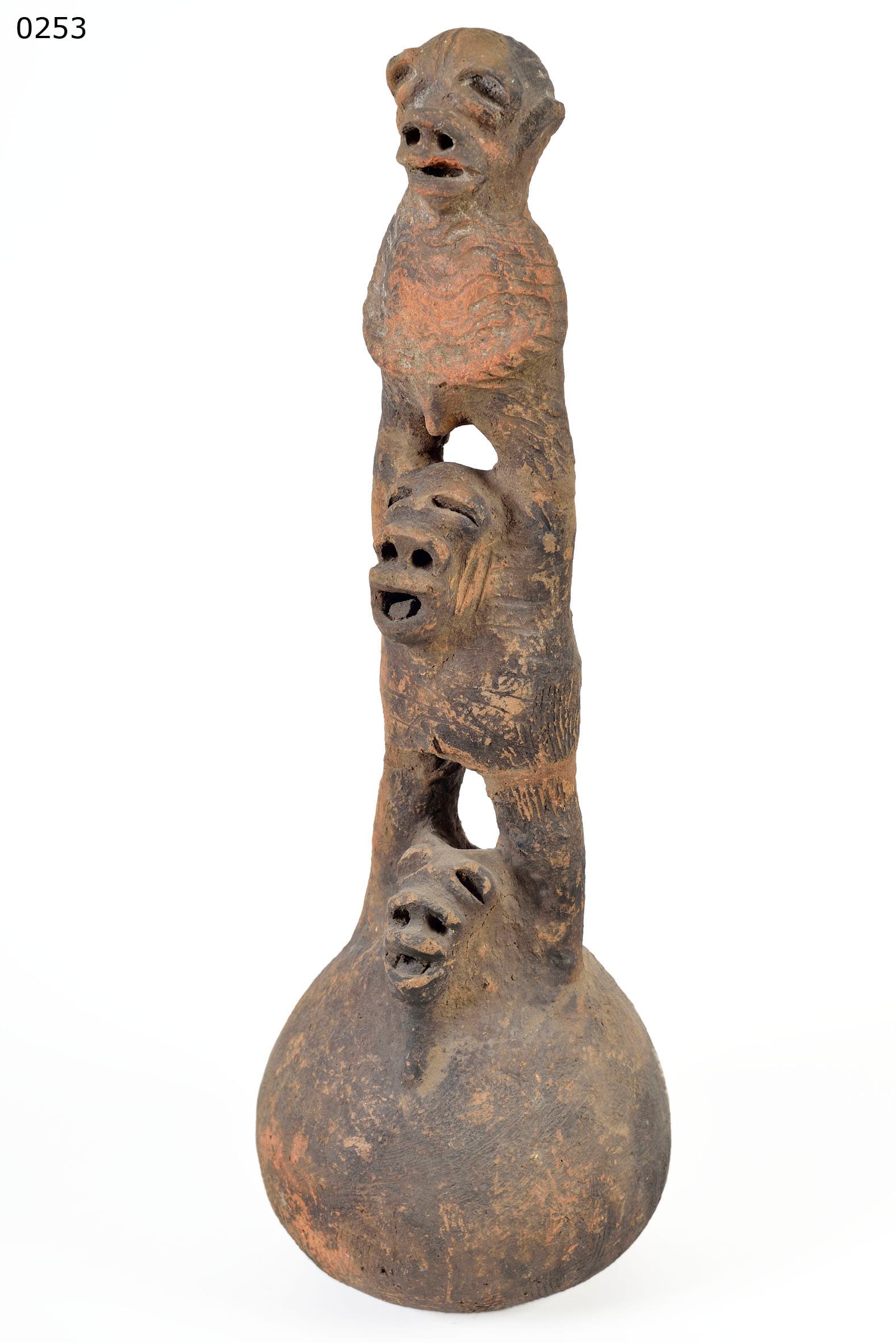
On the international art market and in museological discourses, the material legacy of the Dakakari is defined almost exclusively by their ritual terracotta sculptures. The canonical object typology is functionally limited to funerary artefacts, which appear in a remarkable formal diversity. The iconographic repertoire includes anthropomorphic figures (male, female and androgynous), zoomorphic representations and complex compositional tableaux that unite equestrian figures (equestrians), family groups or animals on a common basis.
The specific proportions of these works are largely determined by the choice of material and production technique. The Dakakari potters use local clay that is heavily interspersed with levelling agents (coarse sand, crushed ceramic), which is hardened in open field firing at relatively low temperatures. Technologically, all sculptures are based on the additive bead technique (coil technique or ring-building), an archaic method in which strands of clay are laid on top of each other in a spiral and spread out. This technique results in a massive, extremely schematised formal language. The joints and seams of the beads are often deliberately concealed beneath decoratively shaped clay bands that simulate physical jewellery or ritual ties.
The canon of proportions completely eludes the Western pursuit of anatomical mimesis. The sculptures are characterised by a radical abbreviation and abstraction of the limbs. Arms and legs are often only rudimentarily indicated, organically fused with the massive torso or completely absent from the overall composition. The heads are often highly abstracted, with the neck thrown back and hands facing forwards, which is interpreted by scholars as a depiction of a ritual dance position during mourning festivities.
An omnipresent and iconographically highly controversial feature of the anthropomorphic subtypes is the slightly open mouth. The sources reveal divergent indigenous and scholarly interpretations. In many villages in the Zuru region, the open mouth is interpreted locally as a manifest, eternal expression of mourning and lamentation (mourning). Inventory documentation from the British Museum, on the other hand, refers to historical field notes that interpret the open mouth as a purely aesthetic decision, which primarily served the purpose of presenting the well-formed teeth that were considered attractive in the Lelna ideal of beauty. The facial iconography is complemented by scarification marks carved deep into the moist clay, which faithfully depict historical, real body modifications of the Dakakari elite.
The size spectrum of the sculptures correlates directly with the social status of the deceased. Allen Bassing, who carried out fundamental field studies in the 1970s, documented six distinct categories of funerary sculptures. The most prominent and massive subtype is known as the "elephant". Paradoxically, these large sculptures are often characterised by heads with grotesque, almost simian (simian) features and represent the most expensive and prestigious grave decoration.
One of the most virulent controversies in African art history centres on the stylistic and chronological classification of this aesthetic. Ekpo Eyo (2008) and Frank Willett postulate a long-term historical thesis. They draw constant formal parallels between the Dakakari sculptures and the over 2000-year-old archaeological finds of the Nok and Sokoto cultures in the same large region. Eyo argues that the Lelna, Jukun and Yoruba are direct cultural and stylistic descendants of the Nok civilisation, which is reflected in the additive processing technique and the expressive physiognomy.
This Nok continuity thesis is massively deconstructed by Roy Sieber (1989). Sieber dates the genesis of today's Dakakari tradition (similar to that of the Tiv) much more recently and warns against forcing the works into a constructed ancient narrative. He argues that the glaring archaeological gap of almost one and a half millennia makes a direct continuity untenable and criticises that an insufficient understanding of the independence of 19th and 20th century African art forms often leads to them "falling prey to the taste of the twentieth century" by frantically searching for ancient roots. Karl-Ferdinand Schaedler adds a further nuance to this debate by seeing more stylistic "trans-reminiscences" of the geographically distanced Igala sculptures of the 17th century (such as the so-called "Igala star figures"), whose foetal forms were echoed in early Dakakari works before the tradition changed to its recent, highly abstract idiom.
The difference between a freshly fired, profane object and a ritually activated ritual object manifests itself physically in the patina. Dakakari terracottas are placed exclusively outdoors (outdoor exposure) on the grave mounds. The authentic development of the patina is therefore the result of decades of exposure to wind, monsoon rain and sand abrasion. Genuine market pieces from collections (such as those of the Khepri Gallery or formerly Kees Keus) almost always show significant damage. The loss of the legs or the hemispherical base on which the figure once sat is not a flaw, but a primary forgery criterion or mark of authenticity. A perfectly preserved, undamaged piece with an intact base is highly suspect on the collectors' market, as the ritual nature and climatic conditions of West Africa make it almost impossible to preserve it intact for over a century.
Ritual practice
The lifecycle of a Dakakari funerary sculpture is a strictly regulated process, separate from everyday profane life, which begins with the specialised potters and ends on the burial mound of the elite. The creation of these objects is subject to a dense network of religious taboos. Production may only take place for the ceremonial, commemorative end purpose; production for commercial barter, for dealers or the art market was strictly forbidden in the indigenous system and was considered spiritual sacrilege.
After moulding the figure using the described beading technique and the successful open field firing, the object initially remains in a ritually inactive, quasi-profane state. The decisive transformation into an activated sacred object only takes place during the complex burial rituals. The spatial setup of these rituals manifests itself in specifically structured family necropolises.
The architecture of a Dakakari altar or burial complex consists of conical mounds of earth (mounds), which have an average height of around two feet (approx. 60 cm) and a diameter of three feet (approx. 90 cm). Not only the patriarch is buried beneath this mound, but also his wives and unmarried daughters over the course of time, making the grave the territorial centre of the patrilineal ancestral line.
The allocation of burial plots is a strictly anti-equality, highly elitist process. The display of figurative terracotta on the mound is a visual privilege granted exclusively to the highest-ranking members of society. Ordinary villagers receive only the simplest household ceramics (water pots, bowls) as a mnemonic marker of their grave. The elite circle that acquires the right to a figurative representation - such as an "elephant" or an equestrian motif - includes village chiefs (chiefs), great hunters, war heroes who have distinguished themselves through special valour in golmo service, leading master blacksmiths and the high-ranking, initiated members of the secret men's society oknu.
The installation of the sculptures on the Mound follows a rigid, gender-specific semantics, which is expressed in the shape of the base vessels on which the figures are mounted. Urns and vessels dedicated to a female deceased person have a wide, open mouth. Vessels that mark a male ancestor, on the other hand, have a narrow lip (small-lipped urn).
| Grave typology and social stratification among the Lelna | Assigned pottery / sculpture |
|---|
| Profane population (simple farmers) | Everyday household ceramics (bowls, simple jugs) |
| Local elite (blacksmiths, hunters) | Small figurative inscriptions, simple anthropomorphic "sons of the grave" |
| Highest authorities (chiefs, oknu leaders) | Complex tableaux (horsemen), zoomorphic large sculpture (type "elephant") |
| Male deceased (basic vessel) | urns with narrow lip (small-lipped) |
| Female deceased (basic vessel) | urns with wide mouth (wide-mouthed) |
The activation of the sculpture reaches its ritual climax during the second burial rites, which are accompanied by dances and festivities. From this point onwards, the object becomes the focus of continuous offerings. The most important and indispensable libatory act consists of keeping the vessels and urns used as a base permanently filled with fresh water. The cosmological reason for this rite is deeply rooted in the fear of wandering spirits: the Lelna believe that the dead walk at night and that their thirst must be quenched in order to avert their wrath against the community of the living.
The further life cycle of the objects inevitably leads to their deactivation and disposal, which forms a fundamental contrast to Western ideas of art conservation. The terracottas are not repaired or protected in depots. Their durability is left to the African climate.
Remarkably, the ethnographic literature of the 1940s documents a far more drastic form of deactivation. In 1944, a British explorer, R. T. D. Fitzgerald, observed in Dakakari cemeteries that up to fifteen elaborate terracotta vessels were draped around individual graves, but almost all of them were wilfully smashed and scattered. This intentional destruction is interpreted in the context of the final replacement of the mourning period. The breaking of the vessel marks the final transition of the spirit into the purely transcendent ancestral world. What remains are ritually fragmented shards, which today, eroded by the weather and recovered by collectors such as Joseph Christiaens or institutions such as the Royal Museum for Central Africa (RMCA) in Tervuren, are misunderstood as solitary works of art, although they were originally part of an ephemeral, performative arrangement.
Historical context
The genesis of the Dakakari and their material culture is the result of a highly dynamic migration history, the exact dating of which represents an ongoing controversy within African historiography. There is a broad consensus that the ancestors of today's Lelna were not indigenous to the Zuru region. Historical models (such as Augi's) date the most significant waves of immigration to the 15th century. Driven by the increasing political pressure for expansion and the economic dominance of the Hausa city-states to the north (especially Kano and Katsina) as well as the search for fertile farmland, various groups migrated southwards. In the Zuru region, they encountered the Achipawa, the indigenous inhabitants, which led to a far-reaching linguistic and ritual synthesis from which the recent Lelna culture emerged.
The pre-colonial and early colonial encounter was characterised by massive military conflicts. In the 19th century, the Dakakari communities were exposed to the aggressive expansionism of the Islamic Kontagora Emirate (part of the Sokoto Caliphate). In the first decade of the 20th century, the conflict escalated against the advancing British colonial state. Paradoxically, this initial resistance soon turned into a highly profitable symbiosis for both sides.
The influence of the colonial administration on the social structure of the Dakakari was immense, but indirectly protected artistic production. The British quickly realised that the traditional Golmo system had produced men of extreme physical endurance and strict hierarchical habits. As a result, the colonial officers categorised the Dakakari as a "martial race" and recruited them disproportionately for the Nigeria Regiment of the West African Frontier Force (WAFF). Contemporary reports show that it was not uncommon for up to ten male members of Dakakari families to serve in the army at the same time. Paradoxically, this radical migration of men into the military strengthened the self-sufficient position of women in the home villages, as a result of which the maternally handed-down production of ritual terracotta sculptures was not eroded by colonialism, as was the case with so many other ethnic groups, but continued untouched as a living tradition until the 1960s.
The market history of Dakakari art in the West is characterised by an extremely late discovery. While works of Benin bronzes or Yoruba art were already flooding European museums at the turn of the century, the Lelna funerary artefacts remained completely unknown for a long time. This was primarily due to their isolated geographical location and the fact that they were absolutely not designed for barter. The first early collections were brought to Europe in the 1910s by Leo Frobenius (for example to the Museum für Völkerkunde in Berlin), but were often falsely attributed to the Fulani. In the 1930s, unique pieces found their way into the private collection of the important Swiss patron Han Coray, whose holdings now form the core of the Rietberg Museum in Zurich. A real scientific breakthrough only came in the 1970s with the field research and publications by Allen Bassing in the journal African Arts, which systematically analysed the typology of funerary monuments. Objects then found their way into institutions such as the Metropolitan Museum of Art (Met) in New York, albeit often as unclassified "Middle Niger" finds.
This late discovery led to a dramatic rise in prices from the 1980s onwards and, at the same time, to a massive counterfeiting problem. Driven by the immense demand from Western collectors for archaeological terracottas from the Malian Jenne-Jeno culture and the Nigerian Nok culture, local potters in West Africa began to produce high-quality forgeries for the international market. Experts estimate that up to 80 per cent of the supposedly ancient terracottas exported in this era and traded at auction houses such as Sotheby's were recent forgeries or so-called "pastiches" (assemblages of various authentic fragments).
As the dakakari tradition was alive well into the middle of the 20th century, the definition of authenticity criteria on the art market is highly complex. What is a "genuine antique" piece from the 19th century, what is a legitimate ritual object of the living tradition from the 1940s, and what is a workshop replica from the 1980s created specifically for export? The visual inspection of heartwood cracks (which in terracotta are substituted by stress cracks in the clay), termite damage (which would only affect wooden extensions) or artificially applied patina is not sufficient for these porous materials, as forgers often buried the objects in damp soil for years to simulate weathering.
Thermoluminescence dating (TL dating) has therefore established itself as the absolute and irrefutable main criterion in forensics. The exact age can only be determined by physically measuring the radiation dose stored in the quartz lattice of the clay since the last firing. For example, a Dakakari monkey figurine from a renowned gallery explicitly refers to a TL test carried out by the Ralf Kotalla laboratory in 2006, which attests an age of 400 ± 80 years and thus dates the piece to the 17th century (which in turn supports Schaedler's trans-reminiscence theory). For the serious private collector today, the source situation for African terracotta without an accompanying, certified TL expertise is per se ambiguous and harbours an incalculable investment risk. Nevertheless, the authentic, weathered Dakakari funerary artefacts - testifying to a vanishing patrilineal ancestral world - remain some of the most expressive and rarest monuments in African art history.