Overview
The ethnographic and art-historical documentation of the Ejagham continues to pose complex taxonomic and geographical challenges for researchers to this day. Historically and in the old collections of Western museums mostly subsumed under the exonymous collective term "Ekoi", the Ejagham form an extensive, transnationally settled ethnolinguistic grouping in the dense rainforest corridor of the Cross River basin. This area extends from south-eastern Nigeria (especially Cross River State with the local government areas of Akamkpa, Etung, Ikom and Ogoja) to the neighbouring Southwest Region of the Republic of Cameroon. The demographic relations reflect this cross-border reality: current population estimates put the total population at around 240,000 individuals, of which an estimated 134,000 live on Nigerian territory and 106,000 on Cameroonian territory. However, this geopolitical separation through colonial demarcation has never completely broken through the fundamental cultural cohesion of the group.
The nomenclature of the ethnic group is the subject of ongoing discourse. The sources are ambiguous as to the exact etymological genesis of the term "Ekoi". Some historical linguists and ethnographers postulate that it is a pejorative foreign term for the neighbouring Efik who settled near the coast. An alternative, economically based theory derives the term from "ekui", the local name for red camwood (African padouk), which the Ejagham sold to the coastal ethnic groups as a highly valued commodity. In contemporary research and in the internal discourse of the community, however, the self-designation "Ejagham" has prevailed. This endonym usually refers etiologically to the mythical place of origin of the ethnic group, Lake Ejagham in south-west Cameroon, which is regarded as the spiritual centre and starting point of historical waves of migration. Other linguistic derivations interpret the prefix "E-" as a language classifier and "Jagham" as an ethnic root, resulting in the meaning "language/people of Jagham".
The linguistic categorisation of Ejagham marks a significant research controversy. The language forms the main branch of the Ekoid cluster. While early classifications, largely influenced by the work of Crabb (1969), regarded the Ekoid languages as a highly isolated group, modern linguistic analyses by Watters and Blench assign the Ekoid to the South Banoid subgroup of the Niger-Congo language family. A. dates the separation of Ekoid from Proto-Bantu to a very early phase of Bantu expansion, while B. argues that the structural similarities are due to later, intensive contact phenomena in the Cross River Basin. This linguistic localisation is of eminent importance, as it identifies the Ejagham as the bearers of one of the oldest continuous civilisations in the run-up to the Bantu expansion.
The social structure of the Ejagham differs radically from the highly centralised, monarchical systems of neighbouring regions (such as the grassland kingdoms of Cameroon or the Yoruba states). Society is organised in a decidedly acephalous way. Instead of a vertical, royal hierarchy, the political and social order is based on a horizontal network of patrilineal, segmentary lineages and a strict system of age groups. Authority lies in the hands of a council of elders (gerontocracy), whose decisions are primarily based on consensus. The executive and judicial enforcement of this consensus is not the responsibility of a state monopoly, but of the superordinate secret societies, above all the Leopard Society, which functions as a trans-linear integration authority.
Economically, the subsistence of the Ejagham is primarily based on rainforest cultivation (shifting cultivation), whereby the cultivation of yams is of such paramount material and symbolic importance that the entire social stratification is permeated by it. The class of the most successful cultivators forms an elite that bears the prestigious title of nti'maetahn (yam title). This economic basis is supplemented by hunting and, for historical reasons, by a deep involvement in regional and later transatlantic river trade. The relationship with the neighbouring peoples - including the Boki in the north, the Anyang and Banyang in the east and the Efik, Ibibio and Annang in the south - was and is characterised by a highly complex, ambivalent network of armed conflicts, symbiotic trade and profound ritual exchange. This permeability of cultural boundaries has led to specific Ejagham art forms and institutions being adapted by neighbouring groups, making it difficult to clearly identify historical artefacts in collections (such as those in the Musée du quai Branly or the Fowler Museum at UCLA) to this day.
| Demographic and structural parameters | Ejagham (Ekoi) specifications |
|---|
| Primary settlement areas | Cross River State (Nigeria), Southwest Region (Cameroon) |
| Estimated population (2024) | approx. 240,000 (Nigeria: ~134,000, Cameroon: ~106,000) |
| Linguistic classification | Niger-Congo > Southern Bantoid > Ekoid-Mbe > Ejagham |
| Type of society | Acephalous, patrilineal, gerontocratic, age group-based |
| Subsistence basis | Extensive rainforest agriculture (focus: yams), hunting, river trade |
| Central neighbouring tribes | Boki, Banyang, Anyang, Efik, Ibibio, Annang |
Cultural context
The religious and cosmological system of the Ejagham is characterised by a pronounced duality that closely interlocks metaphysical concepts with the physical ecology of the rainforest. At the top of the cosmological order is a bipolar creator entity: Obassi Osaw (the sky god) and Obassi Nsi (the earth god). This supreme entity is considered omnipotent, but rarely intervenes directly in everyday profane events. Instead, daily spiritual interaction and the maintenance of cosmic balance are the responsibility of a dense pantheon of nature and water spirits (often referred to as Ndem or Ikan) and the omnipresent ancestors. The ancestors form the moral and legislative axis of society; they are regarded as active participants in village life whose benevolence must be secured through continuous libations and complex performative rites.
What structurally distinguishes the religion of the Ejagham from the hierarchical systems of many neighbouring peoples is the complete absence of a professionalised, institutionalised priesthood that would be tied to centralised shrines. Instead, ritual authority is decentralised and concentrated in the hands of gender-specific, esoteric societies (secret societies). The absolute nucleus of the male power architecture is the Mgbe society (known as Ekpe among the neighbouring Efik), which means "leopard" in local terminology. This confederation was historically not only a religious brotherhood for ancestor worship, but de facto the supreme executive and judicial authority of the Cross River area. The Mgbe League regulated trade, collected debts and sanctioned social transgressions. The esoteric exclusivity of this covenant manifests itself in the use of Nsibidi, a highly complex, ideographic communication system. Nsibidi is not a phonetic script in the Western sense, but a visual vocabulary of hundreds of signs encoded on bodies, calabashes, ritual ukara cloths (indigo-coloured fabrics) and in the choreography of the mask dances. Mastery of Nsibidi marks the ultimate level of ritual literality and the highest initiatory status within the society.
The historical genesis of the Mgbe/Ekpe covenant and the Nsibidi system is the subject of one of the most prominent research controversies in the region. In her analyses of religion in Calabar, Hackett (1989) emphasises the central role of the Efik and the coastal trading centres in the institutionalisation and spread of the confederation in the context of transatlantic trade. In direct contradiction to this, the extensive fieldwork of Amanda Carlson (2003) and Ivor Miller (2004) demonstrates that the intellectual and ritual roots of the covenant, and of the Nsibidi script in particular, undoubtedly lie in the forested hinterland among the Ejagham. Carlson argues conclusively that the Ejagham are the archaic originators of this system and that it was only adapted and modified by the Efik in Calabar through the economic dynamics of river trade.
Another elementary aspect of the Ejagham cosmos is the remarkably strong and institutionalised role of women, which forms a sharp contrast to the patriarchal dominance of many West African ethnic groups. The female ritual sphere is structured by covenants such as Nnimm, Ekpa (or Ekpaeku in local variations) and the complex Moninkim system. The academic reception of this female sphere was long characterised by colonial misunderstandings. Historian Edna Bay and theologian Etchi (2024) have shown that Western observers falsely reduced rituals such as moninkim to mere "fattening house" practices, in which young girls were merely prepared for marriage and reproductive duties. In reality, Moninkim and Nnimm were tuition-based, highly elite training centres for female prophetic leadership, esoteric knowledge and the perfection of ritual arts (body painting, singing, dancing). The women's unions historically had the power to block or sanction male decisions through the collective withdrawal of reproduction, specific "dances of the night" or the demonstrative use of nudity. This structural complementarity of the sexes in the exercise of metaphysical and political power is a defining feature of Ejagham culture.
| Ritual institution | Socio-political function | Gender specificity | Iconographic / performative markers |
|---|
| Mgbe / Ekpe | Judicial executive, ancestor worship, trade sanctioning | Exclusively male (exception: ranks of honour) | Nsibidi ideograms, leopard symbolism, Ukara cloths |
| Nnimm / Ekpa | Social corrective, fertility rites, land purification | Exclusively female | Specific chants, body painting, ritual nudity |
| Moninkim / Nkim | Rite of passage, training of prophetic leadership | Female initiates | Complex hairstyles (often horn-like), circumcision rites (historical) |
| Obasinjom | Divination, witch identification and combating | Male bearers, often across villages | Dark costumes, zoomorphic and anthropomorphic assemblages |
Aesthetic features
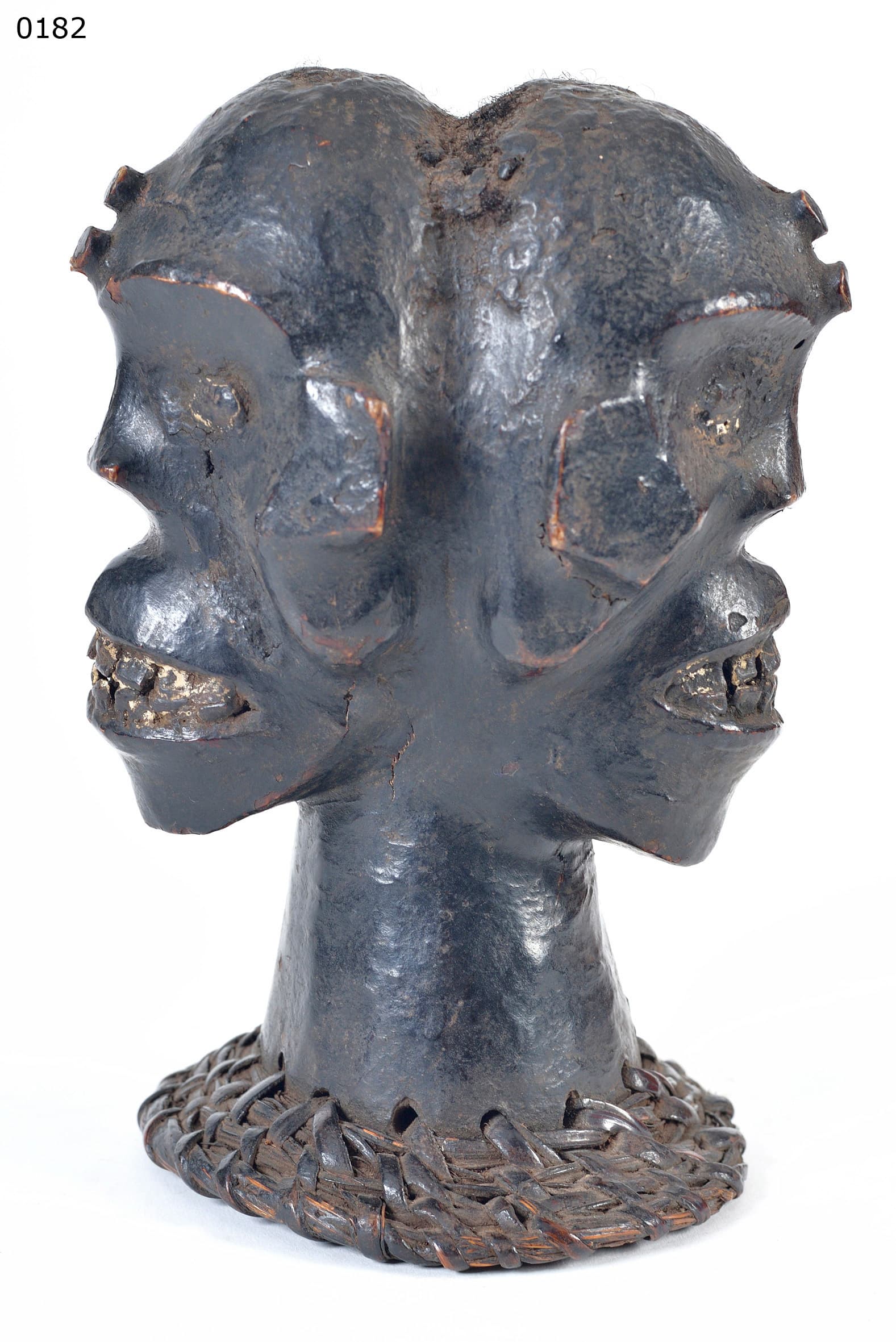
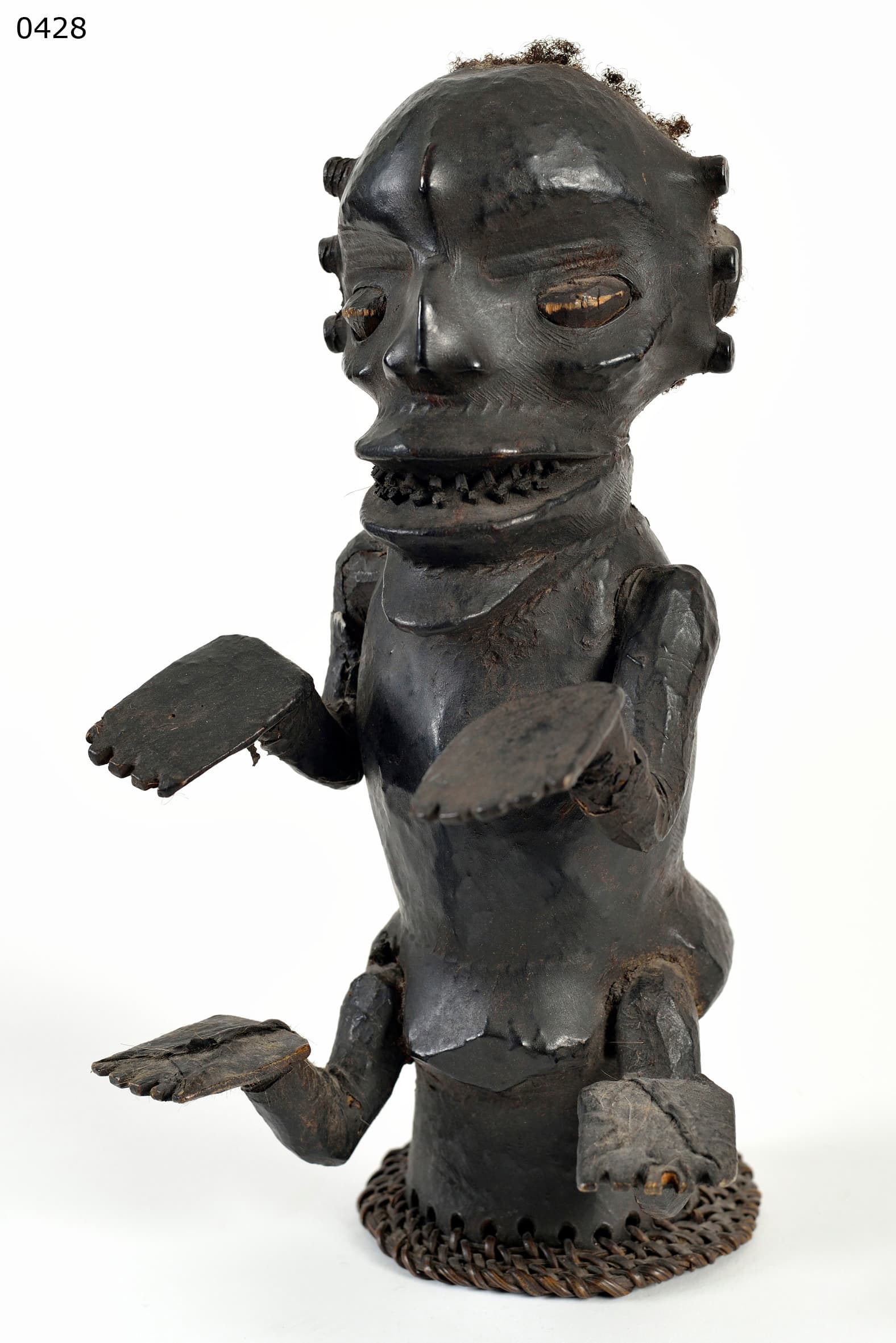
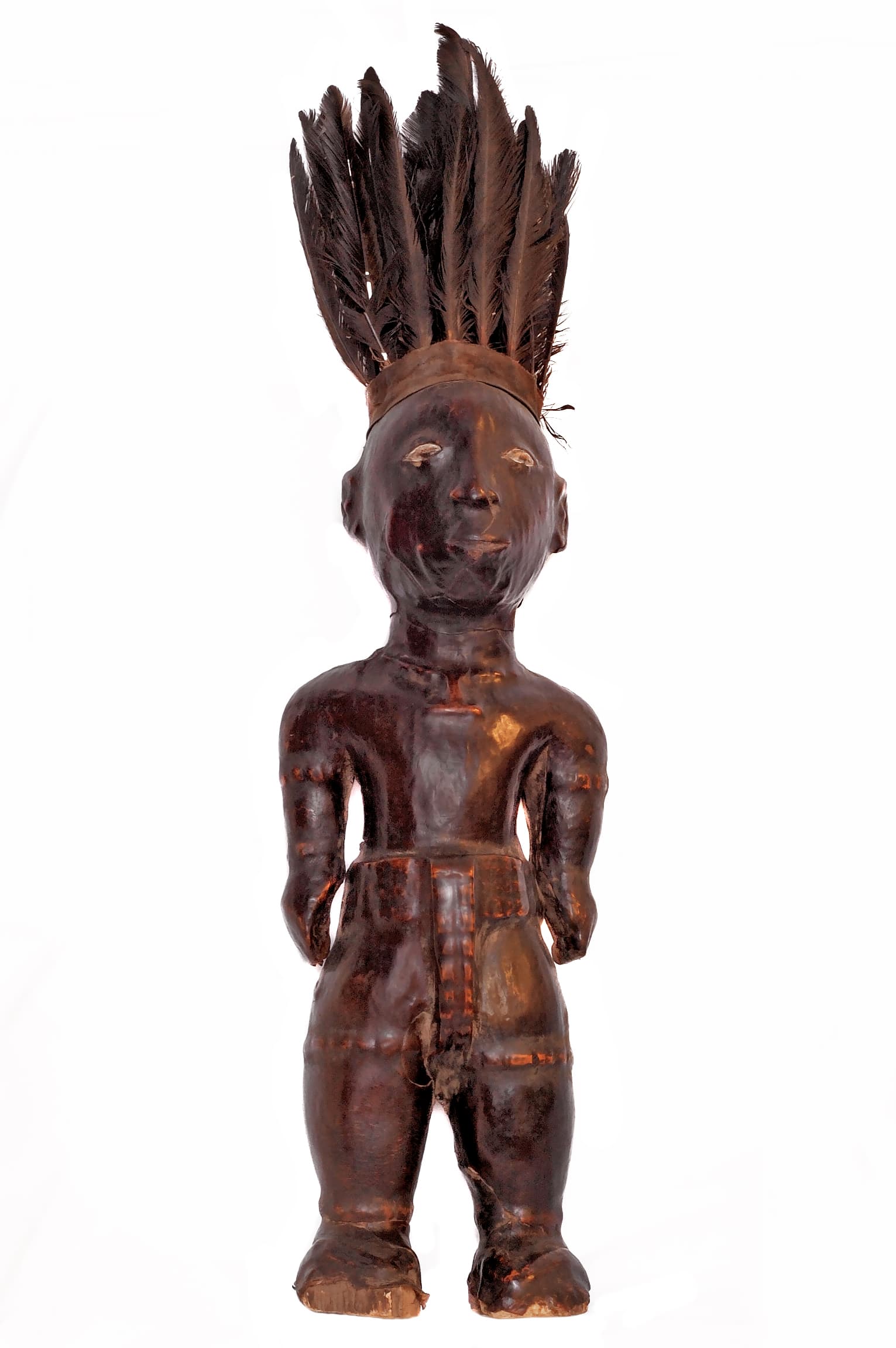
The undisputed unique selling point of the Ejagham within the Pan-African art canon is the masterful production of wood-carved masks covered with animal skin. This technique, in which the fresh corium of antelopes, forest duikers or, more rarely, sheep is applied over a soft wooden core, lends the objects an almost hyper-realistic, carnal quality that is unrivalled in Africa. The canonical object typology of Ejagham masks can be differentiated into three primary subtypes: First, the full helmet mask (helmet mask), which completely encloses the wearer's head and extends to the shoulders; second, the classic face mask; and third, the characteristic crest (crest mask or cap mask), which rests on a woven raffia basket base and is fixed to the top of the dancer's head.
The manufacturing process for these objects requires outstanding material expertise. The carver first moulds the rough physiognomy from a block of soft, porous wood. The rawhide, which has previously been soaked in water for days to make it supple, is then stretched wet over the wood. The residual grease on the uncleaned inside of the skin acts as a natural adhesive during the slow drying process. The skin is fixed in place with wooden pins or fine metal nails, usually at the base, around the root of the nose and on the ears. Anatomical details are only added after the skin has completely dried and shrunk, which is precisely placed in the carved recesses of the wood: Eyes made of bone, ivory or polished sheet metal as well as teeth made of carved bone splinters or wood.
Iconographically, the masks follow a strict canon of proportions. The female depictions are characterised by soft, idealised features, light skin colouring (often created using kaolin) and elaborate, horn-shaped hairstyles. These hairstyles imitate the traditional hairstyles of the Moninkim initiates. The male or warrior masks, on the other hand, are often dark-skinned, more expressive or aggressive in their facial features and decorated with archaic scar tattoos (cicatrices), which correspond in shape and placement to the nsibidi markings. An outstanding example of the formal mastery is the Janus-headed essay (e.g. The Metropolitan Museum of Art, Accession Number 1979.206.266), in which two faces - often a dark male and a light female - look in opposite directions. This Janus-faced typology symbolises omnisciency, the ability of spirits to look simultaneously into the physical and metaphysical world as well as into the past and future.
In the study of these masks, there is a significant iconographic controversy regarding ethnic attribution. As the mask tradition was disseminated throughout the Cross River Corridor, the distinction between Ejagham (Ekoi), Boki and Bangwa works is highly complex. Nicklin and Salmons (1984) identify formal differentiation criteria: Boki masks tend to have greater stylisation, elongated facial features, the use of imported sheet metal (galvanised iron) for the eye areas and specific black tattoo patterns (locally called kedako). Bangwa works, on the other hand, are characterised by extreme expression and dynamic asymmetries. The French ethnologist Pierre Harter (1994), however, partially contradicts Nicklin's pure form analysis and urges caution when interpreting the patina. Harter argues that the thick, sooty encrusted patina of many pieces, which is often taken as a sure sign of Bangwa influence from the grasslands, may in reality have been caused by the local storage of the masks in the roof truss above the open hearth fires of the Ejagham houses. This debate proves that exact workshop identification is often impossible, although master craftsmen such as Asikpo Edet Okon (from Ibonda, died in the 1920s), who was a style-defining influence on the female Ikem masks, are occasionally documented.
For the Western art market, forgery criteria and material forensics are of crucial importance. A ritually activated object can be distinguished from profane copies by specific signs of ageing. Criteria for authenticity include cracks and shrinkage at the edges of the animal skin caused by decades of climatic fluctuations. Fresh, light-coloured cracked edges indicate recent damage or manipulation, while darkened, stable cracks are evidence of old age. Other indicators of authentic pieces are natural termite damage to the wooden core, which is often only partially covered by the intact leather cover, and deep cracks in the heartwood. The identification of animal horns instead of carved wooden coiffures requires forensic scepticism, as these were often applied as later repairs or to enhance workshop replicas (which have been produced for export since the 1960s).
Ritual practice
In the indigenous context, the masks of the Ejagham are never isolated, static art objects, as they are presented today in the showcases of the Rietberg Museum or the Musée du quai Branly. Rather, they unfold their ontological meaning exclusively within the context of ritual performance, in which they function as the "head" of a larger, kinetic and sonic ensemble. The lifecycle of a mask begins with its ritual activation. A profanely carved and freshly covered object does not yet possess any inherent spiritual power. Only when it is consecrated in the secret lodge (the Efe Ekpe or Osam Mgbe) is the mask charged with the presence of the ancestors or the spirit of the covenant.
The performance itself is a highly orchestrated event. In the helmet and crest masks (Crest Masks), the wickerwork of the base is tied tightly under the dancer's chin. The human actor, who serves as a vessel for the spirit, is completely de-individualised: A voluminous garment made of woven raffia, cotton netting or imported fabrics and reaching down to the ankles completely veils his body, while the face remains covered by a semi-transparent cloth. Before the performance, the leather of the mask is rubbed intensively with palm oil. This act not only has a preservative function to keep the leather supple, but also intensifies the lustre and carnal quality of the mask, drastically enhancing the illusion of metamorphosis and aliveness (the affecting presence) in the flickering light of the ceremony.
The occasions for these mask performances are strictly regulated and include initiations into higher grades of the warrior or leopard societies, agricultural rites to secure the yam harvest and the organisation of commemorative mourning ceremonies for high-ranking dignitaries. A central and existentially significant ritual in this context is the Ekpaeku. The cosmology of the Ejagham states that an individual is inextricably linked to their ancestral land. If a member dies far from home, their spirit is in danger of wandering as a restless entity. The Ekpaeku ritual serves to spiritually return the deceased to the village in order to safely integrate the spirit into the genealogical continuity of the ancestors. During this and similar funerary practices, the Janus-headed masks act as visual metaphors of the all-seeing ancestors who simultaneously watch over the world of the living and the dead.
One fascinating aspect of the ritual practice of the Ejagham is the socio-economic mobility of the cults, which was analysed by Ute Röschenthaler (2011) under the paradigm of "Purchasing Culture". Secret societies, dance societies and specific masked traditions (such as the witchfinder cult Obasinjom) were not rigidly tied to a village, but were traded as intellectual and spiritual property between the communities of the Cross River Corridor. When a village acquired the rights to a cult, the transaction included not only the physical mask object and associated medicines (ajom), but also the esoteric knowledge, choreography and permission to perform. This commercial and ritual transfer explains the wide geographical dissemination of the leather-covered masks to the Igbo and Banyang.
The deactivation and disposal of a ritual object is also of paramount importance. If a mask became physically unusable due to termite infestation, climatic damage or old age, it did not necessarily lose its spiritual charge. The sources are ambiguous as to a standardised disposal rite, but ethnographic records suggest that highly sacred pieces were left to decay naturally in the secrecy of the lodge instead of being profanely destroyed. When a replacement mask was made, the spiritual essence was ritually transferred from the decaying mask to the newly carved mask through libations (blood from sacrificial consecrations, palm wine).
| Phase of the life cycle | Ritual action & materiality | Socio-religious purpose |
|---|
| 1st Profane moulding | Carving the soft wooden core, stretching the wet animal skin, fixing with pins. | Production of the physical carrier (vessel) without spiritual charge. |
| 2nd sacred activation | Consecration in the lodge house (Efe Ekpe), application of palm oil, pigments and offerings (libations). | Transformation of the wood into an active ritual agent; entry of the ancestral/covenant spirits. |
| 3rd Performance & Transaction | Kinetic use in Ekpaeku mourning rites or agricultural festivals. Masks can be sold to other villages ("Purchasing Culture"). | Social control, defence against witches, ancestor honouring; economic profit through cult export. |
| 4. deactivation / disposal | ageing through shrinkage/cracking. Withdrawal of power through transfer rituals to new objects. Storage in secret until decay. | Ensuring that sacred powers do not escape uncontrolled into the profane world. |
Historical context
The genesis and evolution of the Ejagham art and ritual world cannot be decoded without the traumatic and transformative tectonic shifts of regional history. The historical turning point of the Cross River Basin was the region's integration into the transatlantic slave trade beginning in the late 16th and 17th centuries. The delta around Rio del Rey and later the city of Calabar became massive trading centres for the export of human beings, ivory and palm oil. The Ejagham in the forested hinterland were integral players in this mercantile network. The Mgbe/Ekpe confederation, whose origins are deeply rooted in Ejagham culture, was transformed in this era from a primarily religious institution into a highly political, transnational freemasonry that guaranteed and regulated trade relations between the European slave ships on the coast and the African middlemen in the interior. The wealth that flowed into the region through this trade led to an unprecedented flourishing of ritual art; the elaborate skin masks and insignia served as visible manifestations of economic power and political hegemony.
With the beginning of direct colonial penetration at the turn of the 20th century by the British Empire in Nigeria and the German Empire in Cameroon, this system came under massive pressure. Colonial officials and early anthropologists began to systematically record and "collect" the region. Two figures stand out in particular: the German district officer and doctor Dr Alfred Mansfeld, who was stationed in Odissinge (now Mamfe) from 1904 to 1914, and the British administrator Percy Amaury Talbot (author of the standard work In the Shadow of the Bush, 1912). Mansfeld systematically exported hundreds of artefacts, including many of the canonical Ejagham helmet masks, to museums in Berlin and Hamburg, often on the direct instructions of Felix von Luschan.
This early colonial encounter gave birth to one of the most persistent and murky research controversies in African art history: the myth of the human skin. In their writings, Mansfeld (1908: 150) and Talbot (1912: 261) propagated the theory that the Ejagham used the skins of killed enemies or slaves for older, particularly sacred masks and war trophies. Talbot even claimed that ritual effectiveness presupposed that the victim had been deliberately killed to make the mask. The legend of the German colonial agent Gustav Conrau, whose skin was allegedly used to make a mask after his death, reinforced this European fascination with the macabre. However, modern forensic and material research, including that of Keith Nicklin (1974), has largely deconstructed this myth. Extensive analyses of museum objects have consistently proven that the coverings are invariably the leather of forest antelopes, duikers or sheep. Today, the "human skin myth" must be understood as a colonial tropical narrative that served to underpin the alleged savagery of the local population and justify Europe's "civilising" mission.
The market history of these artworks in the West underwent rapid development in the 20th century. In the 1920s and 1930s, European collectors such as Han Coray and Baron Eduard von der Heydt (whose collection now forms the nucleus of the Rietberg Museum in Zurich) discovered the aesthetic radicalism of the Ejagham masks. The reception within the framework of Western primitivism particularly appreciated the astonishing naturalism and formal tension of the Janus heads. A market breakthrough that canonised the Ejagham essays as global masterpieces occurred in the post-war period, flanked by prominent auctions such as the Helena Rubinstein auction at Sotheby's (1966) and later the Allan Stone collection. The prices for authentic, well-patinated old pieces reached historic highs.
Parallel to the massive increase in value in the West, the indigenous production continuity collapsed. As early as the 1940s, the British researcher Kenneth Murray documented that it had become almost impossible to find active craftsmen in the Cross River region who could still master the highly complex technique of skin covering. From the 1960s onwards, this drastic shortage of originals led to a massive counterfeiting problem and the production of workshop replicas for the African art trade. Modern authenticity testing (forensics) must therefore apply highly precise criteria. Today, certificates of authenticity are based on the chemical analysis of the patina (differentiation between ritually applied blood/palm oil and artificially burnt soot), the identification of deep, natural heartwood cracks, the radiological examination of the connecting pins (historical wrought iron vs. industrial wire) and the microscopic examination of termite damage, which must be logically coherent with skin loss at the seams. Only objects that pass these forensic and stylistic hurdles are considered authentic relics of the historic Ejagham culture on the highly competitive collectors' market.