Overview
The ethnographic and art-historical localisation of the Chamba - often subsumed under the terms Samba, Tchamba, Tsamba, Daka or Leko in older colonial and Francophone ethnographic literature - requires a highly differentiated view of the demographic, linguistic and socio-political realities of the central Benue basin. Geographically and historically, this people forms one of the key cultural nodes in the so-called Adamawa corridor, a broad contact zone that stretches from the Benue, Taraba and Faro river valleys up to the inaccessible Mandara and Shebshi mountain ranges. Current demographic surveys and estimates by international population funds put the total Chamba population at around 182,000 individuals, with the demographic centre of gravity of around 124,000 people located in north-eastern Nigeria (in the present-day states of Taraba and Adamawa), while a significant diaspora of around 58,000 individuals resides in neighbouring north-western Cameroon.
The linguistic classification of the Chamba groups represents one of the most intensively and controversially discussed fields of African linguistics and is a paradigmatic example of the epistemological challenges of categorisation in West Africa. The ethnic group is primarily divided into two distinct, only distantly related language groups: the Chamba Leko and the Chamba Daka. The historical development of linguistic categorisation reveals fundamental discrepancies in research.
| Research Era | Linguist / Author | Classification Model | Justification & Reception |
|---|
| Classical phase (1960s) | Joseph Greenberg (1963) | Adamawa-Ubangi language family | Greenberg assigned both language branches (Daka and Leko) homogeneously to the Adamawa group. This early classification dominated the literature for decades and characterised the museum classification. |
| Revisionist phase (1980s) | Patrick Bennett (1983) & Raymond Boyd (1989) | Benue-Congo branch (Bantoid) | Based on in-depth lexicostatistical studies, Bennett and Boyd argued strongly in favour of separating Chamba-Daka from the Adamawa group, which broke up the linguistic unity of Chamba. |
| Synthetic phase (2000s) | Raymond Boyd (2004) | Peripheral Adamawa language | Boyd revised his own radical reclassification and defined Chamba-Daka as a peripheral form, which emphasises the fluid linguistic boundaries in the Benue Valley. |
This classification controversy - Adamawa-Ubangi versus Benue-Congo - is by no means of purely academic interest. It correlates directly with profound historical processes of migration, assimilation and creolisation. The language reflects the fluid identity of the Chamba, who have historically always navigated between self-designation and ascription to others. In the colonial discourse of the 19th and early 20th centuries, the term "Chamba" itself often operated as a blurred collective term for martial, horse-riding peoples of the Adamawa region, which obscured the actual heterogeneity of the Leko and Daka speakers and their complex interactions.
The social structure of the Chamba rejects monocausal, generalising models and is characterised by a remarkable duality resulting from their turbulent migration history. In their Nigerian areas of origin south of the Benue, the Chamba traditionally lived and still live in acephalous, i.e. rule-free and decentralised communities. Political life here is primarily controlled by patrilineal clan affiliations and the authority of councils of elders. These structures show striking parallels to the organisational forms of their immediate neighbours, the Mumuye and Vere, who are organised in so-called dola (kinship-based small groups). In striking contrast, those Chamba groups (predominantly Leko speakers) who migrated to the Cameroon grasslands in the 18th and 19th centuries established highly centralised, hierarchical kingdoms, including the chiefdoms of Bali Nyonga, Bali Kumbat and Bali-Gangsin, which are still significant today. There, the acephalous structure was transformed into a system of divine kingship with an elaborate court.
A constant, identity-forming institution that bridges these radical socio-political differences is the existence of a strictly endogamous blacksmith caste. The artisanal and spiritual authority of the blacksmiths is a pan-cultural phenomenon in the region. As detailed surveys by the Royal Museum for Central Africa (RMCA) in Tervuren have shown for comparable Central African cultures, the blacksmiths do not merely function as metallurgists. Among the Chamba, they are the exclusive ritual specialists who moderate the ontologically dangerous transition between material transformation - the smelting of raw ore into culturally usable iron - and the spiritual sphere. These specialists weave together the social fabric and are the primary producers of sacred works of art.
Despite historical phases of militarisation and the slave trade, the subsistence economy of the Chamba is primarily based on agriculture. They practise mixed farming in the savannahs and river valleys. While the neighbouring Mumuye concentrate almost exclusively on the labour-intensive production of yams, the Chamba and Vere use draught animals to a large extent and cultivate sorghum (millet), maize and peanuts alongside yams. Millet is not only a staple food, but also an indispensable material component of religious life as the basis for the ritual millet beer (pito). The relationship with the neighbouring peoples - especially the Jukun, Tiv, Bata and Fulani - was historically an oscillating continuum of warlike conflict, symbiotic trade and ritual exchange. The Jukun kingdom in particular (the Kwararafa confederation) exerted a massive structural influence on the entire Benue Valley as an expansive trade and ritual network, which manifested itself in the pan-regional spread of syncretic mask cults and divination systems.
Cultural context
The religious and cosmological system of the Chamba defies orthodox, monotheistic explanations and instead operates as a dynamic, multi-layered network of clan cults, secret societies and highly localised traditions. The British anthropologist Richard Fardon, whose publications - in particular the comprehensive monograph Between God, the Dead and the Wild (1990) - are regarded as the undisputed standard work on the ethnography of the Chamba religion, structures its cosmology into three distinct but highly interdependent ontological spheres: The enraptured, transcendent creator god (Su), the omnipresent sphere of the ancestors (the world of the dead, which remains anchored in the villages) and the untamed natural and spiritual beings of the wilderness.
What significantly distinguishes this system structurally from the religions of hierarchical neighbouring peoples such as the Jukun is the lack of a centralised divine kingship in the acephalous regions, coupled with a pronounced emphasis on thermodynamic metaphors in ritual practice. Rituals such as those of the Voma or Vah cults are fundamentally based on the ritual manipulation of metaphysical states of "heat" and "coolness". In Chamba ontology, heat is associated with acute danger, death, uncontrolled numinous activity and ritual pollution. Coolness, on the other hand, symbolises healing, social balance, peace and the necessary deactivation of toxic spiritual energies that threaten the village fabric. This thermodynamic logic permeates every ritual act, from sacrifice to the mask dance.
Consequently, ritual authority among the Chamba is not monopolised by an omnipotent priestly caste or a sacral king, but distributed through various esoteric institutions. At the forefront are the divinators, who act as diagnosticians of the metaphysical sphere. They attribute illness, infertility or social misfortune to specific breaks in the thermodynamic or social balance. The executive ritual power, however, lies in the hands of the male and female secret societies, whose access is regulated by strict initiation rites. The blacksmiths again occupy an exposed, almost liminal position. They are regarded as the undisputed masters of elemental transformation. As they are able to transform raw ore into cultural artefacts in the extreme physical 'heat' of the forge, they are credited with the analogous spiritual ability to banish the hostile, hot entities of the wilderness and bind them into sacred iron bars, masks and altars.
In stark contrast to many strictly patrilineal and patriarchal neighbouring cultures of the Adamawa corridor, the socio-religious system of the Chamba gives women an essential and powerful role in the institutionalised cult. This manifests itself most impressively in the Vara cult. This cult does not focus exclusively on the veneration of anonymous patrilineal ancestors, but explicitly celebrates a central guardian spirit who personifies the "first mala" - the mythical paternal aunt of the chief or clan founder. At highly significant rites of passage, such as the funerals of elite members of the lineage or the enthronement of local dignitaries, this primordial female spirit appears in public in the physical form of a male masked dancer. This represents a remarkable ritual gender inversion that emphasises the duality of the world order. The ontological gendering practice also extends to the material objects: Female masks, for example, are traditionally patinated with thick, black layers of soot and resin, while male masks are rubbed with bright red laterite or Camwood powder.
Central initiation and transition rituals include elaborate circumcision ceremonies for adolescent boys. In the enclosure of the bush, elite esoteric knowledge of the secret societies is transferred and the novices learn the complex acoustic and visual secret language of the ancestors. The other pole of the ritual spectrum is formed by sprawling, highly complex death ceremonies (wakes), which often take place weeks or months after physical death. They are essential in order to guarantee the transfer of the erratically wandering soul to the secure, protective status of an ancestor.
The interpretation of these rituals reveals one of the most striking research controversies in modern African studies. Classical, structural-functionalist ethnologists (as they dominated early British social anthropology) often implicitly assumed that indigenous actors possessed a complete, seamless theological exegesis (interpretation) of their own ritual practices. Richard Fardon, on the other hand, formulates the thesis of the "limits of Chamba exegesis" (Limits of Chamba exegesis) in his analysis. Fardon meticulously documents that numerous Chamba ritual specialists - especially in the migrated Bali communities - explicitly state that they have "lost" the deeper semantics of certain ritual formulas, chants or the exact iconography of old cult objects. This loss is explained locally with the traumatic, centuries-long historical flight movements. For the Chamba performers, the ritual therefore does not necessarily function through an intellectually coherent theological level of meaning, but through pure performance, the correct observance of the ritual protocol and the material, physical presence of the ancestors in the act itself. Museum holdings, such as the extensive multimedia archive of the art ethnologist Hans Himmelheber in the Museum Rietberg in Zurich, support this praxeological perspective: Himmelheber's photographs and films emphasise the performative dynamics of West African ritual aesthetics, in which the isolated, static art object is only a temporary vessel within a much larger, dynamic structure of action.
Aesthetic features
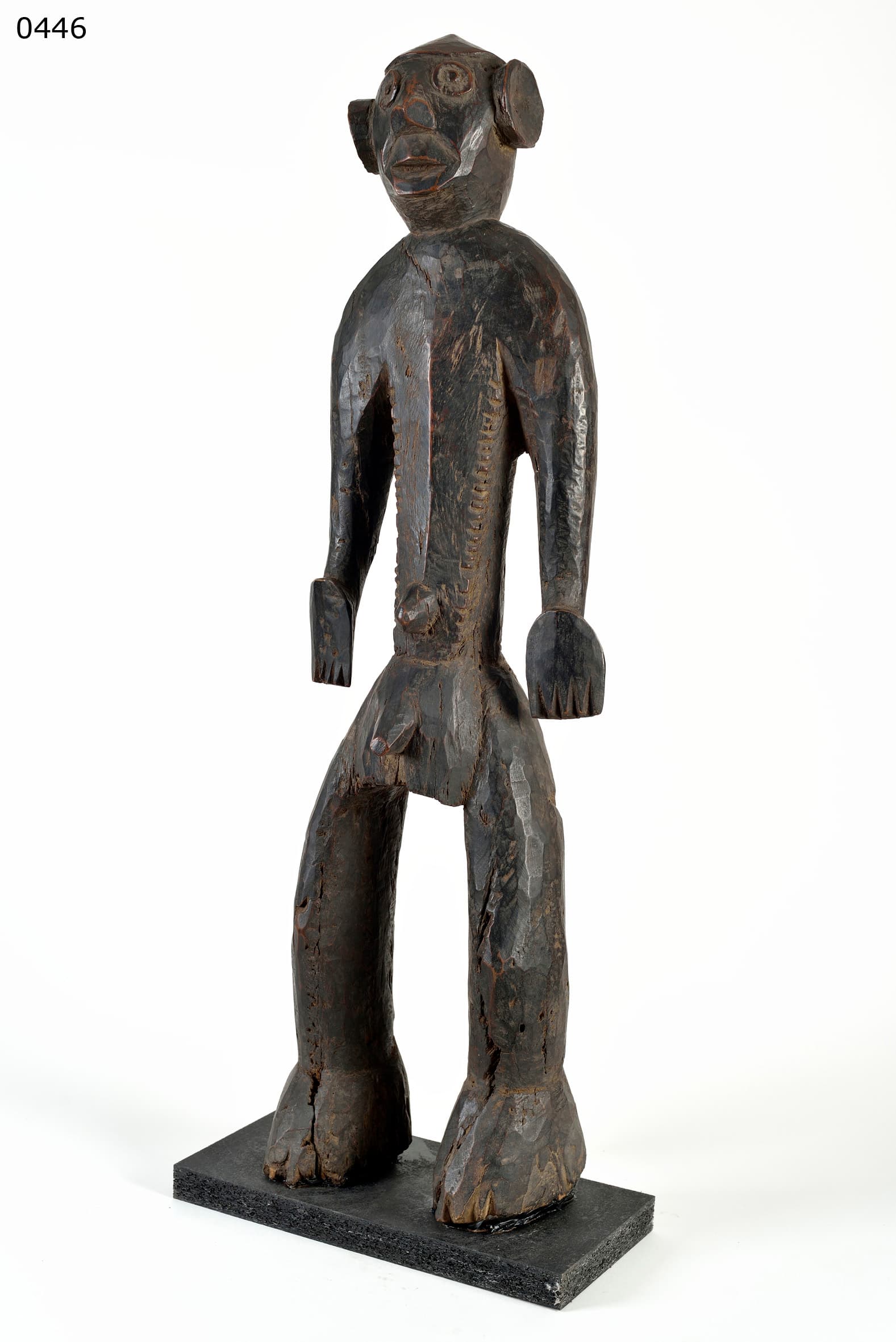
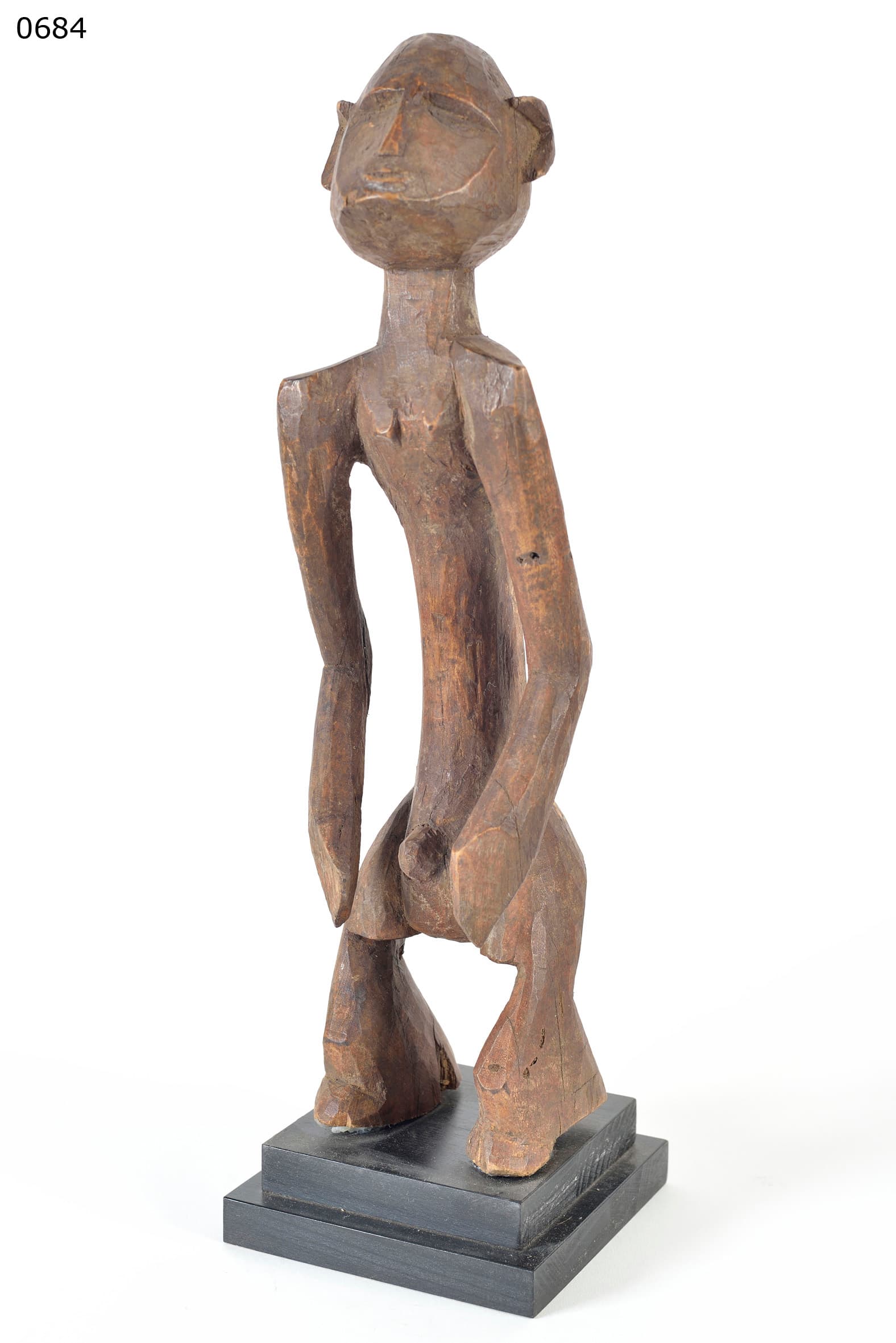
The surviving canon of classical Chamba artworks is relatively small in quantitative terms, but is characterised by an outstanding sculptural quality in its formal abstraction, its volumetric construction and its iconographic density. The typology of Chamba objects can be divided into four canonical subtypes, whose formal and aesthetic parameters have been systematically recorded and researched by institutions such as the Musée du quai Branly, the British Museum and the Fowler Museum.
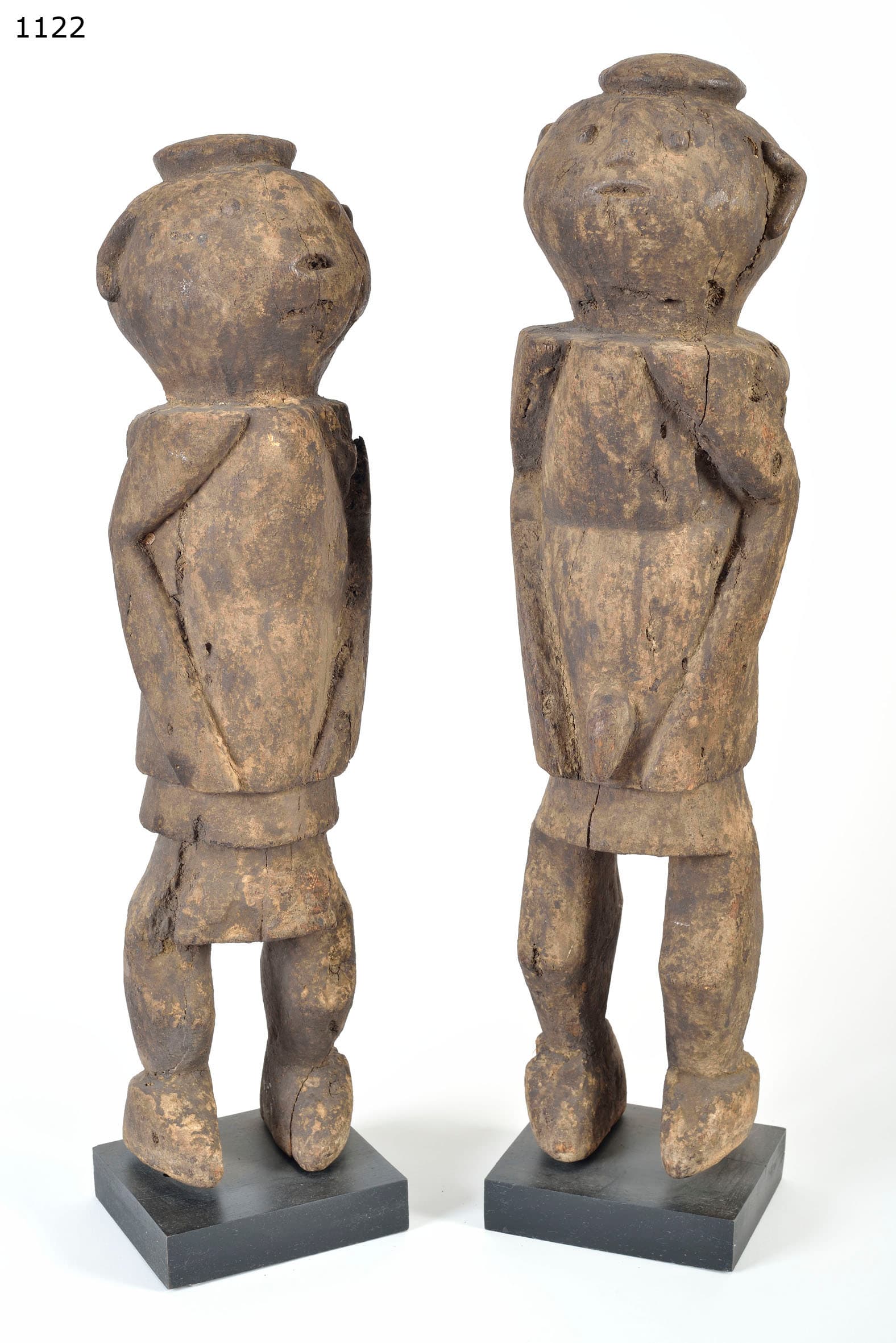
The most internationally recognised and by far the most relevant subtype on the secondary market is the cylindrical anthropomorphic sculpture carved from extremely hard heartwood, which in most documented cases appears as a bicephalic (two-headed) "Janus" figure. These statues have a striking columnar basic structure in which the torso, legs and neck merge into one another. Two often completely identical faces, positioned back to back, are enthroned at the top of the columnar structure. These are characterised by protruding, often zigzag-shaped incised jaws, strictly geometric triangular noses and strongly protruding, bulbous eyes. The canon of proportions of the Chamba statues is characterised by a radical reduction to the vertical axis. The British sculptor Henry Moore, who in 1951 intensively studied the formally closely related "Lilley figures" of the Mumuye in the archives of the British Museum, particularly admired the mastery in dealing with negative space in this Adamawa-specific formal language. The statues convey the impression of two outer surfaces that create an enclosed inner space - a sculptural dialogue between mass and emptiness that Moore found highly innovative (Moore quoted in Fardon 1999).
One of the most prominent controversies in West African art history concerns the deep iconographic interpretation of these Janus figures.
| Author / research direction | Interpretation of Janus symbolism |
|---|
| Classical art dealers & early ethnologists (e.g. K.-F. Schaedler) interpreted the two-headedness primarily as a profane status marker or as a simple aesthetic formalism intended to suggest an all-round visibility of the guardian figure (vigilance in all directions). The double face is read here in a functionalist way as a warning against theft or spiritual invasion. | |
| Richard Fardon & Christine Stelzig (2005) postulate the thesis of "cosmological doubleness". Fardon argues that bicephalic composition is an ontological necessity. It serves to bind the omnipresent dualisms of the Chamba world (male/female, village/wilderness, heat/cool) in a single vessel and make them ritually manageable. The sculpture becomes a thermodynamic accumulator that unites opposing energies. | |
The second central type in Chamba art is the mighty, archaic-looking buffalo or bush cow helmet mask, which is called Lang-gbadna by the Daka speakers and Vara by the Leko groups. These masks are architectural masterpieces of abstraction and conceptual condensation. They consist of a voluminous, smoothly worked hemispherical dome, from the base of which strongly reduced, curved horns emerge at the sides and a massive, flat jaw, often only indicated by a stylised gap, emerges at the front. Data from the inventory catalogues illustrate a clear cosmological assignment of the physical attributes: The central hemispherical dome symbolises the human skull and thus stands for the ancestor, death and the cultivated sphere of the village. The protruding horns, on the other hand, represent the African forest or savannah buffalo, and the abstracted, elongated jaw refers to the crocodile. These animalistic elements epitomise the unpredictable, "hot" forces of the wilderness. By wearing the mask, these antagonistic spheres merge on the dancer's body to form a ritually controllable unit.
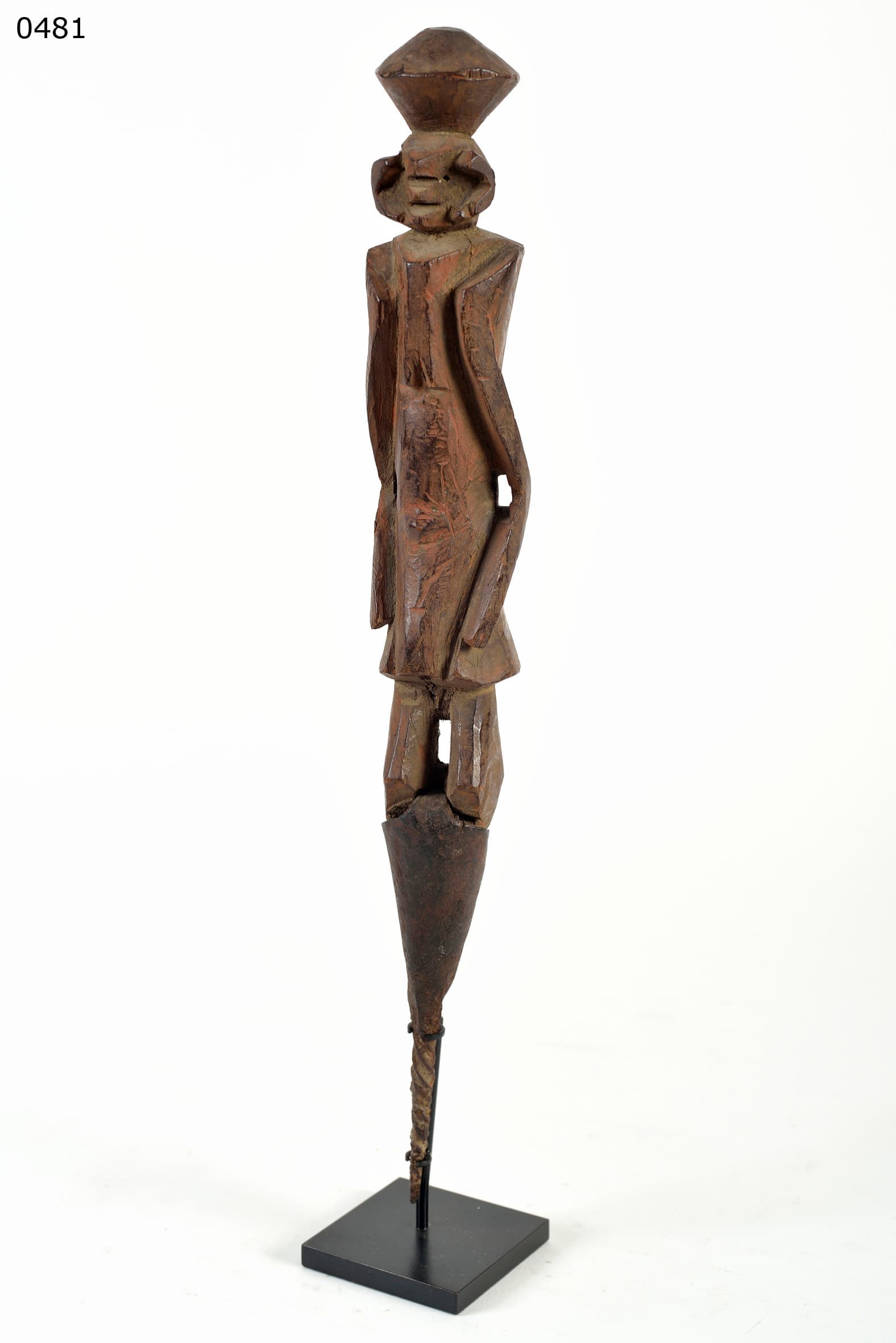
The iron sculptures and altar pieces form a third, less frequently publicised group of materials. The Metropolitan Museum of Art in New York preserves an important series of iron rods (approx. 30 to 50 centimetres high) that are forged into delicate human figures at their upper end. A fourth category comprises the highly complex bronze castings (produced using the lost wax technique, often with iron core supports). These are mainly ceremonial bells, some of which are anthropomorphic in design or decorated with equestrian motifs (equestrian figures). The iconography of the equestrian figures refers to the historical militarisation of the Benue Valley and shows technological and symbolic parallels to the courtly bronzes from Benin City, as extensively documented by the British Museum and the Penn Museum.
A substantial and often frustrating problem of morphological analysis among experts is the extremely fluid stylistic relationship in the Adamawa corridor. The formal-linguistic boundaries between the Chamba, Mumuye, Vere and Jukun workshops are almost impossible to draw ethnographically. The source situation regarding provenance is profoundly ambiguous, as Western dealers and auction houses in the 1960s and 1970s summarily declared thousands of works as "Mumuye style" - simply because the name Mumuye was in vogue and more lucrative on the art market - although many of these sculptures actually came from remote Chamba villages (Fardon 2011; Herreman 2016). Workshops documented by name or individual "master hands" are therefore extremely rare in the Chamba context and are mostly based on Western style groupings, such as the "Soompa artist" hypothetically named by traders or the localisation of the singular "Develon mask".
The fundamental difference between an activated, sacred ritual object and a profane carving (produced for tourists or purely for personal use without ritual consecration) manifests itself in the Chamba almost exclusively in the patina. A newly carved or profane object remains transparent or is only superficially coloured. A ritually activated object, on the other hand, undergoes countless applications of kaolin (white clay), crushed laterite, charcoal and specific sacrificial substances (primarily millet beer, more rarely animal blood) over decades. Over the course of generations, these layers form a thick, often heavily encrusted and cracked patina. Today, forgery criteria in the high-price segment focus precisely on this materiality: forgers imitate the age through artificial weathering in mud or acids, but can hardly replicate the microscopic depth structure of genuine sacrificial layers that have grown over decades, the natural and uneven termite feeding on the areas close to the ground and the slow, deep cracks in the heartwood caused by decades of climatic fluctuations in the altars of the Benue Valley in a chemically and physically flawless manner.
Ritual practice
Chamba ritual practice is a highly formalised, choreographed system based on the constant calibration of metaphysical energies. A central locus of this practice is not the open village centre, but the altar in the sacred grove hidden deep in the bush (the wilderness sphere) far from the profane village boundaries. The use of these altars is inextricably linked to the agricultural cycles (especially the sowing and yam harvest) and the critical passages of the human life cycle.
The iron rods recorded in the collections of the Metropolitan Museum of Art are an impressive illustration of the structure and function of such a secret altar. These iron rods with anthropomorphic tips are driven deep into the earth of the grove by the officiating blacksmith-priest as corresponding male-female pairs. This physical penetration of the ground is of crucial conceptual importance: it literally "grounds" the object and establishes a physical channel into the subterranean sphere of the ancestors. These altars are not activated through daily, permanent worship, as is common in Christianity or Islam, but are strictly event-bound. They are visited to ward off acute crises - epidemics, prolonged periods of drought or escalating social conflicts - and to perform the complex Vah and Voma rituals.
The offerings made at these altars obey the logic of thermodynamic regulation. They primarily consist of libations of pito (home-brewed millet beer). Millet beer is regarded as a "cooling", soothing substance that is poured over the iron or wood to neutralise the "hot", potentially destructive and demanding energies of the spirit world (Fardon 1990). Only in moments of maximum ritual danger or during the initial consecration of a high-ranking object are bloody animal sacrifices (chickens or goats) made, whose vital "heat" charges the object energetically and whose blood combines with the iron or wood to form the characteristic dark patina.
The performative dimension of the Chamba religion culminates in the mask dance of the Lang-gbadna (the buffalo mask). This performance is not an abstract, representative theatre piece, but for the believers the real, ontological manifestation of the transition from wilderness to civilisation. The structure of the masquerade is strictly regulated. The wearer - exclusively an initiated man of the appropriate age group, whose individual, profane identity must be completely obliterated during the act - balances the heavy, often unwieldy wooden helmet mask on his head. The dancer's body is completely hidden from view by a voluminous, often multi-layered suit made of undyed, layered raffia fibres that fall from the edge of the mask to the ankles. The dancer's view of the outside world is severely restricted and is achieved through the gaping, stylised "crocodile jaw" of the mask.
The mask is activated before the performance by esoteric incantations in the secret house, whereby the untamed spirit of the "bush cow" (the forest buffalo) is acoustically and ritually summoned into the wood. The dance itself, which is often accompanied by massive wooden slit drums, ritual flutes and the piercing sounds of bronze bells, is characterised by uncontrolled, aggressive and escalating movements, known in Daka as gbalang. The dancer hurls his heavy head, stamps his feet massively and imitates the brute aggression of the African cape buffalo. At death ceremonies, this outburst of raw energy has a paradoxical purpose: the mask, which represents the dangerous forest spirit, is ironically used to escort the soul of the deceased safely through the dangers of the wilderness and guide it into the realm of the dead.
Regional variations of the ritual practice exist mainly in the visual coding of the masks. The Daka-speaking groups in the West make a strict distinction between black-painted masks (which are considered feminine and are often danced in memory of the mythical primordial mother who, according to legend, emerged from the river as a buffalo girl and shed her animal skin) and red-painted masks (which are categorised as masculine, aggressive and warlike). Some eastern Leko groups also have rare bichromatic masks (with the halves of the face split red and black), which embody androgynous, all-encompassing powers.
The life cycle of a ritual object among the Chamba is characterised by deep pragmatism. From the moment it is carved by the blacksmith, through its initiation by blood and beer sacrifice, to the climax of its ritual "charging", the object is intensely revered, fed and feared. However, when the power of an object diminishes - be it through diminishing success in divinations, the absence of rain despite correct sacrifices, or simply through advanced termite damage to the material - it is by no means preserved or museumised. Deactivation and disposal usually takes place completely silently and without any accompanying ritual: the object is returned to the sacred grove deep in the forest and left to decay naturally and inexorably. It returns to the entropic cycle of the wilderness from which its material substance (the wood) was once taken (Fardon 1990).
Historical context
The artistic, cultural and social history of the Chamba is inextricably linked to the massive, often extremely violent demographic upheavals that have kept the Benue Valley in suspense for centuries. In his influential historical monograph, anthropologist Richard Fardon aptly characterises the history of the Chamba as that of "raiders and refugees". The history of migration escalated dramatically in the late 18th and especially in the early 19th century due to the far-reaching Islamic jihad of the Fulani empire under Usman dan Fodio. Highly mobile, heavily armed cavalry troops of the Fulani and their allied Bata forced many Chamba communities out of the fertile, open savannahs and into the inaccessible, rugged Shebshi Mountains or forced them to migrate southwards to Cameroon on a massive scale.
These migration narratives involve considerable dating controversies: while some historians argue that climatic changes and droughts triggered the initial migrations, other authors date the refugee movements precisely to the military shock waves of the jihad in the early 19th century. The historical result was the fundamental division of the ethnic group into the acephalous, defensively organised mountain Chamba in present-day Nigeria and the massively militarised Chamba-Leko, who also relied on cavalry. The latter conquered territories in the Cameroon grasslands, founded centralised kingdoms (such as Bali Nyonga) and transformed older ritual festivals, such as the Lela festival, into gigantic, martial weapons displays and durbars, which clearly borrowed from the court culture of the Muslim emirates.
The subsequent colonial encounter towards the end of the 19th century - initially by German Schutztruppen, which fuelled expansion in Cameroon, and later by the British colonial administration (Indirect Rule) in Nigeria - administratively froze these highly dynamic pre-colonial migration movements. The presence of the colonial powers influenced Chamba art production on several, often contradictory levels. On the one hand, the import of industrially manufactured steel tools (axes, adzes, knives) changed the carving techniques of the blacksmiths, which led to more precise, but sometimes less organic formal languages. On the other hand, British colonial officials and Christian missionaries rigorously prohibited the practice of "bloody" and, in their view, subversive secret society rites. As a result, many shrines were destroyed, cult objects confiscated or - in order to protect them - relocated deep into inaccessible forest areas, where they fell victim to rapid decay.
The market history of Chamba art in the West is a surprisingly late phenomenon compared to coastal peoples. While wooden sculptures from the Congo or the Ivory Coast were already circulating in the studios of the European avant-garde (as with Picasso or Braque) before the First World War, the wide valley of the Benue River remained an ethno-aesthetic terra incognita. The sudden breakthrough on the international art market occurred as a direct, tragic consequence of the devastating Nigerian civil war (Biafra War, 1967-1970). The massive military devastation and the accompanying famine in eastern Nigeria led to an unprecedented exodus of cultural artefacts. During this chaotic period, thousands of ancient sculptures travelled to Europe and the USA. Ironically, most of these Chamba masterpieces were sold by Western dealers under the pan-ethnic label "Mumuye style", as interest in African abstraction was growing and the Mumuye had just been "discovered" in museums.
The first important pioneers of collecting, such as the doctor Pierre Harter, who worked in Cameroon, and the Munich scholar Karl-Ferdinand Schaedler, saved key collections of Benue Valley art from being lost forever in the 1970s. Harter's private collection, large parts of which were later transferred to the Musée du quai Branly in Paris, provided the first stable taxonomic basis for classification. However, the final scientific and economic breakthrough for Chamba art was only cemented very late in the day by monumental academic exhibitions. The groundbreaking exhibition Central Nigeria Unmasked: Arts of the Benue River Valley, which premiered at the Fowler Museum at UCLA in Los Angeles in 2011 and was later shown at the Musée du quai Branly in collaboration with Hélène Joubert, marked a turning point. Curated by Marla C. Berns, Richard Fardon and Sidney Kasfir, this project realised the unfinished dream of the late explorer Arnold Rubin. The exhibition finally freed Chamba art from the historical shadow of the Mumuye and defined it as a completely independent, highly complex stylistic province. In the wake of this museum canonisation, prices on the secondary market exploded, especially for the abstract Janus figures and the massive bronze bells that were prized by Cubism.
The rapid price explosion inevitably escalated the problem of forgery. As systematic field research by Rubin in the 1970s and Fardon in the late 1980s documented that an enormous vacuum had been created in the country of origin - most authentic, pre-colonial objects had long since left Nigeria - local carving workshops in West Africa began to meet the massive demand of the global market with professional reproductions. Today, the authenticity criteria and forensics for Chamba wooden objects are extremely rigid in renowned museums such as the Museum Rietberg or the Quai Branly. Genuine pieces must show deep, irregular termite damage on the surfaces close to the ground that has not been artificially imitated with drills. Natural, asymmetrical heartwood cracks caused by decades of slow shrinkage in the alternating tropical climate of the Benue Valley are equally important. The radiological and chemical examination of patina layers - the detection of crystallised millet residues, decomposed animal proteins and deeply washed-in lateritic dust as opposed to hastily sprayed-on chemical ageing agents - is now considered an indispensable conditio sine qua non for the proof of museum authenticity and the protection of private investments.