The Fon are a Beninese people concentrated on the Abomey Plateau in southern Benin, known for their courtly-elitist art, highly centralised state, and elite female regiments.
Overview
The Fon, whose autonymic self-designation is Fon-nu, are the demographically and culturally historically most dominant ethnic group within the modern Republic of Benin. Based on current census data and demographic projections, the population of the Fon and their directly related subgroups is estimated to be between 4.8 and 5 million individuals, which corresponds to around 33.2 to 38 per cent of the total Beninese population. In the historical, primarily francophone colonial literature, the exonymous term "Dahomeans" was established for this ethnic group, which is derived directly from the hegemonic kingdom of Dahomey, which controlled the region from the early 17th century until the French conquest in 1894. The geographical core settlement area of the Fon is concentrated on the reddish, iron-rich and agriculturally demanding Abomey Plateau in southern Benin, which lies around 100 kilometres north of the Atlantic coast. In addition to the historic capital Abomey, there are significant urban concentrations in Cotonou, Ouidah, Allada, Bohicon and Lokossa as well as transnational exclaves in the Atakpamé region in south-western Togo. Beyond the core area, there are historically grown diaspora communities in Togo (~55,000), France (~18,000, primarily former colonial metropolises), Gabon (~14,000) and Ghana (~11,000), which document the transnational reach of Fon culture.
Linguistically, Fongbe (or Danmegbe, literally: the language of Dahomey) belongs to the Kwa language family within the wide-ranging Niger-Congo language phylum. It forms a central branch of the so-called Gbe dialect cluster, which spans the coastal areas of Ghana, Togo, Benin and Nigeria. Fongbe is an analytic language with a strict subject-predicate-object word order (SVO) and is divided into distinct regional dialects such as Agbome, Arohun, Gbekon and Kpase.
The traditional social structure of the Fon is based on a strictly patrilineal and patriarchal kinship system organised in concentric social units. The cellular basis is the polygynous family (xue), in which each wife and her children live in their own house within a common, fenced homestead. Several of these homesteads, which are connected by male lineages, form an extended lineage community (henu), which is always headed by the oldest male member as lineage head. The macro-sociological bracket is formed by the patrikian (ako), a widely ramified network that can comprise thousands of individuals who refer to a common mythical ancestor and share specific food taboos, even if they do not reside in geographical proximity to each other. The subsistence economy on the arid plateau, which is characterised by tropical rainy and dry seasons, is dominated by the cultivation of oil palms, manioc and yams.
Structurally, the Fon show a massive organisational contrast to numerous neighbouring peoples. While many surrounding ethnic groups (especially in the west) traditionally had acephalous, decentralised social structures, the Fon, whose ethnogenetic roots go back to the Aja people, established a highly centralised, hierarchical and militarised state with the Kingdom of Dahomey. This tight state organisation, which was secured by the institutional integration of elite female regiments (known in Western reception as "Dahomey Amazons" or N'Nonmiton), enabled the Fon to become one of the main players in the transatlantic slave trade in the 18th and 19th centuries (Polanyi 1966; Law 2005). The material representation of this hierarchy is excellently illustrated by the collection holdings at the Fowler Museum (UCLA), where the courtly-elitist art of the Fon is curated in sharp contrast to the egalitarian material culture of neighbouring, acephalous groups.
With regard to ethnolinguistic classification, there is considerable controversy among researchers. The sources are ambiguous as to the extent to which neighbouring groups such as the Mahi in the north, the Ayizo and Hueda in the south or the Gun in the southeast should be categorised as independent ethnic groups or as mere demographic subgroups of the Fon. While colonial ethnographies tended towards a subsuming categorisation, modern linguistic analyses (Lewis et al. 2014) emphasise a high mutual intelligibility of the idioms, but call for a more differentiated socio-cultural separation.
| Demographic & linguistic parameters | Specification in the context of fon culture |
|---|
| Estimated total population | 4,800,000 - 5,000,000 individuals (including closely related Gbe subgroups) |
| Geographical epicentre | Abomey Plateau, Department of Zou, Republic of Benin (162 inhabitants/km²) |
| Linguistic macro-classification | Niger-Congo language family > Kwa branch > Gbe dialect cluster |
| Primary social structure | Strictly patrilineal: xue (family) > henu (lineage) > ako (clan) |
| Historical form of government | Highly centralised, hierarchical military state (Kingdom of Dahomey) |
Cultural context
The spiritual and religious system of the Fon manifests itself in the highly complex cosmology of the West African Vodun, a polytheistic tradition that not only represented a religious practice in the historical kingdom of Dahomey, but was also developed into the central institutional pillar of the state's power architecture. The cosmological order of the Vodun (a term that basically means "spirit", "power" or "god" in Fongbe) is strictly hierarchically structured. At the top of the divine pyramid is an omnipotent, dual creator deity (often conceptualised as Mawu-Lisa), who acts as an unfathomable, life-giving source of energy from which all other forms of existence descend. Beneath this omnipotent entity operates an extensive pantheon of over one hundred specialised Vodun deities and natural beings who, as personified forces, govern specific aspects of the physical world (waters, trees, stones) and human civilisation.
What fundamentally distinguishes the Vodun religion of the Fon from the spiritual systems of its neighbouring peoples, both structurally and historically, is the degree of state instrumentalisation and centralisation. While the Orisha system of the neighbouring Yoruba in Nigeria remained strongly decentralised and tied to local lineages despite obvious syncretic overlaps and metaphysical affinities - for example with corresponding deities such as Legba/Elegba (threshold guardian) or Gu/Ogun (iron god) - the kingship of Dahomey usurped the cult for its political purposes (Mercier 1954; Egharevba 1946). The kings of Abomey placed the high priests and divinators under their direct control, redefined the hierarchy of the gods and established Vodun as an official institution that served to sacralise the absolute monarchy.
There is a sharp research controversy in the academic interpretation of the genesis and meaning of the term Vodun. The older philological faction derived the term historically from the Ewe word vo (translated as "hole" or "opening", associated with the hidden) and du (a term for oracle sign or "messenger"), which established a rather mystifying interpretation as "messenger of the unseen". Suzanne Preston Blier (1995), however, vehemently deconstructs this interpretation. She bases her psycho-anthropological thesis on the Fongbe verbs vo ("to rest") and dun ("to draw water"). Blier argues that the core of vodun does not lie in mystical concealment, but in the existential philosophical premise of inner peace and serenity in the face of unavoidable adversity and life's risks.
Ritual authority manifests itself among the Fon primarily in two institutions: the bokonon (divinators) and the specialised secret societies. The bokonon are the exclusive interpreters of the Fa oracle, a binary divination system that acts as a codifier of the divine will. In addition to the clergy, masked and secret societies such as the Zangbeto ("Guardians of the Night") act as ritual authorities and informal instances of social control. These rotating mask structures made of raffia, which are regarded by the community as purely spiritual and free of human actors, patrol the villages to exorcise evil spirits and sanction worldly criminality. Here too, in comparison to the structurally similar Oro cult of the Yoruba, a stronger formal integration of the Zangbeto into the public, preventative security policy of modern society is evident.
An outstanding specificity of Fon culture, which has received intensive attention in gender theory, is the role of women in the institutional cult and at court. Research by Edna Bay (1998) sheds light on the institution of the kposi ("women of the leopard") - an elite category of royal wives who are to be distinguished significantly from regular concubines (ahosi). These women not only functioned as reproductive guarantors of the dynasty, but also acted as high-ranking palace officials, ministers and priestesses who acted as ritual doubles of male officials and balanced and controlled the king's theoretically absolute power in realpolitik terms. Another central element was the institution of the kpojito ("bearer of the leopard"), the official royal mother, who was filled by a representative deputy after the death of the biological mother, which guaranteed the continuous presence of female authority in the Council of State. Collections in the Royal Museum for Central Africa (RMCA) in Tervuren document this gender dynamic through specific insignia and ritual objects that are explicitly assigned to female priesthoods and refute the narrative hegemony of a purely patriarchal kingdom. However, the sources are ambiguous as to the specific extent to which peripheral, rural communities of the Fon away from the courtly metropolis of Abomey were permeated by these elite, institutionalised gender roles.
| Structural parameters | Fon (Vodun) | Yoruba (Orisha) |
|---|
| Divine creator authority | Mawu-Lisa (dual concept, often with female connotations) | Olodumare (distant creator deity) |
| State institutionalisation | Highly centralised through the Dahomey kingship; priesthood subordinate to the king | Decentralised, highly fragmented, tied to local lineages and city-states |
| Social control mechanisms | Zangbeto (preventive guardians of the night, public presence) | Oro / Egungun (strictly exclusive ancestor cults, sometimes with massive taboos for women) |
| Threshold and protective deity | Legba (often iconographic as a phallic clay figure at the entrance to the village) | Elegua / Eshu (complex trickster and communicator) |
Aesthetic features
The material culture and aesthetic canon of the Fon radically elude the Western, function-free pursuit of formal beauty or mimetic harmony. Fon art is extremely purposeful, conceptually charged and uncompromisingly focussed on mystical, emotional and, above all, apotropaic (ominous) efficiency. The canonical object typology of the Fon is primarily divided into four main categories, whose formal syntax is strictly subordinate to the respective ritual or representative function.
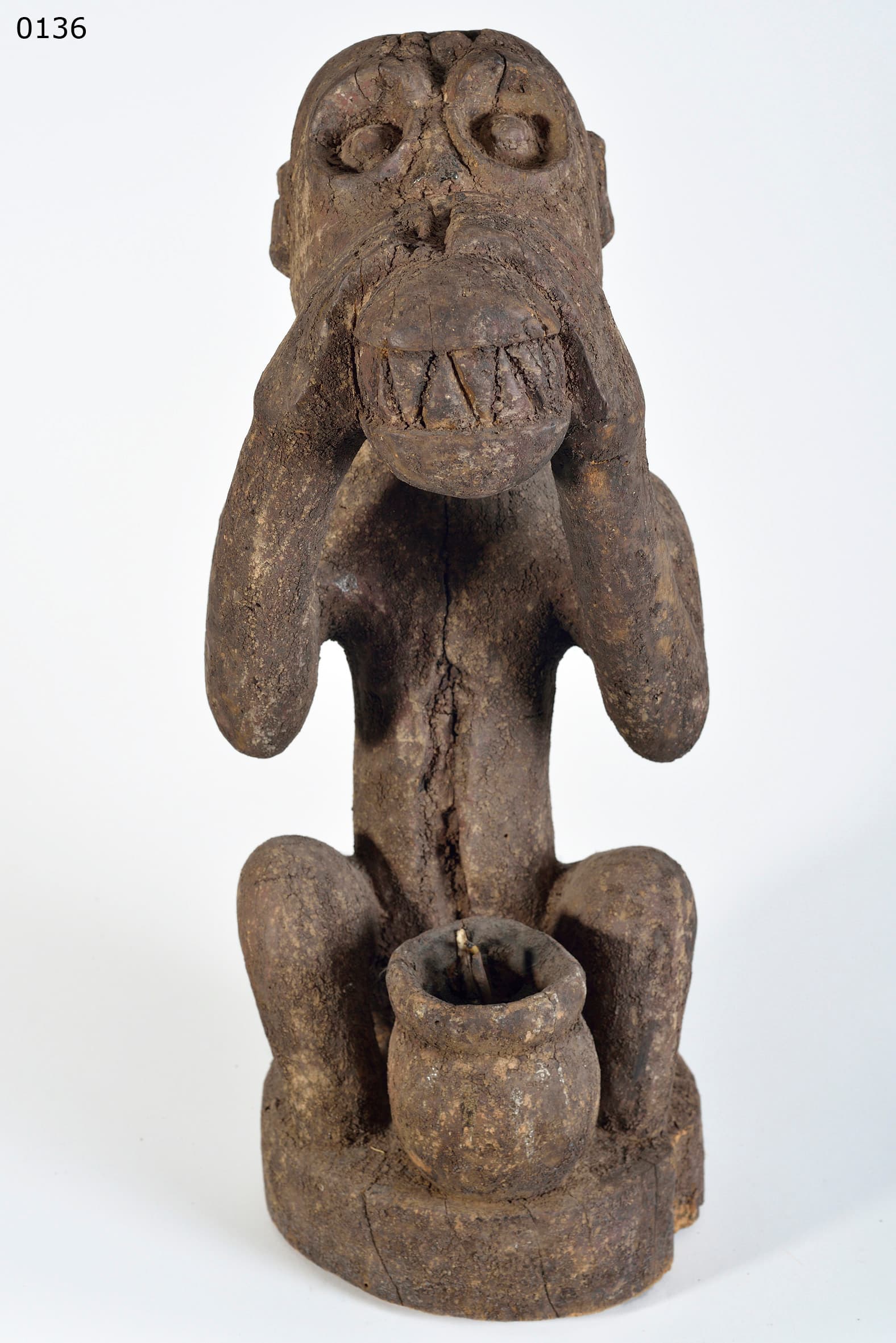
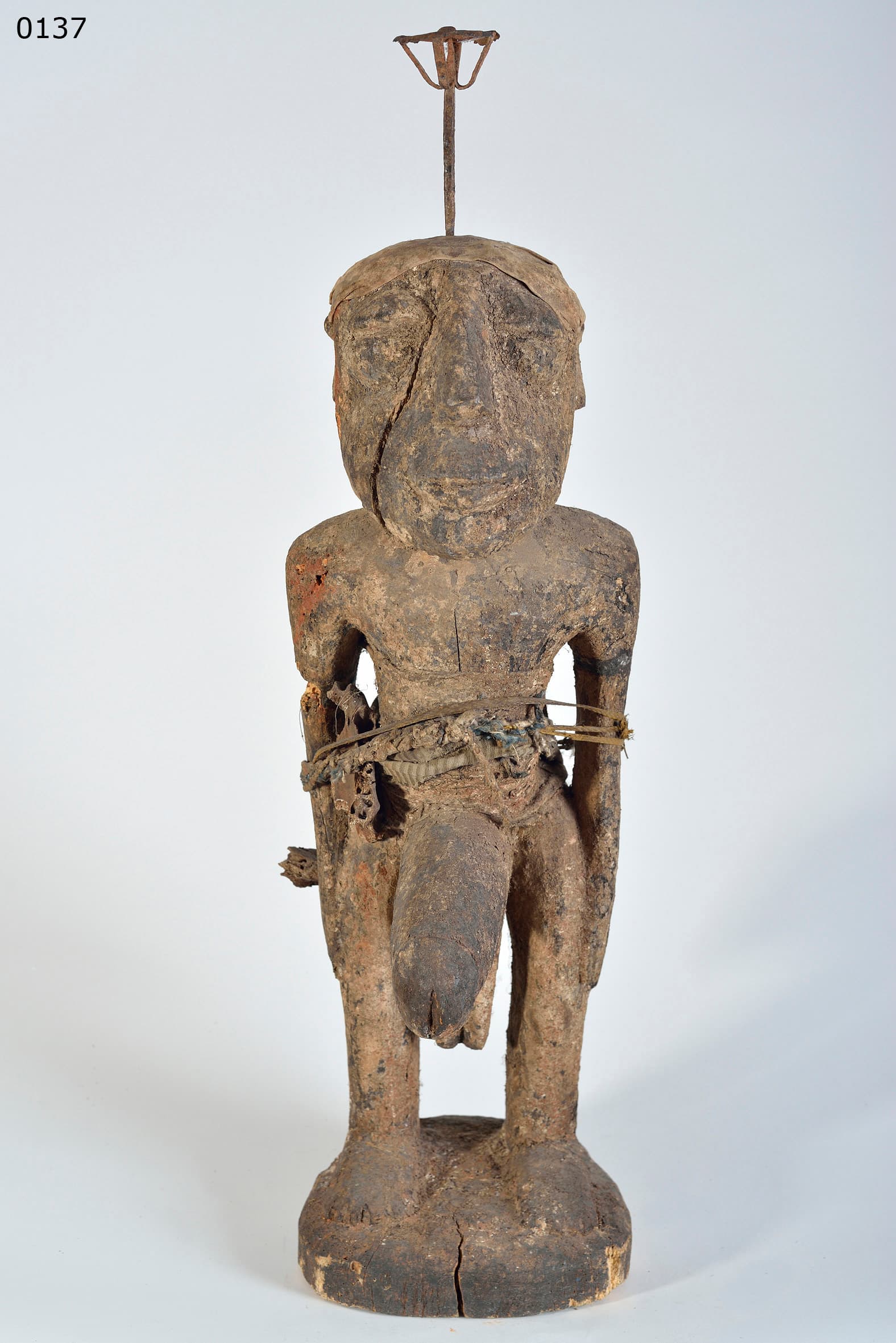
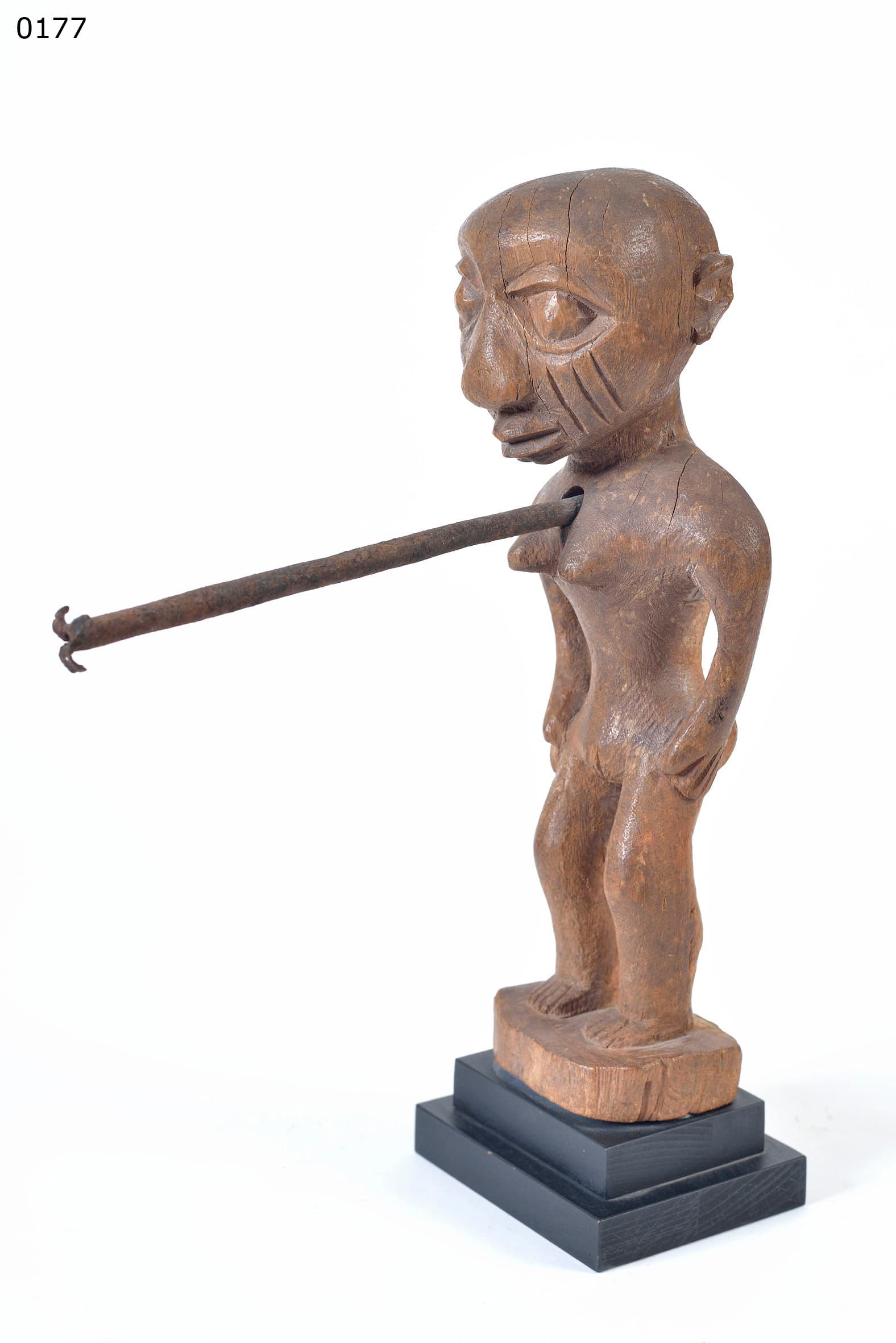
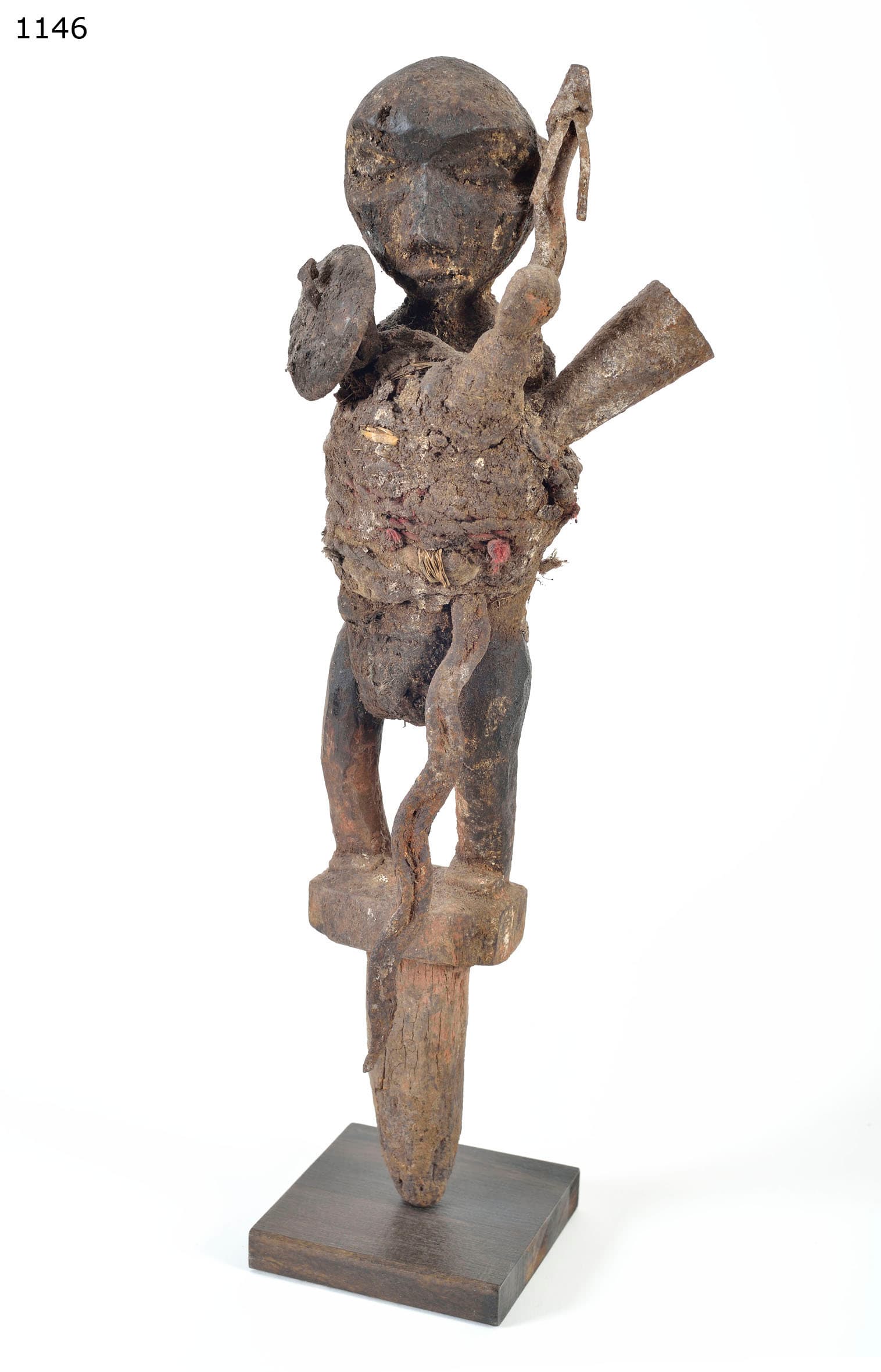
The most prominent and complex object category is the bocio (literally derived from fongbe: bo = empowered, power; cio = corpse), which function as highly potent protective and offensive figures. These sculptures serve as surrogates for their owners and are intended to deflect harmful energies. The bocio are divided into specific subtypes: The adoblakan-bocio are iconographically characterised by extreme, sometimes claustrophobic, lacing with cotton thread, raffia bast or animal skin. This binding symbolises the binding of enemies, the restraint of diseases or protection against miscarriages. The second variant, the kpodohonme-bocio, is defined by the ritual hammering of wooden pegs, iron pins or padlocks into the wooden body in order to materially seal a curse or wish previously spoken into a cavity. The size spectrum of these objects is extremely divergent: it ranges from intimate, 15-centimetre private figures to anthropomorphic, hybrid royal statues over 180 centimetres high.
Other canonical categories include the Asen, standard-like memorial altars forged from iron and copper alloys, which are decorated with complex relief scenes and serve as a temporary resting place for ancestral spirits. This repertoire is complemented by the recade (or makpo), iron or wooden ceremonial and dancing staffs, which often take the form of axes and functioned as royal insignia and means of communication. Textile artistry manifests itself in the polychrome appliqué fabric banners, which document historical narrative scenes and war deeds of the kings.
Outstanding works of courtly art can be attributed to documented master workshops and artist dynasties, an aspect that sets Fon art apart from many anonymous African traditions. The iron and silver work, in particular elaborate asses and royal symbols such as the silver water buffalo of King Ghezo (now in the Metropolitan Museum of Art, New York), mostly originate from the renowned Hountondji smith dynasty. The monumental, zoomorphic wooden statues of the monarchs (Glele as a lion, Ghezo as a cardinal bird, Behanzin as a shark) are attributed to the studios of the Sossa Dede family, the Donvide workshop or the Houeglo family.
A central characteristic of the aesthetic is the fundamental visual and ontological difference between a profane, freshly carved object and an activated ritual object. The unactivated object is merely a piece of wood - a functionless, empty "corpse" (cio). It only acquires its metaphysical and aesthetic power through the accumulation of additive materials and offerings. An activated bocio is an "alchemical assemblage", encrusted with a thick, often irregular patina of palm oil, clay, maize flour, saliva, urine and dried sacrificial blood. This raw, unrefined surface texture is accentuated by the application of cowries, bones and skulls. An iconic example from the holdings of the Metropolitan Museum of Art (Met) is a Janus bocio crowned by a dog skull, its four eyes suggesting a state of absolute, supernatural vigilance and surveillance.
It is precisely this additive, crude materiality that lies at the heart of one of the most high-profile iconographic controversies in African art history. Older anthropologists such as Melville Herskovits (1938) categorised the formally asymmetrical, encrusted bocio as unrefined, primitive folk art that was qualitatively far inferior to the courtly brass art of Benin or the fine woodcarving of the Baule. Harvard scholar Suzanne Preston Blier (1995) has fundamentally refuted this Eurocentric reading in her definitive Bocio study. Blier argues that the structural "ugliness" and formal distortion are highly intentional and intellectually calculated. She identifies in them a deliberate "aesthetics of shock" and a psychological "distortion magic": the chaotic, entangled form reflects raw human emotions (fear, envy, anger) and binds the addressed disaster through its physical resilience (sien - strength/toughness, symbolised by the Raphia nodes).
For the international art market, these material specifics are the primary basis for criticism of forgery. As the demand for authentic Vodun art is increasing, forensic analysis of the patina is of crucial importance. Forgery criteria focus on the identification of artificially applied ageing. An authentic bocio shows deep cracks in the heartwood, which indicate decades of organic drying in the tropical climate, as well as traces of historical termite damage that cannot be reproduced artificially with mechanical tools. The chemical layering of the ritual patina is also crucial: while forgeries often have monochrome, superficial coatings (caused by heat or bitumen, for example), microscopic examination of genuine objects reveals a heterogeneous, geological layering of blood, fats and botanical resins that has accumulated over generations.
| Object typology | Material execution & iconographic meaning | Primary ritual / representative purpose |
|---|
| Adoblakan-Bocio | Wooden body, extremely laced with raffia bast, cotton threads or animal skin. | Binding magic: holding diseases, binding enemies, securing pregnancies. |
| Wooden body, pierced with wooden pegs, nails or padlocks. | Sealing magic: Physical locking of a spoken curse or wish in the figure. | |
| Asen | Filigree wrought iron and copper alloys, standard form with relief plates. | Memorial altars: Serve as a landing place and temporary resting place for ancestral spirits during libations. |
| Recade / Makpo | Ceremonial staffs made of hardwood or bronze, often in the form of axes ("staffs of wrath"). | Insignia of power: Legitimisation of royal messengers, bearers of proverbs and visual puns. |
| Royal statues: Monumental wood, polychromed, hybrid (half human, half animal), metallic accents. | Warfare & representation: personification of the king's strength (lion, shark, bird); were carried into battle. | |
Ritual practice
The ritual practice of the Fon is characterised by a highly formalised, procedural lifecycle that transforms artefacts from a state of dead matter into dynamic spiritual actors and ultimately back into profane objects. This transformation cycle is exclusively controlled by institutionally legitimised ritual authorities such as the bokonon (divinators) or designated priests.
The cycle begins with the consultation. A private individual turns to a divinator in the event of an existential crisis - such as suspicion of witchcraft, persistent illness or the desire for economic success. The diviner consults the Fa oracle to determine the exact nature of the threat and the architectural specification of the required object of protection. Based on this divination, a wood carver is commissioned to make the basic body of the Bocio. At this stage, the object is still completely empty and profane; it merely represents the physical placeholder for the client.
The actual activation phase (the infusion of the bo, the empowering force) takes place in strict secrecy, so that the exact recipe of the ingredients often remains unknown to the client. The bokonon introduces a mixture of highly effective organic and animal materials into cavities in the figure (usually in the abdomen or skull). These ingredients include pulverised bones, specific medicinal plants, clay from ritually significant regions and human bodily secretions (saliva, urine), which transfer the essential life energy (zoe) or "breath" to the object. The ritual performance then manifests itself in the external treatment: the sculpture is massively laced with fibres as part of an adoblakan ritual to ward off metaphysical dangers, or penetrated with iron stakes in a kpodohonme ritual to irrevocably seal a previously spoken incantation in the wood. Finally, the activated object is doused with palm oil, cornmeal porridge or the blood of ritually sacrificed animals (usually chickens or goats).
When activated, the bocio is placed at strategically critical threshold locations: at crossroads, at the entrance to farmsteads, in agricultural fields or inside private shrines. There it acts as a proxy "decoy", attracting the attention of malevolent spirits or the damaging spells of rivals and diverting it away from the actual owner. The situation is similar with the Asen altars, which are primarily placed in the ground on family farms. The lineage performs regular libations (libations of palm wine or distilled alcohol) and blood sacrifices at them to maintain the favour of the ancestral spirits summoned into the iron.
The final stage in the lifecycle of the objects is deactivation or disposal, a process often described as "ceremonial death". Historically, it was customary for the Fon to place bocio figurines in the grave with the deceased. As the object had served as a metaphysical representative of the individual during their lifetime, this burial practice was intended to "cheat" death and prevent it, not yet satiated, from claiming the life of another lineage member.
An alternative form of deactivation has developed in response to the commodification of African art by the Western collectors' market. If a bocio loses its function after the death of the owner or is to be sold due to economic hardship, it must be ritually "discharged" in order to protect bystanders from the inherent, highly concentrated spiritual radiation. To do this, the priests remove the highly potent organic fillings from the sculptures' abdominal cavities and sometimes scrape off the thick, bloody patina crusts (Quénum 1936). A high-profile example of a partially deactivated but iconographically intact object can be found in the Brooklyn Museum: a bocio with a duck's beak integrated into its body - a symbolic element that served the magical purpose of "silencing" the slander of enemies. However, the sources are ambiguous with regard to the existence and systematics of strict regional variants of deactivation. Since such practices are subject to the hermetic secrecy of local priesthoods and ethnographic field research in this area is limited, comparative longitudinal studies between urban centres such as Ouidah and peripheral villages of the Abomey Plateau are lacking.
Historical context
The genesis of the material culture and artistic production of the Fon is inextricably interwoven with the history of military expansion and migration in the Kingdom of Dahomey. According to historical reconstructions, whose exact dating of the early phase is partly the subject of chronological controversy, ancestors of the Fon (presumably from the Aja ethnic group) migrated to the Abomey Plateau in the early 17th century and began the systematic subjugation of autochthonous groups. Under the aegis of rulers such as Agaja in the 18th century and Ghezo and Glele in the 19th century, Dahomey emancipated itself from its interim vassalage to the Oyo empire of the Yoruba and transformed itself into one of the most efficient and brutal military machineries in West Africa. This hegemony was massively financed by strategic participation in the transatlantic slave trade, with harbours such as Ouidah (Whydah) becoming global hubs of human trafficking on the so-called "slave coast" (Law 2005). The courtly art production of the Fon - from the iron and copper Asen altars to the jewellery-like silverwork of the Hountondji workshop and the royal Recades - explicitly served to legitimise absolute power, the psychological intimidation of enemies and the ostentatious documentation of state wealth during this period.
The fundamental historiographical break came in the late 19th century with the colonial encounter with France, which culminated in the two Franco-Dahomean Wars. In November 1892, French expeditionary forces under the command of General (later Colonel) Dodds marched towards the capital Abomey. Anticipating inevitable defeat, King Behanzin ordered the royal palace to be set on fire before he and his remaining troops resorted to guerrilla warfare (maquis). The advancing French soldiers plundered the royal treasures that had been spared by the fire or buried by the Fon. This mass appropriation of representational art and ritual objects as imperial spoils of war led to an immediate collapse of royal art patronage on the Abomey Plateau. As a result, the Fon's artistic production was inevitably reoriented and from then on focused on private demand within the popular Vodun cult and, from the early 20th century, on the production of commercial artefacts for the emerging Western souvenir and collectors' market (Polanyi 1966).
The reception and market history of these artefacts in the West underwent a dramatic, almost paradigmatic evolution. The objects transferred from Dodds to Paris in 1892 were initially deposited in the Musée d'Ethnographie du Trocadéro as mere "war trophies" and ethnographic curiosities with no intrinsic artistic value. It was not until the late 1920s and 1930s that the ontological status of African material culture changed radically. Pioneering Parisian dealers such as Paul Guillaume, Charles Ratton and Louis Carré, in close alliance with the artistic avant-garde (surrealists, cubists), began to recontextualise African sculptures aesthetically. They liberated the objects from the dusty showcases of ethnological museums and presented them on pedestals as self-sufficient masterpieces of modernism. The absolute institutional breakthrough came in 1935 with the groundbreaking exhibition African Negro Art at the Museum of Modern Art (MoMA) in New York, curated by James Johnson Sweeney with significant assistance from Ratton. This decontextualisation of the original ritual purpose led to a massive price development in the high-price segment of the international art trade, which continues to this day.
The most recent, ethically explosive caesura in the history of the reception of Fon art is the global restitution debate. In November 2021, based on the recommendations of the Sarr-Savoy Report on the Restitution of African Cultural Heritage (2018), the French Republic returned 26 iconic masterpieces from the holdings of the Musée du quai Branly - Jacques Chirac to the Republic of Benin. This collection included the anthropomorphic, hybrid-animal royal statues and thrones from the Palace of Abomey. This historic political and museological precedent has dramatically intensified the demands on provenance research for private collectors and auction houses.
The problem of forgery in the field of Vodun art is omnipresent. As genuine, historically significant pieces (pre-1892) are extremely rare and valuable, artificial replicas are flooding the market. Authenticity testing is based on strict forensic criteria. Experts analyse the extent and distribution of wood-destroying insect infestation; authentic termite damage has specific feeding galleries that are difficult to simulate mechanically. Furthermore, deep, longitudinal heartwood cracks must be present, which serve as indicators of decades of organic desiccation of the wood under tropical climatic conditions. The chemical composition of the ritual patina is analysed spectroscopically in order to differentiate between a genuine layering of blood, vegetable resins and fats accumulated over generations and modern surface ageing artificially produced by heat, shoe polish or chemical acids. In this context, the Museum Rietberg in Zurich is heavily involved in collaborative provenance research and regularly consults Nigerian and Beninese experts in order to document the work biographies of its African holdings - also against the background of potential future restitution claims - in a complete and forensically sound manner.
Provenance & materiality of the Fon masterpieces restituted in 2021 (extract):
- Statue of King Glele: Half man, half lion; wood, pigments, leather; made by Sossa Dede (1858-1889); former inventory no. Quai Branly: 71.1893.45.2.
- Statue of King Ghezo: Half man, half cardinal bird; wood, pigments, iron; Donvide or Akati workshop (second half of the 19th century); former inventory no.: 71.1893.45.1.
- Statue of King Behanzin: Half man, half shark; wood, pigments, metal; Sossa Dede or Houeglo family (1890-1892); former inventory no.: 71.1893.45.3.
- Throne of King Ghezo: Afro-Brazilian style, inspired by Akan and Portuguese influences; wood and metal (early 19th century); ex-inventory no.: 71.1895.16.8.
- Architectural elements: Four wooden palace doors from the ajalala (palace) of King Glele, decorated with allegorical relief motifs of the Vodun pantheon.